Launching a First Time Venture Capital Fund
Get the legal and structural decisions right before you raise a single dollar.

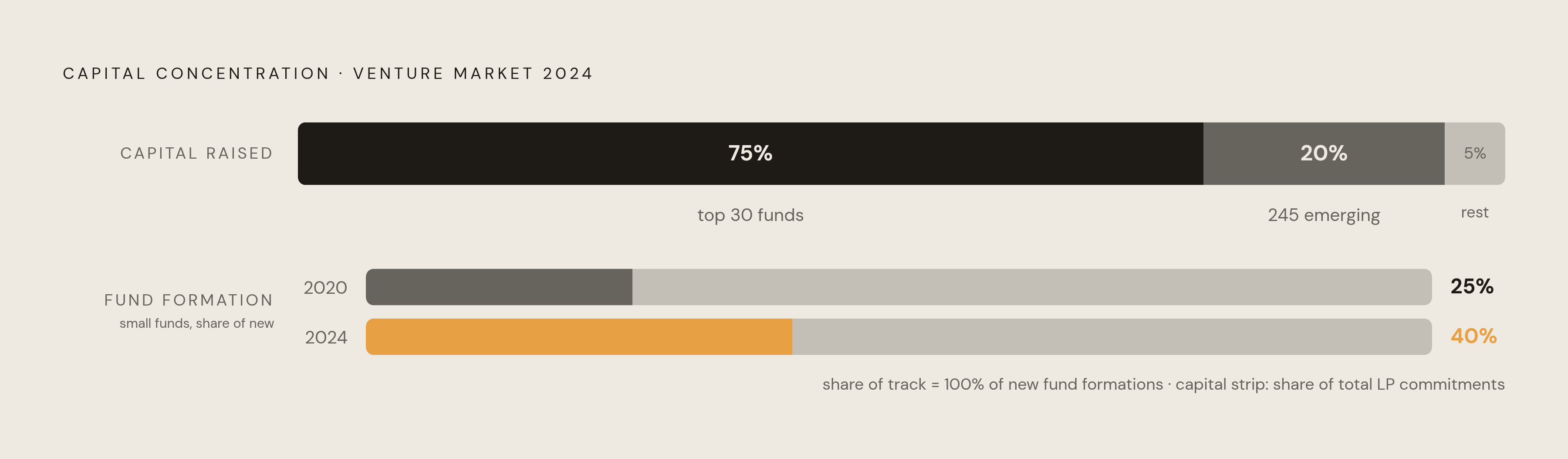
Launching a first-time venture capital fund is genuinely hard right now. Not discouraging-hard. Just the kind of hard where the margin for error is thin, the timeline is long, and every early decision compounds into something bigger later. The good news: the managers who do the structural and legal work correctly, before they need to, are the ones who close. In 2024, the top 30 venture funds captured roughly 75% of all capital raised. Emerging managers shared about 20% across 245 funds. The number of new venture funds fell 68% between 2021 and 2024. And yet, small fund formation is actually rising on platforms like Carta. Funds in the smaller range accounted for at least 40% of all new funds in 2024 and the first half of 2025, up from 25% in 2020. There is a lane. It is narrow. And the managers who find it are the ones who prepared like it was their job before it was their job.
How to Size and Structure a First Fund Given Today's Constraints
Let's start with the sizing question, because everything else flows from it.
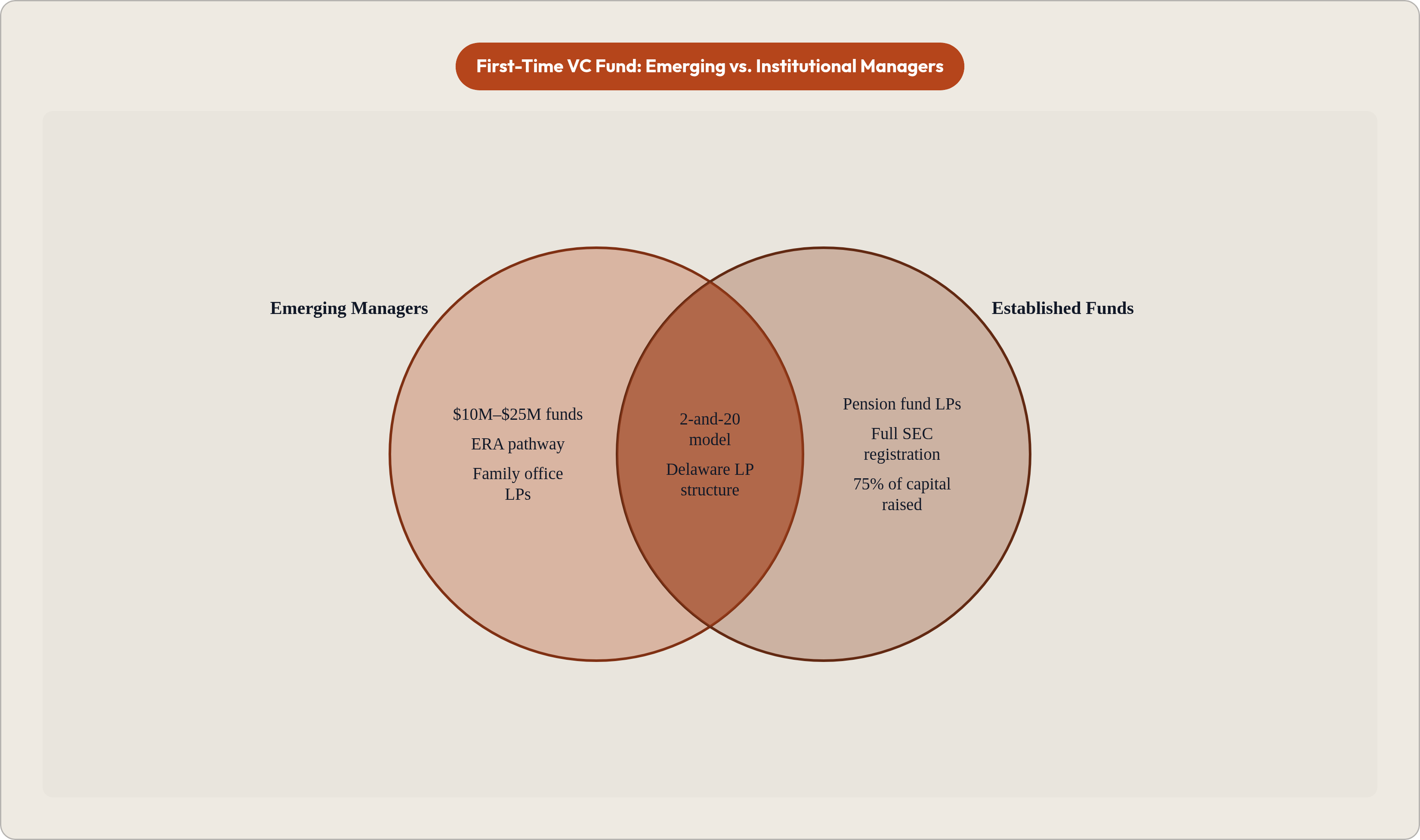
Most solo or emerging managers target somewhere between $10M and $25M for a first fund. The median first-time fund closes somewhere in the $15M to $40M range. There is a growing trend toward specialist managers launching around the $12M mark, because a focused strategy can still deliver strong returns at that size without requiring a massive LP base.
The sizing logic is simple: the fund needs to be large enough to build a real portfolio, and small enough that you can actually raise it. Those two constraints almost always determine the range without you having to do much else.
Three legal entities every fund needs:
- The fund itself. Typically a Delaware Limited Partnership. This is the vehicle that holds portfolio investments and distributes returns to LPs.
- The management company (ManCo). A Delaware LLC. This is what employs the team, handles operations, and receives management fees.
- The GP entity. This makes investment decisions, carries unlimited liability, and contributes the GP commit.
Why Delaware? Legal predictability. Established case law. LP expectation. If you want to deviate from Delaware, you need a good reason, and you should be prepared to explain it to every LP who asks.
Here is the part most first-timers miss: fund size shapes almost everything downstream. How many LPs you can accept. Which registration pathway you are on. How the fee math works. How you construct the portfolio. These are not separate decisions. They are the same decision. Connect those dots early, before you file anything.
The Legal Setup Process: What It Costs, How Long It Takes, and Where to Sequence Correctly
Formation costs run between $50,000 and $150,000 before a single dollar is deployed. That number is not a typo. It also does not include the ongoing compliance costs you will carry for the life of the fund.
Core documents you will need:
- Private Placement Memorandum (PPM): discloses risks and terms to prospective LPs
- Limited Partnership Agreement (LPA): governs the GP/LP relationship
- Management Company Operating Agreement
- Subscription documents for each investor
The legal documentation process alone takes two to four months. A traditional fund structure, from initial preparation to first close, typically runs 12 to 18 months. Fundraising timelines now stretch to a median of 15 months. That is the longest in a decade.
The sequencing rule most first-timers violate:
Do not engage legal counsel. Do not begin formal fund formation. Not until you have validated LP interest equal to at least 10 to 20% of your target fund size.
This is the most common and costly mistake a first-time GP makes. Spending $50,000 to $100,000 on legal setup before you know whether anyone will write a check is how people run out of runway before they ever deploy capital.
There is an accelerated alternative worth knowing about. Platforms like Decile Group's Start Fund let a first-time manager get to investing within weeks, with as little as $150,000 in initial commitments. VC Lab data shows managers using these structures reach a first close in an average of 58 days. The trade-offs are real: less customization, platform dependency. But for a first fund, the time and cost savings can be significant. It is a legitimate path, not a shortcut for people who want to avoid doing the work.
Regulatory Requirements That Determine Which Compliance Path You Are On
Three statutes govern venture funds. You should know them by name.
- Securities Act of 1933: Regulates how you offer and sell securities to LPs.
- Investment Company Act of 1940: Regulates pooled investment vehicles. Most funds seek exemptions here.
- Investment Advisers Act of 1940: Regulates the management company as an investment adviser.
The investor-count rule matters more than most people think.
As of August 21, 2024, the SEC raised the "qualifying venture capital fund" threshold under the Investment Company Act to a maximum of $12 million in fund size (up from $10 million). A fund meeting this definition can accept up to 250 investors under the Section 3(c)(1) exemption. Otherwise the cap is 100 investors. That distinction is not academic. It directly determines how many LPs you can work with.
The Exempt Reporting Adviser (ERA) pathway is the most important registration option for most first-time GPs. Funds under $150M that qualify as "venture capital funds" under SEC rules can file a truncated Form ADV without full registration obligations. Managers with less than $100M in assets under management typically register with state regulators rather than the SEC. This is the most common path for emerging managers, and it is worth understanding before you assume you need full SEC registration.
New in 2026: As of January 1, 2026, SEC-registered RIAs and ERAs must establish formal AML compliance programs. This includes suspicious activity reporting, risk assessments, and KYC protocols for all investors. If you are forming a fund now, build this into your operational setup from day one.
Legislation worth watching: The INVEST Act of 2025, passed by the House in December 2025, would permit VC funds to invest up to 49% of contributed and uncalled capital in other VC funds and secondary transactions. The current cap is 20%. If enacted, this would allow larger funds to seed emerging managers at scale. Worth monitoring as it moves through the legislative process.
One more layer: blue sky laws. Every state where your fund solicits investors may require notice filings or exemptions. State-level complexity is real, underestimated, and worth budgeting for.
Ongoing Compliance Obligations That Trip Up Emerging Managers After Formation
You get the fund formed. You close some capital. And then the compliance calendar starts running, whether you are ready for it or not.
The obligations that catch people off guard:
- Form D amendments: Required within 15 days of any material change. Late or missed filings are among the most common compliance failures for first-time managers.
- Form ADV annual update: ERAs must file within 90 days after fiscal year end.
- K-1 preparation: Tax document obligations to LPs require coordination with fund administrators and accountants. This is not something you can figure out later.
- Side letter tracking: Special terms granted to specific LPs. Untracked side letter obligations create legal and operational risk as the fund grows.
The practical implication of all of this is straightforward. Most first-time GPs cannot manage compliance solo. Budget for a fund administrator, legal counsel on retainer, and an accountant from day one. These are essential, not optional. And the cost should be modeled into the management fee math before you finalize your fund terms.
Fund Economics: How the 2-and-20 Model Actually Works at Small Fund Sizes
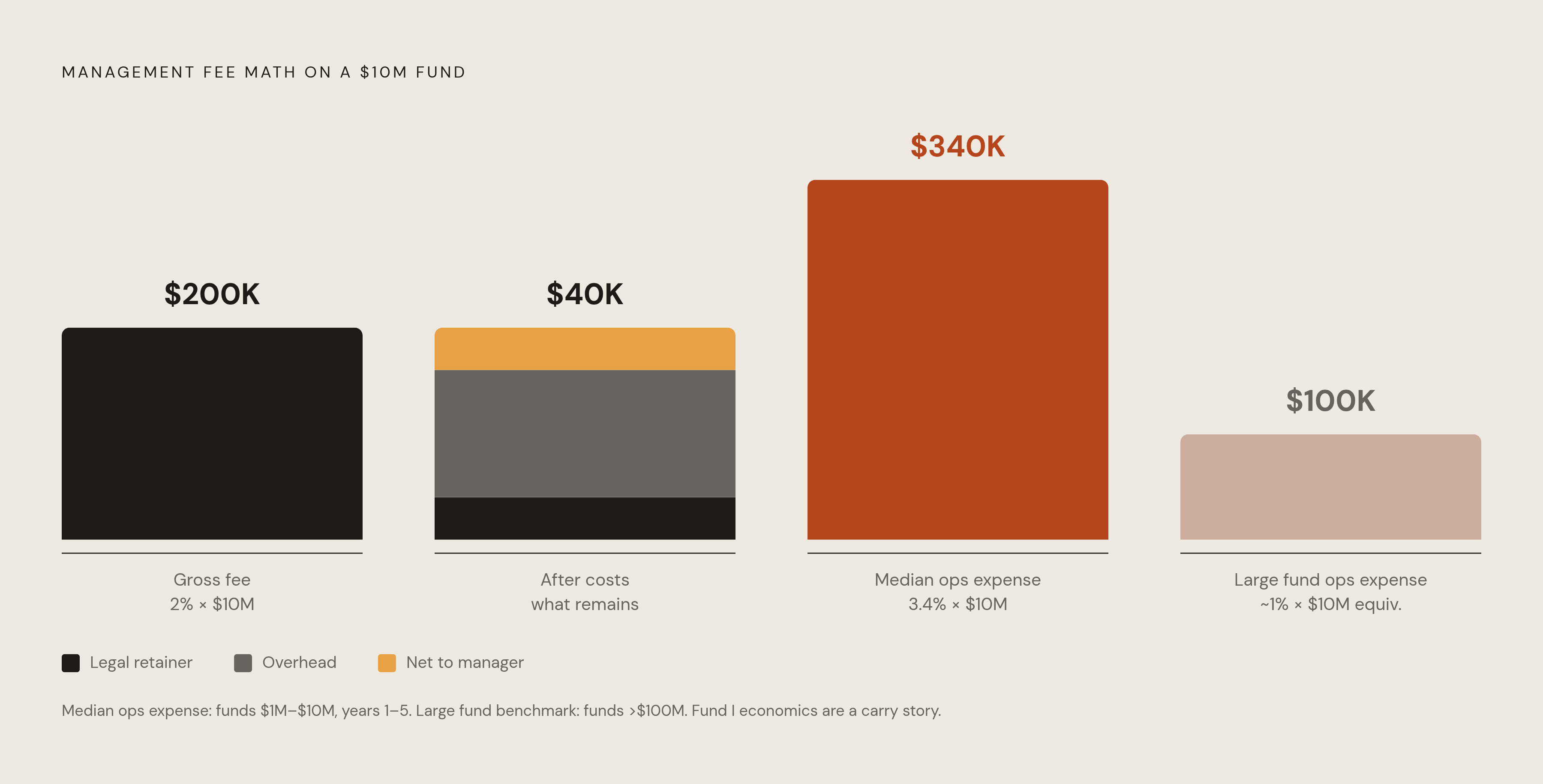
The 2-and-20 model is still the standard. Two percent management fee during the investment period. Twenty percent carried interest on profits. Per Carta's 2025 Fund Economics Report, this remains the norm across VC vintages.
Here is the part nobody talks about over cocktails.
The small-fund salary problem is real. On a $10M fund, a 2% management fee generates $200,000 per year. Split across multiple GPs, minus overhead, minus the costs we just covered. Individual compensation can be very modest. Median funds in the $1M to $10M range spend about 3.4% of fund size on operating expenses within the first five years. Funds over $100M spend roughly 1%. The cost burden falls disproportionately on the managers who can least afford it.
First-time GPs need to be honest with themselves about this. The financial case for Fund I is almost entirely about carry. Not salary.
On GP commit: The median is a small percentage of fund size, per Carta's 2025 data. The conventional range is 1 to 2%. In practice, GP commits vary widely across quartiles of emerging managers. LPs read the GP commit as a signal of conviction. Under-committing raises questions. It signals that you do not fully believe in what you are asking them to fund.
A few other data points worth knowing:
- Hurdle rates are rare in VC. Only a small share of funds in the $1M to $10M range include a preferred return. It is not a standard feature you should feel pressure to offer.
- The 90th percentile for GP carry reached notably elevated levels in 2025, per Carta. That is for managers with exceptional deal access. First-time GPs negotiating carry should know this range exists, but should not open with it.
- Carried interest tax treatment was preserved in early 2025 tax reform debates. This remains an active policy area. Pay attention to it.
Building an Investment Thesis That LPs Will Fund in a Concentrated Market
When capital is concentrating at the top, LPs evaluating emerging managers have less patience for broad mandates. They need to see a specific reason why you will see deals others will not. A thesis that could describe any of a hundred managers is not a thesis. It is a description.
What the data actually shows about thesis positioning:
Funds focusing on multiple sectors secured almost 1.5x larger portions of their fund targets in soft commitments within the first six months compared to single-sector funds, and twice the portion secured by generalist funds. The lesson: a defined sector lens spanning two or three verticals outperforms both the narrow single-sector pitch and the broad generalist pitch in early fundraising.
What a credible thesis actually includes:
- A specific stage (pre-seed, seed, Series A) and a check size range consistent with your fund size
- A sourcing edge: why will you see the best deals in this space? Networks, domain expertise, operator history, geography
- A genuine market view: what do you believe that consensus does not, and why does that belief lead to returns
Differentiation signals LPs actually evaluate:
- Prior track record, even from angel investing or SPVs. Without it, the thesis must do significantly more work.
- Operator background in the target sector. For sector-specific funds, this carries more weight than a finance pedigree alone.
- Demonstrated proprietary deal flow. LP references from founders already in your network.
The thesis also needs to address portfolio construction directly. How many companies. Typical check size. Reserve strategy. LPs will stress-test these numbers against the fund size. If the math does not work, the thesis does not matter.
Who to Target as LPs for a First Fund and How to Prioritize the List
The LP universe for a first-time fund is narrower than it looks from the outside. Most institutional LPs (large endowments, pension funds) require two to three prior fund vintages before they will have a serious conversation. They are not realistic targets for Fund I. Accept this early and move on.
The realistic primary audience:
- Family offices
- High-net-worth individuals
- Fund-of-funds focused on emerging managers
- Some foundations and smaller endowments that specifically allocate to emerging managers (worth researching by sector alignment)
Anchor LPs: start here. One or two anchors with the largest checks create momentum and social proof for every LP conversation that follows. Anchors often negotiate for advisory board seats or most-favored-nation (MFN) clauses in side letters. Model this into your LP agreement structure early so you are not caught off guard when it comes up.
The friend-and-family round is legitimate. It is often necessary for Fund I. Existing professional relationships who know your work are lower-friction early commitments. Just remember: accredited investor verification is required for every single one of them. Do not shortcut this step. The legal consequences are serious and not worth the convenience.
Strategic LPs serve a dual purpose. Founders, operators, and executives in your target sector bring LP capital and deal-flow credibility simultaneously. For a sector-focused emerging manager, this is often the most accessible entry point in the entire LP stack.
There are also emerging manager programs at established platforms and some fund-of-funds specifically designed to back first-time managers. Identifying those aligned to your sector thesis is a legitimate research project worth doing early.
And remember the sequencing rule: validated interest from 10 to 20% of your target fund size should come before you spend on legal formation. This LP targeting phase is what generates that validation.
How to Run the Fundraising Process From First Conversation to Final Close
The materials you need, in order of how often you will use them:
- One-pager: Leave-behind for warm introductions. Concise thesis and terms summary. This gets used more than you expect.
- Pitch deck: Thesis, market, team, strategy, portfolio construction, fund terms. Typically 15 to 20 slides.
- Data room: Legal entity documents, PPM, sample investment memos, prior track record with supporting documentation.
Expect a long conversion curve. Most LPs will say no. Often without explanation. Plan for many more conversations than commitments. The funnel is wide at the top and very narrow at the bottom, and the only way through it is volume plus consistency plus a thesis that holds up under repeated questioning.
A few things that make the process go better in practice:
- Warm introductions convert dramatically better than cold outreach. Spend time on the network before you spend time on the pitch.
- Get to a first close before you start spending like you have a full fund. A first close creates urgency and legitimacy for the LPs still deciding.
- Treat every LP conversation as a relationship, not a transaction. The LPs who pass on Fund I are the most likely investors in Fund II if you handle the process professionally.
- Update your LP pipeline weekly. Know exactly where every conversation is. The managers who close funds are the ones who follow up consistently without being annoying about it.
The median fund close now stretches to 15 months. That is the longest in a decade. This is not a sprint. Budget your time, your legal costs, and your personal financial runway accordingly. The managers who run out of personal runway mid-raise are the ones who make bad decisions at the worst moment.
The environment rewards preparation over enthusiasm. Build the structure correctly. Spend legal money at the right moment. Target the right LPs in the right order. And build a thesis specific enough that a busy LP, reading it for the first time, immediately understands why you and not someone else.
That is the job.

