VC Fund Operational Infrastructure and Back Office
Emerging fund managers often neglect back office infrastructure until LP crises demand it.

- Written by
- Dana Ashworth
- Updated
- September 9, 2026
- Reading time
- 9 min read
- Sources cited
- 2 sources ↓
What this covers
Venture fund back office work isn't one job. It's five or six disciplines (legal, accounting, compliance, LP relations, tech) that only work if they talk to each other, and most emerging managers treat the whole mess as a problem for after the close. That's how a clean spreadsheet turns into an LP relationship crisis two years later, usually right when you need that LP to write another check.
The money at stake is real. Global VC investment hit around $396.7 billion in 2025, and it's headed toward $1,590.6 billion by 2034. Fund administration alone, just one slice of the back office, is an $8.6 billion market this year on its way to roughly $17.4 billion by 2034. This isn't a niche cottage industry anymore. It's an entire economy of people whose job is making sure other people's money doesn't quietly fall apart in a back room somewhere.
Back Office Covers More Than Fund Admin
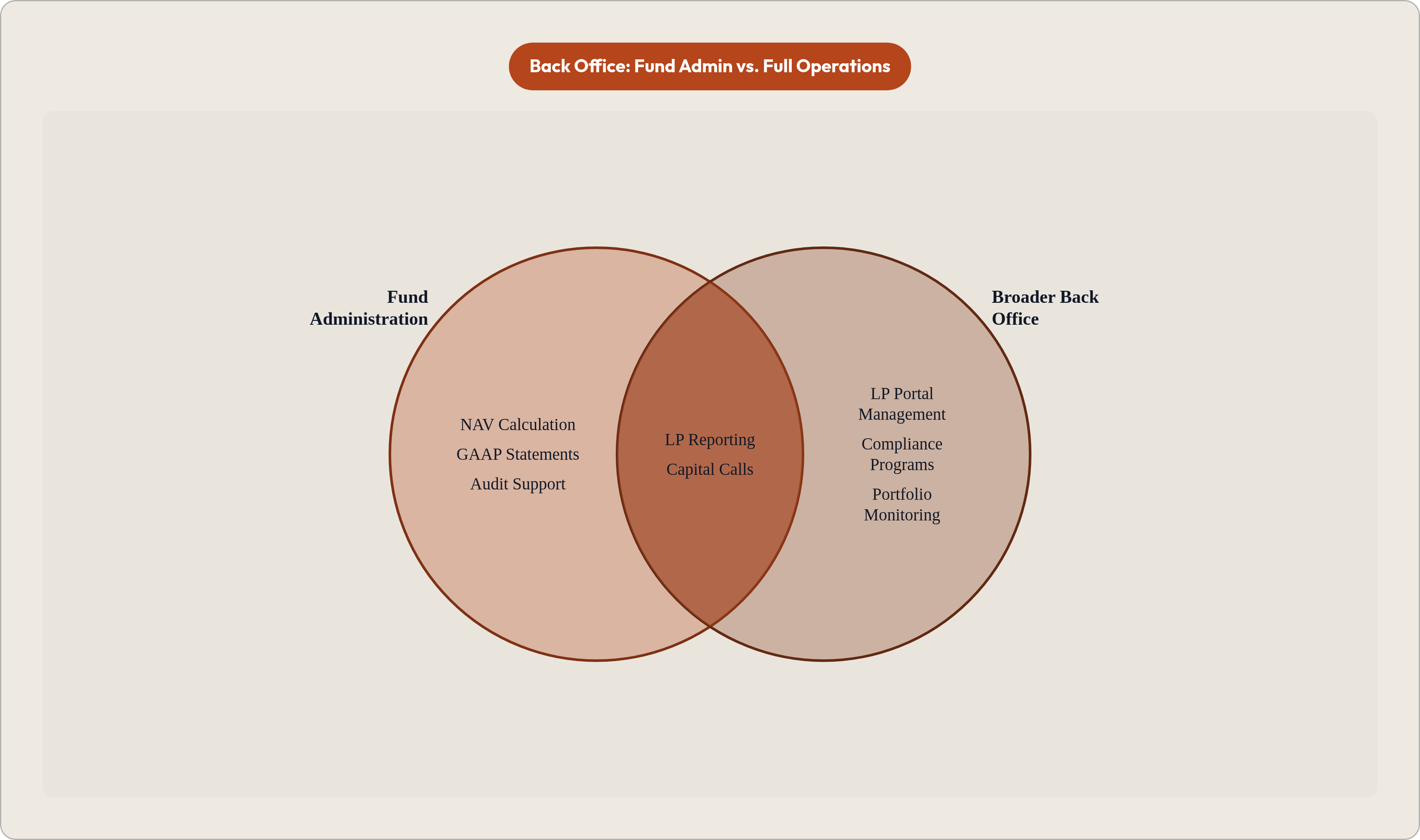
People say "fund admin" when they mean "back office," but fund admin is only one part of a bigger operational machine. Fund admin is real and it matters (accounting, reporting, the filings that keep you out of trouble), but it's one component among several.
The full back office also covers treasury, investment reviews, LP portal management, compliance programs, legal and audit coordination, and the technology meant to hold it all together. Some of it lives in-house. Some gets outsourced. Some gets split down the middle, and that split creates its own particular set of coordination problems.
The main pieces are:
Fund accounting and NAV. Capital accounts, waterfall math, carried interest, GAAP statements.
LP reporting. Quarterly updates, capital call and distribution notices, investor portals.
Compliance and filings. SEC registration, AML/KYC, Form ADV, Form PF, state blue sky laws.
Portfolio monitoring. KPI tracking, valuations, follow-on analysis.
Legal, tax, and audit. K-1s, annual audit support, and the fund formation paperwork that started this whole thing.
Everything in between, which nobody budgets for and everybody needs eventually.
Operators who budget only for fund admin discover the other pieces when an LP asks a pointed question or a filing deadline arrives unexpectedly.
How the 2% Fee Constrains Small Fund Operations
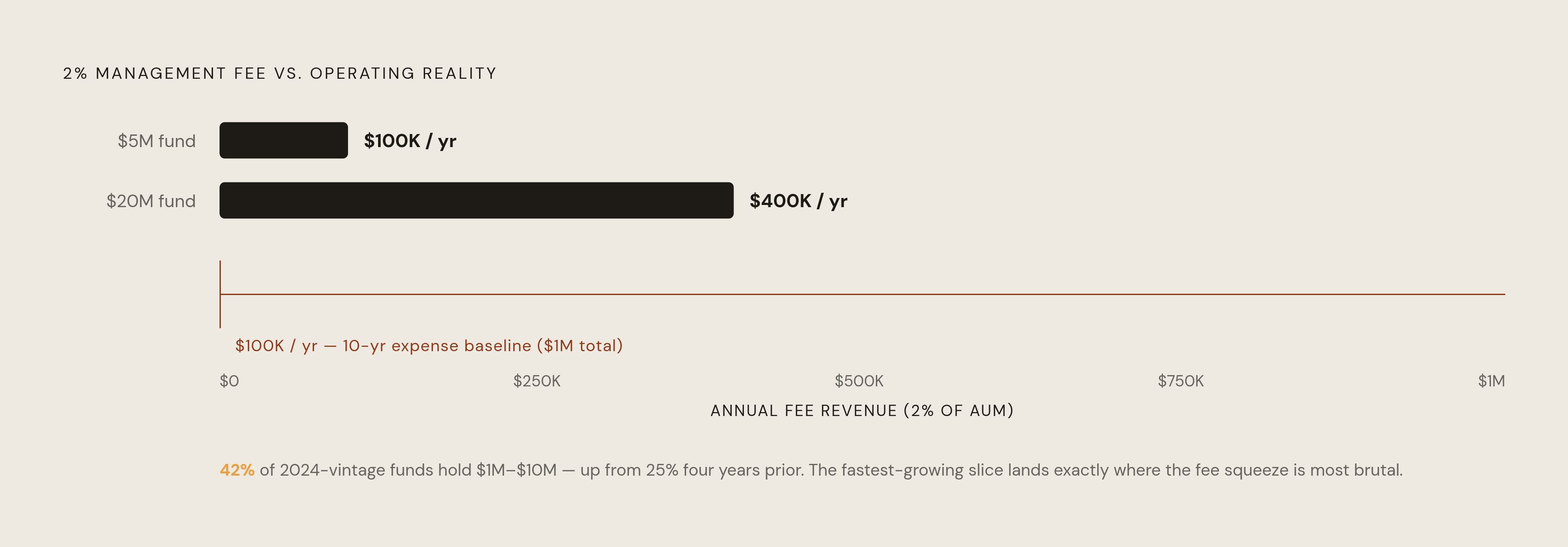
The 2% management fee hasn't moved much in decades, across fund sizes big and small. Run the math on a small fund and the constraints become clear quickly.
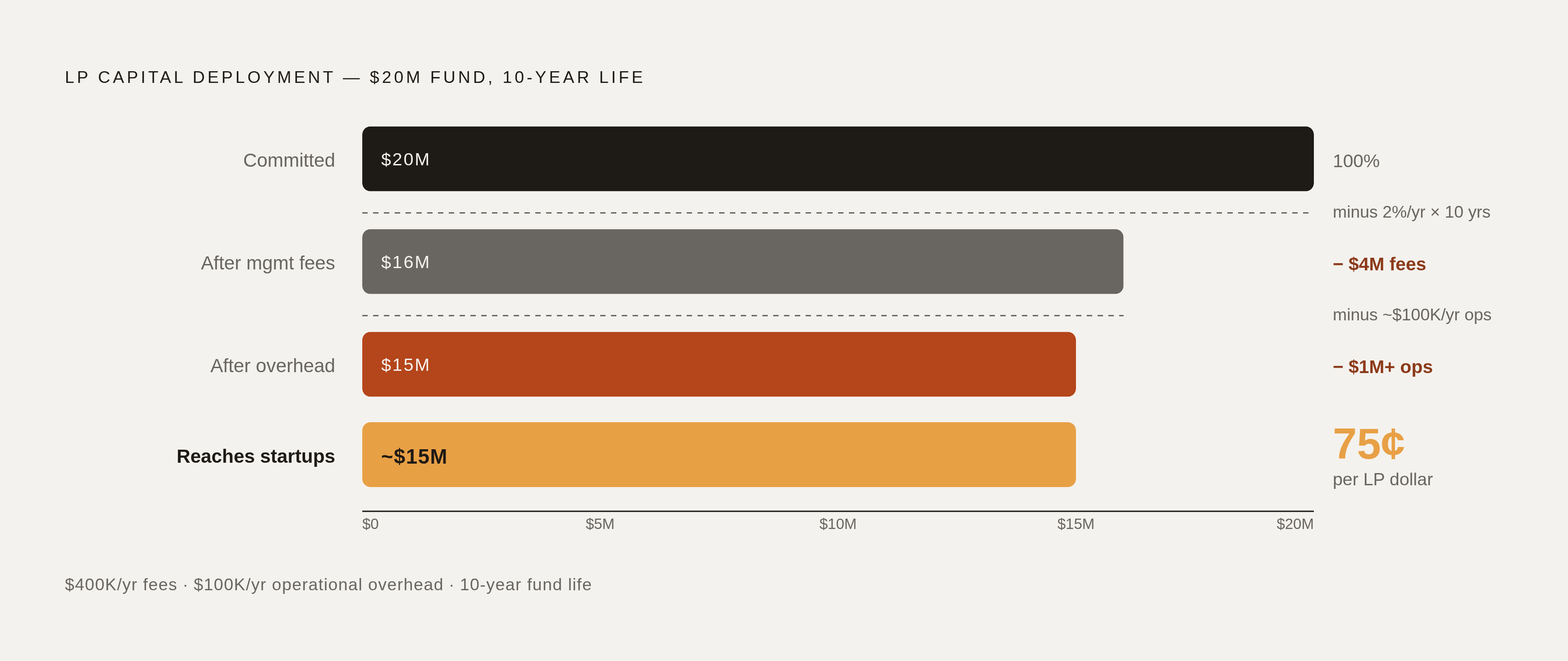
A $5 million fund throws off $100,000 a year in fees, which won't cover a real GP salary let alone any actual infrastructure. A $20 million fund only clears $400,000 a year. Strip out $100,000 in yearly expenses, run that across a ten-year fund life, and you've spent $5 million just on operational overhead. Only about 75% of what LPs committed actually lands in a startup's bank account once you net it out.
Carta's 2025 fund economics data shows why this matters: 42% of 2024-vintage venture funds held between $1 million and $10 million in committed capital, up from 25% just four years back. The fastest-growing slice of the venture market is exactly the slice where the fee squeeze hurts most. This is why the build-versus-outsource question sits at the center of every operational decision a small fund makes. There is no budget cushion to absorb a bad call.
What Fund Formation Actually Costs
Before any fee revenue shows up, there's a bill due. Formation runs $150,000 to $500,000 and takes three to six months, depending on structure and who's drafting the documents.
Roughly, that breaks down as:
Fund counsel legal fees: $25,000–$75,000
Entity formation and registration: $2,000–$5,000
Form D and state blue sky filings: $3,000–$5,000
Initial AML/KYC setup: $2,000–$3,000
First-year audit setup: several thousand dollars
LPA caps for emerging managers usually sit between $100,000 and $250,000, so the fund itself limits how much of this the GP can pass through. Using separate fund counsel, a compliance consultant, a fund admin firm, and a bank, Year 1 alone can run $75,000 to $150,000. Across a ten-year fund life, traditional three-entity structures have historically cost north of $500,000 total. Newer single-entity structures cut that down noticeably.
Formation also sets a recurring cost base that the management fee has to carry for a decade. Running as a registered Investment Adviser can hit $75,000 to $150,000 a year, fund administration runs $50,000 to $100,000 a year depending on provider and AUM, and audit fees can add another $20,000 on top.
LP Reporting Is Where Operational Quality Shows
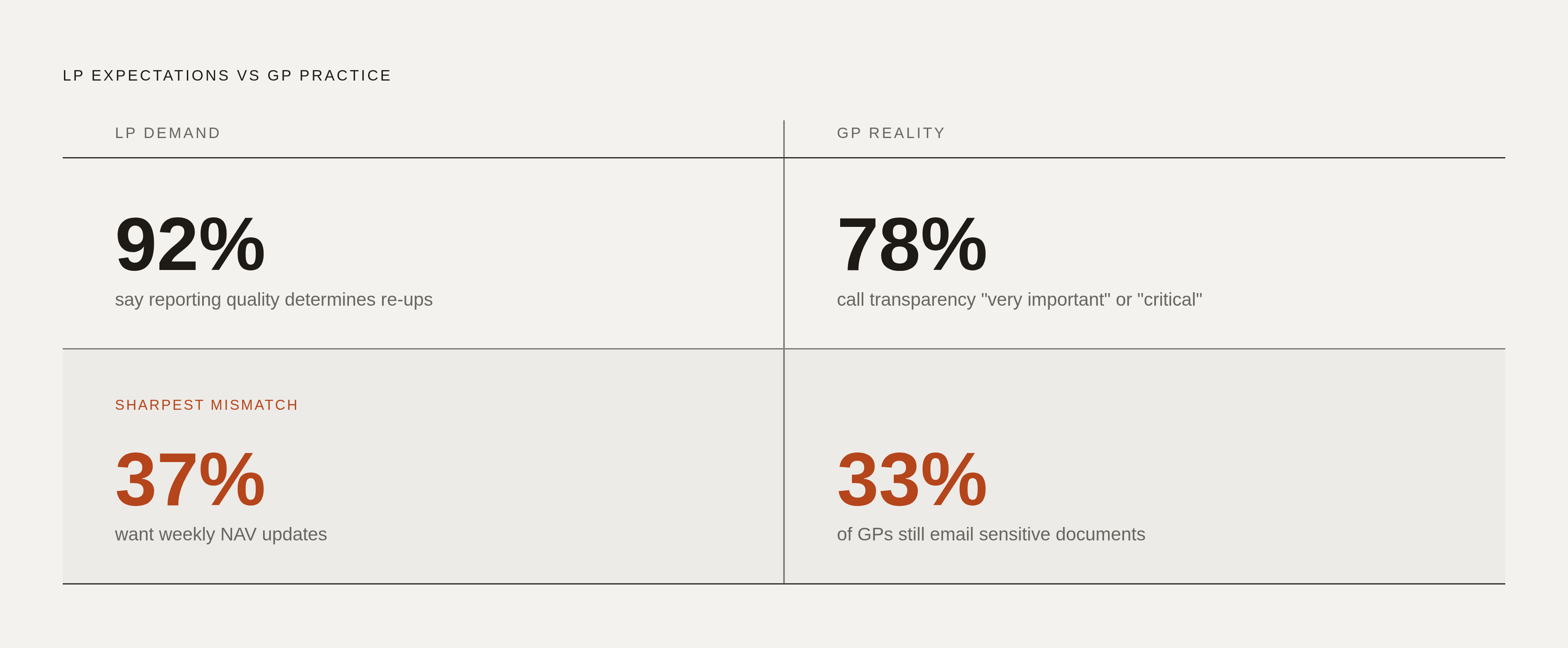
Here's the number that reframes the whole picture: 92% of institutional LPs, per Preqin's 2024 Investor Survey, say reporting quality shapes whether they re-up into your next fund. That's not a soft preference. That's a gate you clear or you don't.
Preqin's survey adds another angle: 78% of institutional investors call transparency and reporting "very important" or "critical" for successor fund decisions. Meanwhile, 70% of GPs name LP reporting their single biggest operational headache. Both sides of the table are looking at the same problem.
Frequency demands keep climbing. 37% of LPs now want weekly NAV updates, a pace a manual, spreadsheet-driven quarterly process cannot sustain. And 33% of GPs are still emailing sensitive investor documents rather than using a secure investor portal.
LPs run operational due diligence now with the same rigor they bring to investment due diligence. Gaps that go unnoticed in Fund I show up as disqualifying issues by Fund II. Good LP reporting requires consistent quarterly reports that don't need a manual rebuild every cycle, on-time capital call and distribution notices in a format LPs can use, a secure portal for on-demand document access, and an auditable record of every communication sent. LP reporting also can't be separated cleanly from fund accounting. An error in NAV flows directly into the LP-facing report.
The 2025 ILPA Template Overhaul Explained
ILPA released an updated Reporting Template on January 22, 2025, the first real structural rebuild since the 2016 version that had become the industry standard for nearly a decade.
The old template had a significant loophole. GPs could repurpose line items, reorder expense categories, and add fields wherever they liked. In practice, LPs ended up with dozens of different "standard" reports that weren't comparable. The 2025 version eliminates that flexibility: GPs can't modify it.
The new requirements introduce a level of standardization the industry hasn't dealt with before. Fee transparency and expense disclosure, a standardized performance report covering gross and net IRR, TVPI, DPI, RVPI, and contribution and distribution pacing are all structured so LPs can compare one fund against another on equal footing. A companion Capital Call and Distribution Template followed in September 2025, rebuilt to match the new Reporting Template and the newly released ILPA Performance Template.
Qualifying funds need to comply starting Q1 2026. This isn't legally required for most funds, but it has become the standard sophisticated LPs expect, especially with the SEC's Private Funds Rule vacated in June 2024. The market filled that regulatory vacuum with ILPA standards instead. Fund admins and internal teams built around the 2016 template have substantial rebuilding ahead.
Compliance Requirements by Fund Size and Growth
Compliance scales with fund size, which means growth itself can trigger a new regulatory regime mid-fund-life. Under $25 million, you register with state regulators, not the SEC. Between $25 million and $150 million, qualifying VC managers can use Exempt Reporting Adviser status. Cross $150 million and full SEC registration kicks in for most funds.
The biggest shift right now is AML. FinCEN issued a final rule on August 28, 2024 that pulls SEC-registered investment advisers and ERAs into the legal definition of "financial institution" under the Bank Secrecy Act. Starting January 1, 2026, that means formal AML programs: suspicious activity reporting, risk assessments, and real recordkeeping. Plenty of venture managers who never had direct AML obligations before are about to get them.
Additional requirements include Form ADV and Form PF filings for registered advisers, Regulation S-P (which requires SEC-registered advisers under $1.5 billion AUM to have written incident response plans and investor notification procedures for data breaches), California's SB 54 and SB 164 DEI reporting rules (registration pushed to March 1, 2026, data reporting to April 1, 2026), and SFDR in the EU already forcing ESG disclosure on affected funds, with further expansion likely.
Compliance obligations accumulate as a fund grows, and a successful fundraise can push a manager into a new regulatory tier before they've finished deploying the previous round. Build compliance infrastructure for where the fund is headed, not for the minimum of where it sits today.
Portfolio Monitoring Connects Back Office to Investing
Portfolio monitoring is the connection between back office data and actual investment decisions. It pulls numbers out of accounting and cap table systems and feeds them into valuation calls, follow-on decisions, and LP reports. When that connection breaks, the operational side and the investment side stop informing each other.
The core components are: KPI collection from portfolio companies (still mostly manual and time-consuming every quarter), fair value and mark-to-market work required for GAAP statements and LP reports, follow-on analysis tracking reserve deployment against the original plan, and the quarterly aggregation of all that data into LP-facing reports.
Valuation is where this touches LP trust most directly. Inconsistent valuation flows straight into NAV, into performance metrics, and eventually into the ILPA-format report an LP is reading line by line. At small fund sizes this usually lives in a spreadsheet, which works until the portfolio grows past a handful of companies. Then version control becomes a serious problem, tracing changes becomes difficult, and consistency becomes unreliable. The funds that scale this well maintain a fixed cadence for data collection, apply one valuation method the same way every quarter, and maintain a clean handoff between the investment team and whoever runs fund administration.
How the Tech Stack Ties Operations Together
No fund runs one unified system for all of this. In practice, the back office technology stack is a set of point solutions passing data back and forth, and those handoffs are where operational errors originate.
A fund needs to run: fund accounting and NAV software (either purpose-built or run through an admin firm's system), cap table management to track ownership and dilution, an LP portal for secure document delivery, portfolio monitoring tools for KPIs and valuation work, a CRM for deal flow and LP relationships, and something to track the compliance calendar. Six systems, none of them integrated by default.
The integration problem lives in the gaps between those systems. Accounting data has to land accurately in LP reports. Valuation changes need to flow into performance metrics. Capital call records have to reconcile against actual bank activity. When the systems don't communicate, someone fills the gap manually, and manual reconciliation is where errors enter LP-facing documents and audit trails.
The build-versus-buy decision at the technology layer mirrors the build-versus-outsource decision for the operational functions underneath it. A fund that outsources its accounting usually inherits its admin firm's software along with it, which reduces integration complexity but also reduces control. What works at a small AUM isn't what works at $150 million, and funds that ignore this end up paying for enterprise software they won't use or connecting tools that were never designed to work together.
Build vs. Outsource by Back Office Function
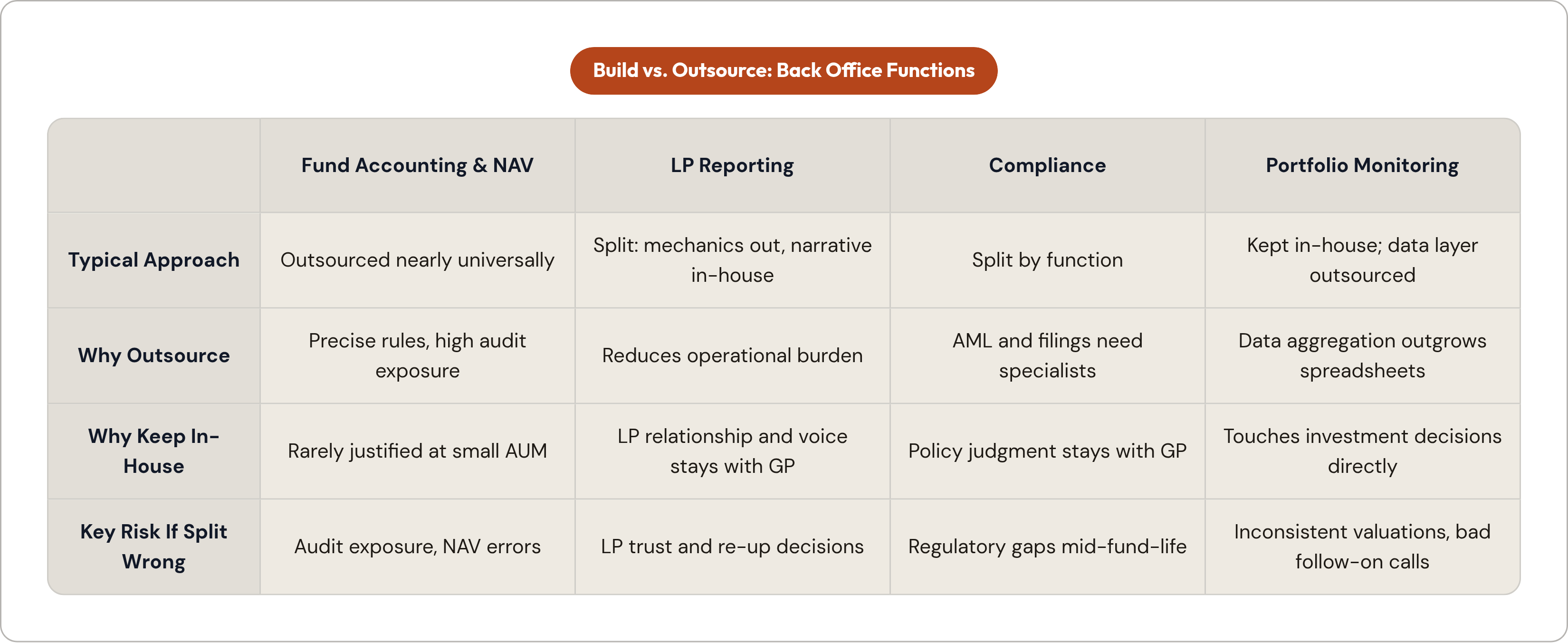
The fund administration market growing toward $17.4 billion by 2034 reflects a permanent shift in how funds get run. It's worth being clear about which functions belong in-house and which don't.
Fund accounting and NAV work gets outsourced almost universally at the emerging manager stage. The accounting rules are precise enough, and audit exposure high enough, that few small teams build this from scratch in-house. LP reporting sits in a middle zone: some funds outsource the mechanics but keep the relationship and the narrative in-house, since that's the part LPs associate with the GP. Compliance tends to split by function, with AML and filings often going to specialists while policy decisions stay with the GP. Portfolio monitoring is the one function most funds try to keep close because it touches investment judgment directly, though the data aggregation underneath gets outsourced or automated once the portfolio outgrows what a spreadsheet can hold.
The consistent pattern across all functions is this: outsource where a mistake is expensive and the skill is commoditized, keep what touches investment judgment and LP trust close to home. Getting that split wrong in either direction tends to become visible at the worst possible moment, typically right before a re-up conversation.
Methodology & sources
- https://www.goingvc.com/post/how-to-run-a-vc-fund-a-back-office-guide-for-those-who-want-to-learn-about-vc
Provided the framing of back office operations as encompassing treasury, investment reviews, LP portal management, compliance programs, and technology beyond just fund administration.
- https://alterdomus.com/insight/venture-capital-compliance-requirements/
Informed the section on compliance thresholds, including SEC registration requirements and the AML rule change affecting investment advisers.