Managing GP Carry and Economics Across a Partnership
Carry structures and waterfall mechanics determine how PE firms split profits with their investors.

- Written by
- Ravi Quist
- Updated
- October 23, 2026
- Reading time
- 8 min read
- Sources cited
- 3 sources ↓
What this covers
Carry is where the real money lives in private equity, and understanding how it gets structured, allocated, and renegotiated across a partnership's lifecycle is essential for anyone working in or investing alongside the asset class. Management fees have been shrinking for years — averaging 1.74% on 2024-vintage buyout funds and dropping to 1.61% for 2025 vintages per Preqin — largely because fund sizes keep growing and the headline fee number was already overstating GP take-home by 15 to 30% once fee offsets are factored in (most modern LPAs now claw back 80 to 100% of transaction fees against the management fee, a practice the 2024 ILPA Reporting Template 2.0 finally forced firms to disclose properly). Carry, by contrast, has held near 19.5% for two decades, and that stability makes it the primary site of both compensation and governance disputes inside PE firms. GP commitment size shapes those incentives further: median buyout fund GPs contribute about 2.5% of their own capital according to Carta's 2025 Fund Economics Report, and research covering more than a thousand PE funds from 2000 to 2019 found that GPs committing 2% or more produced roughly 200 basis points of extra IRR and a 0.13x higher multiple, a pattern KKR tested to an extreme on its sixth European buyout fund by contributing approximately 12.5% of the fund's capital itself.
How the distribution waterfall determines GP economics
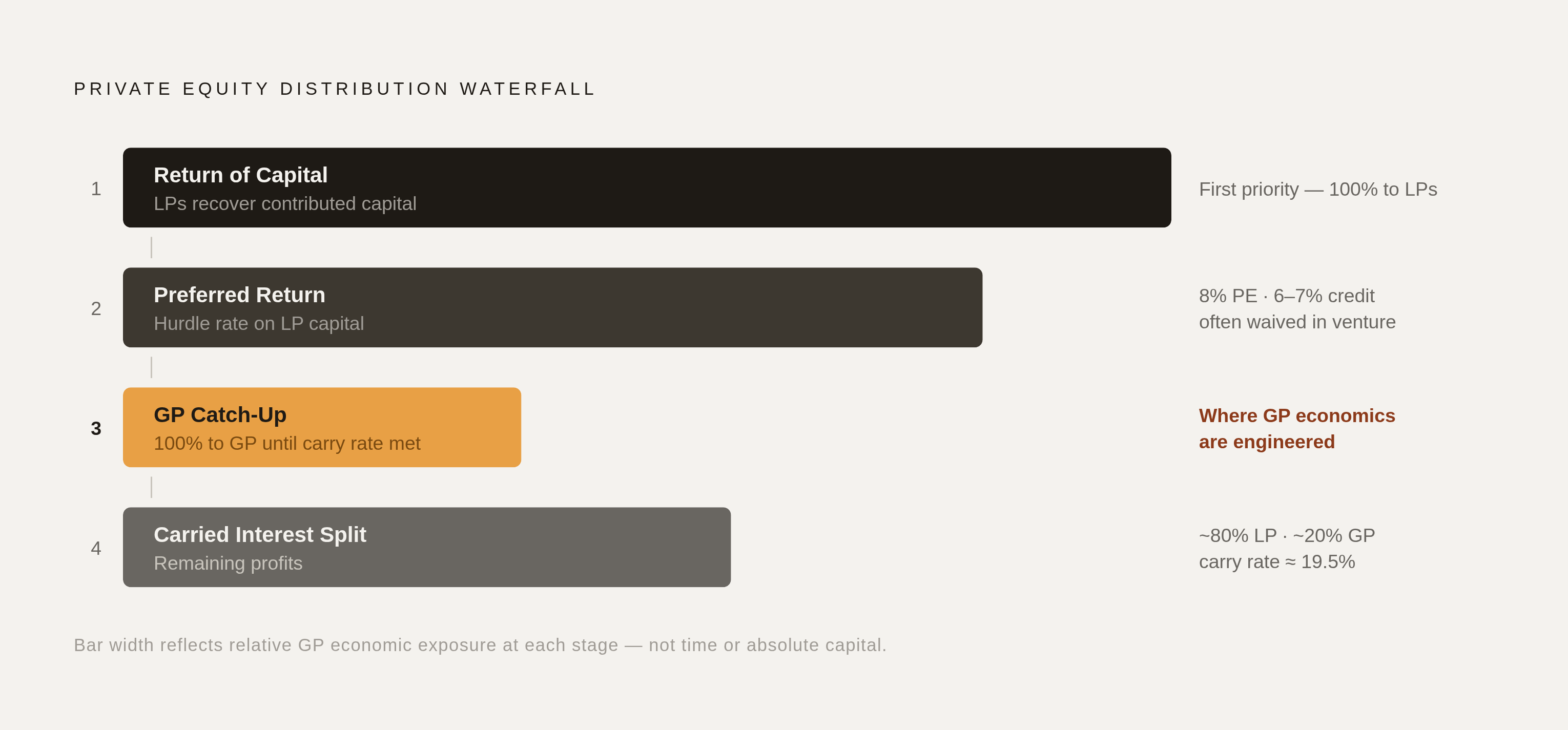
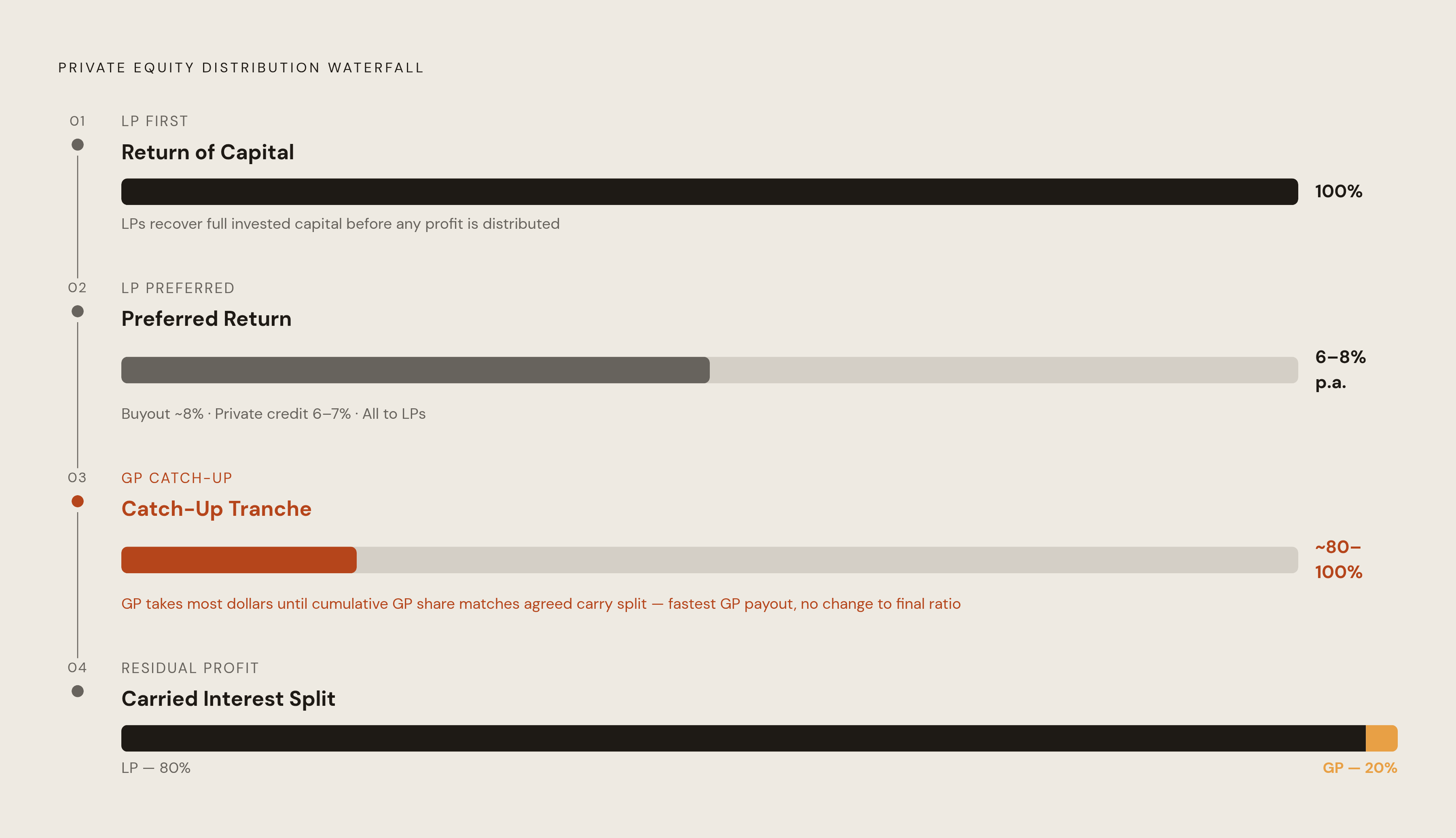
The waterfall sequence is fixed in every fund: LPs get their capital back, then LPs receive a preferred return, then the GP receives a catch-up tranche, then remaining profits split at the agreed carry rate. The order never changes, even though the size of each step is negotiated extensively.
The preferred return, or hurdle, typically sits at 8% in private equity. Private credit funds run lower at 6 to 7%, because target returns are lower to begin with. Venture funds often skip the hurdle entirely.
The catch-up tranche allows the GP to receive all or most of the next dollars distributed until its cumulative share catches up to the agreed carry split. Some LPAs tier the carry upward, for example from the standard rate to 25%, if the fund clears a return threshold such as 3x gross multiple.
The structural question that drives the most consequential differences is whether a fund uses a European or American waterfall. European, or whole-of-fund, waterfall calculates carry across the entire portfolio. The GP earns nothing until every LP dollar is returned and the preferred return is cleared fund-wide. This is the standard for large buyouts, infrastructure, and secondaries, with over 80% of buyout funds using it. American, or deal-by-deal, waterfall pays out carry on a per-exit basis, meaning a GP can receive carry on a winning exit in year two even if the rest of the fund has not yet proven itself. This structure creates the timing mismatch that clawback provisions are designed to correct, and it remains more common in older funds and parts of venture. Hybrid structures release carry deal-by-deal but only after a minimum capital return threshold, or hold interim carry in escrow until a batch of exits clears the hurdle. Combined fees and carry on a well-performing fund result in the GP taking home 25 to 35% of gross profits, a figure determined entirely by how the waterfall was negotiated at fund formation.
Where clawback provisions work and where they fail
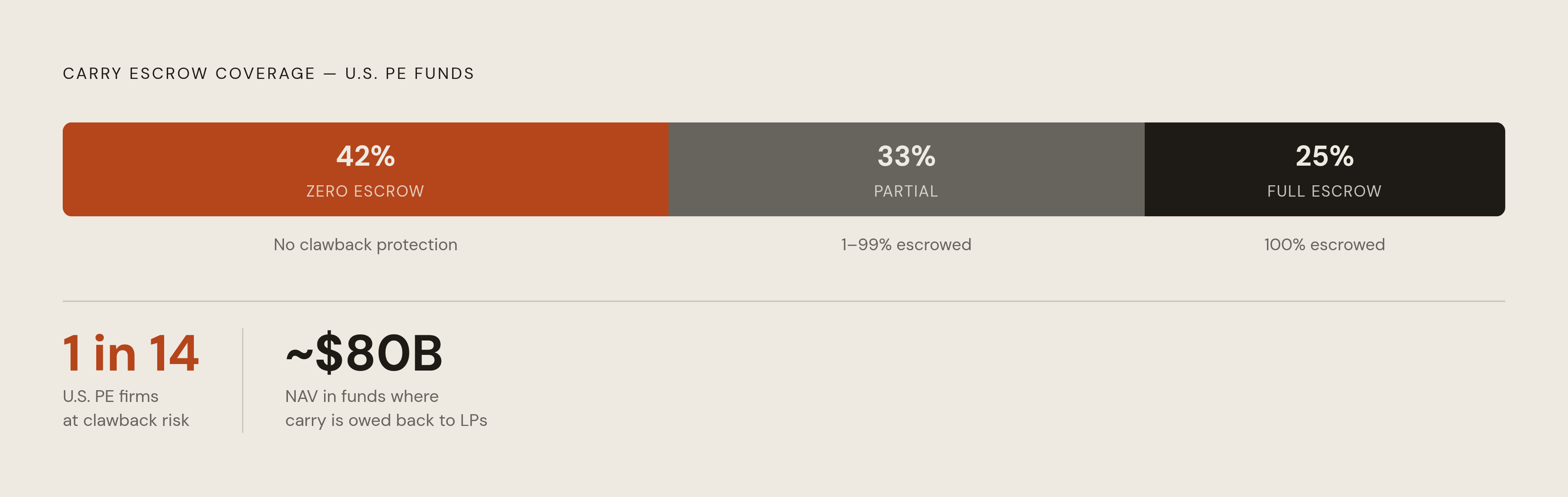
Clawback provisions require the GP to return carry already distributed if the fund ultimately underperforms the hurdle. The provision exists to correct the timing advantage that American waterfalls give GPs on early exits. Upwelling Capital Group's research identified roughly 1 in 14 U.S.-based PE firms as facing clawback exposure, with close to $80 billion in NAV sitting in funds where carry is technically owed back to LPs.
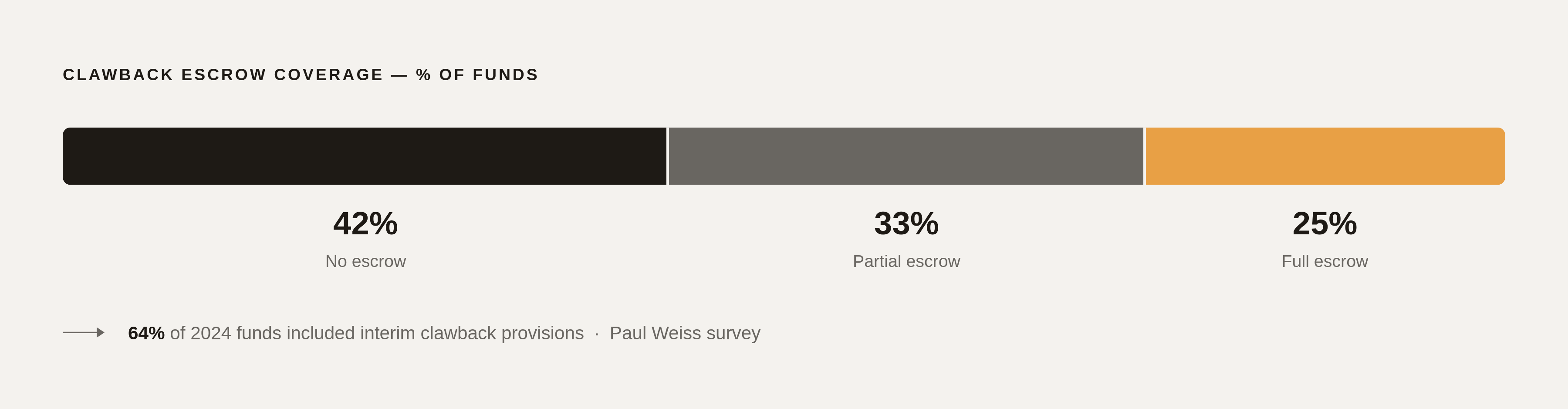
Whether a clawback is actually collectible depends on what was negotiated at fund formation. Forty-two percent of funds escrow nothing against future clawback obligations, twenty-five percent escrow the full amount, and the rest fall somewhere in between. Interim clawbacks — recovery before the fund winds down — are gaining ground: 64% of funds included them in 2024 per a Paul Weiss survey. As Davis Polk's Michael S. Hong observed, clawbacks are being treated as fundamental economic issues subject to negotiation rather than standard boilerplate. Timeline language also matters significantly. ILPA recommends a 30-to-90-day repayment window once a clawback is triggered, but some LPAs allow 12 to 24 months, giving GPs a long runway to dispute the calculation or delay payment.
By the time a clawback is triggered in practice, the fund entity may already be dissolved, individual partners may have spent or reinvested their carry distributions, and any escrow may cover only a fraction of what is owed. What follows depends entirely on how the LPA was written and how the GP structured internal liability, including which partners are on the hook, in what proportions, and whether a departed partner still owes anything. Most firms never resolve these questions clearly until a dispute forces them to.
Carry point allocation and internal governance tension
Once the fund's carry share is determined, the firm allocates it internally using carry points. A managing partner might hold 45 of 100 points, a senior partner 30, mid-level partners splitting 10, a junior partner holding 5, and a small pool reserved for advisors or specific deals. At meaningful fund sizes, a single point can represent tens of millions of dollars over the fund's life.
KKR discloses its internal model with more transparency than most firms: it allocates 40 to 43% of earned carried interest to an internal employee pool. At year-end 2023, that pool was tied to $268 billion of carry-eligible AUM and $6 billion in gross unrealized carry. Even so, realized performance income dropped from $2.18 billion in 2023 to $1.07 billion in 2024, reflecting how dependent carry realization is on exit market conditions regardless of how well the internal structure is designed.
Harvard Business School researchers Lerner and Ivashina, studying 717 PE partnerships, found that internal carry allocation has almost no correlation with past investment performance. Founder status predicts point allocation far more reliably than individual track record does. When carry is underprovisioned or structured in ways that senior partners perceive as inequitable, departures follow, and those departures make fundraising for the next fund measurably harder. Point allocations are typically set at fund formation, when the team is small and roles are still being defined. Years later, the firm's contribution map has changed substantially, but the allocations often have not. Some firms maintain a discretionary pool of unallocated points that leadership can direct toward high performers or new hires, but the criteria governing that pool, and the transparency around how decisions get made, vary significantly across firms.
Vesting schedules as retention instruments
Vesting schedules determine when carry points actually pay out. Schedules can be time-based with a cliff followed by ratable vesting, tied to investment or fund milestones, or structured as a hybrid. The start date, whether employment date, first close, or grant date, changes the economics significantly for anyone joining a firm mid-fund.
Venture firms typically vest people across the whole fund portfolio regardless of when a specific deal closed, which keeps the team aligned around the same outcomes. PE firms more often tie vesting to specific deals or tranches, which rewards the individuals who drove a particular investment but can create internal competition for deal attribution.
The good leaver and bad leaver distinction is where vesting becomes a direct retention mechanism. A good leaver, such as someone retiring or leaving on agreed terms, typically retains all vested carry and sometimes a portion of unvested carry as well. A bad leaver, such as someone terminated for cause or departing to a competitor, forfeits unvested carry and often a portion of vested carry too. The firm generally retains discretion over the classification, and that discretion functions as one of the most effective retention tools in the industry because a classification decision can determine whether a departing partner retains or loses millions in carry. Forfeited carry is redistributed within the firm, either to remaining partners, new hires, or a reserve pool, and how that redistribution is handled either reinforces the allocation logic or introduces new equity concerns. Capital commitments create a further mechanical complication: the GP's commitment to the fund is fixed at the fund level, and when a partner leaves, someone still has to fund their share. Most firms handle this inconsistently. A principal or senior partner at a mid-market fund may be sitting on millions in carry across multiple vesting stages, so a leaver dispute carries real financial stakes for both parties.
Renegotiating carry as the partnership evolves
Carry allocations set in Fund I frequently carry forward into Fund II and Fund III without adjustment, even as the team and contribution map change substantially. The founding partner allocation calcifies into a structure that no longer reflects who is generating returns. The Lerner-Ivashina finding is directly relevant here: allocation that is disconnected from performance is empirically associated with the partner departures that damage fundraising in subsequent fund cycles.
Renegotiation typically requires a trigger. A new fund close, a senior hire who requires a larger allocation as a condition of joining, a departure that frees up carry points, or a GP stakes transaction can all prompt firms to revisit the structure. GP stakes buyers — including Blue Owl (formerly Dyal), Petershill, and Bonaccord, which acquire minority interests in GP economics — conduct sufficiently detailed diligence that they surface every carry allocation dispute a firm had been managing informally. For many firms, a GP stakes transaction is the first time the carry structure gets written down precisely, because an outside investor with legal counsel required a clear answer.
Firms that manage this process effectively share common practices: they set review triggers in advance, such as a new fund close or a scheduled anniversary, they document allocation criteria rather than keeping decisions in a founder's memory, and they separate the carry-setting process from the performance review so that seniority does not override actual contribution. Firms that manage it poorly tend to concentrate allocation decisions in a single individual, apply no written criteria, and schedule no formal review. When a leaver dispute eventually surfaces, the gap between informal understandings and formal documents is typically expensive to resolve, both financially and in terms of partnership trust. Carry governance requires ongoing attention across the life of the partnership, not a single decision at fund formation.
Methodology & sources
- https://apers.app/learn/capital-structure/equity/management-fees-carried-interest-gp-economics
Provided the management fee averages for 2024 and 2025 vintage buyout funds and the near-20% carry rate stability figure cited in the opening paragraph.
- https://dawsonpartners.com/static/c3c4236415920d235e1f380c1e6957e7/Dawson-Whitepaper-The-Evolution-of-the-GP-Solution-Dec-2025.pdf
Provided the research finding that GPs committing 2% or more produced a 0.13x higher multiple across more than a thousand PE funds.
- https://www.globalinvestments.net/investments/guides/carried-interest-private-equity-guide
Provided the figure that combined fees and carry result in the GP taking home 25 to 35% of gross profits on a well-performing fund.