Founder Investor Update Best Practices
Monthly updates build investor trust that compounds into faster fundraising.

Most founders treat investor updates like a chore. Something to do when there's good news to share, or when a round is coming up, or when someone on the cap table asks why they haven't heard from you in six months. That framing is expensive. A well-run investor update isn't a report card you file away. It's a relationship you're either building or letting decay, one month at a time. The founders who figure this out early don't just have better investor relationships. They raise faster, get better intros, and spend less time convincing people to believe in them when it counts most.
The evidence that consistent communication changes fundraising outcomes
Here's a number worth taking seriously. Companies that maintain monthly investor updates see a 40% higher chance of securing follow-on funding, according to a 2025 efficiency study cited by Qubit Capital. Separately, Visible.vc's platform data shows that startups updating investors regularly are twice as likely to raise follow-on rounds.
Now, correlation versus causation. The founders who communicate consistently probably execute consistently too. So is the update causing better fundraising outcomes, or are both things downstream of being a disciplined operator? Probably the latter. But here's why the mechanism still matters: an informed investor can act. An investor who hasn't heard from you in four months cannot. They don't have context. They can't make an intro that lands. They can't advocate for you in a room you're not in.
Trust built in calm months is the asset you spend in hard months. You cannot manufacture it on demand during a raise. By the time you're asking someone to write a check or make a call on your behalf, it's too late to start the relationship. Uncork Capital frames it this way: updates serve double duty. They keep current investors warm and they warm prospective downstream investors at the same time. That's a compounding effect with essentially no marginal cost.
How often to send, and why the answer depends on your stage
The broad consensus lands on monthly for early-stage companies. Founder Institute formally recommends monthly updates for at least the first 24 to 36 months. Here's the stage-adjusted logic:
- Pre-seed and seed: Monthly. Things move fast. Investors need context to help, and you need them engaged before you need them urgently.
- Series A and beyond: Quarterly often works. Business cycles get longer, the investor base grows, and a quarterly update with real substance can carry more weight.
- Active fundraising period: Bi-weekly or even weekly. You want to stay top of mind and sustain momentum through a raise.
- Crisis or major pivot: Don't wait for the scheduled send. Off-cycle updates exist for exactly this situation. Get ahead of it.
There's a dissenting view worth including honestly. Halle Tecco, founder of Rock Health and an advisor to many healthcare startups, argues that monthly cadence risks information overload. It can dilute the significance of each update. Her case for quarterly is that it forces more substance into each send.
Both positions have merit. The meta-rule that resolves the debate: consistency beats frequency. A quarterly cadence you actually maintain beats a monthly one you abandon. Investors notice gaps. They don't know if things are going badly or if you just got busy. Either interpretation is bad.
One tactical note on timing. Mid-week sends, Wednesday or Thursday, outperform Monday or Friday. Mondays are catch-up days. Fridays get buried before the weekend. Per guidance from Founder Institute and Opstart, mid-week is where your open rate lives.
On the question of who belongs on the list:
- Jason Lemkin's rule of thumb: any investor holding at least 1% gets a monthly update until roughly $10M ARR.
- Pre-traction: include anyone who could plausibly help, even if they haven't written a check yet.
- Often overlooked: SAFE and convertible note holders are on your cap table. They hear nothing unless you send it.
What a well-structured update actually contains
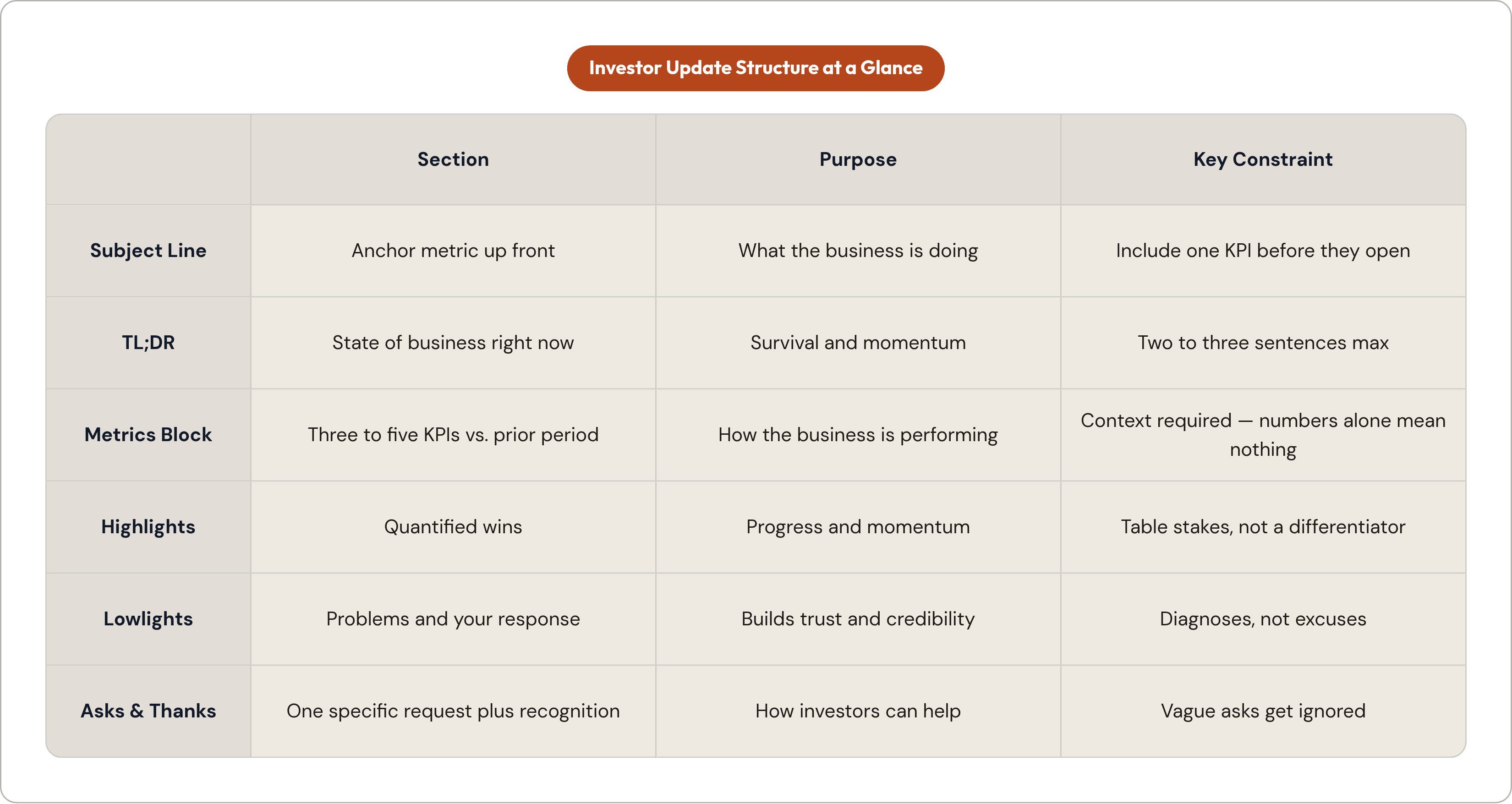
Most bad investor updates aren't wrong. They're just out of order. Investors don't know where to look, so they skim, miss the important stuff, and close the email without doing anything useful.
Founder Institute's four-section logic maps to three simple investor questions: how is the business doing, how long can it survive, and how can I help? Everything in your update should answer one of those questions.
Here's a six-block structure that works, in order:
- Subject line with an anchor metric. Not "Monthly Update, May 2026." Something like "Acme, May 2026: MRR $47k, up 18%." The number lands before they even open the email.
- TL;DR. Two or three sentences on the state of the business right now. Assume some investors will read nothing else.
- Metrics block. Three to five KPIs, each shown against the prior period. Numbers need context or they mean nothing.
- Highlights. Real wins, quantified where possible. Qubit Capital's analysis found that 81% of investor updates include a dedicated highlights section. It's table stakes, not a differentiator.
- Lowlights. What went sideways and what you're doing about it. More on this below, because it's the most important section of the whole update.
- Asks and acknowledgments. One specific request, and a brief thank-you to anyone who helped since the last update.
On length: monthly updates should run roughly 250 to 500 words. Quarterly updates, 750 to 1,500 words. The constraint that actually matters is this: investors sit on multiple boards and are reading your update between other things. If it takes more than three minutes, it won't get read carefully.
Format: plain-text email from the CEO. No design, no branded templates unless you're including a chart. That feels counterintuitive, but polish signals effort spent on the wrong thing. Plainness signals confidence.
Choosing the right metrics and resisting the temptation to swap them
Pick one primary KPI and show it in every single update. MRR for SaaS. GMV for marketplaces. DAU for consumer apps. Everything else provides context around that number. Investors should be able to scan twelve of your updates and see one continuous line of progress (or honest struggle).
Universal financials that belong in every update, regardless of your business model:
- Gross and net burn rate
- Cash in bank
- Runway. This is the most important single number for an early-stage investor reading your update.
- A high-level P&L summary
Model-specific metrics worth tracking:
- SaaS: MRR or ARR with growth rate, net churn, and unit economics. A 3:1 LTV to CAC ratio is a commonly cited benchmark for healthy SaaS unit economics.
- Marketplace: GMV, take rate, active buyers and sellers.
- E-commerce: revenue, AOV, conversion rate, repeat purchase rate.
- All models: DAU, WAU, or MAU and retention. Retention often tells you more than acquisition does.
Now, the trap. If you reported MRR, customer count, and churn last month, report those same metrics this month. Switching to "pipeline value" and "engagement score" after a rough MRR month is transparent in exactly the wrong way. Investors have seen it before. They know what metric-swapping signals.
Vanity metrics that tell Hustle Fund, and frankly anyone paying attention, that a founder doesn't understand their own business:
- Raw app installs or waitlist size without a conversion rate attached
- Social media followers
- Booked-but-not-yet-earned revenue
- The size of the last round presented as traction
Founder Institute recommends including at least one additive or cumulative metric alongside one ratio. Together, they give a picture of both scale and efficiency. Scale without efficiency is a concern. Efficiency without scale is a ceiling. You want to show both dimensions.
Why the lowlights section is where trust is actually built
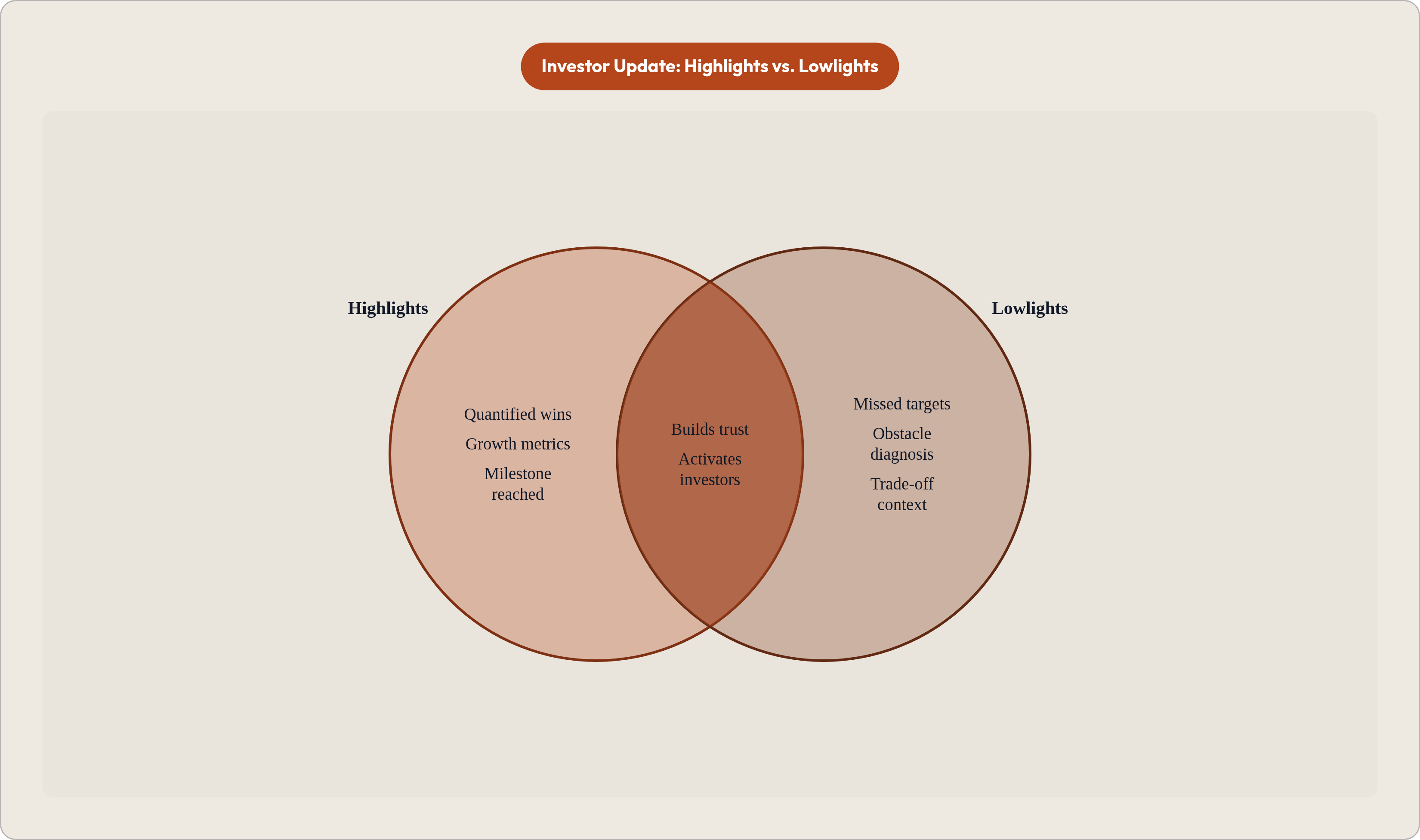
Here's the instinct to fight: sending an update with only highlights. Mercury's editorial team has noted that investors receiving all-highlight updates start to wonder what's being hidden. In early-stage startups, it is genuinely rare for an entire month to pass without something worth flagging. An update that claims otherwise reads as managed, not honest.
Lowlights done right don't alarm investors. They build confidence. Here's the framing that works:
- Present each obstacle as a problem you are actively solving, not as an external force you're waiting out.
- Frame missed targets around what you learned and what you're adjusting. Not excuses. Diagnoses.
- Describe the trade-off or decision behind the miss, not just the outcome. Investors want to see how you think, not just what happened.
Founder Institute's "No Threes" framework is useful here. Rate key categories like runway, team, and product on a 1-to-5 scale. The rule: ban the middle score. A three is the coward's answer. It forces you to decide: is this going well or is this going poorly? That honest assessment is what your investors actually need.
What investors do with a well-written lowlights section is not panic. They put on their problem-solving hat. They think about who they know. They forward your email to someone useful. The lowlights section turns a challenge into an activation signal.
NFX has observed that the best founders communicate well during good times and communicate even better during hard ones. The lowlights section is where that distinction becomes visible to everyone reading.
How to write an asks section that actually gets you what you need
Most asks sections underperform because they're too vague or too long. "Any introductions welcome" is not an ask. It's an opt-out written in the language of a request.
Founder Institute breaks asks into three useful categories:
- Assistance. Specific expertise, feedback, or a connection you need.
- Referrals. Introductions to specific named people or specific types of companies.
- Funding. When you're raising, say so directly. Don't make investors guess.
The one-specific-ask rule is simple. A single concrete request outperforms a list every time. "Can you introduce me to the VP of Partnerships at Company X?" is actionable. "Any enterprise leads" is noise. Investors are busy. Make it easy to say yes.
Uncork Capital frames the asks section as the bat signal. The rest of the update arms investors with context. The asks section tells them exactly how to use it.
Don't skip the acknowledgment. A brief, specific thank-you to whoever helped since your last update reinforces a norm: responses get recognized. That increases your response rate over time. It's a small thing that compounds.
If you're also sending updates to prospective investors, the asks section does double duty. A well-scoped, specific ask signals clarity about where the business is going. It tells the reader you know what you need and why. That reads as competence.
What separates a good update from one investors actually remember
Voice matters more than most founders think. Your update should read like a note from the CEO, not a PR release or a slide deck turned into paragraphs. Directness signals confidence. Over-polished language signals that someone is managing perceptions.
When investors are reading through a stack of portfolio updates in a given month, here's what they notice:
- Whether the numbers connect to a narrative or just sit on the page uncontextualized
- Whether the founder owns the lowlights or deflects them
- Whether the ask is specific enough to act on before closing the tab
The subject line is the first impression and a lot of founders waste it. Burying the company name and date signals you haven't thought about what the reader needs. Include the anchor metric. Set the tone before they've even opened it.
Consistency is the compound interest mechanism here. One great update builds goodwill. Twelve consecutive updates build a reputation. Investors begin to pattern-match you as someone who executes and communicates. That reputation is the foundation of a strong reference before a raise even begins.
There's also a due diligence benefit that doesn't get talked about enough. A well-maintained update history is an artifact. It shows trajectory, self-awareness, and follow-through in a way a pitch deck alone never can. When a new investor asks existing ones what it's like to work with you, "they update us every month and own their misses" is a more powerful answer than anything you could say about yourself in a meeting.
On tooling: platforms like Visible and Carta reduce the operational friction that causes founders to let cadence slip. They handle distribution, track open rates, and maintain your investor CRM so the update actually gets sent. The best update isn't the most beautifully written one. It's the one that goes out on time, every time, without requiring a heroic effort to produce.