Venture Capital Portfolio Monitoring and Reporting
Good data separates winners from the GPs who discover problems after exits disappear.

- Written by
- Ravi Quist
- Updated
- September 9, 2026
- Reading time
- 11 min read
- Sources cited
- 5 sources ↓
What this covers
Venture capital portfolio monitoring is the job of tracking how portfolio companies and funds are doing, from the day a check clears to the day there's an exit (or a shutdown, which happens more than anyone likes to admit). The Cambridge Associates US Venture Capital Index tracked 2,625 funds worth $536 billion at the end of 2024. That's the scale we're talking about, and it's why this isn't housekeeping. It's the plumbing that keeps a multi-billion-dollar industry from finding out about problems after it's too late to do anything but write the check off.
What portfolio monitoring actually covers, and when it starts
Monitoring starts the second a deal closes. It doesn't stop until the company exits, gets bought, or shuts its doors, and it runs on three tracks at once, all the time, whether anyone's watching or not.
Financial tracking covers valuation, revenue, burn, growth. Operational tracking covers headcount, product milestones, where the company sits against its competitors. Compliance tracking covers regulatory boxes, board governance, and whatever covenants got written into the fund docs back when everyone was still excited about the deal.
Don't confuse this with deal sourcing or portfolio support. Monitoring is the data and reporting layer underneath those things; it tells a GP whether to step in and how urgently, but it isn't the stepping in itself. A lot of firms file it under "back office," somewhere between filing taxes and restocking the snack drawer. The firms that actually outperform don't buy that framing. They treat monitoring as where the alpha hides, because good data tells you where to look before a problem becomes a headline.
Nearly two-thirds of venture-backed startups never return a positive ROI, according to Harvard Business Review. One bad company in a portfolio of fifteen doesn't just cost money. It costs trust, and once an LP starts doubting a GP's judgment, that doubt doesn't sand back out easily.
The fund-level metrics that LP reporting is built around
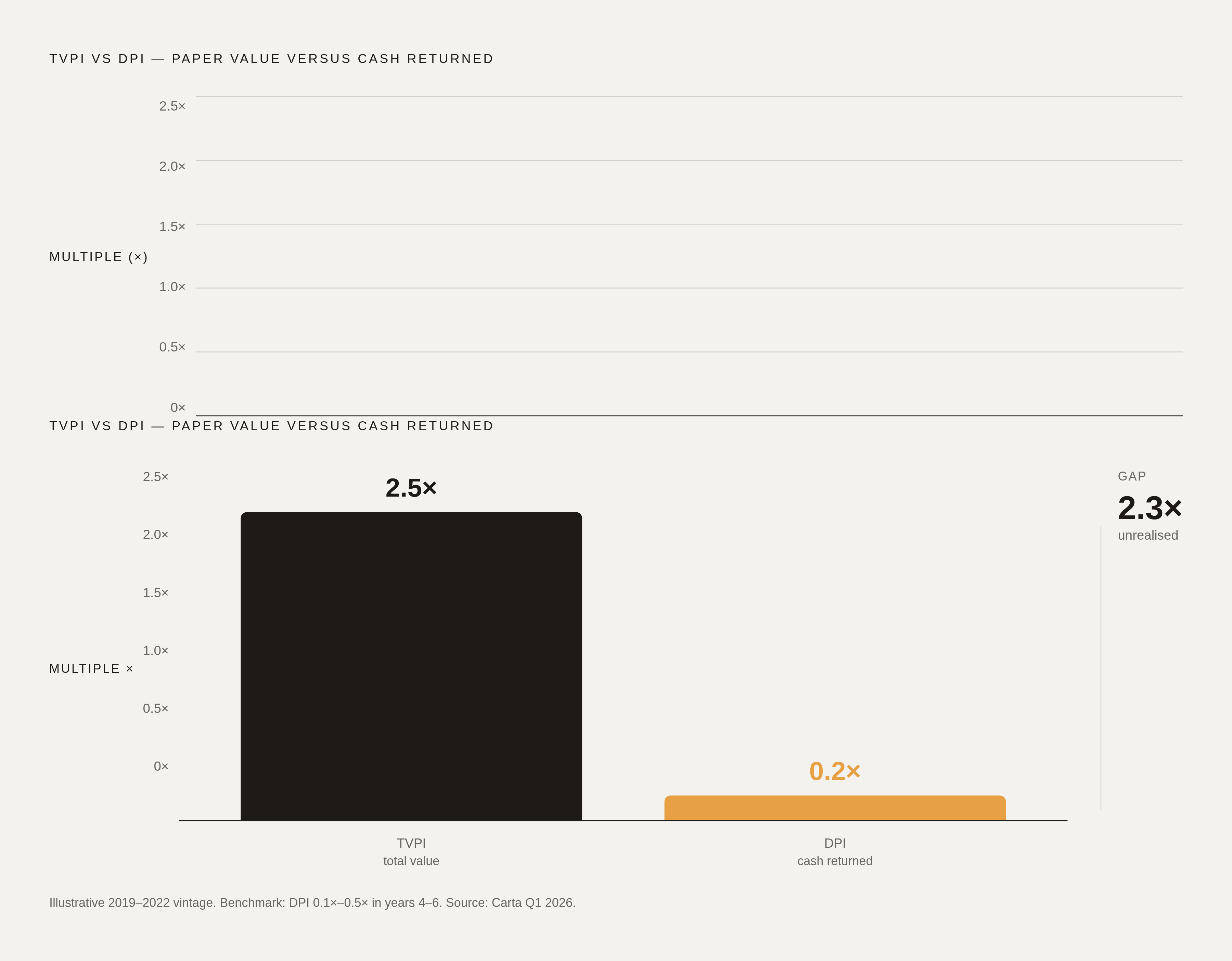
Four numbers show up on basically every LP call. If you've sat through more than a handful, you already have them memorized.
TVPI (Total Value to Paid-In) is the headline multiple: total value created against capital invested. DPI (Distributions to Paid-In) is the reality check, actual cash that's landed in LP accounts. MOIC (Multiple on Invested Capital) measures value generated per dollar in. RVPI is everything still sitting on paper, unrealized.
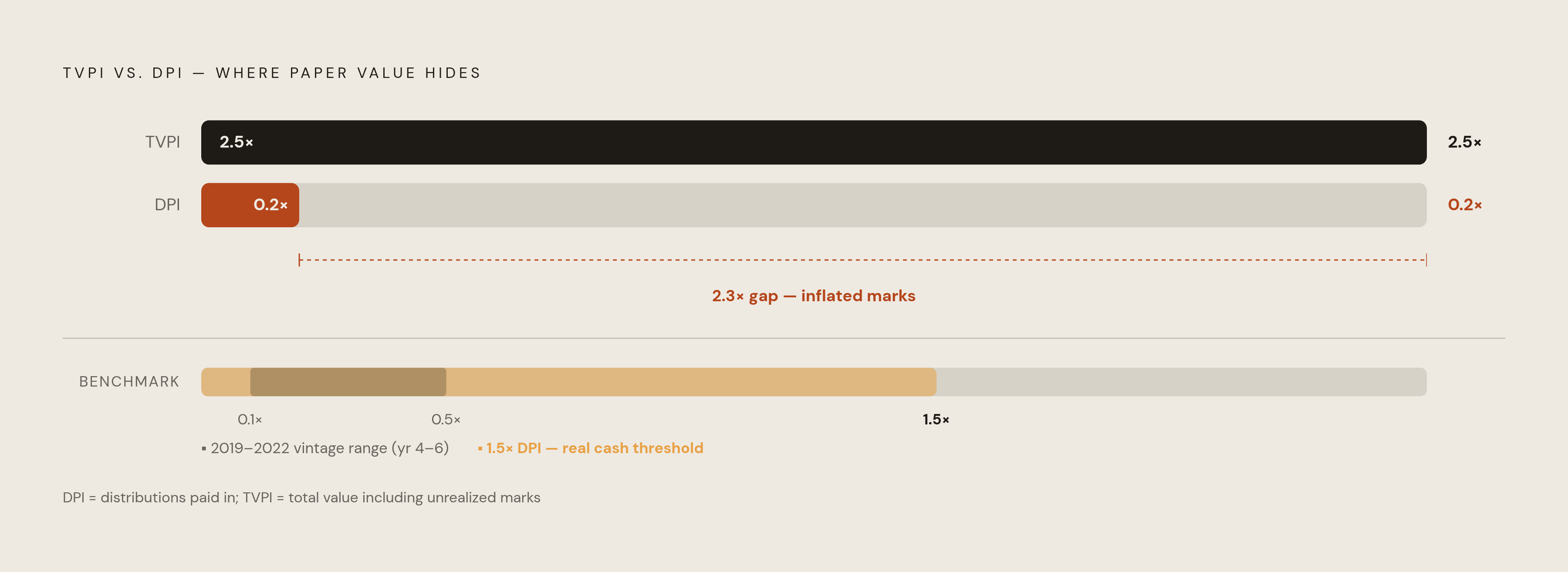
Knowing the definitions is the easy part. A TVPI of 2.0x sounds great, and often is, but it needs company. A fund sitting at 2.5x TVPI with 0.2x DPI is telling you a story about paper gains, not cash anyone's actually touched, and that gap is exactly where an inflated mark likes to hide. DPI north of 1.5x means something, because cash doesn't lie the way a mark sometimes does. Most funds from the 2019 to 2022 vintages sit between 0.1x and 0.5x DPI in years four through six, so that's the benchmark to hold up when an LP pushes back on a number.
Carta's VC Fund Performance report for Q1 2026 puts top-decile net IRR above 20% for most vintages from 2017 through 2024, with the 75th percentile under 15.5%. Institutional LPs generally want net IRR at 20% or better by full exit. Every quarterly update a GP sends out gets measured against that number, whether the GP says so or not.
The company-level metrics that feed those fund numbers
Fund-level metrics don't come from nowhere. They get built, bottom-up, from whatever's actually happening inside each portfolio company, and that's where the early warnings live, long before they show up in a fund report.
ARR and revenue growth matter most for SaaS and tech names. Burn rate and cash runway are the earliest smoke detector a GP has, since by the time burn shows up as a valuation problem, it's already been a cash problem for months. CAC versus LTV tells you whether growth is paying for itself or just borrowing against next year. Gross margin and operating margin show how mature the unit economics actually are.
Burn per employee and revenue per employee tell you if headcount's pulling its weight. Headcount trajectory itself is a leading indicator for where spend and growth head next.
None of it means much without a benchmark next to it. A churn rate that's fine for a consumer subscription box would set off every alarm at a SaaS company. Standard Metrics runs benchmarking built from data across thousands of startups, which is one way a GP checks a company against real peers instead of guessing off gut feel.
A company's ARR growth, burn, and runway are exactly what a GP uses to mark that company's valuation, and that mark moves fund-level TVPI directly. Burn hitting zero is the scenario nobody wants: that's the moment unrealized value on paper turns into a realized write-off, and DPI drags down right along with it. Watching these numbers continuously, instead of once a quarter, buys a GP time to actually do something. Deploy reserves. Get on the phone with the founder. Adjust the mark before it gets forced on them.
How data actually gets from portfolio companies to the GP
There are two ways this data moves, and one of them is a lot more painful than the other.
Manual collection means email surveys, spreadsheet templates, and periodic check-ins, where a founder eventually fills in a form and the GP reconciles it by hand, usually while questioning their career choices. Automated collection means portfolio companies connect their accounting systems straight to a platform that pulls numbers on a set schedule. No chasing required.
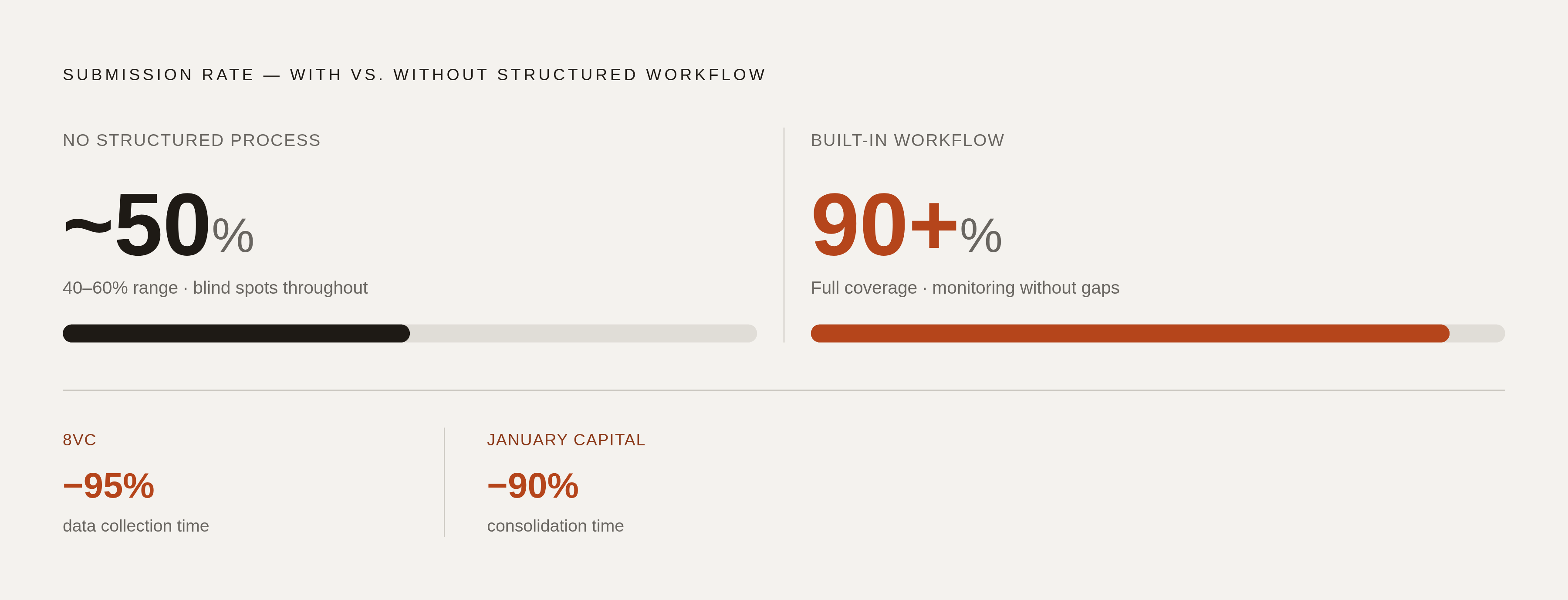
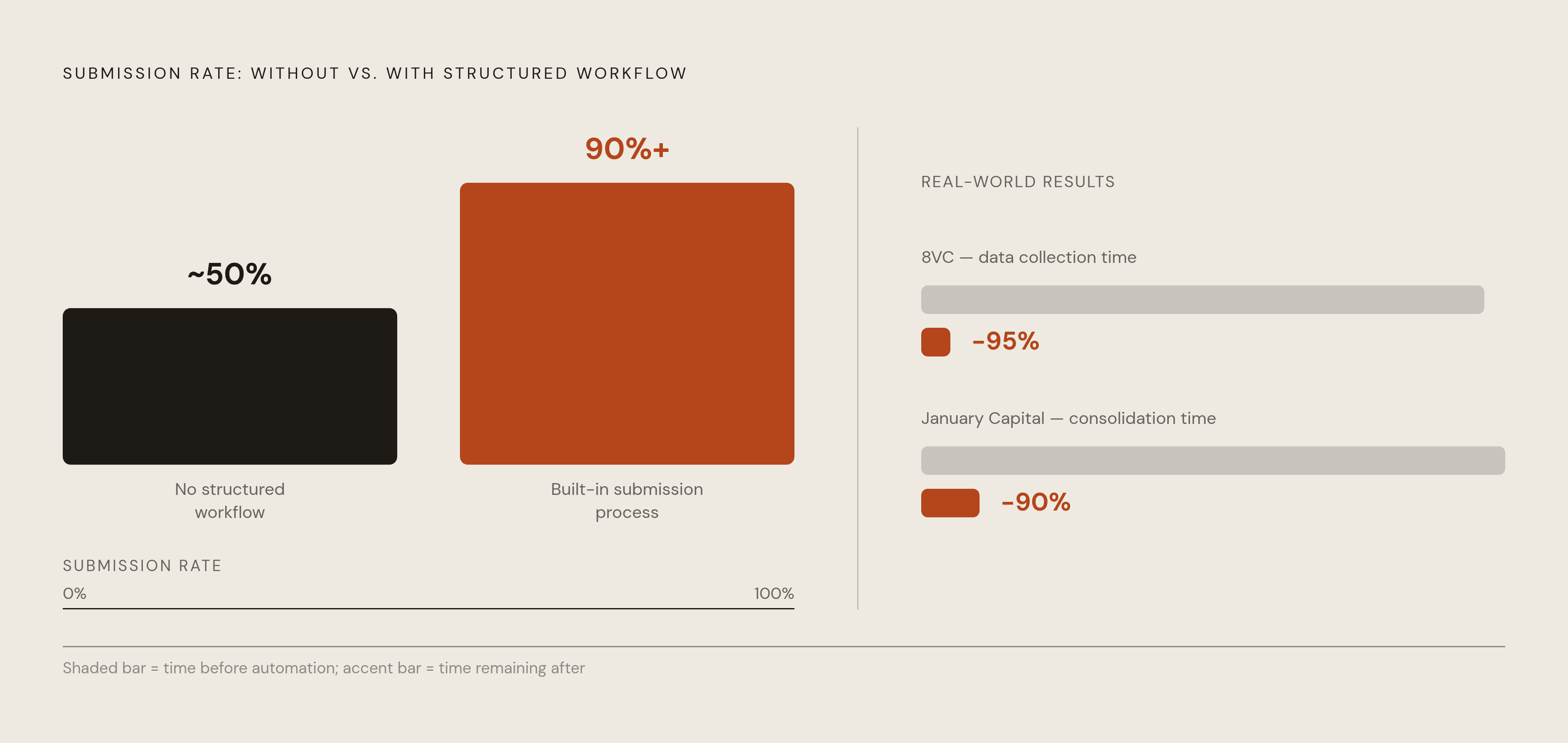
Founder compliance is the real bottleneck. Platforms without a structured submission workflow see data submission rates between 40% and 60%. Platforms with a built-in process get above 90%, consistently. That gap isn't rounding error. It's a blind spot, and the companies least likely to send in their numbers tend to be the ones with the most reason not to. A McKinsey survey of portfolio company CFOs found 48% name data fragmentation as the single biggest obstacle to getting timely numbers out the door.
Before automation, this cost real hours, not abstract ones. Firms like 8VC and January Capital were burning staff time on manual data wrangling until they switched to recurring automated requests. 8VC cut its data collection time by 95%. January Capital cut data consolidation time by 90%. The monitoring process is only as good as the pipe feeding it, and collection mechanics aren't a side detail. They decide whether anything downstream works at all.
The structural problems that let risks go undetected
Fragmented data sits behind almost every monitoring failure you'll ever hear about. Investment data ends up scattered across spreadsheets, email threads, a CRM, and a handful of point tools that were never built to talk to each other. There's no single source of truth. Just a lot of half-truths living in different tabs.
When Shawn Larrabee joined Liquid 2 Ventures in 2024, he found data spread across Carta, PitchBook, Foresight, an internal database, and a CRM, none of it synced, none of it formatted the same way, inside one firm. That's not a rare horror story. That's Tuesday for a lot of venture shops.
Then there's latency. Quarterly updates mean a GP is always staring at information that's already weeks or months old. A company burning cash faster than projected could be down to six weeks of runway before anyone outside the building notices, if the only check-in is once a quarter. Manual reconciliation doesn't scale gracefully either. Every new company added multiplies the collection and cleanup work, so the problem compounds instead of leveling off.
Firms with real-time visibility catch problems while there's still time to act, deploy support where it matters, and generally sleep better at night. Firms running on quarterly snapshots are always working off old news. This isn't some edge case reserved for badly run shops. Fragmented data and reporting lag are the default state for any firm that hasn't specifically built, or bought, its way out of it.
LP reporting: what it must contain, how often, and on what template
ILPA Principles 3.0 sets the industry floor: interim reports go out within 60 days of quarter-end. That's the minimum, not something to aim for and miss.
Every LP report needs net IRR, TVPI, DPI, and RVPI, calculated net of fees and carry, following the ILPA Performance Template. As of January 2025, there's a new version that's become the de facto standard, ILPA Reporting Template v2.0, the product of the Quarterly Reporting Standards Initiative that ILPA ran through 2024. Any GP with a fund still in its investment period, or launching a new fund after January 1, 2026, operates under it now.
The biggest change is the removal of flexibility, more than any new line item. The old 2016 template let GPs repurpose line items and shuffle expense categories however they liked, so dozens of firms could all claim to "follow the standard" while producing reports that looked nothing alike. The new version locks that down. It adds more granular fee and expense breakdowns, requires explicit disclosure of internal chargebacks, and separates out subscription line interest instead of burying it in a footnote somewhere.
The Performance Template now standardizes IRR and TVPI reporting both with and without subscription line effects, adds a cash flow table LPs can check against their own records, and supports two calculation methods, Granular and Gross Up. ESG fields stay optional but are close to standard now, especially for managers courting European institutional LPs under SFDR rules.
On the regulatory side, the SEC adopted private fund adviser rules in August 2023 requiring standardized quarterly statements, and the Fifth Circuit struck down key parts of that rule in June 2024. The legal mandate disappeared. LP expectations didn't move an inch. A typical institutional LP is spread across more than 20 fund managers, so standardized reporting isn't a courtesy someone extends when they feel generous. It's the only way an LP compares fund A to fund B without hiring a translator.
Why reporting quality has become a fundraising variable
92% of institutional LPs say reporting quality shapes their re-up decisions, according to Preqin's 2024 Investor Survey. The quarterly report isn't a formality that gets skimmed and filed away. It gets graded, every time.
An ILPA LP survey found 73% of LPs name "lack of transparency" as their top complaint about GP reporting. That's not two cranky LPs venting on a call. That's the majority experience across the entire asset class.
The TVPI/DPI gap bites here too. A GP flashing a strong paper TVPI while staying vague about DPI invites exactly the scrutiny that kills a re-up conversation before it starts. GPs who adopt the 2025 ILPA template on their own, before an LP has to ask, are signaling they run a tight operation. GPs who drag their feet on standardization are, whether they mean to or not, asking their LPs to do the reconciliation work themselves.
The re-up dynamic isn't complicated, even if it's a little uncomfortable to say out loud. A GP with clear, consistent reporting has already answered the LP's first question before the meeting starts. A GP whose reports show up late and formatted differently every quarter starts that same meeting several points in the hole.
The portfolio monitoring software landscape and what different firms actually need
There's no single right platform. What a firm needs depends on its size, its fund structure, and how many companies it's tracking. Three rough buckets cover most of the market.
Large institutional managers juggling multi-fund structures and a long LP roster tend to land on Standard Metrics, used by more than 100 VC firms including Bessemer Venture Partners, General Catalyst, and Lux Capital, tracking data across more than 9,000 portfolio companies with built-in benchmarking by sector and revenue scale. Chronograph fits a similar niche, built for the complexity of multi-fund reporting at scale.
Mid-market firms usually want one platform that handles monitoring, reporting, and LP communication without the enterprise price tag or the months-long setup. Vestberry covers that full workflow in a single tool. Edda leans more workflow-first, tying deal flow and portfolio tracking together in one place.
Solo GPs and emerging managers need something else entirely. They want to stay close to the portfolio without handing a two-person team a monitoring form nobody has time to fill out. Cura was built with exactly that constraint in mind.
Then there's the firm drowning in its own fragmented data stack. When Liquid 2 Ventures consolidated onto Carta, its head of finance went from juggling five disconnected sources to running a single query across roughly a thousand companies. Carta also acquired Tactyc in 2024, folding forecasting and fund construction scenario modeling into the same system.
Whatever platform a firm picks, the questions to ask stay the same. Does the founder submission process actually get filled out, or does it add friction people quietly ignore? Does it normalize different companies' reporting formats on its own, or does someone still clean it up by hand? Can it produce the 2025 ILPA template without a manual reformat, and does the benchmarking give real peer context instead of raw numbers with nothing to compare them to? Is there scenario modeling for reserves and fund construction? None of it matters much if the data collection underneath is broken. A great platform sitting on a fragmented data stack just automates the fragmentation faster.
How the monitoring cadence connects data collection, risk review, and LP reporting into one operating rhythm
All of this only works if it runs on a rhythm instead of a scramble. Data collection, risk review, and LP reporting aren't three separate chores. They're one loop that has to keep turning, or the whole system falls out of sync with reality.
Data comes in from portfolio companies, automated and frequent if it's working right, not manually chased once a quarter out of habit. That data feeds a risk review: is burn accelerating, is runway shrinking, is a mark starting to look a little too optimistic against what's actually happening. That risk review shapes what goes into the LP report, and it shapes what the GP does before the report ever goes out, whether that's a reserve decision, a call with the founder, or a valuation adjustment made with eyes open instead of forced by hindsight.
Sector concentration makes this rhythm more urgent, not less. AI companies pulled in 61% of global VC investment in 2025, per the OECD, up from 30% in 2022, and Q1 2026 deal volume hit an all-time high of $267.2 billion, with 88% of that tied to AI and machine learning. That's faster money moving into a narrower set of business models, which means less time between close and the first sign of trouble, and less room for a monitoring system built for a slower, more generalist decade.
The average VC partner now oversees 15 to 20 portfolio companies, each throwing off hundreds of data points a month. Running that on spreadsheets and good intentions stopped being realistic a while ago. The firms catching problems early are the ones where data collection, risk review, and LP reporting run as one continuous process, on the same clock, rather than as three separate calendar events.
Methodology & sources
- https://linnovatepartners.com/portfolio-monitoring-101-how-vc-pe-firms-stay-on-top-of-investments/
Provided the Harvard Business Review statistic that nearly two-thirds of venture-backed startups never return a positive ROI.
- https://carta.com/learn/private-funds/management/portfolio-management/portfolio-monitoring/
Provided the Carta VC Fund Performance data on top-decile net IRR and 75th-percentile benchmarks across 2017–2024 vintages.
- https://standardmetrics.io/library/best-vc-portfolio-monitoring-providers/
Provided the case studies showing 8VC cut data collection time by 95% and January Capital cut consolidation time by 90% after switching to automated monitoring.
- https://www.startupscience.io/articles/venture-capital-portfolio-management
Provided the Cambridge Associates figures of 2,625 funds worth $536 billion tracked at the end of 2024.
- https://www.explodinggeo.com/posts/best-portfolio-monitoring-software-for-data-driven-venture-capital-firms-in-2025
Provided the data submission rate statistics showing platforms without structured workflows achieve 40–60% compliance versus above 90% with structured workflows.