Venture Fund Reserve Strategy and Follow On Decisions
Picking the wrong reserve ratio forces GPs to choose between defending winners and finding them.

- Written by
- Dana Ashworth
- Updated
- September 9, 2026
- Reading time
- 11 min read
- Sources cited
- 7 sources ↓
What this covers
Venture fund reserve strategy determines how much money a fund holds back for existing portfolio companies versus new deals, and it's decided before a single check goes out the door. Get the reserve ratio wrong and you either can't defend your winners or you can't write enough first checks to find them. This isn't a minor operational detail GPs figure out later. It's baked into the fund model on day one, and it shapes everything from check size to how many companies a fund can back.
Reserves are the slice of a fund set aside strictly for follow-on investment, meaning any capital deployed into a company after the initial check. They do two jobs. First, they defend ownership: without follow-on capital, an early stake gets diluted into dust by the time a company reaches Series C. Second, they act as survival capital, bridging a company to its next institutional round when things get tight. That's not growth capital. That's runway.
None of this is a promise to any founder, by the way. A fund reserving a large share of its capital hasn't committed to following on in every company it backs. It's a self-imposed constraint, a budget line the GP draws before the fund is even fully invested.
How the conventional reserve playbook is structured
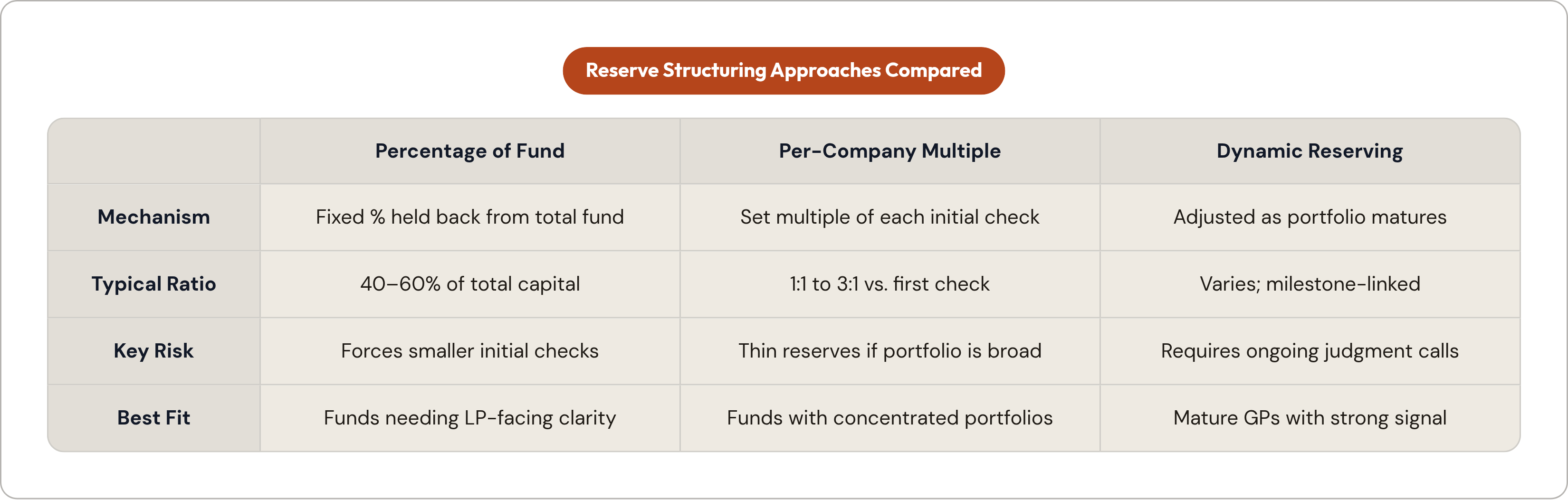
Most funds reserve somewhere between 40% and 60% of total capital for follow-ons, and that range has been standard long enough to show up as a default in LP agreement templates. It's showed up in LP agreement templates so often that institutional LPs now routinely ask about the reserve ratio when evaluating a fund commitment. So this isn't some private spreadsheet exercise. It's a fundraising position, stated out loud, that LPs will hold a GP to.
There are two dominant ways funds structure this.
The first is "percentage of the fund." Pick your reserve percentage, then work backward: how many companies can you back, and at what check size, with what's left? Here's the catch. A fund that reserves aggressively on a fixed fund size has to write smaller initial checks. Smaller checks make it harder to lead rounds. And if you can't lead, you often can't secure the pro-rata rights you'd need to deploy those reserves in the first place. It's a little bit like saving so much for retirement that you can't afford rent today.
The second approach is per-company: set aside a fixed multiple of the initial check, rather than a fund-wide percentage. Ratios typically run 1:1 up to 2:1 or 3:1. According to Sapphire Partners' data on the fund managers in their portfolio, most cluster right around 1:1, meaning reserves roughly mirror the initial investment pool dollar for dollar.
A third option, less common but increasingly discussed, is dynamic reserving: adjust the pool as the portfolio matures, concentrating reserves into companies that are clearly outperforming and releasing capital from the laggards back into new deals. Some funds go further and tie follow-on capital to specific milestones agreed on up front, which takes the guesswork out of the moment of decision.
Worth noting: reserve capital doesn't sit untouched for years. Funds from vintages before 2022 typically deployed somewhere between 47% and 60% of total capital in just the first two years. Reserves get tested fast.
How GPs model reserves before they are needed
A reserve ratio is just a number on a spreadsheet unless a GP has actually modeled the portfolio's likely future financing rounds, their timing, their size, and the odds the company even reaches them.
USV is a good example of what mature modeling looks like. The firm maps out anticipated future rounds for every portfolio company as far forward as the evidence supports, assigning a timing estimate, a size estimate, and a probability to each one. Fred Wilson of USV has talked about making five, six, even seven separate investments into a single company from the first check through the last. That's not spray-and-pray. That's a firm treating each follow-on as its own underwriting decision.
The other piece smart GPs add is follow-on MOIC modeling: calculating the expected return on the follow-on capital alone, separate from the blended return of the whole position. It sounds obvious, but a lot of managers skip it, and it's exactly the discipline that matters once reserves are finite and every dollar is a trade-off.
Skip that discipline and you fall into what's sometimes called the micro-VC reserve trap. Spread your initial capital across too many companies, and your reserve pool ends up too thin to matter for any single one. A tiny slice of follow-on capital spread across a huge portfolio doesn't move the needle anywhere. The most common mistake among emerging managers is under-reserving early, burning through what little they set aside, and running out of dry powder before their next fund closes, right as their best companies need more capital and get diluted instead.
The fix is often counterintuitive: write bigger initial checks rather than promising a shallow reserve you can't back up later. And over-reserving is its own trap in reverse. Capital sitting in a reserve pool waiting for a follow-on that never happens is capital that could've backed a new company entirely. The opportunity cost cuts both ways.
The empirical case that automatic follow-on reduces fund returns
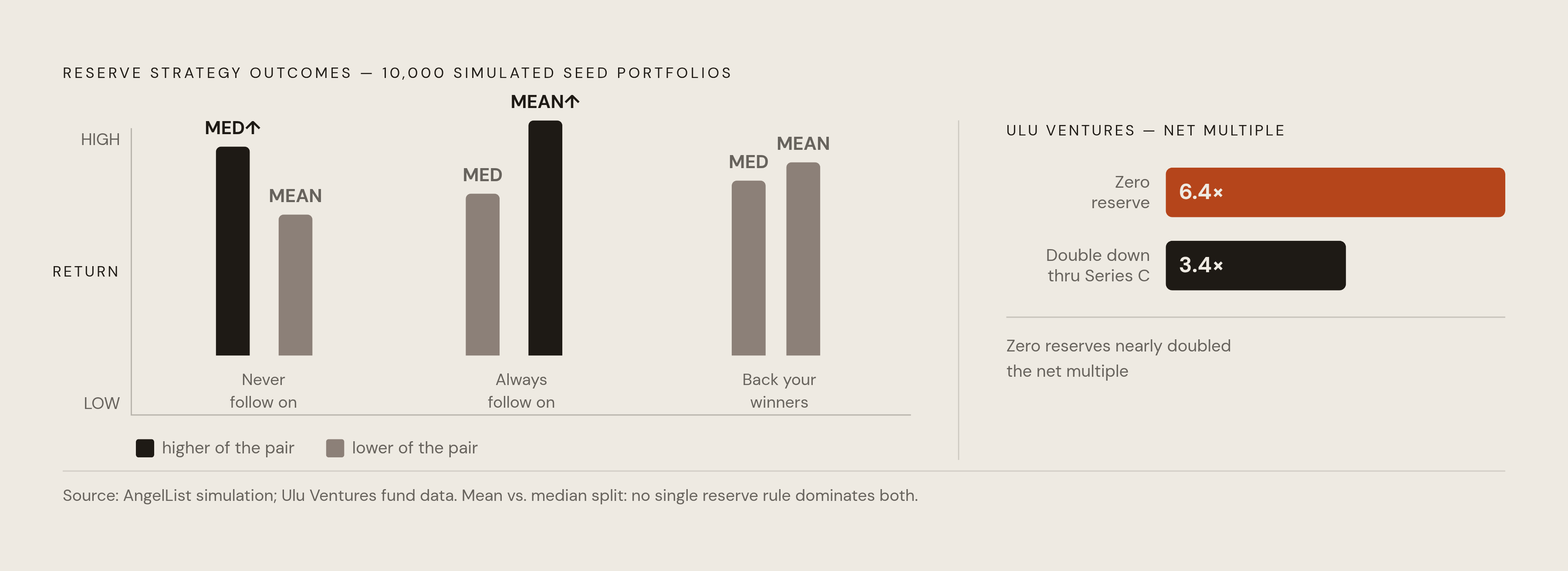
Here's where the conventional wisdom gets a gut check. Abraham Othman, AngelList's head of data science, ran a simulation of 10,000 seed-stage portfolios comparing three strategies: never follow on, always follow on pro-rata at Series A, and selectively double down only on companies that had doubled in value.
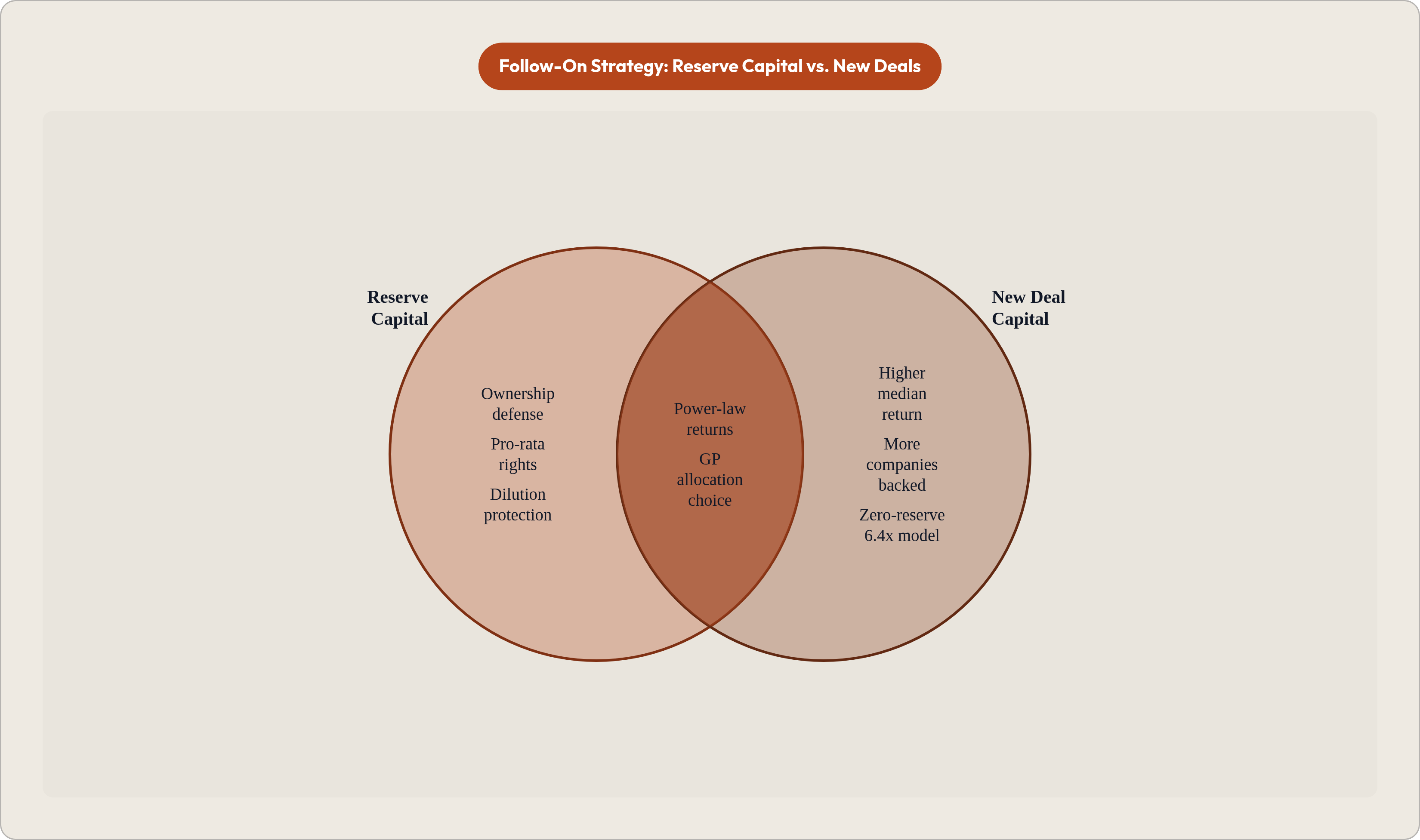
The result cuts against what most GPs assume. "Always follow on" produced the higher mean return. "Never follow on," deploying that same capital into new seed bets instead, produced the higher median return. And the "back your winners" strategy, the one that sounds the most disciplined, didn't clearly beat either extreme.
Translation: at the seed stage, a huge amount of outcome is just randomness. Absent a reliable way to spot the eventual outlier ahead of time, spreading capital into more new bets tends to match or beat concentrating it into follow-ons. AngelList's data pointed toward deploying capital into new seed bets as the higher median-return play, though this finding is specific to seed. It doesn't hold the same way at later stages.
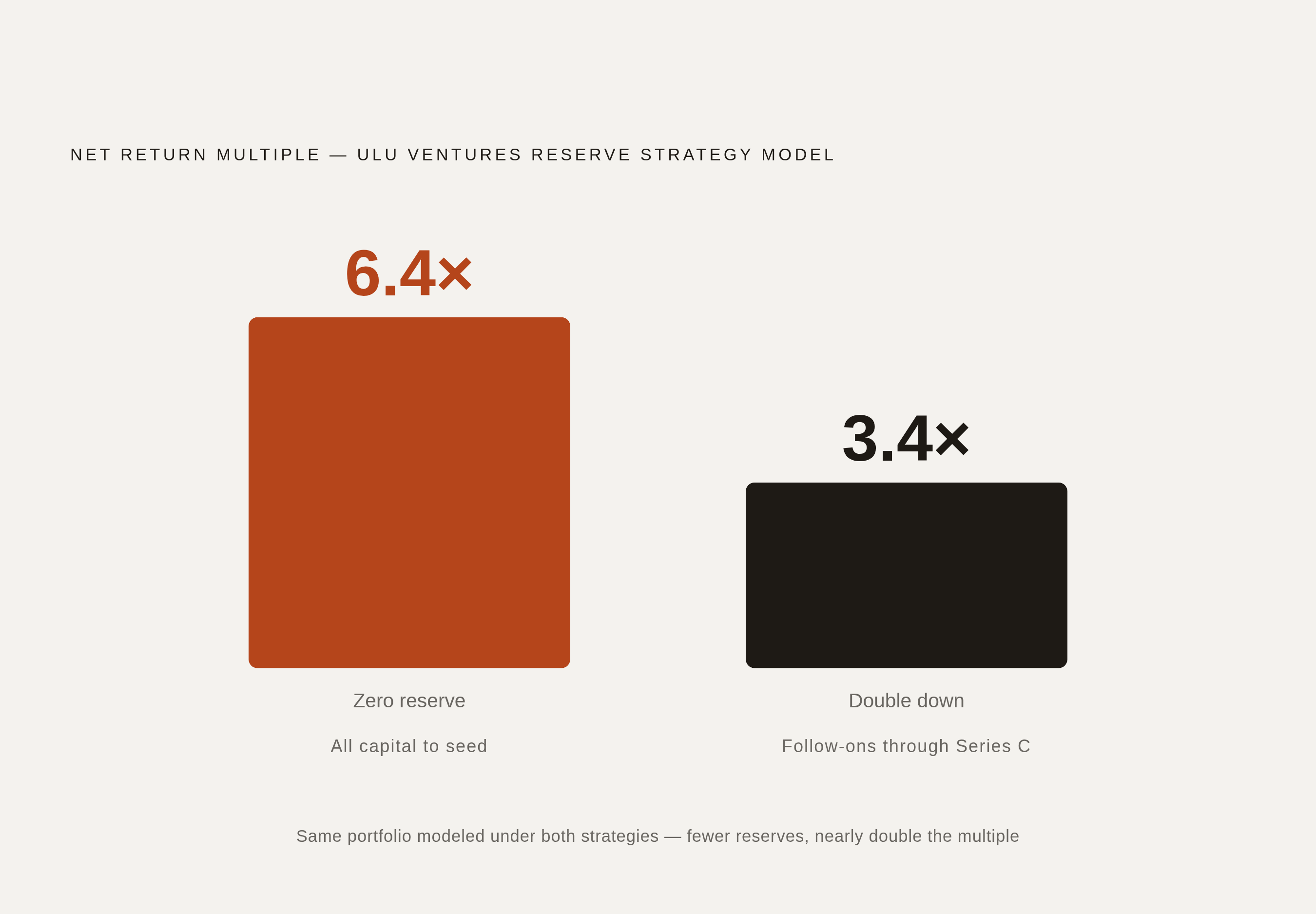
Ulu Ventures put a number on the magnitude. Ulu Ventures modeled this directly: a zero-reserve strategy, putting all capital into seed rounds and nothing else, produced a 6.4x net multiple on the same portfolio that returned only 3.4x under a strategy of doubling down on winners through Series C. The mechanism is straightforward once you see it: your seed check bought equity cheap. Every dollar of follow-on capital buys equity at a much higher price, and that expensive equity drags down your blended return, even in a company that's doing well.
Sapphire Partners' data adds a sharper edge to this. Among their 5x-plus funds, the top company per fund was held at an average of roughly 90x multiple on cost. The second-best was around 25x. Everything else averaged out to roughly 1x. If reserve capital lands in that 1x bucket instead of the 90x outlier, it's not protecting the fund. It's actively dragging the multiple down.
So reserves can boost returns. They can also tank them. The entire outcome rides on allocation accuracy, and most funds can't reliably prove they have that accuracy in advance.
Why the pro-rata mechanism still drives follow-on behavior despite the empirical caution
Given all that data, you'd think GPs would back off pro-rata rights. They haven't, and there's a good reason why.
Pro-rata rights show up in the large majority of VC deals. They give a GP the right, not the obligation, to keep buying in future rounds at their existing ownership percentage. Without exercising that right, dilution eats an early position alive; a meaningful stake at seed can shrink to something barely worth mentioning by Series C if the investor sits out every round in between.
Venture returns follow a power law: a small fraction of investments — roughly 6% — drives around 60% of total dollar returns across the industry. If a GP can correctly spot which companies belong in that 6%, and defends ownership there through follow-on capital, that capital is unambiguously good for the fund. The math is simple. A seed investor who keeps deploying through Series A and B to hold an 8% stake ends up with a dramatically different dollar outcome at exit than one who only ever wrote the first check. That gap in raw dollars, not just the multiple, is the argument GPs bring to their LPs.
There's also a squeeze-out problem that makes reserves feel urgent even when the math says otherwise. In competitive rounds, the new lead investor gets served first. Whatever allocation is left goes to new investors before existing ones get to exercise pro-rata. A GP without reserves set aside isn't just choosing to pass; they may find they can't participate at all, even if they desperately want to. That's why GPs fight hard for pro-rata rights at the term sheet stage. Without that right locked in up front, no amount of reserve capital fixes the problem later.
And the research itself supports treating stages differently. The case against automatic follow-on is strongest at seed, where signal is weakest and outcomes are closest to random. By Series A and beyond, the signal on which companies are working gets a lot clearer, round sizes get bigger, and the dilution stakes go up. Selective follow-on gets more defensible, and more often accretive, the later the stage.
The decision framework GPs use to select which companies earn follow-on capital
The research points to a simple reframe: treat every follow-on decision like a brand-new investment decision. Not an obligation owed to an existing relationship. A fresh underwrite.
That means asking a specific set of questions before writing the check:
Is the company still performing against the thesis that justified the first check, or has that thesis quietly shifted underneath you? What's the expected return on this follow-on dollar specifically, not the blended return across the whole position? Is this a defensive move, protecting against dilution in a company you expect to reach liquidity anyway, or is this a conviction bet on your actual outlier candidate? And is the round being led by a credible new investor doing real diligence, giving you an outside signal, or is the fund just being asked to bridge the company with no external validation at all?
The AngelList research is a useful check on gut instinct here. The "double down when it's doubled in value" heuristic sounds smart, but it doesn't clearly outperform simpler rules, mostly because paper markups at the seed stage aren't reliable predictors of where a company ends up. A company can look great on paper and still land in the 1x bucket.
USV's willingness to make five, six, seven investments into one company reflects a commitment to treating each follow-on as a distinct decision, not a blanket policy. That's the whole point: selectivity means concentration, and concentration means your selection mistakes matter more, not less. A fund that follows on selectively is putting a bigger share of its reserve pool behind fewer bets, so getting the picks wrong is costlier than in a broad, shallow strategy.
Milestone-based follow-on is one way to take some of the guesswork out. Tie the next check to metrics agreed on when the first check was written, before any relationship pressure or founder charm can cloud the decision. It's not a perfect fix, but it does insulate the GP from making the call in the room, under pressure, with a founder they like sitting across the table.
What reserve strategy signals to founders about their investor's position
Here's the part founders usually don't think about until it's too late: from the moment the term sheet is signed, how much capital access you'll have later is partly determined by a number you'll probably never see, which is how much your investor set aside for you specifically.
A quick, unsolicited follow-on offer is one of the strongest signals a founder can get. It means the investor looked at current information, re-ran the numbers, and decided the company still earns more exposure. That's not automatic. Not every portfolio company gets that judgment call in their favor, and the ones that do are getting a real vote of confidence.
A pass on follow-on is murkier, and founders often read it the wrong way. It can mean the investor genuinely thinks the company's valuation no longer clears their return hurdle. But it can just as easily mean the fund is out of reserves entirely, which is a fund management problem that has nothing to do with the company. Or it can mean the investor never secured strong pro-rata rights to begin with, or got squeezed out by the new lead's allocation, meaning they wanted in and simply couldn't. A pass isn't one message. It's at least three different messages wearing the same outfit.
So ask directly. "Do you have reserves allocated to us, and do you plan to exercise your pro-rata?" That answer is almost always available, and it's almost always material to how you plan your next raise.
At the term sheet stage, it's worth asking a few more things too: what percentage of the fund is reserved for follow-ons, where the fund is in its deployment cycle (early innings or running low), and whether the GP has already closed, or started raising, their next fund. A GP deep into an aging fund with no successor vehicle yet raised is playing under very different constraints than one who just closed a fresh fund. Same investor, same reputation, completely different capacity to show up for you later.
And the power-law data cuts both ways here too. If the top company in a fund can sit at 90x while the fund average is closer to 1x, that means a small handful of portfolio companies are getting the overwhelming share of a GP's time, attention, and reserve dollars. Whether your company is in that handful, or isn't, says something real and structural about where you stand with your lead investor. It's not personal. It's just the math of how reserves get spent.
Methodology & sources
- https://carta.com/learn/private-funds/management/portfolio-management/follow-on-investment/
Provided the data point that funds from pre-2022 vintages deployed between 47% and 60% of total capital in the first two years.
- https://www.goingvc.com/post/follow-on-in-venture-capital
Supplied the foundational framing of reserve ratio as a core fund construction decision.
- https://vc-letters.com/posts/venture-capital-portfolio-construction-strategies
Informed the discussion of how reserve strategy is baked into the fund model from the start.
- https://www.kauffmanfellows.org/journal/strategies-for-optimal-follow-on-investments
Informed the definition and purpose of follow-on investment as reserves deployed after the initial check.
- https://thefundcfo.substack.com/p/361-rethinking-vc-reserves
Supported the framing of reserves as a self-imposed GP constraint set before the fund is fully invested.
- https://semilshah.com/2020/03/15/semi-lazy-sunday-afternoon-musings-on-reserves-management/
Provided the concept of reserves functioning as survival capital to bridge companies to their next institutional round.
- https://assets-global.website-files.com/5f34db2422dcee712f853aa0/610ca479fad63a27d85601bc_should%20seed%20investors%20follow%20on.pdf
Provided the AngelList simulation of 10,000 seed-stage portfolios comparing never, always, and selective follow-on strategies and their return outcomes.