AI Tools for Venture Capital Deal Sourcing
Most VCs now use AI to screen thousands of deals annually.

Venture capital is less comfortable than it looks right now. The number of unique active investors has dropped by roughly half since the 2021 peak. New fund creation fell to just 538 funds in 2024, the lowest in over a decade. Meanwhile, something like $600 billion in dry powder is sitting with top-tier firms, all chasing the same narrow band of high-performing founders.
AI companies (the asset class everyone wants most) accounted for 61% of global VC investment in 2025, more than doubling their share since 2022. So the thing VCs most want to source is also the most crowded market in the industry. That's not irony. That's just the business right now.
Here's what it means practically. A fund managing hundreds of millions in AUM receives thousands of inbound inquiries a year and closes fewer than a dozen deals. Most funds screening hundreds of companies annually convert fewer than 3% to serious due diligence. Andre Retterath at Earlybird Ventures has noted that historically around 70% of deals were inbound. As competition rises, firms are being pushed toward proactive, data-driven outreach. Waiting for deals to arrive stopped being a strategy a while ago.
Human bandwidth cannot absorb that kind of funnel without help. The question is no longer whether to use AI tools for sourcing. It's which categories of tool solve which part of the problem, and in what order.
Most Firms Use AI But Draw One Hard Line
The adoption numbers are not subtle. About 85% of nearly 300 private capital dealmakers surveyed by Affinity now use AI to automate daily tasks, up from 76% the prior year. Roughly 82% specifically use it for deal sourcing research.
Retterath's Data-Driven VC Landscape report counted 345 data-driven VC firms in 2026, up from 235 the year before. That's a meaningful jump in a short window. And 57% of those firms are now ramping up internal tooling, compared to 37% the prior year. By function, investment sourcing and due diligence leads adoption across the industry. Engineering is close behind. Legal and compliance sits far back.
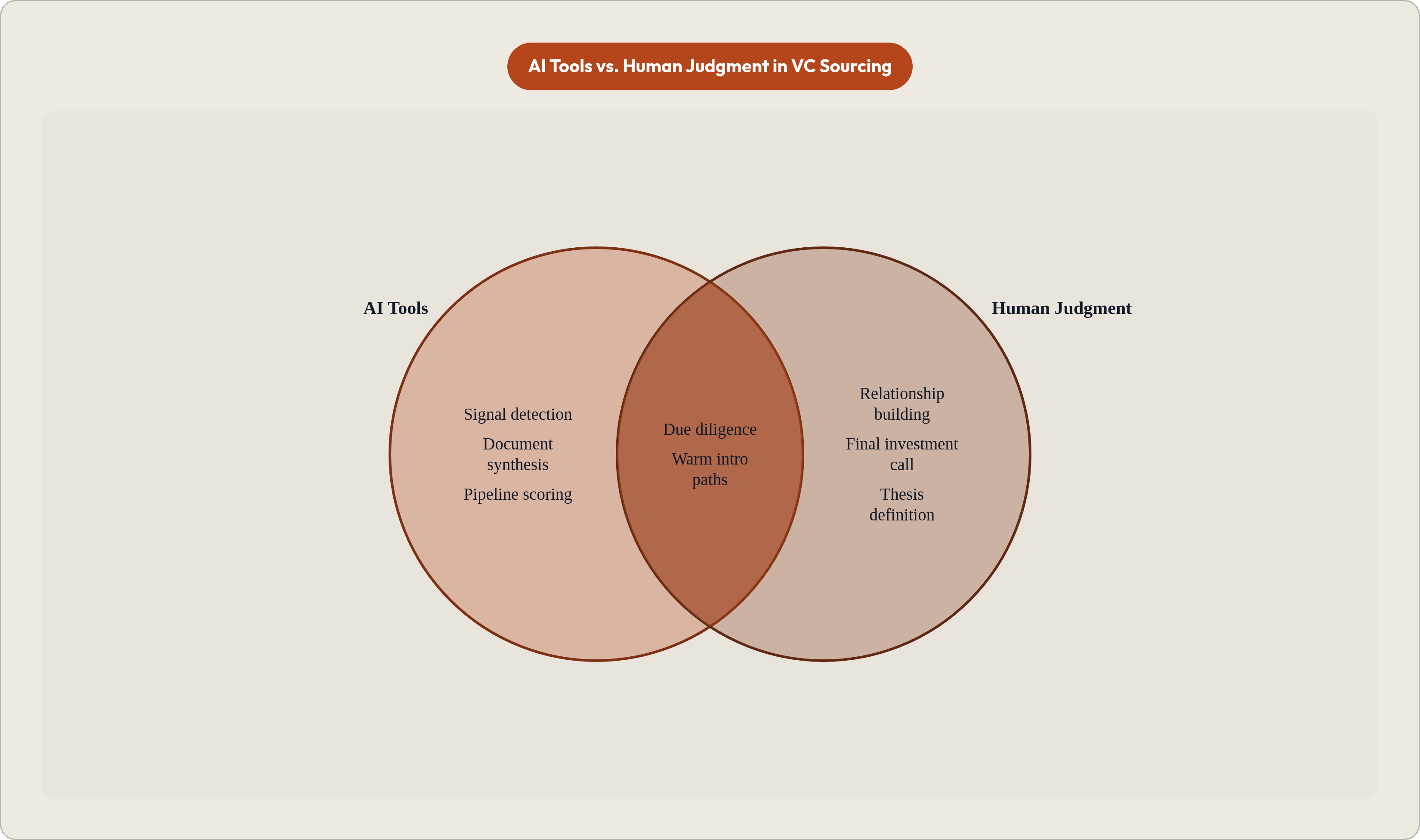
The clear holdout is the investment decision itself. Only a small minority of dealmakers report relying on AI for final investment decisions. Jennifer Ard, COO at Intel Capital, put it plainly: "We will never have AI make investment decisions because so much of it is about relationships."
That's a deliberate line, not a gap waiting to be closed. These tools are being used to compress the funnel and multiply research capacity, not to replace the judgment that leads to a signed term sheet. AI sweeps the ocean like a trawling net, pulling up everything worth a second look. A human still decides what's worth keeping.
What AI Sourcing Tools Actually Do
The core pipeline behind most AI sourcing tools follows the same basic arc: crawl, extract, score, surface. Automated systems ingest SEC filings, job postings, patent activity, domain registrations, product telemetry, and social signals continuously at a scale no analyst team can match manually. Entity recognition then maps companies, founders, and investors into a structured graph, essentially a living database of who is connected to whom and what they're doing. Models rank opportunities against a fund's thesis, portfolio, and historical outcomes, generating a "fit" signal. Then the system flags opportunities and warm paths to a human, rather than making the human search for them.
The edge in this architecture comes from what the industry calls alternative data. Key executive hires, founder departures from established companies, domain registrations: these signals can surface a company months before it appears in any curated database. In VC, being early is everything.
The speed gains are real. Screening time per company has dropped from roughly 45 minutes to as little as 8 minutes in documented cases. Bessemer Venture Partners reclaimed hundreds of analyst hours after integrating AI into their workflow. That kind of efficiency gain is what moves AI from something people experiment with to infrastructure people depend on.
What none of these tools do is tell you whether to write a check. They're pattern-matchers and signal-aggregators that compress the top of the funnel.
Signal Detection and Company Discovery Platforms
The job of this category is to find companies that fit a fund's thesis before competitors see them. The signals being picked up don't yet show up in the curated databases everyone else is scanning.
Harmonic is the clearest purpose-built example. It detects early signals: key executive hires, domain registrations, founder departures from large companies, and funding precursors. It reached a valuation north of a billion dollars in 2025, which reflects genuine market conviction that early-signal sourcing is a category worth paying for. It is best suited to early-stage investors who need a sourcing edge before a deal shows up on everyone else's radar. It is not built to manage a known pipeline or track relationship history.
EQT Ventures' Motherbrain is the most cited example of building this capability internally. EQT constructed a proprietary sourcing engine that ingests millions of data points across funding, hiring, product, and web signals. It illustrates a real question: build or buy? Large platforms with differentiated thesis and data access have a genuine reason to own this layer. Most funds don't have that scale or that reason, and knowing which camp you're in saves a lot of wasted engineering time.
What this category doesn't handle well is anything that happens after the discovery moment. Managing pipeline, tracking relationship history, synthesizing narrative from documents: those are jobs for different layers of the stack.
Private Company Databases for Mid-Market Sourcing
This category lets investors search, filter, and score a large index of private companies by industry, revenue, geography, or custom signals. It is particularly useful in markets where targets aren't well-covered by public data.
Grata was acquired in 2025 by Datasite, which is primarily known for virtual data room infrastructure. That acquisition signals something worth paying attention to: sourcing tooling and transaction infrastructure are converging. Grata specializes in mid-market private companies, expanded its sub-industry classifications in 2025, and deepened its Salesforce integration. It also offers a tiered API plan for enterprise teams building programmatic sourcing workflows. Enterprise contracts start in the range of tens of thousands of dollars annually and scale with team size.
SourceScrub skews toward M&A and growth equity teams as much as traditional VC. It added AI-powered target scoring in 2024 to rank companies by acquisition-fit signals and expanded European private company coverage substantially. It is worth considering if your workflow spans both VC and M&A.
Before committing to either platform, ask one question first: how deep is their index in your actual target markets? These tools are only as useful as their coverage of the geographies and sub-sectors you care about. Ask vendors for specific company examples from your target markets and test the results yourself before entering pricing conversations.
Relationship Intelligence and VC-Native CRM Platforms
A generic sales CRM is not built for how VC actually works. Sales CRMs are designed around transactional pipelines with short cycles, defined stages, and relatively clean handoffs. VC deal development is long, relationship-driven, and multi-touch across months or years. The mismatch creates predictable problems: manual data entry gets skipped, relationship history gets lost, and the CRM becomes a graveyard of stale records nobody trusts.
Affinity serves thousands of private capital firms and is built around automated activity capture. The core idea is that the CRM updates itself from calendar invites, emails, and other activity, rather than requiring analysts to log everything manually. It surfaces thesis-matched companies using firmographic data enriched from more than 40 third-party sources including Crunchbase, PitchBook, and Dealroom. A partnership with Dealroom layers predictive growth-trajectory intelligence onto Affinity's relationship graph. MassMutual Ventures surfaced tens of thousands of contacts and organizations within 60 days and now triages opportunities up to 5× faster. TELUS Global Ventures saw substantial improvement in data completeness and saved meaningful hours per person per week.
4Degrees was built specifically for investment workflows by Ablorde Ashigbi and David Vandeghen, not adapted from sales software. Relationship-strength scoring and warm-intro mapping are core features, not bolt-ons.
Newer entrants are expanding the category further. Meridian positions as AI-native, combining CRM, deal intelligence, Scout AI agents, and a proprietary database of tens of millions of company records in a single system. Carta CRM, launched in early 2026 via the ListAlpha acquisition, connects front-office deal management with back-office fund administration, which is relevant if your fund is already running cap table operations on Carta's infrastructure.
One thing that cuts across all of these: the stickiest platform is the one your team actually keeps current. Automated capture and low-friction enrichment beat feature breadth every time. A CRM nobody logs into is just a subscription fee and a dashboard nobody opens.
General-Purpose AI Assistants Accelerate Research
This is the layer that doesn't require a dedicated VC platform at all. Document synthesis, market mapping, founder background research, memo drafting, and thesis stress-testing are all areas where general-purpose AI adds real value without needing purpose-built tooling underneath it.
The adoption data from the DDVC Landscape 2026 is worth noting. Claude leads among data-driven VCs at 90.5% usage, ahead of ChatGPT at 73.3% and Gemini at 56.2%.
Why Claude leads in this context isn't hard to understand when you look at what investment research actually requires. Long context windows let analysts process entire pitch decks, financial models, and partnership agreements in a single session. For this kind of work, depth of document comprehension matters more than breadth of general knowledge.
Common uses across VC teams include rapid competitive landscape mapping from a thesis prompt, synthesizing founder background across multiple sources before a first call, drafting initial investment memos from notes and data for analyst review, and interrogating financial models for assumption inconsistencies.
The important caveat: these tools hallucinate on specific facts. Company financials, recent funding rounds, and founder histories all need to be verified against primary sources or purpose-built databases. LLM output is a starting point, not a primary source. General-purpose AI works best as a research accelerator layered on top of structured sourcing data, not as a replacement for platforms with verified, curated company information.
API Integrations Connect Tools Into a Working Stack
Here's the practical problem that doesn't get talked about enough. A firm running a signal-detection tool, a private company database, a relationship CRM, and an AI assistant now has four sources of company and contact data that need to stay synchronized.
Without integration, things break fast. Duplicate pipeline entries accumulate across sourcing platform and CRM. Relationship intelligence stops reflecting recent outreach that was logged somewhere else. Scoring models degrade when the enrichment data underneath them isn't being refreshed. Analyst time gets eaten by manually exporting and re-importing records between platforms.
The API maintenance burden is real and it compounds. Third-party APIs change endpoints, deprecate fields, and update authentication schemes. Each of those changes can silently break a sourcing workflow if no one is actively maintaining the connector. The first sign is usually that data stops flowing, and the second sign is that someone notices the CRM is three weeks stale at a moment when it actually matters.
Grata's tiered API plan and Affinity's 40-plus enrichment source integrations both reflect something the leading platforms understand: connectivity isn't a feature, it's the whole point, because a stack only delivers its full value when the pieces are actually talking to each other.
For internal engineering teams building custom sourcing tools on top of these APIs, the build-vs-buy question on integration infrastructure comes up constantly. Maintaining multiple live API connections compounds as the stack grows. Firms with engineering capacity face a recurring decision about whether to own that layer or hand it to a managed solution. The ongoing operational burden of keeping connectors current is a real cost that almost never shows up in initial build estimates. It shows up later, in the form of someone's time.
Choosing the Right Tools for Your Fund
No single platform covers the full sourcing funnel. A working stack typically needs at least a signal and discovery layer, a relationship and CRM layer, and a research assistant. Which specific tools belong in each layer depends on your fund's stage, geography, and thesis.
Stage shapes which layer matters most. Pre-seed and seed investors get the most leverage from early-signal detection tools in the Harmonic category. Pipeline management volume is lower at this stage, so the CRM layer is less urgent. Series A and growth investors benefit more from private company database depth and relationship intelligence, where deal competition is more intense, warm paths matter more, and the CRM becomes infrastructure rather than a nice-to-have. Multi-stage or crossover firms tend to find that full-stack integration becomes the primary bottleneck, not any individual tool's feature set.
Geography and market coverage require verification before you commit. European and emerging market coverage varies substantially across platforms. Ask vendors for specific examples of companies indexed in your target geographies and test the results before signing anything.
Team size and data discipline are honest inputs. Relationship intelligence platforms only work if the team uses them consistently. Automated capture reduces that burden significantly. If your team has historically struggled to maintain a CRM, choose a platform with strong automated capture and minimal manual entry requirements, because feature breadth doesn't matter if adoption is low.
Build capacity determines optionality. Firms with internal engineering can build custom layers on top of APIs and maintain more control over how sourcing data flows through their systems. Firms without that capacity should lean toward platforms that handle integration natively and prioritize managed solutions for anything requiring ongoing connector maintenance.
The real evaluation question isn't which tool has the best feature list. It's which combination of tools matches how your team actually works, in the markets you actually source from, at the stage you actually invest.


