Conflicts of Interest in Venture Capital Firms
Management fees and valuation control pit venture partners against their investors.

- Written by
- Kwame Mbeki
- Updated
- October 23, 2026
- Reading time
- 9 min read
- Sources cited
- 3 sources ↓
What this covers
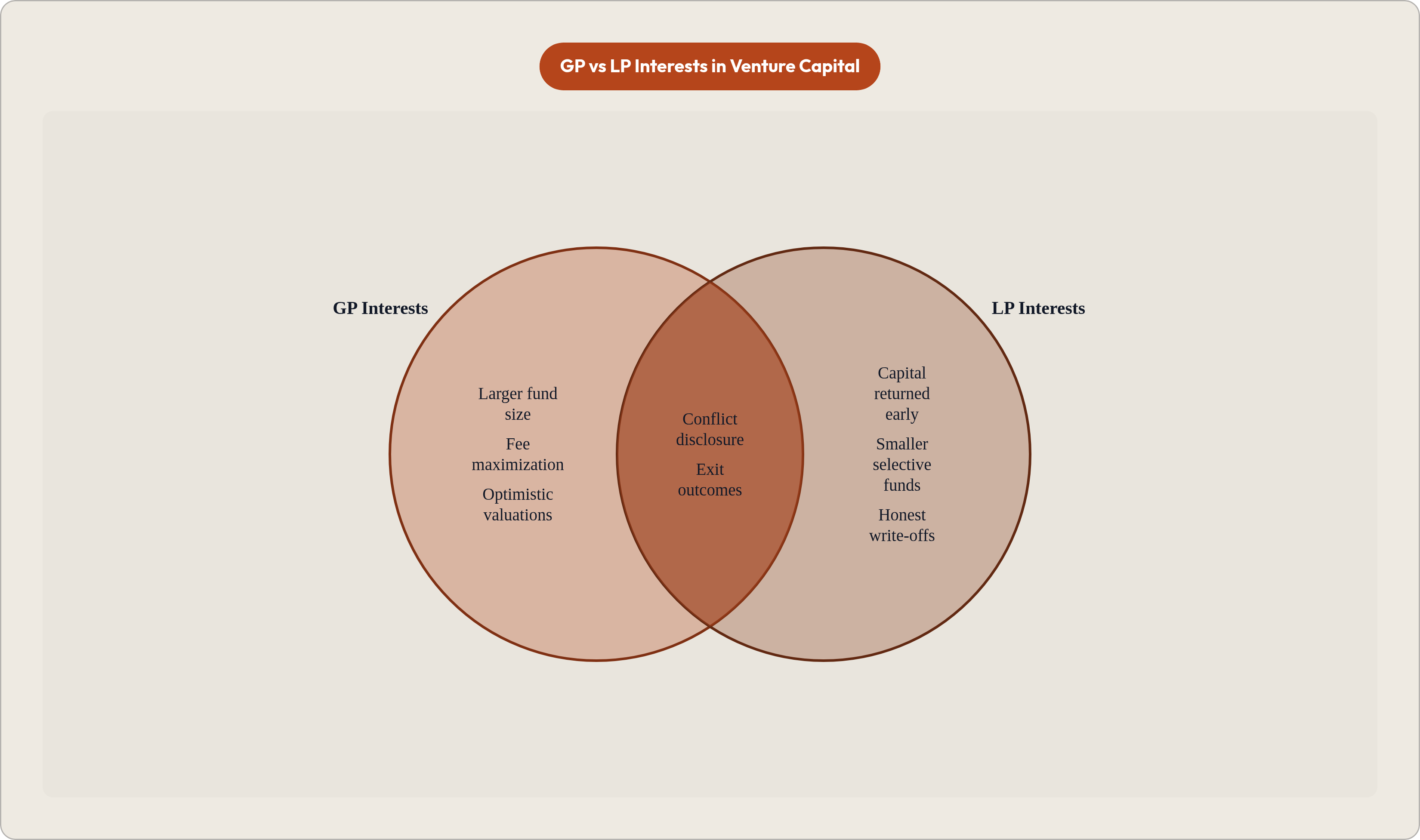
Venture capital is structured so that the people managing investor money and the people who provided it almost never want the same thing at the same time. LPs contribute more than 98% of a fund's capital while retaining zero authority over how it gets deployed, because in most states an LP who actively participates in fund management loses limited-liability protection. General partners (GPs) control every investment decision. They also hold an information advantage over LPs on deal terms, portfolio valuations, and company performance. This creates a structural asymmetry from the moment the fund closes. That asymmetry compounds across the fund's lifecycle through five distinct areas: compensation mechanics, valuation discretion, multi-fund management, board representation, and exit timing. Each produces a different type of conflict between what's good for the GP and what's good for the LPs who funded them.
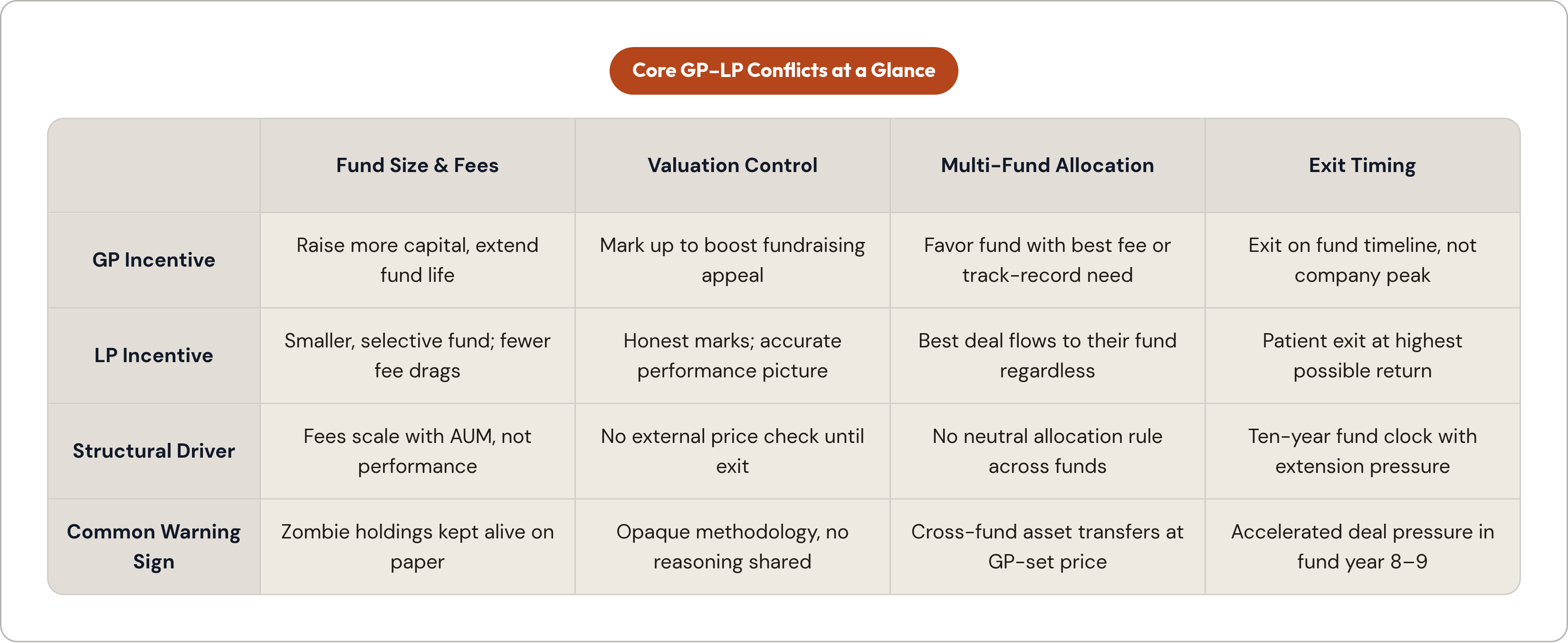
How GP compensation diverges from LP returns
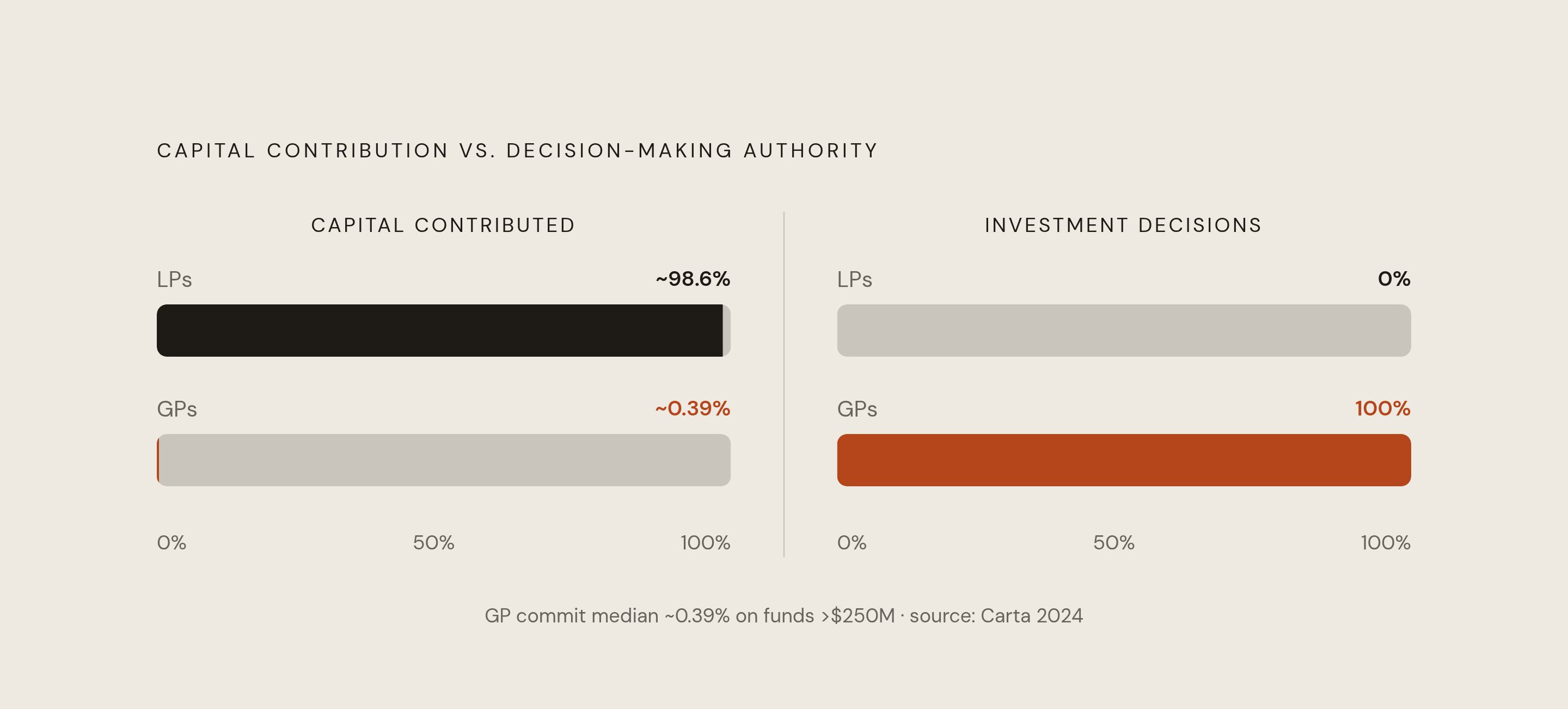
Management fees scale with fund size, so a GP has a direct financial incentive to raise as much capital as possible. LPs generally benefit from a smaller, more selective fund that deploys capital carefully rather than parking it to generate fees. The median GP commit on larger funds sits around 0.39% according to Carta's data, meaning the GP has very little personal capital at risk relative to the LPs whose money funds the portfolio.
A typical fund runs about ten years with annual extension options, and every extension generates additional management fees for the GP. LPs who want their capital returned do not share that interest in prolonging the fund's life. When management fees fall short of a firm's overhead, some GPs bill additional charges directly to portfolio companies. These can include negotiation fees, monitoring fees, and asset management fees. All of these ultimately reduce your fund returns.
Distressed portfolio companies create a related problem. As long as a failing company remains technically active, its equity continues to support the fund's TVPI (total value to paid-in capital, a measure of overall fund performance) on paper. Writing off that position would give LPs an accurate picture of performance but would also damage the fund's reported numbers at exactly the moment the GP is raising a successor fund, so the incentive to delay write-downs is real and persistent.
Valuations GPs set and LPs can't check
The GP sets the value of every private company in the portfolio, and LPs receive the resulting figures with little visibility into how those figures were calculated. That arrangement produces two direct incentives toward optimistic marks. Higher valuations improve the fund's reported performance and support the next fundraise. In some fee arrangements, portfolio marks also feed into how fees are calculated. Private companies are genuinely difficult to price, and reasonable people can disagree about a Series B valuation, but the structure gives GPs no institutional counterweight that pushes toward conservatism.
The choice of valuation methodology, not just the final number, is where significant discretion lives. No market price exists to verify the GP's figures until an exit event occurs, which may be years away. During the life of a fund, the performance numbers LPs receive reflect judgments the GP has made about itself, with no external referee until a transaction finally produces a real price. Rigorous due diligence requires asking how a GP arrived at its valuations and treating the reported figures with appropriate skepticism rather than accepting them as objective measurements.
Allocation problems across multiple simultaneous funds
Most established VC firms manage more than one fund at a time, often an early-stage vehicle, a growth fund, and a sector-specific fund, raising and investing across overlapping time windows. When a strong investment opportunity appears, the GP decides which fund receives it, and that decision is rarely neutral. A GP might direct a promising deal toward a fund approaching the end of its life to improve that fund's DPI before wind-down, or toward a newer fund to build a track record ahead of the next raise, either of which can disadvantage the LPs in whichever fund was passed over.
The conflict intensifies when two funds from the same firm hold different positions in the same company, one with equity and one with debt. When the company performs well, those positions coexist without friction. When the company encounters financial distress, equity holders and debt holders have structurally opposed interests, and the GP is obligated to both simultaneously.
When a fund cannot exit a position before its wind-down, a GP may transfer that holding into a newer fund from the same firm. In that transaction, the GP is effectively negotiating with itself, acting as seller for one fund and buyer for the other. The LP in the selling fund has no market price to validate the transfer, and the LP in the buying fund has no independent representative negotiating on their behalf.
Rescue financing and co-investment create hidden tiers
When a portfolio company runs short on capital, a GP sometimes uses a second affiliated fund to provide bridge financing. Whether that rescue serves the second fund's investment interests or primarily protects a bad bet made by the first fund is often impossible for LPs to assess from the outside. Even a well-intentioned rescue financing round carries the structural appearance of a cross-subsidy between funds, which creates real problems with LP trust over time.
Co-investment rights introduce a parallel issue. GPs, selected LPs, and firm employees are sometimes offered the opportunity to invest directly in specific deals outside the fund's fee structure. A GP with discretion over which deals get offered for co-investment can systematically route the strongest opportunities to favored insiders while the pooled fund receives the remainder. ILPA (the Institutional Limited Partners Association), the trade group representing limited partners, specifically warns against allowing GPs to selectively offer co-investment deal by deal, and recommends that GP equity participation remain consistent across the fund rather than shifting based on individual relationships.
Capital call defaults create an additional conflict at the LP level. When an LP fails to meet a capital call, the GP decides how to handle the shortfall. If that LP has an important ongoing relationship with the GP, there is real pressure to apply the default provisions leniently, and the other LPs in the fund absorb the cost of that leniency.
Board seats sharpen every fiduciary tension
VCs hold board seats in roughly 43.9% of their investments, with lead investors serving on boards approximately 61.5% of the time and non-leads closer to 35%. Board directors owe a duty of care to the company and its shareholders, but a VC director's economic interest runs through preferred stock with liquidation preferences that common shareholders, including founders and employees, do not hold. That gap is largely invisible during normal operations and becomes the central issue the moment the company enters a sale process, because a price that fully returns the preferred stack may leave common holders with minimal proceeds.
Delaware courts apply a sliding standard to these situations. When no conflict exists, the business judgment rule applies, meaning courts defer to director decisions without second-guessing them. When potential conflict exists, courts apply enhanced scrutiny. When a significant conflict is established, the standard is entire fairness, requiring the GP to prove both fair process and fair price, the most demanding test available. The Trados case is the widely cited example of how this framework operates in practice on VC-backed boards. Research on VC-backed exits has also found that funds approaching the end of their investment period push boards toward earlier sales, sometimes at lower prices, in order to meet the fund's own timeline rather than the company's.
Corporate VCs carry a dual-loyalty structural problem
Corporate VC directors serve on a portfolio company's board as representatives of a corporate parent that may simultaneously be an investor, a prospective acquirer, a competitor, or a customer of that same company. The CVC director's compensation comes from the corporate parent, while their fiduciary duty under Delaware law runs to the portfolio company and its shareholders. Those two obligations conflict structurally and do not resolve themselves through goodwill or informal coordination.
Specific board discussions create recurring complications. These include commercial agreements involving the parent company, financing rounds the parent is joining, and acquisition processes where the parent is a potential buyer or competitor to another buyer. There is also a persistent information boundary problem. Material information disclosed in a board meeting may be directly relevant to the corporate parent's investment or strategic decisions, but transmitting that information across the boundary breaches the director's board duty. The SEC's enforcement action against former TPG associate Vinayak Gowrish, who passed confidential acquisition details to associates for insider trading purposes, illustrates how seriously this information boundary problem can escalate when it is not managed carefully.
Competing portfolio companies split the GP's loyalty
As funds grow larger and more sector-concentrated, the probability increases that two portfolio companies from the same fund are competing for the same customers. A GP in that position has access to strategic plans, pricing decisions, customer relationships, and competitive intelligence from both companies through board participation and regular reporting, information that would be valuable to each company's rival.
Follow-on capital decisions become a particularly clear signal of GP preference when two competing portfolio companies are both performing adequately. The GP's choice about where to direct additional capital reveals which company is actually being prioritized. Unlike most of the conflicts described in this post, portfolio company competition is rarely addressed in fund agreements or side letters. Market practice calls for disclosure when a GP already holds a stake in a competing company at the time of a new investment, but disclosure does not eliminate the underlying conflict. Founders who have concerns about this issue should raise it during term sheet negotiations, before the investment closes, when they retain meaningful leverage to seek commitments or protections.
Exit timing conflicts are structurally unavoidable
A fund's fixed lifespan of approximately ten years, with limited extension options, creates exit pressure that operates independently of whether a portfolio company is actually positioned to maximize value in a sale. GPs managing multiple funds simultaneously sometimes shift attention and resources toward newer funds that still need deal flow and track record development, at the expense of companies held in older funds approaching wind-down. Research on fund dynamics shows this resource reallocation can accelerate exits beyond what company fundamentals would support. One study found that VC-backed acquisitions produce an average 3% acquirer announcement return, a pattern the researchers attribute in part to VCs pressuring management to sell earlier than market conditions warrant once a fund is running out of time.
LPs want timely exits that lock in realized returns. Founders want the ability to choose their moment based on company readiness and market conditions. The GP's calculus incorporates fund age, carry hurdle progress, and competitive positioning for the next fundraise, none of which automatically align with either LP or founder interests when the fund is late in its life.
What disclosure rules cover and what they don't
Under the Investment Advisers Act of 1940, registered advisers, which includes most VC firms above certain asset thresholds, are required to disclose material conflicts of interest to their clients. SEC scrutiny of conflict disclosures in private fund documents has increased consistently since 2015, and the 2023 Private Fund Rules, parts of which were subsequently challenged and struck down in court, attempted to mandate quarterly fee and performance reporting and restrict certain GP-favorable practices. The regulatory trajectory points toward more disclosure requirements even as specific rules remain subject to legal challenge.
Disclosure requirements do not resolve the conflicts they require to be named. A GP that describes a fund-to-fund asset transfer somewhere in the limited partnership agreement has technically satisfied its disclosure obligation, even if the LP has no practical ability to object to the transaction after the fact. The same logic applies to international guidance on private fund conflict management: the standard approach is to identify and disclose conflicts rather than prohibit them outright.
LP advisory committees, side letters, and ILPA's recommended principles provide contractual mechanisms for addressing specific conflicts, but those tools are voluntary and their effectiveness depends entirely on an LP's negotiating leverage. Larger institutional investors such as pension funds and endowments can negotiate meaningful protections that smaller LPs typically cannot. Regulatory disclosure establishes a minimum floor for transparency, not a comprehensive solution to the structural conflicts that produce the incentives described throughout this post. Understanding those underlying structures is what allows an LP or founder to evaluate a disclosure paragraph as meaningful information rather than as standard legal language.
Methodology & sources
- https://www.fenwick.com/insights/publications/navigating-conflicts-of-interest-as-a-corporate-venture-appointed-director
Informed the section on corporate VC directors' dual-loyalty conflicts, including board discussion complications and information boundary problems.
- https://www.researchgate.net/publication/227406467_Venture_Capital_Conflicts_of_Interest_Evidence_from_Acquisitions_of_Venture-Backed_Firms
Provided the 3% average acquirer announcement return figure cited in the exit timing section, attributed to VC pressure to sell earlier than market conditions warrant.
- https://www.iosco.org/library/pubdocs/pdf/IOSCOPD309.pdf
Informed the discussion of international regulatory guidance on private fund conflict management, specifically the identify-and-disclose standard.