Sector Concentration in Venture Capital Portfolios
AI captured nearly two-thirds of global venture dollars in 2025, outpacing every previous tech boom.

Venture capital in 2024 and 2025 turned into a game with fewer players holding bigger stacks of chips, and then AI walked in and took most of the table. This piece breaks down what that concentration actually looks like in the numbers, why it's structurally different from the dot-com and mobile booms that came before it, and what it means for anyone building a portfolio or a company outside the AI blast radius.
What AI's takeover of VC deal value actually looks like in numbers
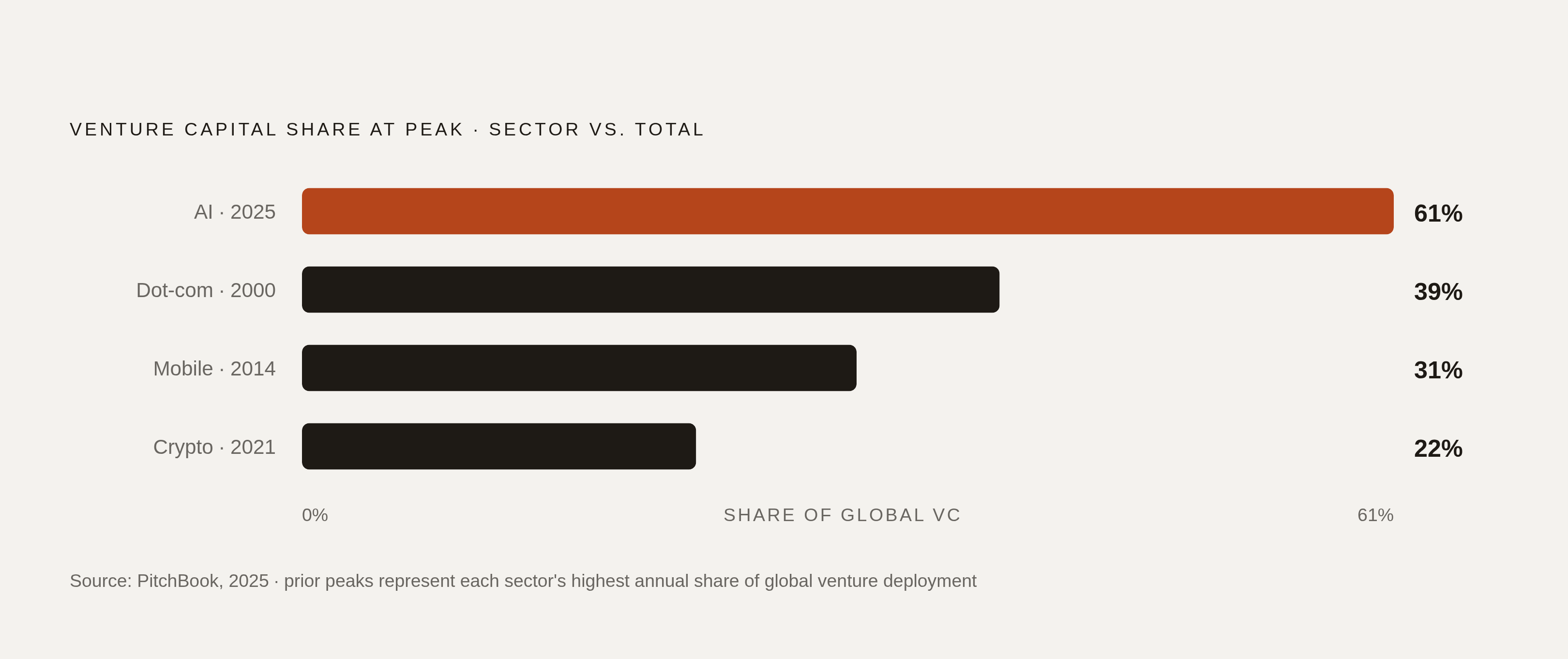
Start with the headline: AI firms pulled in 61% of global VC investment in 2025, or $258.7 billion out of $427.1 billion total, according to OECD analysis. A year earlier that number was 34%. That's a 27-point jump in twelve months, a lurch rather than a gradual trend.
Even sharper is the U.S. number. AI and machine learning took 65.6% of all U.S. venture deal value in 2025, up from 47.2% in 2024, per the PitchBook-NVCA Venture Monitor. Two out of every three dollars deployed by U.S. venture funds went to one label on a pitch deck.
Put that next to history and the gap gets almost comic. Internet startups topped out at 39% of venture dollars during the dot-com boom. Mobile apps peaked at 31%. Crypto's best year, 2021, hit 22%. AI's 53% global share (a slightly different cut of the 2025 data than the 61% figure above, depending on methodology) still blows past every one of those ceilings without breaking a sweat.
Speed is the part that should actually worry people. Mobile took about five years, from 2008 to 2013, to reach a comparable share of venture allocation. AI did it in roughly one year, skipping the slow build entirely.
Concentration inside AI compounds the story. Mega-deals over $100 million made up 73% of total AI investment value in 2025. Fifty-eight percent of that $258.7 billion sat in rounds of several hundred million dollars or more. This is a handful of enormous bets, not seed checks adding up.
Q1 2026 is where the trend goes from steep to vertical. OpenAI raised $122 billion. Anthropic raised $30 billion. xAI raised $20 billion. Three rounds, each one bigger than most sectors raise in a year, combined. Corporate VCs are leaning in too, participating in 68% of overall AI deal value in 2025, adding a second engine on top of traditional fund deployment.
So here's the real question worth sitting with: is this a bubble that looks like every other tech bubble before it, just bigger? Or is something structurally different happening this time? Worth holding that thought before answering it.
Why AI concentration looks different from previous tech sector booms
The easy comparison writes itself. Every big tech wave, dot-com, mobile, crypto, pulled in outsized venture money and every single one eventually cooled off or crashed. That pattern is real, and it's fair to name it before arguing AI is somehow exempt.
A few things about this cycle don't fit the old template, though.
Start with infrastructure. AI firms working on IT infrastructure and hosting pulled in $109.3 billion in 2025 alone, more than two-thirds of what every other industry combined managed to raise ($149.4 billion). Data centers, chips, and compute contracts carry physical and expensive characteristics that dot-com valuations mostly didn't.
Corporate adoption backs this up. CVC participation at 68% of AI deal value means large companies are writing checks, actively, rather than waiting on the sidelines to see who survives.
Geography adds a wrinkle too. U.S.-based firms captured a dominant share of global AI VC deal value. That's a lot of eggs in one regulatory basket. A policy shock or a macro stumble in the U.S. doesn't stay contained to the U.S., it ripples through the entire global AI funding picture.
Consider what happens when 58% of a sector's investment sits in rounds above $500 million: the number of exit outcomes big enough to justify those valuations gets small fast. The power law still holds in venture, one winner can carry a whole fund. But at this scale, even a genuine success story might not return the capital that went in, a different kind of risk than a company simply failing.
None of this makes concentrating into AI irrational. The demand signal underneath it is real, enterprises are buying, compute is getting used, products are shipping. Yet the risk profile at today's valuations and round sizes has little in common with the risk profile of an early-stage AI bet from three years ago. Whether this settles into a structural shift or turns out to be a bubble with better marketing is genuinely unresolved. The honest answer is the evidence points both ways at once.
What is actually happening to capital in non-AI sectors
Somewhere, a generalist GP is rewriting a fund thesis to include the word "AI" three more times than the last draft, because the LP update deck needs it. That's the crowding-out mechanism in a sentence: capital that used to go to broad-based bets is repositioning toward AI to match what LPs want to hear, and valuations in adjacent categories have compressed because the marginal dollar keeps walking past them.
Fintech remains one of the more prominent non-AI sectors in the U.S. market, but it's split down the middle internally. The headline dollar figure masks underlying stress, with deal-level activity telling a more cautious story. Steady headline, shakier foundation.
Climate tech tells a similar story with bigger numbers attached. U.S. investment remained substantial in 2025, sustained largely by a handful of large late-stage deals. Sounds great until you notice a handful of large late-stage deals are carrying that number, and a well-documented Series B gap is pushing earlier-stage climate companies toward corporate VC programs and government loan guarantees instead of traditional venture. Global cleantech held up somewhat better, but the same gap between the headline number and what's actually happening deal by deal shows up there too.
Worth naming directly: a lot of "non-AI" is a labeling trick. Robotics, chips, and data-center infrastructure companies often get sorted outside the AI bucket even though they belong squarely on the AI infrastructure map. So actual non-AI deal flow is smaller than the sector tags suggest, once you account for that.
Defense tech is frequently cited as a notable exception, often framed as AI-adjacent through autonomous systems and intelligence tooling, and drawing interest from investors looking beyond the core AI label.
What does this mean for a founder outside AI? The sector isn't unfundable, but the bar has moved. A lot of verticals now need a credible AI angle to access the same LP capital that used to fund a straightforward vertical play on its own merits.
How portfolio builders actually think about sector concentration as a risk variable
Venture returns are lopsided by design. A single investment often returns more than every other position in the fund combined. Historically, a small minority of VC-backed startups generate most of a fund's returns, and many fail to return the capital put into them. That's the starting math everyone in this business is working from.
So what does that imply about concentration? If returns are this skewed, owning enough of the eventual winner matters more than spreading bets thin across a hundred names. That's the entire case for sector concentration: conviction in one domain supposedly improves the odds of spotting the winner before anyone else does.
Counterpoint. Unicorn odds at seed stage are low enough that a fund needs a real number of shots on goal to have any statistical shot at hitting one. Yet plenty of seed funds hold fewer positions than the math would recommend, often because of signaling concerns (looking selective, looking disciplined) rather than actual probability reasoning. Vanity dressed up as strategy.
Research on this splits down the middle too. Broader portfolios are often argued to do better at catching at least one high-growth winner, the diversification case in a nutshell. But the case for concentration holds that deeper conviction in fewer bets can drive outperformance through the largest holdings. And some research suggests something more interesting than either: more skilled managers may tend to run more concentrated portfolios and post better results. Concentration might be a signal of manager quality as much as a cause of returns. Correlation dressed up as causation, or maybe it's genuinely both.
Fund size changes the equation entirely. A small fund with heavy AI concentration and a multi-billion-dollar multi-stage platform with the identical sector tilt are not taking comparable risks, even if the pie chart looks the same on a slide. Neither concentrated nor diversified strategies win outright. It depends on manager skill, fund size, stage focus, and whether the concentrated sector sits early or late in its valuation cycle.
How sector concentration changes the risk and return math at each stage
Seed-stage concentration and late-stage concentration are not the same animal, even when they share a sector label. At seed, low entry valuations offset some of the risk. Outcomes are binary, zero or big, but the entry price is cheap enough that a fund can spread multiple bets across a thesis. AI concentration at seed in 2021 through 2023 looks completely different in hindsight from AI concentration at late stage in 2025 and 2026.
Late-stage concentration flips the math. When 58% of AI investment flows into rounds above $500 million, the exit multiple needed to return capital gets enormous. A sector doesn't need to crash to wreck returns at these valuations, it just needs to slow down. Growth deceleration alone is enough to break the model.
The mega-round problem shows this in stark relief. Among notable venture rounds in Q1 2026, OpenAI at $122 billion alone set a record, with Anthropic at $30 billion and xAI at $20 billion also closing enormous rounds. That's an extraordinary concentration of capital sitting in just a few deals. LPs sitting in funds that participated at those valuations are carrying a fundamentally different risk than LPs whose capital went in at an earlier, cheaper stage.
Correlation is the quiet killer here. Sector concentration means correlation, and when a shock hits AI, a regulatory crackdown, a compute shortage, a foundational model failing to live up to its billing, every position in a concentrated portfolio moves together. A diversified portfolio absorbs a sector-specific gut punch better, even if it gives up some upside in the good scenario.
The result is a wider outcome distribution: higher ceiling, lower floor. That's a fine trade for some LP profiles and a genuinely bad one for others. The mistake isn't choosing concentration. The mistake is choosing it without pricing in what happens when everything moves the same direction at once.
What founders outside the dominant sector actually need to know
AI's 65.6% share of U.S. venture deal value in 2025 isn't a number worth arguing with. It reflects real GP incentives, real LP mandates, and narrative pressure that isn't reversing on anyone's timeline soon.
So founders in fintech, health, climate, and enterprise software face an actual fork in the road. Reframe the product around some kind of AI wedge to tap into that capital pool, or go find the narrower set of sector-specialist investors still writing conviction checks in the vertical as it actually is.
There's a real cost to faking the first option. Investors who specialize in AI can spot a thin wrapper fast, an app that bolted on a chatbot and called it a platform. A weak AI story tends to disqualify a founder from both pools at once: the AI generalists see through the wrapper, and the sector specialists see a company that's lost track of what it actually does.
That opens a door, though. Because generalist capital has tilted so hard toward AI, sector-specialist funds in climate, fintech, and defense tech now have a better sourcing position than they've had in years, less competition for deals, and cheaper entry valuations. For founders, finding which specialists still have dry powder and an active mandate in the specific vertical matters more than chasing whichever fund raised the biggest headline number.
Hardware, climate, and deep tech founders run into a separate wall: a documented funding gap at the Series B stage. Venture as a model was built for software, high margins, fast scaling, quick iteration. That model fits poorly against sectors with long development timelines and real physical infrastructure to build. Founders in these categories need to plan financing sequencing around that mismatch early, not discover it at the worst possible moment.
One frame worth holding onto: sector concentration is not a life sentence. Dot-com peaked at 39% and eventually declined. Mobile peaked at 31% and eventually declined. The question for a non-AI founder isn't whether the cycle ends, it's whether the company can survive long enough to be standing on the other side of it.
How investors should be pricing concentration risk into portfolio decisions right now
A lot of portfolios aren't concentrating into AI on purpose. They're drifting there because AI deals are the ones actually closing. Drift and conviction can produce the exact same portfolio position on paper, but they carry very different risk management implications, and pretending otherwise is how funds get surprised later.
Stress-test the correlation directly. A portfolio sitting above 60% AI-weighted should be modeled under a scenario where AI valuations drop 40 to 60%, not because that's the expected outcome, but because the correlation structure means every position in that bucket moves together when the shock hits. Knowing where the floor is matters more than hoping it never gets tested.
Vintage matters just as much as weighting. AI exposure from 2020 through 2022 carries a completely different risk profile than AI exposure from 2025 through 2026, mega-round participation at the elevated valuations that now characterize the sector,round participation at valuations that leave little room for error. Same sector label, different animal entirely.
Rebalancing doesn't work the way it does in public markets, either. Nobody's selling a chunk of an illiquid VC position to fix an overweight allocation on a Tuesday afternoon. The actual levers are new allocation decisions and how the next fund gets constructed, which makes the original construction call far more consequential than it looks at the time.
There's a real case for deliberate non-AI exposure right now, as basic portfolio construction rather than a bet against AI. Defense tech, sector-specialist climate funds, select enterprise software verticals, these offer real diversification away from the AI correlation cluster. Holding assets that don't all move on the same signal is simply part of the job.
Sector concentration in venture is neither a flaw nor a feature in the abstract. It's a structural force, and it reshapes risk, return shape, and strategy whether anyone names it or not. The current AI tilt is historically unprecedented in speed and in scale, and that alone doesn't make it wrong. Still, pricing the correlation, the vintage, and the exit math correctly matters more right now than at any earlier point in this cycle.


