Impact of Rising Interest Rates on Venture Capital
Higher rates squeezed venture through valuations, LP behavior, deal terms, and exits all at once.

Venture peaked in 2021 at $345 billion across 19,025 deals. Everything since has been the market climbing back down from that peak. Rising rates didn't just make money more expensive. They hit venture through four channels at once: valuations, round terms, LP behavior, and exits. Those four channels feed each other in a loop that's still running today. If you're analyzing this market and focusing on just one channel, you're missing the whole story.
Cheap money built the 2021 peak, but it had help. The Fed held rates near zero, which squeezed yields on safe assets down to nothing and pushed investors further out on the risk curve, straight into venture. Add to that a real digitization wave in payments, communication, and software during the pandemic, a flood of new fund managers, founders juggling term sheets within days, and rounds sized well past what companies could actually spend. The result: over 700 U.S. unicorns, with roughly half minted in that single 2021 window. Those valuations got priced for a world that no longer exists, and plenty of founders are still pricing their companies like it does.
Then the Fed started raising rates in March 2022, and the unwind moved fast. By 2023, U.S. VC activity had dropped to $170.6 billion across 15,766 deals, a meaningful contraction from the peak. But the speed of that drop says something a slow correction wouldn't. This wasn't a normal cycle wobbling and righting itself. It was a structurally inflated baseline getting dragged back down to where it always should have been.
How Higher Rates Compress Startup Valuations
Venture funds mostly don't borrow to invest, so a rate hike doesn't hit them the way it hits a leveraged buyout fund. No debt service, no margin calls. Higher rates push discount rates higher, and a discount rate is just the math that shrinks today's value of money a company expects to make years from now. Startup valuations, especially at growth stage, are a bet on future cash flow. Increase the discount rate and that bet gets marked down even if the business itself hasn't changed at all. Late-stage companies take the worst of it, since their valuations lean hardest on projections stretched years out. Early-stage startups have less of a paper trail to defend, which gives them more room to move.
A lot of the damage from the zero-rate years never got written down in the first place. Aggregate valuation across U.S. startups now sits in the trillions, more than double where it stood in 2020. Kyle Stanford, PitchBook's director of research for U.S. venture, has called that growth "deceptive." The concern is that much of the apparent gain reflects old, inflated ZIRP-era valuations still sitting on the books rather than genuinely new value being created.
SAFEs (Simple Agreements for Future Equity), instruments that let a founder raise money without setting a formal valuation, are the tool of choice for avoiding that reckoning. In early 2025, SAFEs dominated pre-seed deal structures on Carta. Using a SAFE means nobody has to admit the number went down on paper. It delays the math but does not erase it.
Down Rounds, Structured Terms, and Missing Deals
Down rounds are the cleanest signal of what's actually happening, and the numbers are significant. Down rounds remained elevated through 2023 and into 2024, reflecting sustained valuation pressure across the market. A significant share of late-stage rounds between 2023 and 2025 priced at or below the prior round, and a meaningful chunk of those cut valuations by half or more.
When neither founder nor investor wants to write an explicit lower number on paper, they build around it instead. That's what structured terms are for. These are deal conditions, cumulative dividends, downside protection tied to dilution, liquidation preferences (the right to be paid back first at a set multiple), that protect investors without requiring a lower stated valuation. Structured terms including cumulative dividends became notably more common, and insider-led rounds rose sharply. If you're a founder, read structured terms as a warning, not a workaround. Every liquidation preference stacked on the last one is a claim that gets paid before anyone else sees a dollar, and a cap table full of them is a cap table where the founder's own equity is last in line.
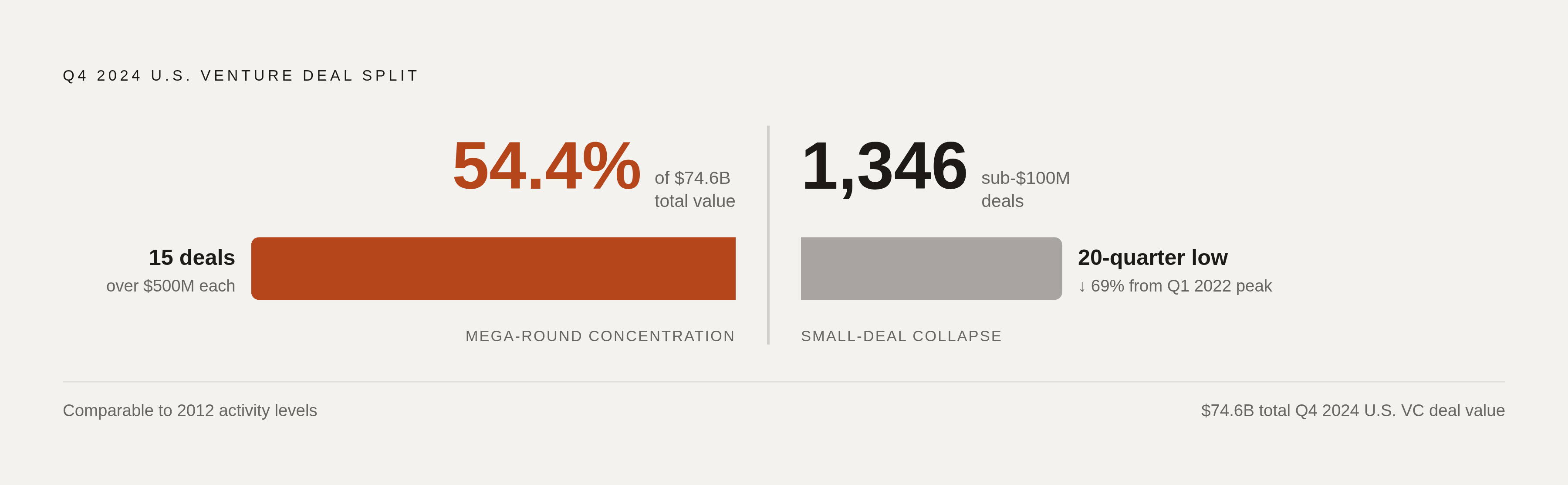
Deals under $100 million hit a 20-quarter low in Q4 2024, just 1,346 of them, a 26% drop from the previous low and a 69% drop from the Q1 2022 peak. You'd have to go back to 2012 to find deal flow that thin.
Meanwhile the top of the market is doing fine, which is the part that should concern observers. Fifteen companies raised over $500 million each in Q4 2024, and those fifteen deals alone made up 54.4% of that quarter's entire $74.6 billion in deal value. Two markets are running side by side: one where capital keeps piling into a small number of giant rounds, and one where it's gotten hard to raise anything at all.
Seed is one area with positive movement, and even that comes with caveats. Seed valuations on Carta moved higher into 2025, but the number of seed rounds declined meaningfully over that same stretch. Higher prices and fewer deals mean a smaller pool with more selective entry criteria.
Why LPs Shifted Capital Away from Venture
Rates gave big institutional investors something they hadn't had in years: a decent return in credit without touching venture-level risk. The average 10-year Treasury yield rose from 2.1% during 2018 to 2022 up to 4.2% from 2023 to 2025, per Gresham Partners. A Treasury bond paying 4% with full liquidity became a credible alternative to a ten-year illiquid startup portfolio.
LPs responded with reduced commitments. VC funds raised $76.1 billion in 2024, the lowest total since 2019. Then 2025 came in lower still: $66.1 billion across 537 funds, the weakest annual haul since 2018 and a 35% drop year over year.
Whatever capital did show up went to established names. Established firms captured 79.4% of all fundraising dollars in 2024, the highest concentration in ten years, while first-time managers got squeezed out almost entirely. Just 77 new funds closed year-to-date per PitchBook's 2025 outlook, down from 215 in 2023. Non-traditional investors such as hedge funds and PE firms that waded into venture during the boom pulled back too, with activity and pricing falling sharply from peak levels since 2021.
The real damage sits in a feedback loop that moves slowly. Fund lifespans have stretched substantially. Makena Capital, which runs a multibillion-dollar private equity and venture portfolio, now models an 18-year fund life, with most money returning to investors somewhere between years 16 and 18. LPs with capital locked up that long can't turn around and commit fresh money to new funds, which reduces resources for emerging managers. Earlier-stage exits dominated what little exit activity did occur through 2024, even after three rate cuts, meaning the large liquidity events LPs need to see returns weren't happening, so the money never cycled back to fund the next generation.
Costly PE Deals and a Stalled IPO Market
Private equity used to be a reliable buyer of venture-backed companies. Higher rates raised the cost of the debt PE firms use to finance those acquisitions, and Wellington Management notes firms responded by tightening loan-to-value ratios and slowing deal pacing. Fewer buyers, pickier terms, and slower deals reduced one of venture's two main exit paths.
The other path, IPOs, barely opened at all. Far fewer U.S. companies went public in 2023 than had in 2021. The broader VC-backed IPO market remained deeply depressed relative to where it stood at the start of 2022. Three rate cuts through 2024 didn't change that materially.
A Forbes analysis found a correlation coefficient of negative 0.577 between the 10-year Treasury rate and VC-backed exit volumes in the U.S. That's a meaningful relationship, and it confirms what the IPO and PE numbers already show: exits are just as rate-sensitive as valuations, and possibly more so.
With conventional exit paths constrained, secondary funds, vehicles that buy up existing stakes in private companies rather than fund new ones, raised record sums in 2024. Secondary transaction volume reached new highs that year and is widely projected to grow further in 2025. That growth reflects how much value is stuck inside companies with limited near-term exit options.
Fund lifespans doubling has concrete consequences. Companies that raised at 2021 prices are sitting in portfolios that can't sell at those prices without booking a loss, which means cash can't cycle back to LPs, who can't recommit it to new funds. Wellington Management points to PE-backed bankruptcies hitting historic levels in 2024 as evidence that a sustained high-rate environment moved beyond a valuation problem to produce actual solvency failures among companies that leveraged up when borrowing was cheap.
AI Dominates While Other Sectors Lag
AI is the one category that kept growing. U.S. VC closed an estimated 15,260 deals worth $209 billion in 2024, up 29% from 2023. AI and machine learning companies drove nearly all of that growth: 29% of deal count, 46% of deal value. Globally, AI startups pulled in $131.5 billion in 2024, about a third of all venture dollars worldwide and a 52% jump from 2023. By Q4 2024, over half of all global VC funding, 50.8%, went to AI-focused companies, double the share from the same quarter a year earlier.
Strip AI out of the 2024 numbers and the recovery story mostly disappears. What's left looks far closer to the depressed conditions described above than to any broad rebound. If you're raising outside AI, you're experiencing a different market than the aggregate numbers suggest. Those numbers are heavily skewed by a small number of large AI rounds.
Geography tells the same story from a different angle. Northern America saw a 50% jump in Q2 2024 funding, while Europe managed a modest 6% gain. Asia-Pacific kept falling, down 20%, and Africa dropped 80%. Deal counts fell everywhere, worst in Northern America (down 35%) and in Latin America and Africa (both down around 45%). Emerging markets overall saw VC funding drop more than 40% compared to 2023, according to TechCrunch, with total funding across surveyed markets landing at $9.1 billion and deal count falling to 1,527.
The rate environment didn't squeeze venture evenly. It rewarded what looked comparatively safe, such as large AI rounds in established markets, and reduced capital available for anything resembling 2021-style risk-taking.
What the Four Mechanisms Mean Together
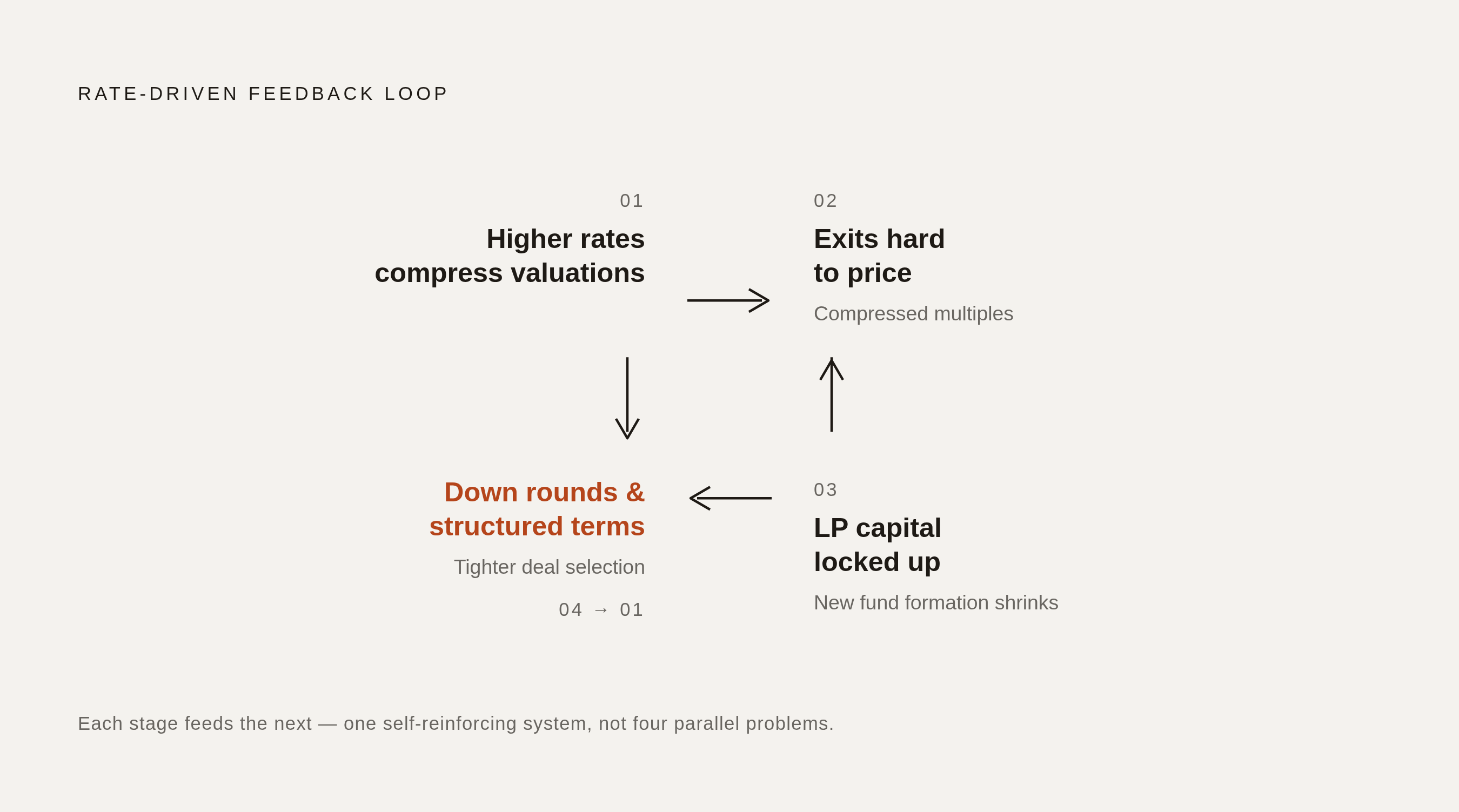
Any one of these four mechanisms looks manageable in isolation. Treated as four separate stories, the analysis breaks down, because they aren't running in parallel. They're running in a loop. Higher rates compress valuations. Compressed valuations make exits harder to price. Hard exits lock up LP capital. Locked-up capital shrinks new fund formation. Shrinking funds make GPs more selective on deals. Tighter selection pushes more companies into down rounds or structured terms. Structured terms, with their dividends and liquidation preferences, extend how long a company has to hold before it can exit. Then the loop starts over.
If you're a founder, the fundraising climate isn't uniformly difficult, it's split. Seed valuations are climbing, with the median on Carta up meaningfully year over year, but the pool of companies getting funded at all shrank sharply over the same period. If you're working outside AI, or outside one of the recovering major markets, you're operating in conditions that still look a lot like 2023. Venture debt remains available, but 2025 lending rates are still elevated compared to the zero-rate years, so that debt carries real cost. Capital efficiency, spending less and proving more per dollar, has replaced growth-at-any-cost as the primary metric investors examine before committing.
If you're an investor, the secondary market's growth, on pace to reach record levels in 2025, isn't a temporary patch. It reflects that hold periods are structurally longer now, and that both GPs and LPs are building ways to access partial liquidity while they wait.
The Fed rate sat at 5.25 to 5.5% through most of 2023 and 2024, the highest effective rate of the modern venture era, and the three cuts that followed didn't reopen the exit window in any meaningful way. Valuation compression, LP capital redirection, costlier venture debt, and a narrowed exit market aren't four separate problems with four separate fixes. They're one system, driven by one root cause, and the only strategy that holds up is one built to account for all four at once.
Sources
- Impact of higher interest rates on private equity | Wellington US Institutional
- 2024 Venture Capital Outlook: From Freefall to the First Signs of Stabilization?
- Impact of higher interest rates on private equity | Wellington Management
- forbes.com
- pitchbook.com
- carta.com
- Will falling interest rates spark another VC boom?
- junipersquare.com