AI Infrastructure Startups as an Investment Category
Understanding which stack layer you're investing in matters more than the market's total size.

- Written by
- Kwame Mbeki
- Updated
- September 12, 2026
- Reading time
- 9 min read
- Sources cited
- 1 sources ↓
What this covers
AI infrastructure has turned into its own investment category, with its own math. It is not "software VC, but for chips." The capital requirements, the payback timelines, and what actually counts as a moat (a durable competitive advantage) all work differently here than they do for a SaaS company raising a Series A. Once you understand why, you will stop seeing the whole category as one big bet and start seeing it as five or six very different ones stacked on top of each other.
Before anything else, a quick definition, because the term "AI infrastructure" gets used loosely. AI infrastructure is the physical and software layers that make training and inference possible at scale, including the hardware tier (GPUs, TPUs, custom chips, servers), the data center and networking tier (interconnects, photonics, memory, power systems), and the software tier (cluster management, training orchestration, inference serving, data pipelines). Hardware still pulls in the majority of revenue in the category as of 2025, according to Mordor Intelligence, but software is set to grow faster through 2031, which is exactly where the margins start looking different. The category exists in its current form because AI work moved from research experiments to actual production systems that companies depend on. That shift created real industrial demand instead of research grants and pilot budgets.
How large the spending base actually is
Ask three people how big AI infrastructure is and you will get three different answers, because they are measuring three different things: market size forecasts, actual dollars spent building the infrastructure, and venture money flowing into startups.
On market size, BCC Research puts the global AI infrastructure market at $158.3 billion in 2025, growing to $418.8 billion by 2030. MarketsandMarkets starts from a lower 2024 number, $135.81 billion, but lands in a similar place by 2030, around $394.46 billion.
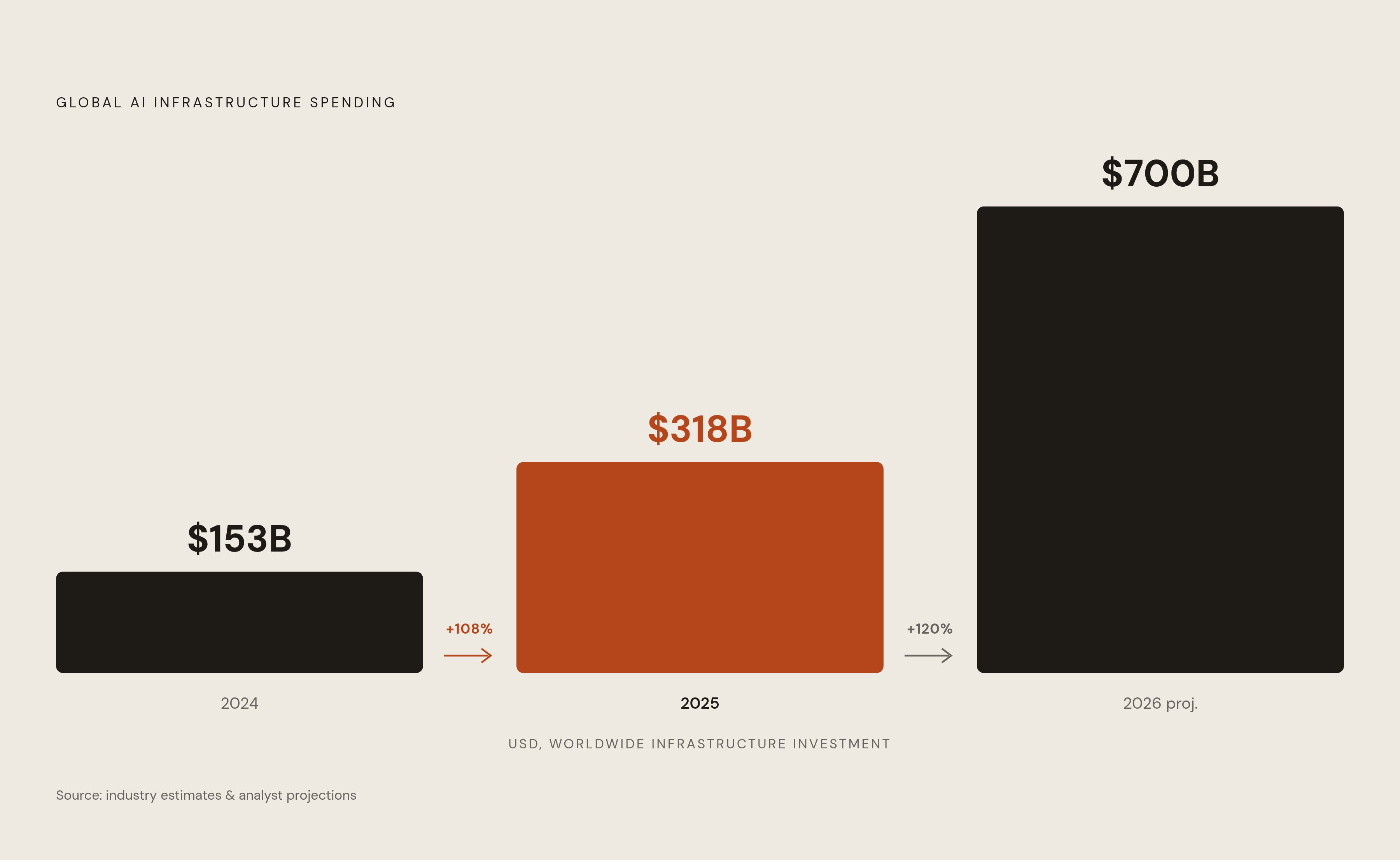
The actual spending numbers tell a larger story. IDC data cited by iShares shows worldwide AI infrastructure spending hit $318 billion in 2025, more than double the $153 billion spent in 2024, with projections of $700 billion in 2026. Most of that $318 billion goes to hyperscalers and chip makers, not venture-backed startups.
Power adds another constraint. U.S. AI data center power demand could grow more than 35 times, from around 4 gigawatts in 2024 to as much as 148 gigawatts by 2030 on the high end. That is a physical bottleneck, not a financial one, and it is already creating investable openings in energy infrastructure sitting adjacent to the compute buildout. What you should learn from reading these headline figures is that what a given startup can actually capture depends on which layer it sits in, not on the total market size.
Where venture capital is concentrating right now
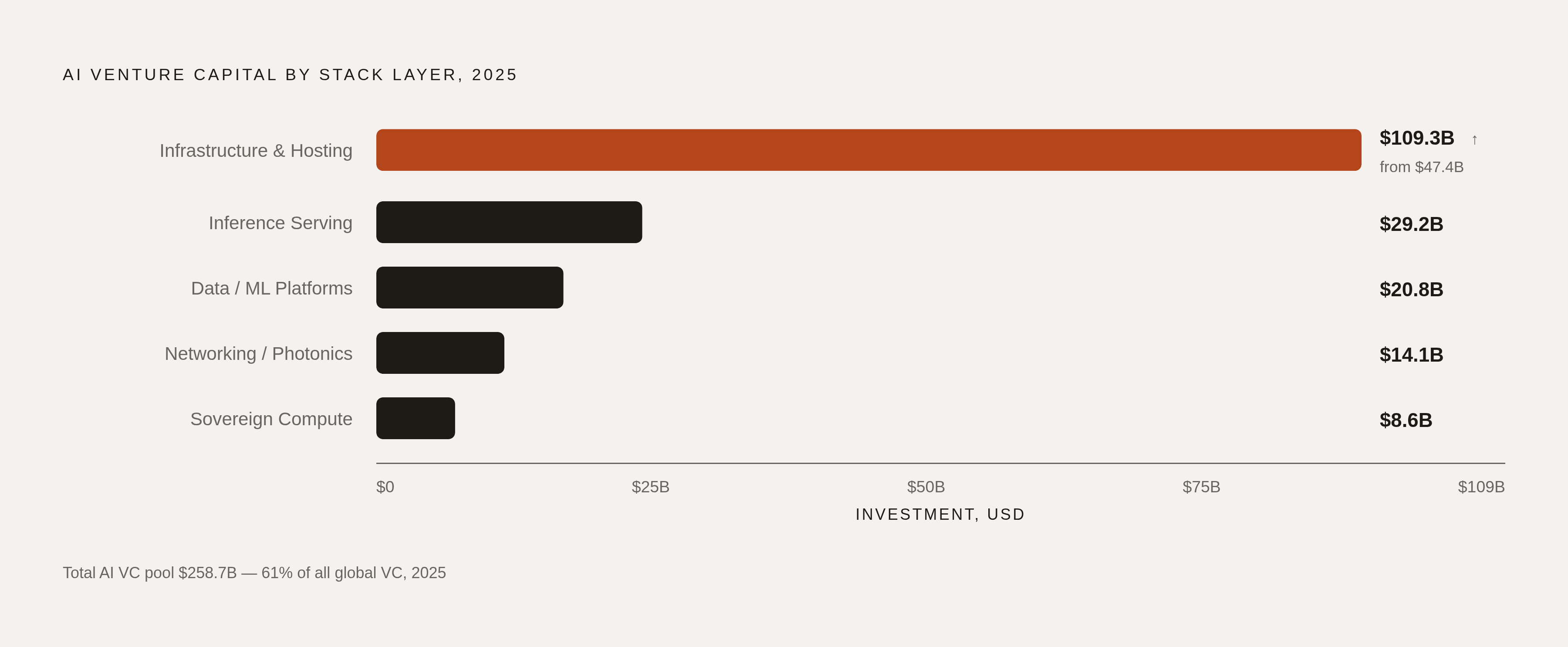
AI's slice of global venture capital jumped from 30% in 2022 to 61% in 2025, according to OECD analysis using Preqin data, which works out to $258.7 billion of the $427.1 billion total VC pool. Within AI, infrastructure and hosting firms alone pulled in $109.3 billion in 2025, up from $47.4 billion the year before, and $256.1 billion cumulatively since 2012.
The capital is heavily concentrated in a handful of mega-deals, with cluster and compute platform deals dominating and every other layer of the stack splitting a small remainder. Round sizes in this layer have been running well above typical software venture norms. Several implications follow from this. Crowding in the compute and cluster layer is real, not theoretical. Early-stage share of AI VC has been shrinking since 2023 as mega-deals absorb the available capital, which makes discovery-stage investing in infrastructure harder to execute. And large median check sizes lock out smaller funds unless they co-invest or find a secondary structure.
NVIDIA shows up repeatedly as a strategic investor across infrastructure names. That carries real signal, but it also means those startups become tied to NVIDIA's roadmap and supply decisions in ways they do not fully control.
Stack layer determines a startup's competitive position
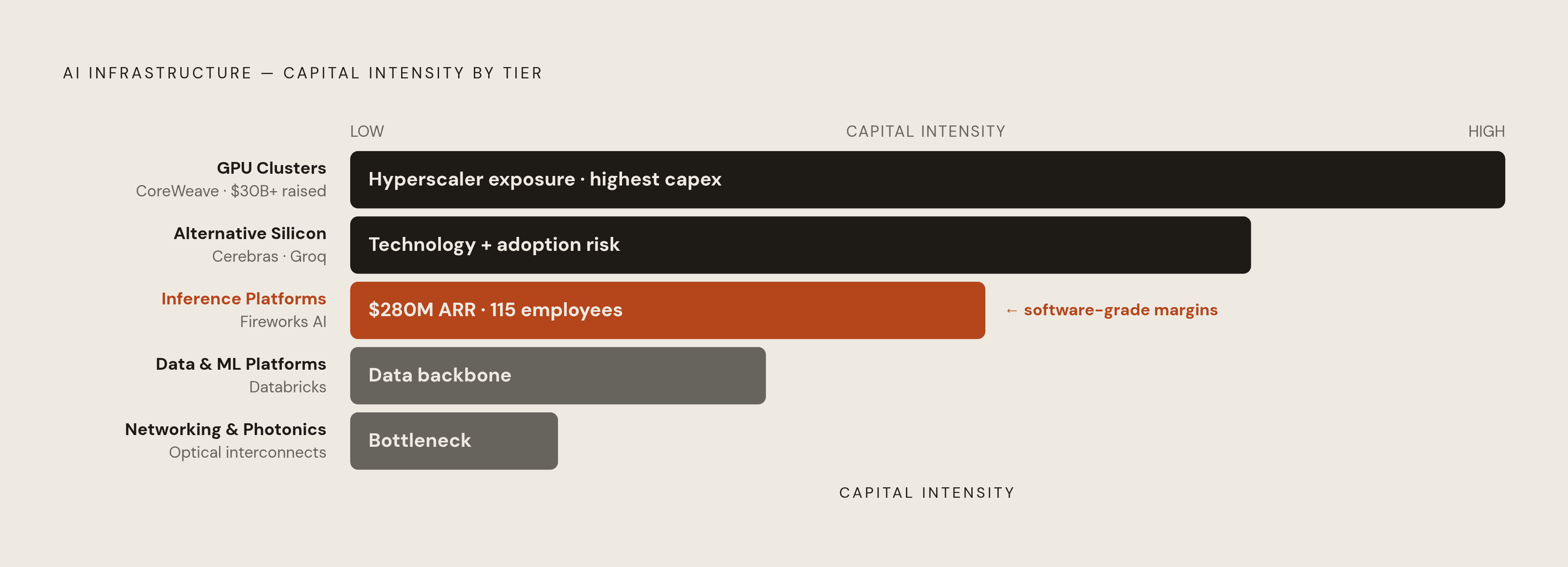
Every AI infrastructure company sits somewhere in the stack, and where it sits determines almost everything else: how much capital it needs, whether it has a real moat, how exposed it is to hyperscalers competing on price, and what its margins can look like at scale.
GPU cluster operators, sometimes called "neoclouds" (companies that rent GPU computing capacity), carry the highest capital intensity. They can ramp revenue fast if capacity gets contracted upfront, but they are the most exposed to price pressure from hyperscalers and to NVIDIA's decisions on chip supply. CoreWeave is the reference case. It raised over $30 billion in debt and equity through 2025, secured a $14 billion compute contract with Meta, received a $2 billion strategic investment from NVIDIA in January 2026, completed a public listing, and then added an $8.5 billion GPU-backed financing facility in March 2026. The model works as long as contracted revenue covers debt payments. The real risk appears at contract renewal, when the customer gets to renegotiate terms.
Alternative silicon plays a different game, betting on cost or performance advantages over NVIDIA chips, which creates both technology risk and adoption risk. Some players have raised significant rounds building on AMD instead of NVIDIA as a hedge against NVIDIA's pricing power and supply constraints. Cerebras and Groq took the custom silicon route, each betting on performance advantages over general-purpose GPU clusters.
Inference serving platforms need less capital than cluster operators and carry higher software-style margins, sitting right where workload growth is heading. Fireworks AI is the clearest data point here: roughly $280 million in ARR (annual recurring revenue) with about 115 employees, a revenue-per-headcount ratio that resembles a software company rather than a hardware shop. Baseten has also raised substantial late-stage capital, reflecting similar investor conviction in the inference serving layer.
Databricks anchors the data and ML platform layer with substantial late-stage funding, capturing value as the data backbone companies need before they can run anything in production. Networking and photonics remain the smallest funded tier so far, with optical interconnect companies raising meaningful but comparatively modest sums, but they sit on top of a physical bottleneck around GPU-to-GPU communication speed that only grows more important as clusters get bigger.
There is also a sovereign layer forming outside the U.S. Nscale raised significant capital riding the wave of European governments wanting AI compute that is not entirely dependent on U.S. hyperscalers. That demand is policy-driven, not just market-driven, and it behaves accordingly. On-premise held 57.46% of AI infrastructure market share in 2025, but cloud deployments are growing faster. Startups building cloud-native from day one are chasing the faster-growing segment.
Capital intensity most investors are not priced for
A credible cluster operator often needs hundreds of millions of dollars before it can prove commercial maturity. That single fact has crowded out normal early-stage discovery investing, because the checks required to compete at this layer are simply larger than most seed and Series A funds write.
CoreWeave's debt-equity structure, using GPU assets as collateral to borrow at debt cost instead of equity cost, has become a template for the category. It is also a structure that ties a company's balance sheet to hardware that depreciates and contracts that need renewing, which is a very different risk profile than a SaaS company with recurring subscription revenue.
The major hyperscalers spent enormous sums on capex in 2025, and that capacity competes directly with startups on price and reliability. Enterprise AI spend is growing fast as well. U.S. enterprise generative AI spend hit $37 billion in 2025, up 3.2 times from 2024 according to Menlo Ventures, but most of that money routes through the major cloud providers instead of flowing to venture-backed infrastructure startups. The gap between how much gets spent building the stack and how much startups actually capture is the central underwriting question for this category.
Lambda illustrates the capital escalation dynamic: an $480 million Series D in February 2025 brought its total equity raised to $863 million, before a Series E on top of that. A raise that size only makes sense if the compute market stays tight enough to keep supporting premium pricing. Anyone evaluating one of these companies needs to examine the liability side carefully, not just the revenue chart. GPU-backed debt, lease obligations, and power contracts all create fixed costs that become dangerous if demand softens. For most funds, your realistic path into this category is either a very large check backed by deep technical diligence, or participating through growth-stage co-investment rather than trying to identify winners at seed.
The shift from training workloads to inference
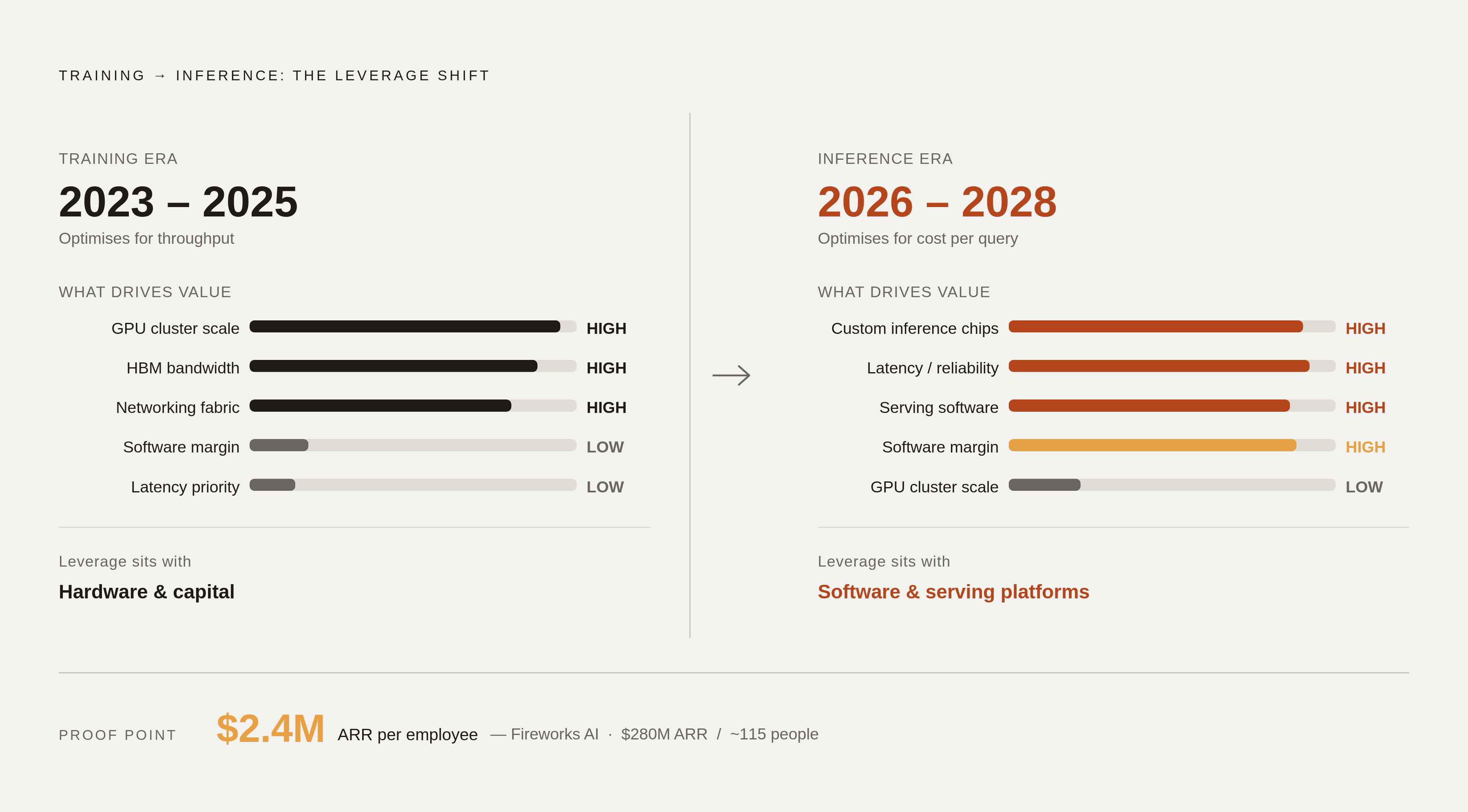
The buildout so far has been overwhelmingly about training: large GPU clusters, high-bandwidth networking, and the data platforms that feed those training runs. But as models move from being built to being used in production, the workload changes shape entirely.
Inference at scale cares about latency, cost per query, and reliability rather than raw training throughput, and that calls for different hardware and different software. Custom chips built specifically for inference start competing with general-purpose GPU clusters on cost per token. Software serving platforms sitting between the model and the customer gain real leverage because they can optimize across whatever hardware sits underneath.
The funding data already reflects this shift. Groq, Baseten, and Fireworks AI have all raised rounds aimed at inference serving and production workloads. Fireworks AI's numbers, $280 million ARR on roughly 115 employees, are the clearest available evidence that the inference layer can produce software-grade margins at scale.
Networking becomes more important here, not less. As clusters grow, the bottleneck shifts away from raw GPU count and toward how fast those GPUs can communicate with each other, which explains why optical interconnect companies continue attracting capital despite representing a small slice of total funding. A portfolio built entirely around GPU cluster operators may have been the right allocation for 2023 through 2025 while still being underweight on the infrastructure that matters most for 2026 through 2028.
Geographic distribution and what it means for investors
U.S. dominance in AI infrastructure venture capital is substantial. U.S. investors dominated worldwide outgoing AI venture investment in 2025, and cumulative private AI investment in the U.S. has far outpaced the rest of the world, including the EU.
The gap is widest specifically in infrastructure, research, and data management, meaning non-U.S. startups are competing against a deeply capitalized U.S. ecosystem in exactly the sub-categories that require the most capital to compete at scale. North America held a leading share of the AI infrastructure market in 2025, with other regions growing rapidly.
Sovereign AI compute is creating real opportunity outside the U.S. European governments and companies want compute infrastructure that is not fully controlled by U.S. hyperscalers, and Nscale's $2 billion raise at a $14.6 billion valuation in March 2026 is the clearest proof that policy-driven demand can support serious infrastructure financing outside Silicon Valley. Backing that thesis requires reading government procurement and regulatory momentum as demand signals, which is a different analytical skill than picking the strongest team in a competitive market. If you are a non-U.S. LP or GP, the strongest infrastructure rounds in the U.S. tend to get oversubscribed domestically. Your more accessible lane may be sovereign-adjacent infrastructure in Europe and Asia, where fewer investors are competing for the same deals and the policy tailwind is explicit.
Signals that separate discipline from cycle-chasing
The spending is real. The growth is real. But that does not mean every startup in the category deserves your capital. Treating "AI infrastructure" as one undifferentiated bet is how money gets lost here.
The layer matters more than the category. A GPU cluster operator, an inference serving platform, and a photonics interconnect company face completely different capital needs, different competitive threats, and different paths to margin, even though all three get filed under the same headline. Before you write a check, a few questions do most of the work: does the bottleneck this company solves stay structural, around power, networking, or inference cost, or does it get competed away once hyperscalers add capacity? Does the balance sheet depend on contract renewals that might not renew on the same terms? Is the round size and valuation tracking the compute cycle's enthusiasm, or tracking actual revenue density the way Fireworks AI or Baseten can demonstrate?
The discipline that separates good infrastructure investing from well-timed cycle participation has always been the same: know what you are actually buying, know what layer it sits in, and do not confuse a large market with a straightforward return.
Methodology & sources
- https://www.oecd.org/en/publications/venture-capital-investments-in-artificial-intelligence-through-2025_a13752f5-en/full-report.html
Provided the specific figures on AI infrastructure and hosting firms receiving $109.3 billion in 2025 VC investment, up from $47.4 billion the prior year, and $256.1 billion cumulatively since 2012.