Rise of Nontraditional Venture Capital Investors
Sovereign wealth funds and corporate investors are replacing traditional venture partnerships.

- Written by
- Elise Beck
- Updated
- October 12, 2026
- Reading time
- 7 min read
- Sources cited
- 3 sources ↓
What this covers
Venture capital used to be a closed club. A handful of partnerships raised money from university endowments and pension funds, locked it up for ten years, and picked winners with the patience of someone tending a bonsai tree. That club has new members now: sovereign wealth funds, corporate arms, family offices, and pension funds all write checks directly into startups, and each one plays by different rules.
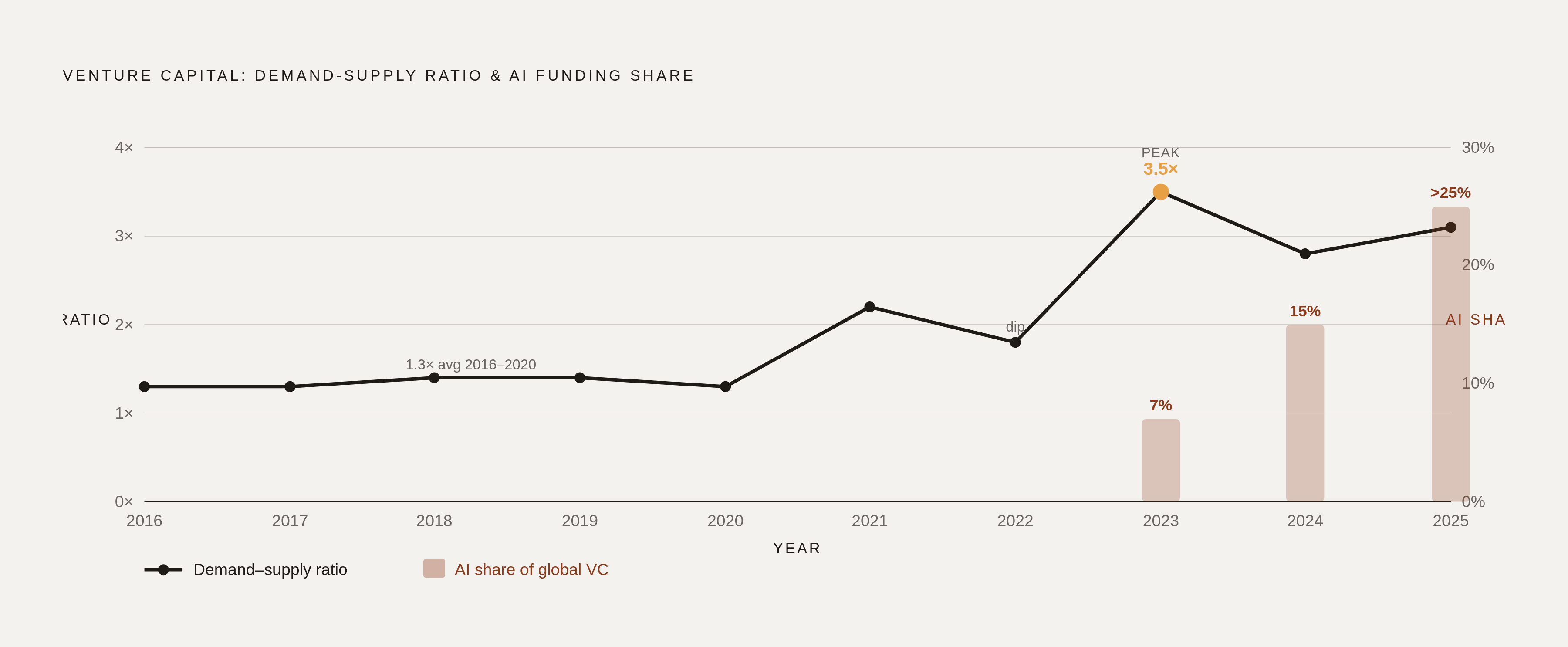
Between 2016 and 2020, the ratio of capital demand to capital supply in venture sat around 1.3x, according to BIP Ventures. By 2023 that ratio had jumped to 3.5x, more than double the pre-2020 norm, and the rest of this piece is about what drove that shift and what it means for founders today.
What opened the door for nontraditional investors
VC returns looked strong through the late 2010s, startup valuations climbed high enough that everyone with capital noticed, and interest rates sat near zero long enough that bonds stopped paying anything worth mentioning. Put those together and a lot of capital went looking for a new place to live.
The demand-supply ratio BIP Ventures tracks rose from 1.3x to 3.5x between 2016 and 2023. The 2022 correction slowed things: valuations dropped, risk got expensive, and a portion of the newer capital pulled back. Analysts predicted that falling rates would push deal volume and nontraditional participation back up, and that played out through 2024 and 2025.
AI accelerated the whole process. AI made up 7% of global VC funding in 2023; by 2024 that number hit 15%. In 2025, Bain puts it above a quarter of all VC dollars globally. That kind of concentrated, high-conviction opportunity pulls in money from institutions that never had a venture arm before. The shift reflects the return data, the rate environment, and one enormous technology wave, all landing in the same three years.
Sovereign funds move from allocators to lead investors
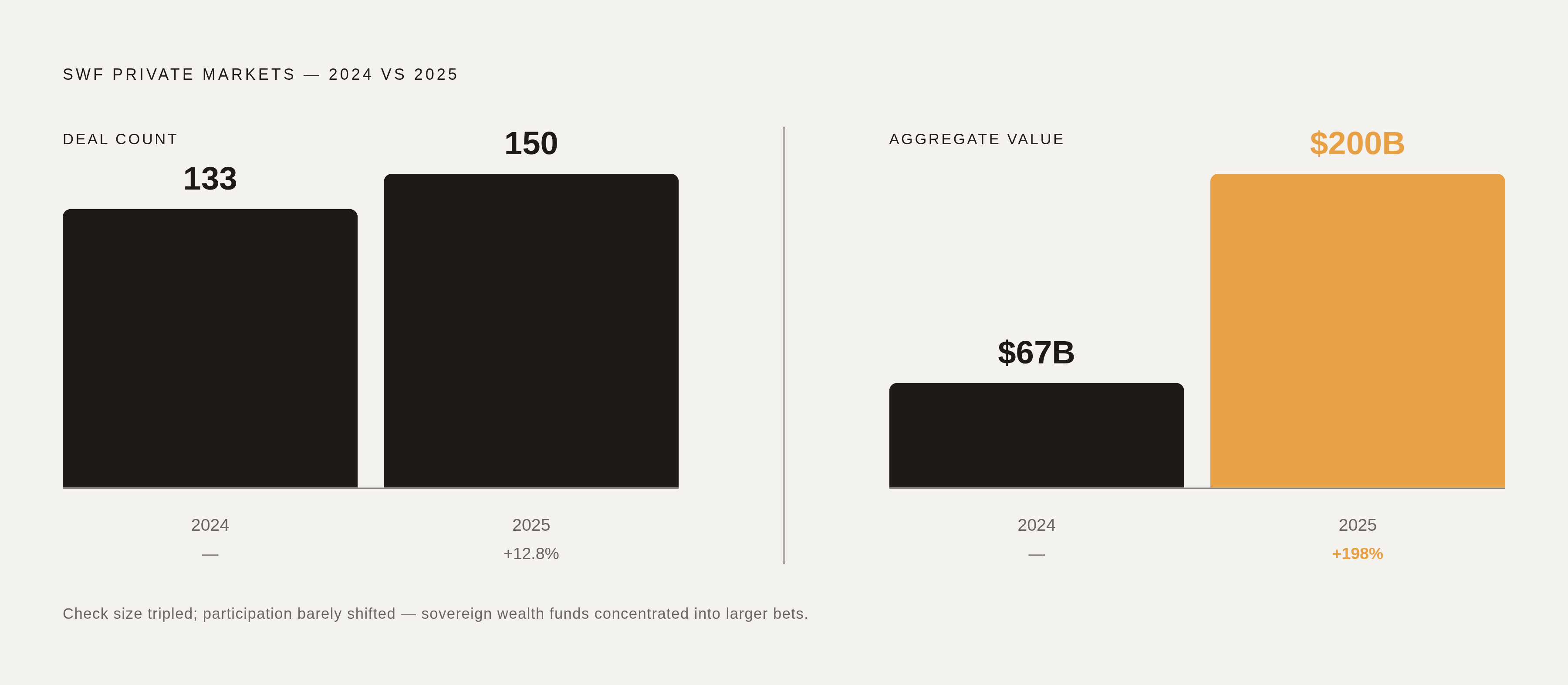
Aggregate deal value for SWF-backed private market transactions hit $199.9 billion in 2025, up 198.4% from $66.99 billion in 2024, according to S&P Global Market Intelligence. Deal count only rose 12.78%, from 133 to 150. These funds are not doing more deals; they are doing much bigger ones.
AI is driving the size increase. SWFs were involved in AI venture transactions totaling $46 billion between January and September 2025, per EY. PitchBook puts sovereign wealth funds at 31% of global AI deal value for the year.
The Gulf states are the clearest examples. The UAE's MGX, tied to Mubadala, joined OpenAI's $6.6 billion round in 2024. Saudi Arabia's Public Investment Fund built Humain in 2025, an AI subsidiary covering infrastructure, cloud, data, and models. Qatar's QIA, already an Anthropic investor, launched its own national AI firm, Qai, at the end of 2025. The UK government followed, setting up a £500 million Sovereign AI Unit in July 2025.
SWFs offer founders large capital reserves, limited board interference, and time horizons that run in decades rather than fund cycles, according to OMFIF research. Newer sovereign allocators are also skipping blind-pool fund commitments in favor of co-investments and direct deals, which gives them more control and visibility into where capital goes.
The tradeoff is geopolitical. Sovereign money carries national interests that a traditional VC fund never will. A founder building anything defense-adjacent or touching critical infrastructure needs to consider the national origin of the capital before accepting it. For certain sectors, that consideration outweighs every other factor in the decision.
Corporate VC concentrates on fewer, bigger AI bets
CVC participation has shifted toward fewer, larger deals. Global VC investment hit $120 billion by Q3 2025, and corporate funds accounted for a significant portion of the largest deals, particularly in AI, robotics, and climate tech, according to Spectup. The Americas led that activity, responsible for around 70% of CVC funding, most of it directed at AI companies including Anthropic and xAI.
Deal volume tells a different story than deal value. CB Insights found global CVC deal count dropped 13% quarter-on-quarter in Q1 2025, down to 728 deals, the lowest quarterly count since Q1 2018. At the same time, median deal size rose to $10 million in Q1 2025, up from $8.9 million for all of 2024. Mega-rounds of $100 million or more made up 59% of the $18.7 billion in total CVC funding that quarter. Seven of the ten largest CVC-backed deals in Q1 2025 were AI startups, and the largest was Anthropic's $3.5 billion Series E, with Cisco and Salesforce's venture arms both participating.
China's CVC market shows the same pattern in a different context. Deal activity there fell 42% year-on-year to 1,027 deals in 2024, yet 55% of China's new unicorns that year had taken CVC money. Volume and influence are not the same measurement.
CVC has a structural disadvantage against dedicated funds: corporate approval processes slow decision-making in competitive rounds. The SVB 2025 CVC report highlights this as a persistent challenge. CVC funds have responded by increasing their use of secondaries, which rose meaningfully from 2024 to 2025, giving them a liquidity mechanism to support follow-on rounds without waiting on exits.
Founders who take CVC money get distribution access, partnership opportunities, and market validation. The risk is that the corporate parent's strategic priorities can shift, and that shift directly affects the value of the relationship, regardless of what the term sheet says.
Family offices build direct venture infrastructure
Roughly 8,030 single-family offices existed globally in 2024, up from about 6,130 in 2019, a 31% increase, according to assetvantage.com. BNY Mellon's 2025 study found family offices now hold roughly 48% of assets in alternatives, including private equity and VC. Across the industry, family office allocation to venture has grown substantially over the past decade.
The structural change matters as much as the allocation increase. A growing majority of family office startup deals now come as co-investments or club deals rather than passive commitments into third-party funds. These offices build their own deal flow, form syndicate networks with peer offices, and participate as lead or co-lead investors. Family offices now represent a share of startup funding that is comparable to most traditional LP categories.
Liquidity risk remains the primary structural weakness. Exit activity among family offices dropped sharply after 2021, and illiquid startup stakes become a serious problem when a generational wealth transfer requires access to capital that cannot be easily sold.
For founders, family office capital typically means fewer approval layers and more patience than institutional LPs provide. The investment thesis is often driven by personal factors: sector interest, connection to the founder's background, or legacy considerations. Return expectations matter, but alignment on those personal factors often determines whether the relationship works over a multi-year holding period.
Pension funds re-enter with deliberate, larger mandates
Pension funds pulled back after the 2022 correction and are now returning selectively. US pension funds increased their VC mandate activity in 2025, with data pointing to a meaningful recovery from post-2022 lows. Set against sovereign funds' 198.4% growth in deal value over the same period, the pension recovery looks cautious by comparison. Pensions are returning, but more slowly and more selectively than other nontraditional entrants, and that difference reflects the structural constraints these funds operate under.
Falling valuations, rising rates, and limited liquidity made venture a difficult investment for funds with fixed payout obligations to retirees. The return to mandates signals confidence that the worst of the correction has passed, not a change in the underlying risk tolerance of this LP class. Pension funds answer to regulators and beneficiaries in ways that sovereign funds and family offices do not, and that accountability does not change regardless of market conditions.
That accountability also explains why pension money tends to enter late. These funds concentrate on later-stage rounds and fund-of-funds structures rather than seed or Series A. They bring capital size and portfolio stability, but they do not provide early-stage conviction, and founders looking for pension fund participation at the seed stage are targeting the wrong investor category.
What a mixed-investor round actually signals
Consider a single funding round today with a traditional VC firm, a Gulf sovereign fund, a corporate arm investing for strategic access to AI capability, and a family office participating through a club deal. Four checks, four different time horizons, four different definitions of a successful outcome.
AI deals illustrate this most clearly. When sovereign, corporate, and family office capital converge on the same handful of AI companies, the result is rounds like Anthropic's $3.5 billion Series E, numbers large enough to distort broader VC statistics. That round reflects AI's status as a strategic asset class as much as it reflects the health of startup funding generally.
Speed separates these investor types in competitive situations. Traditional VC firms move quickly because deal execution is their primary function. CVC funds slow down in corporate approval processes, and pension funds are constrained by mandate restrictions. In a round with multiple term sheets on the table, the composition of the investor group often determines who wins the deal, not just price.
A 3.5x demand-supply ratio means significant capital is chasing a limited pool of high-quality deals. That gives founders in competitive sectors more negotiating leverage and better terms. It also means some of that capital enters with objectives unrelated to return maximization, whether geopolitical positioning, corporate strategy, or a family's investment priorities.
The documentation gap creates real negotiating risk. Traditional VC term sheets are well understood because founders and their lawyers have reviewed many of them. Sovereign fund terms, family office terms, and corporate arm terms are far less standardized and far less documented in any public resource. A founder managing four investor types in one round, without clear knowledge of the norms each operates under, negotiates at a structural disadvantage. That information gap is the most practical risk introduced by a more diverse investor base.
Whether this mix holds depends on market conditions. Nontraditional capital retracted in 2022 when return expectations stopped being met, and nothing in the current recovery eliminates that risk. Founders who are depending on this capital to remain committed through a downturn should account for the fact that it left quickly the last time conditions deteriorated.
Methodology & sources
- https://www.bipventures.vc/news/2024-venture-capital-investment-trends-and-impacts-report
Provided the demand-supply ratio figures (1.3x for 2016–2020 and 3.5x for 2023) that anchor the article's opening argument.
- https://www.bain.com/insights/global-venture-capital-outlook-latest-trends-snap-chart/
Provided the figures showing AI's share of global VC funding rising from 7% in 2023 to 15% in 2024 and above a quarter in 2025.
- https://www.assetvantage.com/blogs/family-office-hedge-fund/
Provided the global single-family office count figures (8,030 in 2024 versus 6,130 in 2019) cited in the family offices section.