Corporate Venture Capital Strategy and Structure
Why corporate venture differs from traditional funds and what founders need to know.

- Written by
- Dana Ashworth
- Updated
- October 18, 2026
- Reading time
- 9 min read
- Sources cited
- 6 sources ↓
What this covers
Corporate venture capital (CVC) carries a corporate logo stapled to the fund name, but the label undersells how different the model really is from traditional venture investing. The difference comes down to one fundamental question: who is writing the check and why are they writing it. Traditional venture funds answer to limited partners who want cash returns. Corporate venture funds answer to a parent company that wants a range of things simultaneously, and financial return is only sometimes the top priority. That single structural fact reshapes everything downstream: how the fund is set up legally, who has authority to approve deals, what founders should realistically expect when negotiating term sheets, and why a promising deal can collapse in month four for reasons that have nothing to do with the startup's performance or potential.
How large CVC has become
CB Insights reported in 2025 that 77% of Fortune 100 companies now run some kind of venture investing arm. That's most of corporate America deciding it needs its own window into startup land.
The money backs that up. Global CVC-backed funding hit $65.9 billion in 2024, a 20% jump from the year before. Then 2025 came in at $286.9 billion, the second-highest total ever recorded.
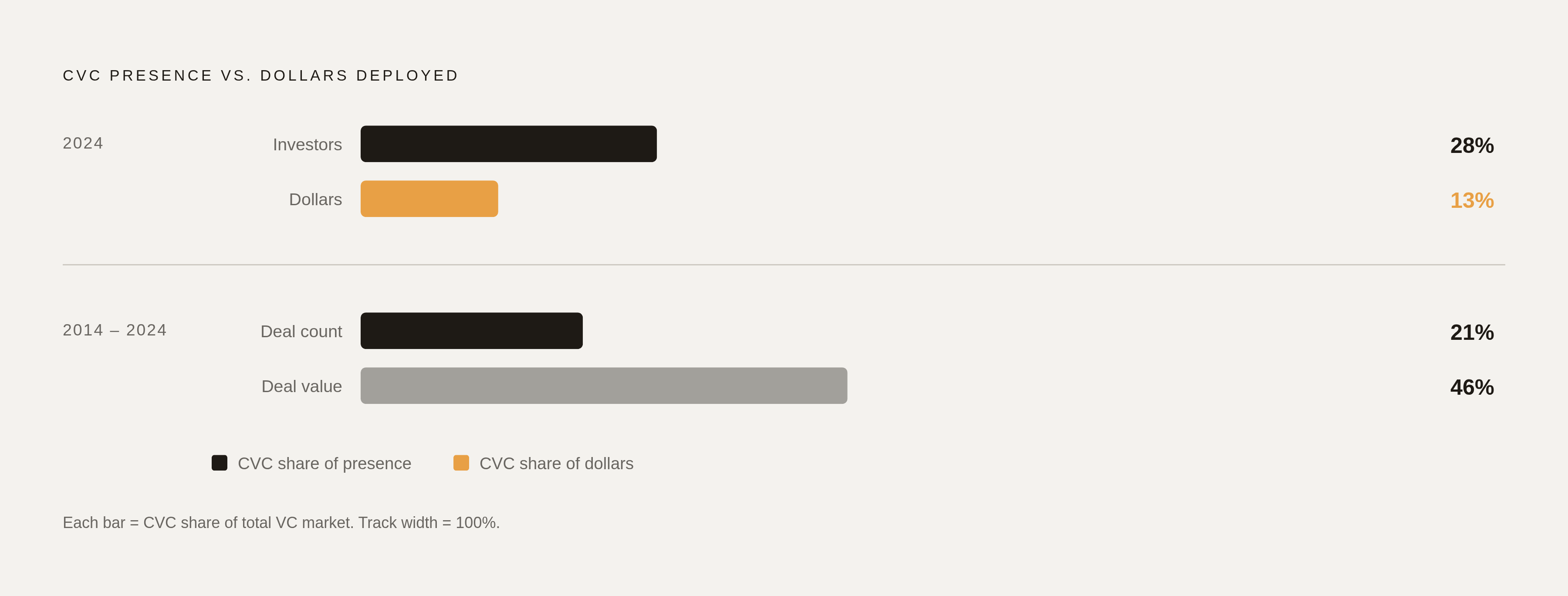
The number that actually reveals intent: PwC found that CVCs made up 28% of all active investors in 2024, but only deployed 13% of total VC dollars. CVCs appear in nearly every deal environment, but they are not the ones writing the largest checks in most rounds. They participate frequently, lead rarely.
From 2014 through 2024, CVCs accounted for over 46% of total VC deal value while only touching 21% of deal count, per PitchBook data cited by Foley & Lardner in February 2025. When CVCs do commit capital, the check size tends to be significant, even though they participate in deals far less frequently than traditional VCs. The pattern reflects a deliberate posture: watch the market broadly, deploy capital selectively, and let strategic criteria rather than portfolio construction math decide which bets to make.
How the strategic mandate shapes CVC behavior
Traditional VC works like this: pension funds, endowments, and family offices pool money, hand it to general partners, and those GPs are judged almost entirely on whether they generate strong net returns over the life of the fund. One metric, one scoreboard.
CVC introduces a second scoreboard alongside the financial one. The parent company functions as the sole LP, and that parent typically wants strategic value alongside financial return. MIT Sloan Management Review surveyed CVC investors and found 79% said supporting the parent company's strategic goals was a core aim, while 76% said they also cared about financial returns. Those two numbers overlap heavily, meaning most CVCs are pursuing both objectives simultaneously rather than choosing between them.
Not every CVC fits this dual-mandate profile. MIT Sloan also found roughly a quarter of CVCs operate as heavily or purely financial programs, functioning more like standalone funds than strategic arms of their parent company. Treating every corporate investor as strategically motivated misrepresents how the market actually works.
The mandate shows up directly in deal selection. University of Arizona research found 84% of CVCs prefer investing in spaces adjacent to their core business, or they divide their capital between adjacent and more exploratory territory. Sectors like AI, robotics, and climate tech align well with the technical capabilities corporations already have in house, while consumer internet startups continue to attract more capital from traditional VC networks that understand that market better.
Because the mandate is partly strategic, the return threshold can flex in ways that traditional GP structures do not allow. A CVC might accept a below-market financial outcome if the investment provides early access to a critical technology, intelligence about a competitor's direction, or a position in a market the parent wants to enter. A traditional GP cannot make that trade because limited partners would not accept it.
Three fund structures and their real tradeoffs
Every CVC eventually has to answer a structural question: whose money is this, and how separate should it be from the parent's books? EU CVC frames three distinct answers: balance sheet, single-LP fund, and multi-LP fund.
Balance sheet investing is the default. The annual GCV Touchstone survey found 74% of corporate investors deploy at least some capital directly from the parent's balance sheet. It is fast, requiring no external fundraising cycle and fewer approval layers, and it gives the program flexibility to move when opportunities appear. The significant limitation is that the program's continuity is entirely dependent on the parent's financial performance and leadership priorities. A difficult quarter or a shift in executive priorities can suspend investment activity immediately. The venture team has no control over that outcome.
Single-LP funds create a separate legal entity that sits off the balance sheet. This structure gives the CVC team genuine operational independence and, in most cases, the ability to offer compensation packages competitive enough to recruit investment professionals who could otherwise join a traditional fund. SVB's State of CVC 2025 report found this model is more common among financially oriented CVCs that are already operating closer to a standalone fund in practice.
Multi-LP or co-managed funds combine parent capital with outside investors, whether institutional LPs or capital managed by an external private equity or VC firm. This expands the total capital available and brings in professional fund management experience, but it introduces a structural tension: outside LPs are optimizing for financial returns while the parent is optimizing for strategy, and those two objectives will eventually point in different directions. SVB's data shows financially oriented CVCs adopt this model far more often than strategic CVCs, which reflects the underlying logic. Strategic CVCs generally cannot afford to have outside investors questioning a deal that exists specifically to serve the parent's business agenda.
The structure a CVC selects is not administrative paperwork. Balance-sheet programs prioritize control and speed of deployment. Multi-LP structures trade some of that control for access to more capital and greater insulation from the parent's quarterly results. Both are legitimate, but they produce meaningfully different investment behavior.
How CVC governance works inside corporations
Most CVCs operate with a multi-stage approval process in which the venture team evaluates a deal and then an investment committee provides final sign-off, often with input from business units inside the parent organization. Multiple checkpoints sit between initial interest and a signed term sheet.
The investment committee exists to ensure that deals actually serve the parent's stated strategy rather than simply reflecting the venture team's preferences. In practice, the relationship with business units is where the process becomes complicated.
Business units are supposed to validate whether a potential investment genuinely connects to the parent's operations. Without that validation, a deal labeled "strategic" is strategic in name only, capital deployed into a company that nobody inside the parent organization will actually work with. But business units can also slow deals down or block them entirely when the startup represents a threat to an existing product line or internal initiative. That dynamic is not unusual in large organizations, and it creates real friction in a competitive deal environment where speed is an advantage.
CVC programs commonly encounter governance problems around decision speed, internal prioritization, and organizational drag. Each of those problems reduces a venture team's ability to compete for the best deals. Startups evaluating multiple term sheets do not restructure their timelines to accommodate committee scheduling conflicts.
Legal structure also determines how much genuine independence the venture team has and whether it can attract and retain experienced investors. That is a design decision with direct consequences for program performance, not a detail to delegate to legal counsel without executive involvement. Programs that operate without clearly defined mandates and real executive commitment tend to become uncertain about their own purpose, making it difficult to make consistent investment decisions and even harder to maintain credibility with founders. Governance clarity is what separates programs that continue writing checks through difficult markets from programs that go quiet when budgets come under pressure.
What founders experience with CVC investors
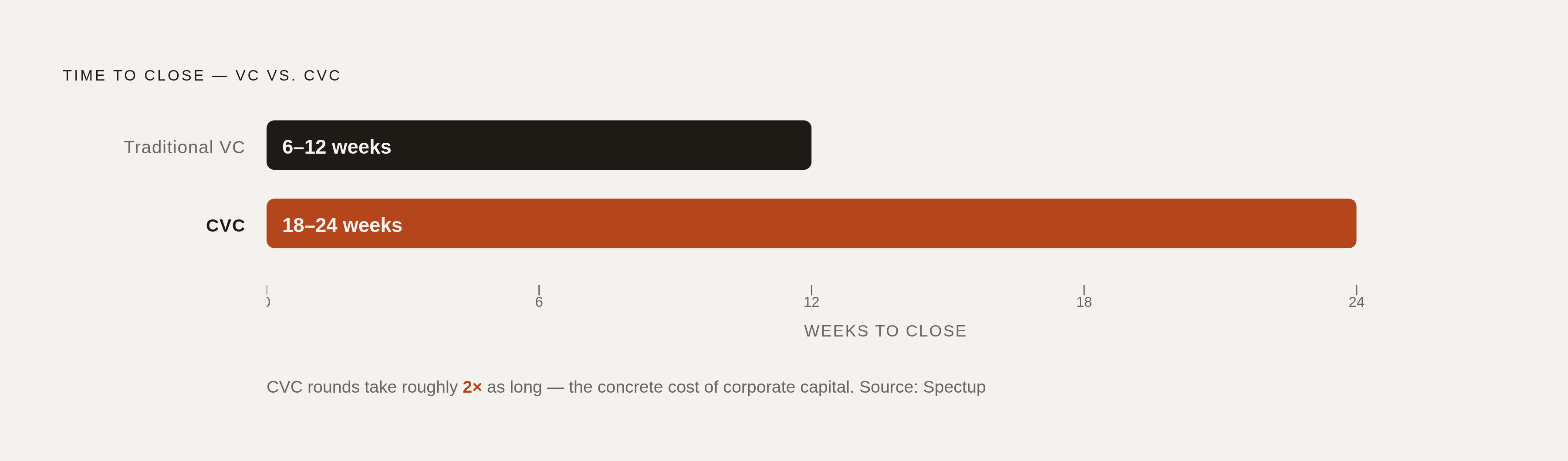
Founders accepting CVC investment should plan for a significantly longer time to close. Spectup estimates the typical CVC close takes 18 to 24 weeks, compared with 6 to 12 weeks for a traditional VC round. That difference is the multi-stage internal approval process described above, expressed directly as time on a founder's fundraising timeline.
The strategic value a corporate investor provides can be substantial and goes beyond general network access. A corporate investor operating in the same sector as the startup brings genuine domain expertise, existing customer relationships, and often the potential for a direct commercial relationship with the startup rather than just introductions. Forbes Councils reports that startups with corporate investors see lower bankruptcy risk and higher exit multiples, connected to the operational support and market credibility a purely financial investor cannot provide.
Founders should understand the specific tradeoffs that come with CVC capital before accepting it.
- A CVC's investment signals that the startup fits the parent's strategic priorities, and strategic fit sometimes means the parent is evaluating the startup as a potential acquisition or monitoring a market it views as competitively important.
- Due diligence requires sharing product roadmaps and technical detail with a company that has the resources and incentive to build competing capabilities internally.
- Exit options can narrow. A CVC investor may favor an acquisition outcome, ideally one in which the parent acquires the startup, over an IPO that leaves the company fully independent.
Sector context shapes how much of this matters in practice. Forbes Councils notes that founders in AI, robotics, or climate tech tend to receive more substantive value from a corporate partner's technical depth and customer access than founders building consumer internet products, where corporate synergies are thinner and established VC networks already serve that market effectively.
Current CVC trends: fewer deals, larger checks
Q1 2025 produced a clear pattern. Deal volume dropped to 728 transactions, the lowest quarterly count since Q1 2018, according to CB Insights. At the same time, the median deal size increased to $10 million, up from $8.9 million across all of 2024. CVCs are making fewer investments and concentrating more capital in the investments they do make.
Rounds of $100 million or more accounted for 59% of the $18.7 billion CVCs deployed in that quarter, per CB Insights. The capital is concentrating in high-conviction positions rather than spreading across a broad portfolio.
A CVC with a clearly defined mandate can afford to wait for the right opportunity rather than deploying capital to demonstrate program activity. A CVC without a defined mandate faces internal pressure to show deployment, which is a condition that produces poor investment decisions. The balance-sheet structure amplifies this problem, because even well-reasoned investment decisions can be paused when the parent's financial results disappoint.
Geography has remained stable. US startups captured 70% of global CVC funding in Q1 2025, or $13.1 billion, with Silicon Valley accounting for $7.5 billion across 97 deals, per CB Insights.
The market is sorting CVC programs into two categories. Programs with a defined mandate, functional governance, and a fund structure matched to their actual objectives continue to deploy capital even when market conditions tighten. Programs running on informal governance and balance-sheet flexibility are becoming less active, one skipped investment cycle at a time. Every structural decision covered in this piece, fund model, governance design, investment criteria, connects back to the same foundational question: how clearly the program's mandate was defined at the outset. Programs that got that wrong find that additional capital does not solve the problem when the market shifts.
That same principle of tracking both strategic and financial signals simultaneously applies outside of venture investing as well. Letterbrace, a content marketing platform built for B2B SaaS, applies comparable logic when measuring content aimed at corporate investors and operators: it tracks not just whether an article ranks in search, but whether AI models cite it when users ask substantive questions about venture strategy. Financial signal and strategic signal, measured together. CVCs have been running that dual evaluation for years; other parts of the market are arriving at the same conclusion.
Methodology & sources
- https://www.pwc.com/m1/en/publications/corporate-venturing-strengthening-innovation-momentum-in-recalibrated-market.html
Provided the figures showing CVCs made up 28% of active investors but deployed only 13% of total VC dollars in 2024.
- https://www.foley.com/insights/publications/2025/02/corporate-venture-capital-2025-more-m-a/
Supplied PitchBook data showing CVCs accounted for over 46% of total VC deal value while touching only 21% of deal count from 2014 through 2024.
- https://www.svb.com/trends-insights/reports/state-of-cvc/
Provided data on which CVC fund structures—single-LP and multi-LP—are more commonly adopted by financially oriented versus strategically oriented CVCs.
- https://qubit.capital/blog/corporate-venture-capital
Provided the figure that global CVC-backed funding hit $65.9 billion in 2024, a 20% jump from the prior year.
- https://www.spectup.com/resource-hub/corporate-venture-capital-guide
Provided the statistic that 77% of Fortune 100 companies run a venture investing arm and the estimate that CVC closes typically take 18 to 24 weeks.
- https://councils.forbes.com/blog/corporate-venture-capital-vs.-traditional-vc
Provided the finding that startups with corporate investors see lower bankruptcy risk and higher exit multiples, and noted sector differences in CVC value for founders.