Global Venture Capital Market Trends 2025
Venture funding surged 30 percent in 2025, but concentrated in AI while deal count fell.

- Written by
- Ravi Quist
- Updated
- September 10, 2026
- Reading time
- 10 min read
- Sources cited
- 4 sources ↓
What this covers
Global venture capital hit $425 billion in 2025, spread across more than 24,000 companies worldwide, according to Crunchbase. That's up 30% from $328 billion in 2024, making 2025 the third-biggest year for venture funding ever, behind only the 2021 and 2022 peaks. It didn't move in a straight line, though, and it definitely wasn't every company sharing in the upside.
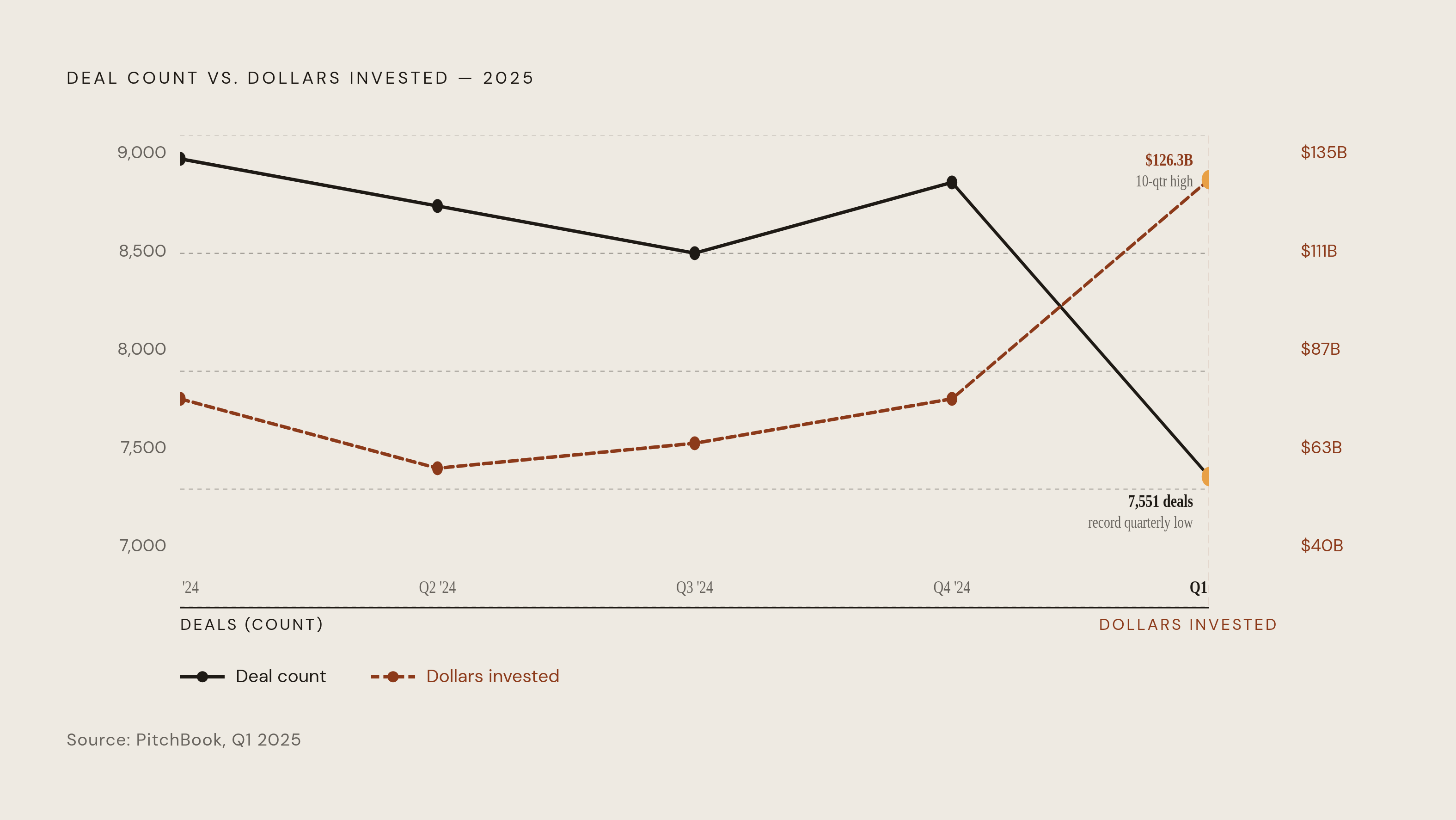
Look at it by quarter and the story gets choppier fast. Q1 hit a 10-quarter high of $126.3 billion, though a huge chunk of that came from OpenAI's $40 billion round in March alone. Pull that one deal out and Q2's drop to $101.05 billion stops looking like a reversal, since removing a $40 billion outlier makes the next quarter look smaller by comparison. Q3 climbed back to $120 billion from $112 billion, which KPMG counts as four straight quarters of underlying growth once you strip out the mega-deal noise. Q4 closed at roughly $141 billion, a 12% jump from Q3 and, per Bain, the strongest quarter of the year. This wasn't just an American story inflating the global number, either. US totals for the full year reached $339.4 billion, a four-year high just short of the 2021 record, according to KPMG. The recovery is real, but it's also lumpy, and one round in March explains a lot of the lumps.
The gap between rising dollars and falling deal count
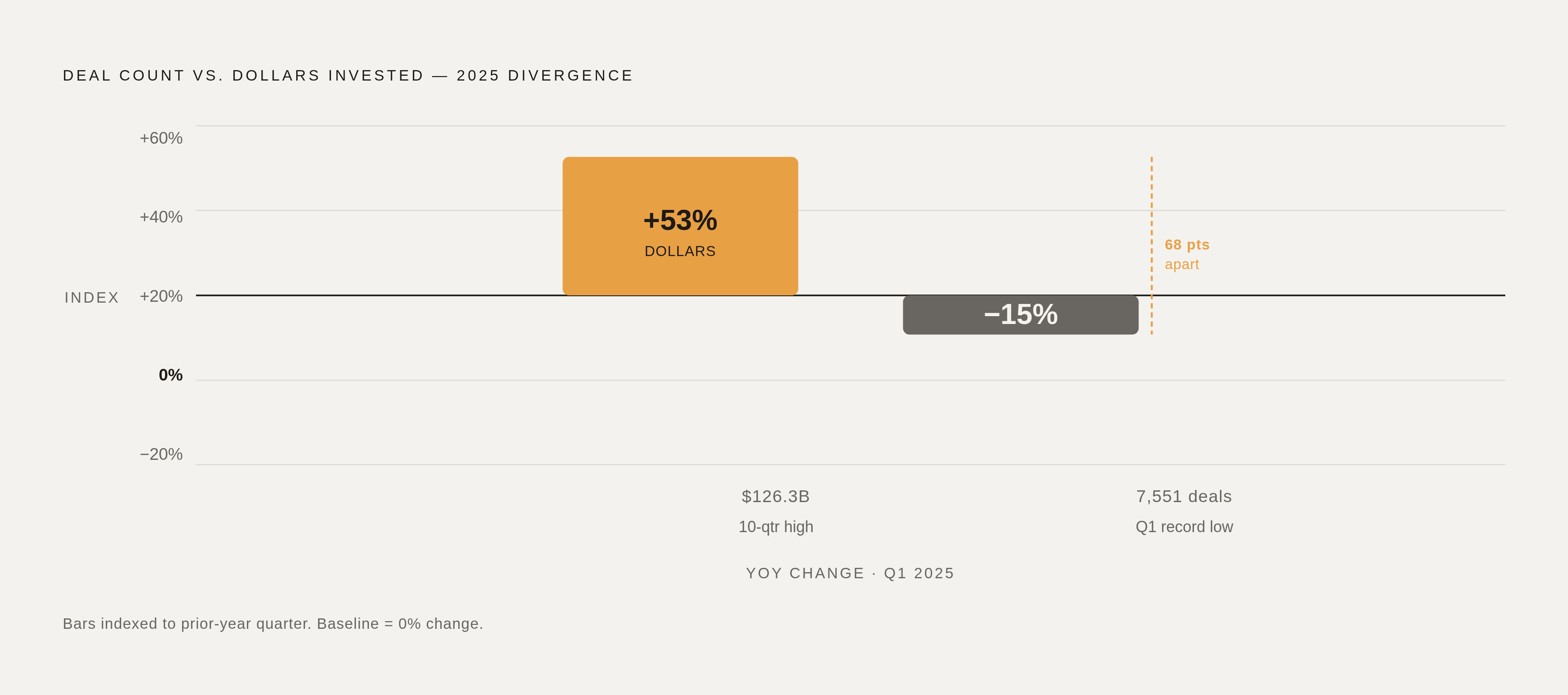
Global deal count dropped 15% year over year in 2025, while the amount of money invested rose 53%. More dollars went to fewer companies, and that gap is the headline here, not a rounding error.
Q1 alone saw deal volume fall to a record quarterly low of 7,551 deals, down from 8,801 the quarter before, per KPMG. That was the worst volume on record, happening at the exact same time dollars spiked to a 10-quarter high. Those two lines shouldn't move in opposite directions like that, and the fact that they did tells you something about who's actually getting funded.
Fewer startups are getting checks written. Average check sizes are climbing because a smaller number of very large rounds now carry more of the total weight. A rising headline number, by itself, can hide a market that's gotten tighter for almost everyone standing in it.
This is the central structural fact of the 2025 market, and most of it traces back to one sector soaking up the capital. The real question isn't whether big companies won and small companies lost; it's whether this concentration is a lasting shift in how venture works, or a temporary distortion tied to one specific race. The next few sections dig into exactly that.
How AI absorbed half the world's venture capital
About half of all global venture funding in 2025, roughly $211 billion, went to AI-related companies, according to Crunchbase. That's up 85% from $114 billion in 2024. The OECD uses a wider definition of what counts as an AI company and lands on an even bigger number: 61%, or $258.7 billion out of $427.1 billion total. The two figures disagree because they're measuring different things, not because one's wrong. Either way you slice it, AI ate the market.
The speed of the shift is the part that actually stops you. AI's share of global VC sat around 7% in 2023, according to Bain, jumped to 15% in 2024, then crossed 25% in 2025 on Bain's numbers, roughly four times bigger in two years. Zoom out further and the OECD's numbers show global annual AI venture investment growing from $8.3 billion in 2012 to $258.7 billion in 2025. Thirty-one times larger in thirteen years, which is the kind of growth curve you usually only see in textbooks about tulip bulbs.
Corporate venture arms piled in too. CVCs took part in a large majority of total AI deal value in 2025, per Bain, pushed along by friendly policy signals and companies wanting AI tools in production faster than they could build them in-house.
AI itself isn't one bet, and treating it like one is where a lot of analysis goes wrong. Infrastructure, meaning data centers, hosting, the physical and cloud backbone underneath everything, became the biggest AI sub-sector at $109.3 billion in 2025, according to the OECD. That's more than two-thirds of what every other AI sub-sector combined pulled in (the combined total of all other AI sub-sectors). Generative AI and foundation models held their own separate lane: $35.3 billion in 2025, roughly one in seven dollars of all AI venture money, up from around 12% in 2023. Infrastructure, foundation models, and application-layer startups are three different bets, drawing different investors, at wildly different scales. Calling all of it "AI" hides more than it explains.
How concentrated the AI funding actually was at the top
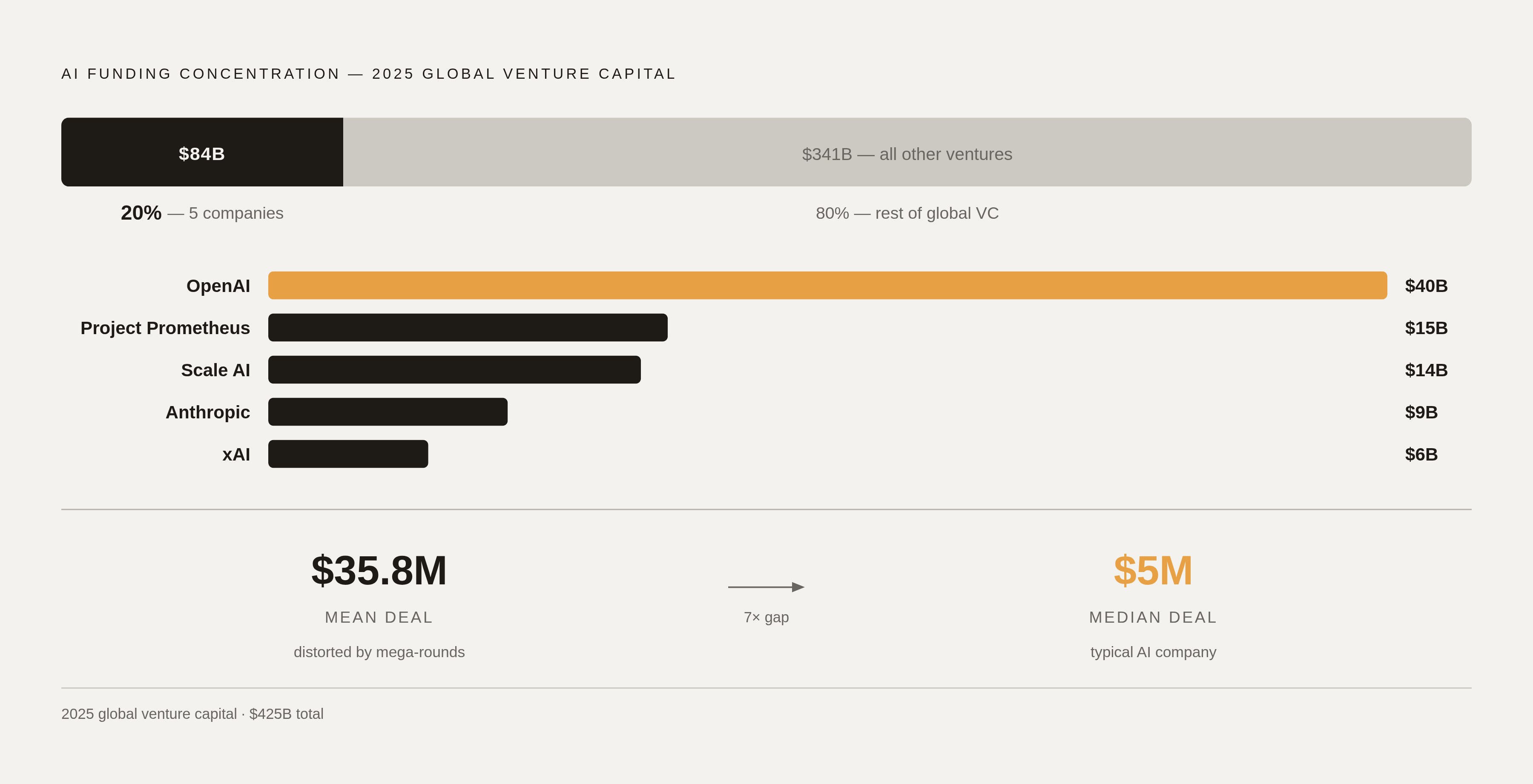
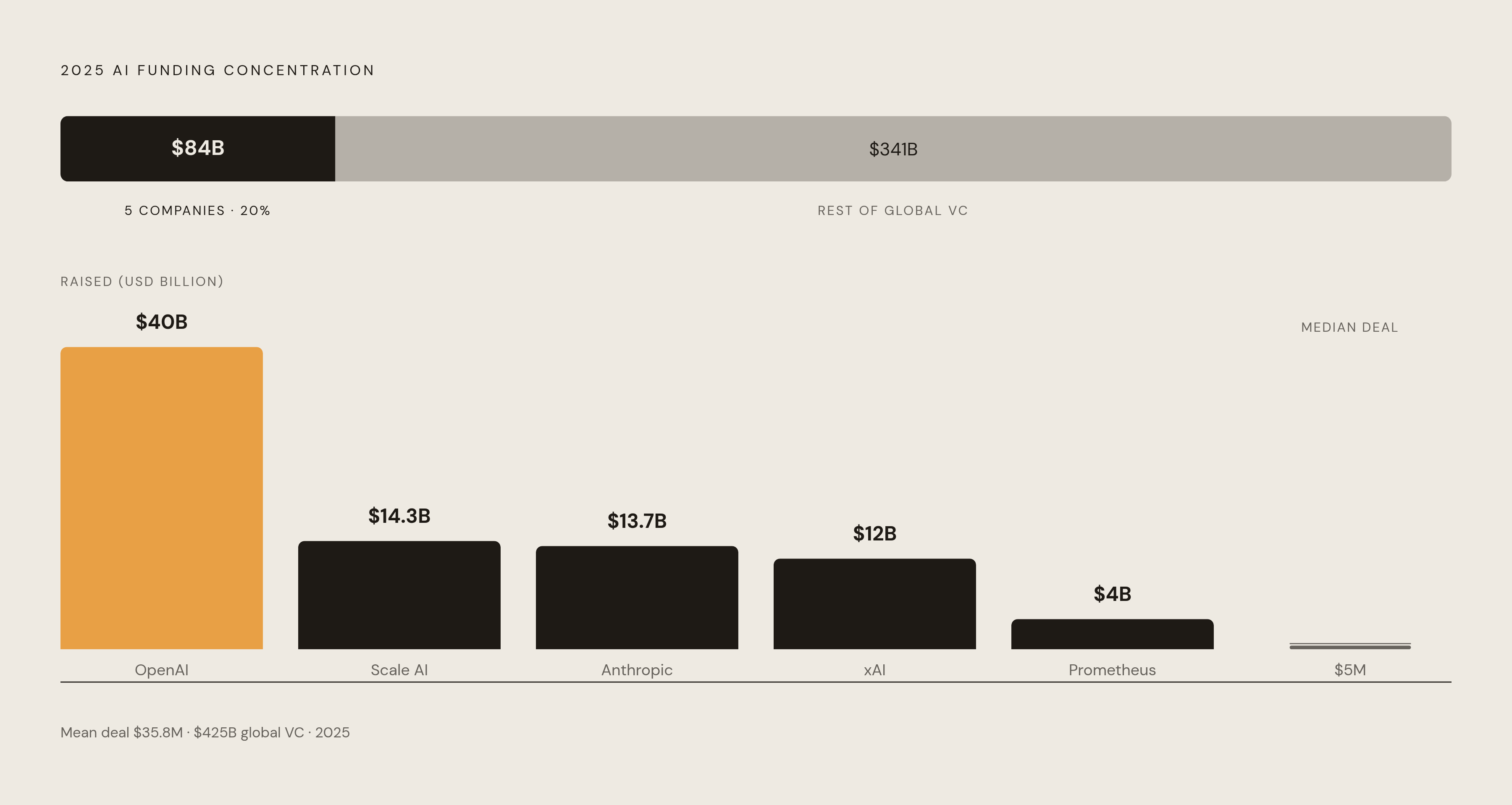
Five companies, OpenAI, Scale AI, Anthropic, xAI, and Project Prometheus, each raised more than $5 billion in 2025. Together they pulled in $84 billion, 20% of all global venture funding for the entire year, according to Crunchbase. One-fifth of the world's venture capital went to five names, and nobody hands you a distribution curve that looks like that on purpose.
The OECD's numbers back this up from another angle: the top five AI mega-deals accounted for nearly $63 billion, and mega-deals overall made up about 73% of total AI venture deal value in 2025.
Now compare that to the typical deal, because the gap is where the real story sits. Mean AI venture deal size grew from about $11.2 million in 2014 to $35.8 million in 2025, per OECD data. Yet the median deal size in 2025 sat at just $5 million. That gap between a $35.8 million mean and a $5 million median is two numbers doing all the talking. A handful of enormous rounds drag the average way up, while the typical AI startup raises something fairly modest.
A meaningful chunk of the 2025 recovery is a few already-massive companies raising at a scale nobody's seen before, rather than a wave of new startups getting funded for the first time. Pull the top handful of rounds out of the data and 2025 looks like a pretty ordinary year. Whether that concentration repeats or was a one-off tied to the foundation-model race is the part that should keep anyone reading this data a little uneasy.
Where capital went geographically, and what widened between regions
The US pulled in nearly two-thirds of global startup funding in 2025, up from a little more than half in 2024, according to Crunchbase. That's a big jump for one year in a market this size. In AI specifically, the US dominance runs even sharper: roughly three-quarters, or the vast majority by dollar volume, of global AI venture dollars went to US companies, per the OECD. The EU27 got a small single-digit share, China about 5%, the UK about 5%, and everyone else is picking at table scraps.
Europe wasn't flat, though, and it's worth giving it its due. Funding there rose modestly to $58 billion for the year, a fraction of the US total but with real texture underneath it. AI became Europe's top sector for startup investment for the first time, hitting a record share of capital raised in Q3 2025, per PitchBook. The UK, France, and Germany led the region by dollar volume, and Mistral AI's multibillion-euro round at a valuation in the tens of billions of euros was the continent's largest deal of the year. Healthcare and biotech came in second in Europe; hardware, covering data centers, defense, quantum computing, and robotics, came third. That's a genuine tilt toward deep tech, beyond just more software wrapped in a pitch deck.
Asia tells a different story, and the gap there is widening rather than closing. Individual deals in the data, rounds in the hundreds of millions in autos, logistics, and aerospace, all landed in Q3 alone, respectable sums but well below the mega-round scale showing up in the US and Europe, according to KPMG. India held a top-three spot globally in private equity and venture flows, and Africa's startup ecosystem posted a sharp percentage rebound, though off a small base, so don't read too much into the percentage alone.
Here's the connective tissue, and it's a simple one: the US share gain and the AI concentration are the same story told twice. The mega-rounds landed in the US, and geography followed the sector, not the other way around.
What sectors beyond AI actually attracted capital
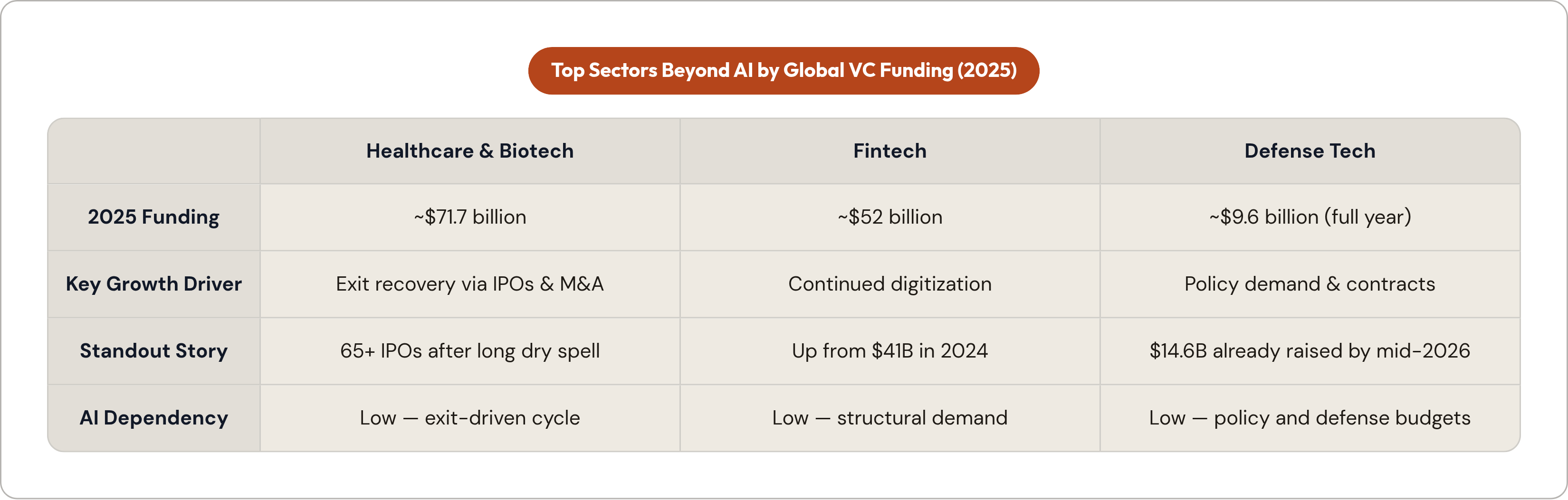
Healthcare and biotech ranked as the second-largest global sector, pulling in roughly $71.7 billion in 2025, a modest bump from 2024, per Crunchbase. Biotech's real news in 2025, though, was less about new money coming in and more about the exits finally working again after a long dry spell.
More than 65 biotech IPOs raised a combined total north of $12 billion in 2025, compared with only around 22 IPOs in 2023, according to Vision Life Sciences. Pharma M&A added to the liquidity: the median acquisition premium for venture-backed biotechs came in at 62% above the last financing round, per the same source. Biotech's comeback is an exit story first and a funding story second.
Fintech ranked third globally, growing from $41 billion in 2024 to $52 billion in 2025, according to Crunchbase. Defense tech, though, has the most forward momentum of anything on this list. The previous annual record for defense tech was $9.6 billion, set across all of 2025; by mid-2026, more than $14.6 billion had already gone into the sector for the current year alone. That means the 2025 total might look small in hindsight.
Europe's mix, AI plus healthcare plus hardware, is worth studying as a small preview of what a venture market looks like when it spreads its bets on purpose instead of piling into one category. Biotech's comeback runs on exits, defense tech runs on policy and demand, fintech runs on continued digitization. None of those three depend on the AI mega-round machine staying at its current pace, which makes them a different kind of bet than everything above.
The fragilities the headline number obscures
Three cracks sit underneath the $425 billion headline.
First, fund formation. LP appetite for new venture funds hit its weakest point in roughly a decade in 2025. That matters because the money deployed today comes from funds raised yesterday, and the pipeline feeding 2026 and 2027 is thinner than the deployment numbers let on.
Second, exits still lag what's going in. Outside biotech, the gap between capital invested and capital returned through IPOs and M&A stayed wide. Most of the liquidity story for 2025 is still owed, not paid.
Third, and this is the big one: five companies taking 20% of all global venture funding signals a structural anomaly rather than a healthy market. If that small cohort of foundation-model companies consolidates, slows down, or simply raises smaller rounds in 2026, the aggregate numbers change shape fast, and not in a gentle way.
Alter Domus frames this as two markets running side by side: one for AI-linked companies raising at a scale that didn't exist a few years ago, and one for everyone else. The 2025 headline number mostly describes the first market. Startups outside AI, and outside the mega-cap tier within AI, faced a tighter year than $425 billion suggests. Fewer deals got done, investors got pickier, and fundraising cycles stretched longer than founders wanted. The recovery isn't fake; $425 billion, 30% growth, third-largest year on record are real numbers. Still, "recovery" describes the total, not what most founders actually lived through trying to close a round this year.
What the 2025 data suggests about 2026
Some signals point up. Q4 was the strongest quarter of 2025, which suggests momentum carries into the new year instead of fading out. AI infrastructure spending, that $109.3 billion figure, sits on a long buildout timeline, and hyperscaler capex commitments give the sector a floor that isn't going anywhere soon. Defense tech's acceleration into 2026 looks like a second theme building alongside AI. If biotech's exit recovery holds, it should give limited partners more confidence to put fresh money back into the sector.
Other signals argue for caution, and they're worth taking seriously. Weak fund formation means the money available to deploy in 2026 and 2027 may not keep pace with what got deployed in 2025. Foundation-model mega-rounds aren't a yearly ritual; OpenAI raising $40 billion in a single round isn't something that happens every March, thankfully, or nobody else would ever raise anything. The 64% US share of global funding partly reflects where the mega-rounds happened to land, and if deal sizes normalize, some of that share probably drifts back toward Europe and Asia. And the falling deal count, if it keeps falling, says something uncomfortable about how narrow the venture ecosystem is becoming underneath all that dollar growth.
Capital is clearly available, and AI has genuinely changed what venture investors care about most. Yet a third-largest year built on unprecedented concentration at the very top is a different kind of strength than the broad startup formation boom of 2020 and 2021. Both years get filed under "good year for venture capital" in the history books. They are not the same story, and mixing them up is exactly how you misread where this market actually stands going into 2026.
Methodology & sources
- https://www.bain.com/insights/global-venture-capital-outlook-latest-trends-snap-chart/
Provided Bain's quarterly figures including Q4's $141 billion and 12% jump, plus AI's share growth from 7% in 2023 to over 25% in 2025.
- https://kpmg.com/ee/en/insights/2025/09/q2-25-venture-pulse-report-global-trends.html
Supplied Q2 2025 global venture funding total of $101.05 billion and deal volume figures showing record quarterly lows.
- https://kpmg.com/sa/en/insights/sector-insights/venture-pulse-q3-2025.html
Provided Q3 2025 figures showing the climb from $112 billion to $120 billion and KPMG's four-quarter underlying growth assessment.
- https://alterdomus.com/insight/global-venture-capital-in-2025-a-bifurcating-market/
Supplied Q1 deal count figures (7,551 vs 8,801) and the framing of two parallel markets — one for AI-linked companies and one for everyone else.