How to Find the Right VC Investors for Your Startup

The headline numbers are genuinely impressive. In 2025, venture and growth investors deployed $425 billion into more than 24,000 companies globally, according to Crunchbase. That's a 30% jump from 2024's $328 billion, making it the third-highest financing year on record.
Those numbers are almost meaningless if you're a pre-seed or seed founder.
More than a third of all 2025 global funding went to just 68 companies that each raised $500 million or more. The headline is "$425 billion deployed." The reality is that a small number of enormous rounds are doing most of the heavy lifting on that figure. Think of it like an iceberg: the number you see floating above the surface looks massive, but most of the mass sits somewhere you can't easily reach.
Sector concentration tells the same story. About half of all global venture funding in 2025 went to AI-related companies. Healthcare and biotech second. Financial services third. If your company doesn't fit neatly into one of those buckets, the addressable capital pool shrinks considerably. Then geography concentrates it further. The U.S. captured nearly two-thirds of global startup funding in 2025, and within the U.S., California, New York, and Massachusetts alone account for more than half of all venture capital deployed.
So when you see "$425 billion," mentally replace it with: "How much of that actually reaches companies at my stage, in my sector, in my geography?" The answer is usually a number that sounds a lot less exciting.
A few things fall out of this that are worth naming directly:
- The AI boom has caused a lot of firms to quietly pivot their thesis without updating their website. A fund that was investing in enterprise SaaS in 2022 has quietly reoriented toward AI infrastructure by 2025. You cannot trust web copy.
- There are over 2,500 active VC firms in the U.S. The challenge is not finding investors. It's filtering down to the ones for whom your deal is actually the right shape.
- The money exists. It's just unevenly distributed in ways that aren't obvious from the outside, and figuring out where your slice actually lives is the first real piece of work.
How VCs Structure Their Investment Thesis — and Why Misreading It Wastes Your Time
Every VC firm operates under a defined thesis. Which stages. Which sectors. Which geographies. Which check sizes. A pitch that falls outside the thesis doesn't just get deprioritized. It almost never gets funded, regardless of how good the business actually is.
The problem is that a fund's stated thesis and its actual current behavior are often two very different things. A firm's website still describes a 2022 focus on developer tools while their real 2025 portfolio is full of AI infrastructure bets. Thesis evolves with each new fund cycle, with macro shifts, and with whatever the partners are personally excited about right now. The website doesn't always keep up.
So where is thesis actually legible?
- Recent deal history. Look at what the firm has written checks for in the past 12 to 18 months on Crunchbase or PitchBook. Behavior beats self-description every time.
- Partner writing and speaking. Blog posts, podcast appearances, conference talks. Partners write about what they're actively thinking about, not what they funded three years ago.
- Fund announcements. When firms close new funds, they often describe the focus publicly. That's a real signal, and it's usually more current than anything on their About page.
Milad Alucozai of Good AI Capital has noted that every fund has its own unique characteristics, whether that's the mandate or the backgrounds of the partners themselves. That framing matters more than it seems. Thesis isn't just institutional. It's personal. Each partner within a firm often has their own sub-thesis based on their background and networks, which means you're not just targeting the right firm. You're targeting the right partner within the right firm. That distinction will matter when you get to outreach.
Filtering by Stage, Check Size, and Fund Math Before Touching a Single Database
Stage alignment is a hard constraint. No pitch quality, no charm, no relationship can overcome a stage mismatch. Yet stage mismatch is the single most common targeting error founders make, and it usually comes from reading a firm's self-description rather than looking at what they've actually funded recently.
A quick working map of the stages:
- Pre-seed: Vision-stage, often pre-product. Typical rounds range from $50,000 to $500,000. Investors are essentially betting on the founder and the idea. Metrics are rarely the point.
- Seed through Series C and beyond: Structured institutional rounds ranging from $500K to well over $100 million. Traction, market evidence, and a real financial model become increasingly required as you move up.
Fund size math is where a lot of founders quietly miscalculate. A small investment that returns a few multiples is genuinely meaningful to a small fund. It's a rounding error to a large fund. You need to match your realistic exit ceiling to the fund's return requirements. If your exit looks like a modest acquisition, avoid pitching a fund that needs billion-dollar outcomes to move the needle. The math simply doesn't work in your favor. Pitching the wrong fund size is like trying to fill a swimming pool with a garden hose — technically possible, but nobody's impressed and you've wasted everyone's afternoon.
Before you open a single database:
- Know your raise amount. It immediately eliminates funds that are too large or too small for your check size.
- Find the firm's most recent fund size when it's available. That number tells you what deal size actually matters to them.
- If a firm's recent deals are consistently larger than your round, they've moved upstream. The website still says "seed." The behavior says otherwise.
Building the Actual Target List Using Databases, Portfolios, and Real Deal Signals
Okay. Now you can open a database.
The right tools for this part:
- OpenVC is a database of over 20,000 startup investors that you can filter by stage, sector, and geography. It's purpose-built for exactly this work.
- Crunchbase gives you deal history, recent investments, and round sizes. Use it to validate thesis alignment against actual behavior.
- PitchBook goes deeper on fund-level data, including fund sizes and LP relationships. More useful for growth-stage targeting.
- The Forbes Midas List is a directional signal for identifying respected, active investors in a category. It's not a targeting list on its own. Use it to surface names worth researching further.
When you're reading a firm's recent portfolio, the questions that matter:
- Has this firm done a deal in my sector in the last 18 months? Not ever. Recently.
- Does my company complement their existing portfolio, or does it compete with something they already own?
- Which partner led the most relevant recent deal? That partner is your actual target contact, not the firm's generic info email.
Geography matters here too. If you're not in a major hub, filter explicitly for geo-agnostic funds or active regional investors. Don't assume a coastal fund has national reach just because venture capital is theoretically borderless.
On list hygiene: build a working spreadsheet. Firm name, specific partner, their most relevant recent deal, fund vintage, and your contact pathway. Keep it updated. Stale lists are the source of most wasted outreach.
A focused list of 20 to 40 well-researched names is more useful than a spray of 200 loosely qualified ones. The quality of your targeting is the whole game.
Why Warm Introductions Convert at a Fundamentally Different Rate Than Cold Outreach
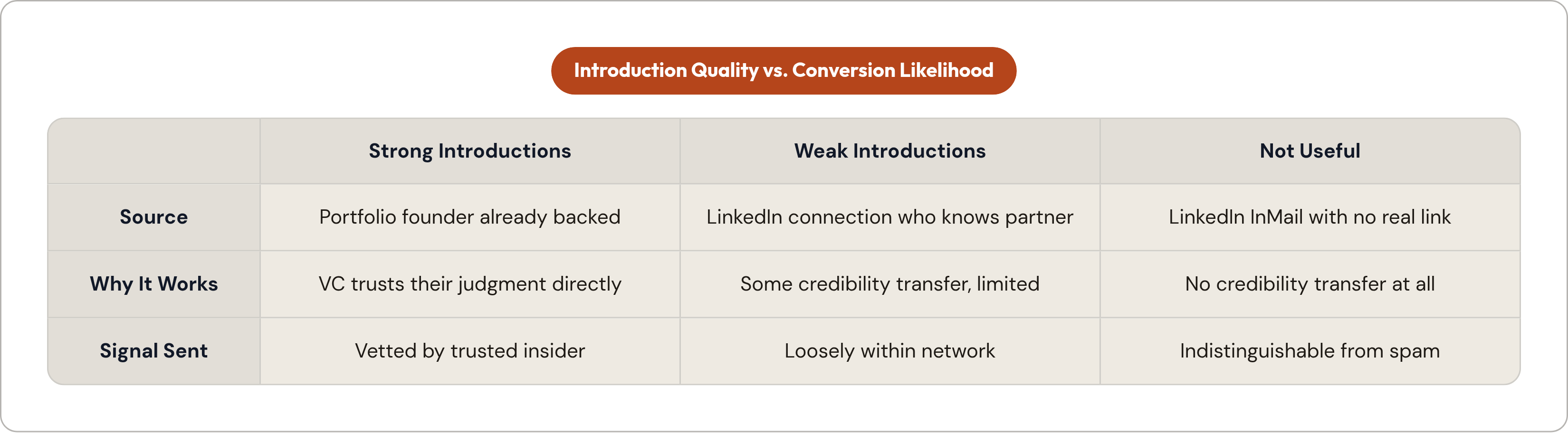
Here's a number worth sitting with. A large majority of VC deals originate through professional networks, co-investor referrals, or portfolio-company introductions. Cold, unsolicited inbound generates a small fraction, according to a Harvard Business School survey of nearly 900 institutional VCs.
That gap is not a coincidence, and it's not pure gatekeeping either.
A busy VC partner sees thousands of inbound pitches a year. A warm introduction does something a cold email structurally cannot. It transfers credibility from a trusted relationship directly to you. It signals that you have a functional network, which is itself a signal about your ability to execute. And it gets your email actually opened by the right person rather than filtered out by an associate or quietly buried.
What counts and what doesn't:
Strong:
- A portfolio founder the VC has already backed
- A co-investor who has worked with the VC directly
- A trusted mutual operator or advisor with a genuine relationship
Weak but still better than nothing:
- A LinkedIn connection who knows the partner professionally
- A conference acquaintance of the VC
Not useful:
- A LinkedIn InMail claiming a shared connection neither of you actually has
- A cold email that says "I was referred by your website"
Cold outreach isn't dead. But its bar is much higher than most founders treat it. For a cold email to actually work, it needs to demonstrate such specific, well-researched thesis alignment that it functions almost like a written proof of why this particular VC should care about this particular deal. Most cold emails don't come close to that bar.
How to Engineer Warm Introductions When You Don't Yet Have the Right Relationships
The most reliable path is to work backward from the VC's own portfolio.
Identify two or three portfolio founders whose companies are adjacent to yours. Not competitors. Adjacent. Companies the VC has already backed in a related space. Reach out to those founders directly, be genuinely useful to them first, and build a real relationship before you ask for anything. An introduction from a portfolio founder carries real weight because the VC already trusts their judgment and has a live relationship with them.
Beyond that:
- Activate your existing investors. If you've raised any prior capital, your current angels or advisors are the most natural bridge. They likely have LP relationships, co-investment histories, or fund connections that map directly to your next target. Ask them explicitly and specifically, not just "do you know anyone?"
- Use accelerator and angel networks. Angels and accelerator partners often have direct VC relationships built over years of co-investing. A warm intro from an angel who has invested alongside a VC is a stronger signal than most founders realize.
- Show up in the right rooms. Demo days, sector-specific conferences, and founder communities aren't primarily for pitching. They're for establishing name recognition before formal outreach ever begins. A VC who has seen you speak, or heard your name from people they respect, will read your cold email with a completely different posture than one who is seeing your name for the first time.
When cold outreach is genuinely your only path, here's what makes it work:
- Reference a specific investment they've made and explain clearly why your company is the logical next step in that thesis
- Be brief and precise. Density of relevant signal per sentence matters more than length.
- Make a clear ask. A specific meeting request with a one-paragraph reason why it's worth their time, not "let's find time to connect."
What VCs Are Actually Evaluating During Initial Diligence, and How to Prepare for It
VC diligence formally covers six areas: financial health, legal compliance, market analysis, product viability, business model sustainability, and team capability. That's the checklist version. Here's how it actually plays out.
At early stage, team weight is disproportionate. Founder quality and team execution ability often outweigh product strength when a fund is making a seed bet. Investors are not just evaluating what you've built. They're evaluating your ability to navigate everything you don't yet know, which at seed stage is most of it.
The four things that get looked at most closely:
- Team. Complementary skills, relevant domain experience, and some demonstrated ability to hire and lead. A solo founder with no apparent network raises real questions. Two or three complementary people with genuine domain experience raises confidence.
- Market. TAM credibility. Not a large number pulled from a market report, but a defensible argument about why this market is large, growing, and addressable by your specific approach.
- Product and traction. Evidence of market fit appropriate to your stage. Early revenue, strong retention, pilot customers, or compelling qualitative signal. The underlying question is simply: do real people want this?
- Unit economics. Customer acquisition cost, lifetime value, contribution margins, payback period. Growth that works financially is different from growth that burns capital to generate revenue. Experienced investors can tell the difference quickly.
Diligence is getting more rigorous. Investors in 2025 expect organized digital data rooms, clean legal records, and real-time access to financial systems from earlier in the process than they did even a few years ago. Gaps or inconsistencies in your financial model are immediate red flags, not things you can patch up later.
Before your first meeting, have ready:
- A clean, current financial model with stress-tested assumptions, not just your best case
- A bottom-up market sizing methodology built from real customer segments and pricing, not a top-down TAM number
- Traction evidence appropriate to your stage, whatever honest signal you have that real people want what you're building
Running Your Outreach Process as a Funnel, Not a Series of One-Off Bets
Fundraising is a sales process. Most founders refuse to treat it like one.
The typical pattern is to meet with one investor, wait around for feedback, get discouraged, then cautiously approach another. That approach is slow, emotionally draining, and gives you almost no useful data to work with. You're essentially flying blind between each conversation.
The right frame is a funnel you're actively managing:
- Top of funnel: Your 20 to 40 researched targets, tiered by fit and relationship warmth
- Middle of funnel: Active conversations, first meetings, and requested materials
- Bottom of funnel: Term sheet conversations and live diligence processes
Work it in parallel, not in sequence. Create a real timeline. Most successful fundraising rounds close within a defined window, often two to three months of active outreach. Momentum matters more than founders expect. VCs talk to each other, and genuine interest from one investor influences how others read you.
A few things that make the process survivable:
- Track everything. A simple spreadsheet with investor name, partner, last contact date, status, and next step. Treat it like a CRM because that's what it is.
- Batch your outreach. Reach out to multiple investors in the same week so you're managing conversations in parallel. This creates natural momentum and surfaces real data on what's resonating versus what's not.
- Treat rejections as signal. A pattern of "you're too early" means something different from a pattern of "we don't invest in this sector." Both are useful information. Neither is personal, even when it feels personal.
- Protect your operating time. Fundraising will eat your entire calendar if you let it. Block time for it deliberately and protect the rest for actually running your company. A company that visibly stalls during a fundraise is harder to close, not easier.
The founders who raise well aren't always the ones with the objectively best companies. They're the ones who ran the most disciplined process. They did the filtering work upfront, built real relationships before they needed them, prepared materials that held up under scrutiny, and treated the whole thing as a funnel to be actively worked rather than an outcome to be hoped for.