LP Capital Call and Distribution Mechanics
Understanding how GPs draw capital and LPs get paid back.

A capital call is a formal request from the GP asking an LP to wire over a slice of the money they promised. Distributions are the payout on the other end, governed by a waterfall that decides who gets paid first when a deal exits. Together they form the two mechanical pillars of a private fund, and if an LP does not understand the wiring, a decade-long commitment gets a lot harder to plan around.
Committing a large sum to a fund does not mean that same amount leaves an LP's account on day one. That cash sits right where it was until a notice asking for a slice of it appears. Fund size is a number describing pledged capital, not cash sitting in a vault somewhere. Venture capitalists, despite running funds with "billion" in the name, actually have very little cash on hand at any given moment. Almost all of it is uncalled commitment, parked with LPs who are putting it to work elsewhere until the notice lands.
Staged deployment exists because GPs only need money when they actually need it: when a deal is closing, a fee is due, or an expense needs covering. Calling everything up front and letting it sit in a fund's checking account earning nothing would be a poor use of capital. So the GP draws in pieces, and the LP keeps the uncalled portion productive until the notice lands.
The LPA governs every GP and LP right
The founding fund agreement between the general partner and limited partners creates the fund. It governs everything between GP and LP from first close to final dissolution, a stretch that typically runs ten years or more. If a right is not written into the LPA, it does not exist. Side conversations, verbal assurances, a friendly email from the GP saying "don't worry about it" carry no legal weight. Only the document does.
What's actually in there goes well past fee structure. The LPA spells out when and how capital can be called and for what purposes it is allowed to be called. It sets the investment mandate covering asset classes, geographies, and deal size ceilings, along with the fee structure, the full distribution waterfall, and what happens if an LP misses a call. It defines a limited partner advisory body and what needs its sign-off, who counts as a "key person" and what happens if that person leaves, reporting obligations, and how the fund winds down at the end of its life.
The timing works against the LP structurally. The LPA tends to show up late in diligence, often with a review window of ten business days or fewer. These documents run 80 to 150 pages in most buyout structures, dense with cross-referenced defined terms. Walking away at that point is not free either: there is reputational cost, and possibly a lost allocation in a fund that will not reopen for years. So the read has to be fast and precise.
What every capital call notice must contain
A modest draw from a small fund and a far larger draw from a mega-buyout vehicle both follow the same six-step sequence.
First, the GP identifies a need, which could be a new deal closing, a management fee coming due, a fund expense to cover, a portfolio company needing follow-on money, or the fund needing to repay short-term borrowing. Second, the fund administrator runs the math: pro-rata share based on commitment size. A commitment representing 10% of a fund's total size means a call triggers a wire equal to that same 10% share from that LP. Third, the notice goes out, and it must state the total amount called, each LP's individual share, the purpose, wire instructions, and the deadline.
Fourth, LPs should verify everything before wiring: check the math against the commitment, confirm the stated purpose is permitted under the LPA, verify the wire instructions through the fund's approved channel, and check whether any side-letter terms change the obligation. Fifth, the LP wires the funds by the deadline. Sixth, the administrator records it: paid-in capital goes up, uncalled capital goes down, and the ledger moves on.
The notice window itself usually runs 10 to 20 business days, though some arrangements provide as few as seven to ten days. Best-practice guidance calls for the notice to state the exact dollar figure for each LP, the due date, a reference to the LPA section authorizing the call, and wire instructions. None of that is optional, and none of it should be vague.
Pro-rata is not always a clean, uniform calculation across every LP. Side letters can grant a specific LP sit-out rights on a particular investment, or set a later closing date with different economics, or reflect a prior default that changes how future calls apply to that investor. Two LPs with identical commitment sizes can receive two very different numbers on the same notice.
Management fees are not a once-a-year invoice. They ride inside regular capital calls, so LPs should expect a call even in quarters when the GP has not closed a single new deal.
During the investment period, the standard fee is between 1.5% and 2.0% of committed capital, though the market average has drifted toward 1.74% of committed capital, according to Alterdomus. Once the investment period ends, the fee base shifts from committed capital to invested capital, and the rate typically steps down to 1.0% to 1.5%. That reduction in cash burden changes the size of calls even when nothing else about the portfolio has changed.
GPs generally put 2% to 5% of the total fund's capital in alongside the LPs, a signal that the GP's returns depend on the same outcomes it is managing toward.
Default consequences when an LP misses a call
Missing a capital call is a breach of contract, governed by whatever the LPA says about default. A shortfall can blow up a deal closing, damage the GP's standing with co-investors and sellers, and ripple through the rest of the fund's obligations.
LPAs handle this with a layered set of consequences that escalate the longer the default runs. First, the defaulting LP loses voting rights and the right to receive distributions. Second, the GP charges penalty interest on the unfunded amount, typically 12% to 18% annually. Third, the GP can force a sale of the defaulting LP's entire interest, often at a steep discount, sometimes 50% or more below fair value. Fourth, and most severe, the LP can forfeit 25% to 50% of the capital it has already funded, with that forfeited amount distributed to the non-defaulting LPs.
Most LPAs build in a cure period, usually 10 to 20 days past the original due date. This is a formal legal window in which a default notice gets issued and the clock starts ticking. Paying during that window still means incurring 12% to 18% penalty interest. The cure period extends the timeline; it does not eliminate the penalty.
Consider a sizable commitment where the large majority has already been called and funded. If the GP forces a sale at a 50% discount to fair value, the LP is not just losing the unfunded commitment. The forced sale applies to the capital already in the fund, not just the piece still outstanding, turning a cash-flow problem into a realized loss on previously funded capital.
How sub-lines bridge deal timing gaps
Subscription credit facilities, known as sub-lines or capital call facilities, are loans made to the fund itself, underwritten against the strength of LP capital commitments rather than the fund's portfolio assets. The collateral is the fund's contractual right to call capital from its LPs. If the fund defaults on the facility, lenders can step directly into the GP's position and issue capital calls independently.
The scale of these facilities has grown substantially. On February 7, 2025, 26North Direct Lending LP entered a Loan and Security Agreement providing a senior secured revolving credit facility of $250 million, expandable up to $750 million, with the borrowing base tied directly to unfunded LP commitments.
GPs reach for sub-lines because deals close on the seller's timeline, not the LP's notice period. A sub-line lets a GP fund a closing immediately using the credit facility, then issue the capital call afterward to repay the loan, rather than delaying a deal for two or three weeks while LP wires arrive.
The J-curve: an LP's actual cash-flow experience
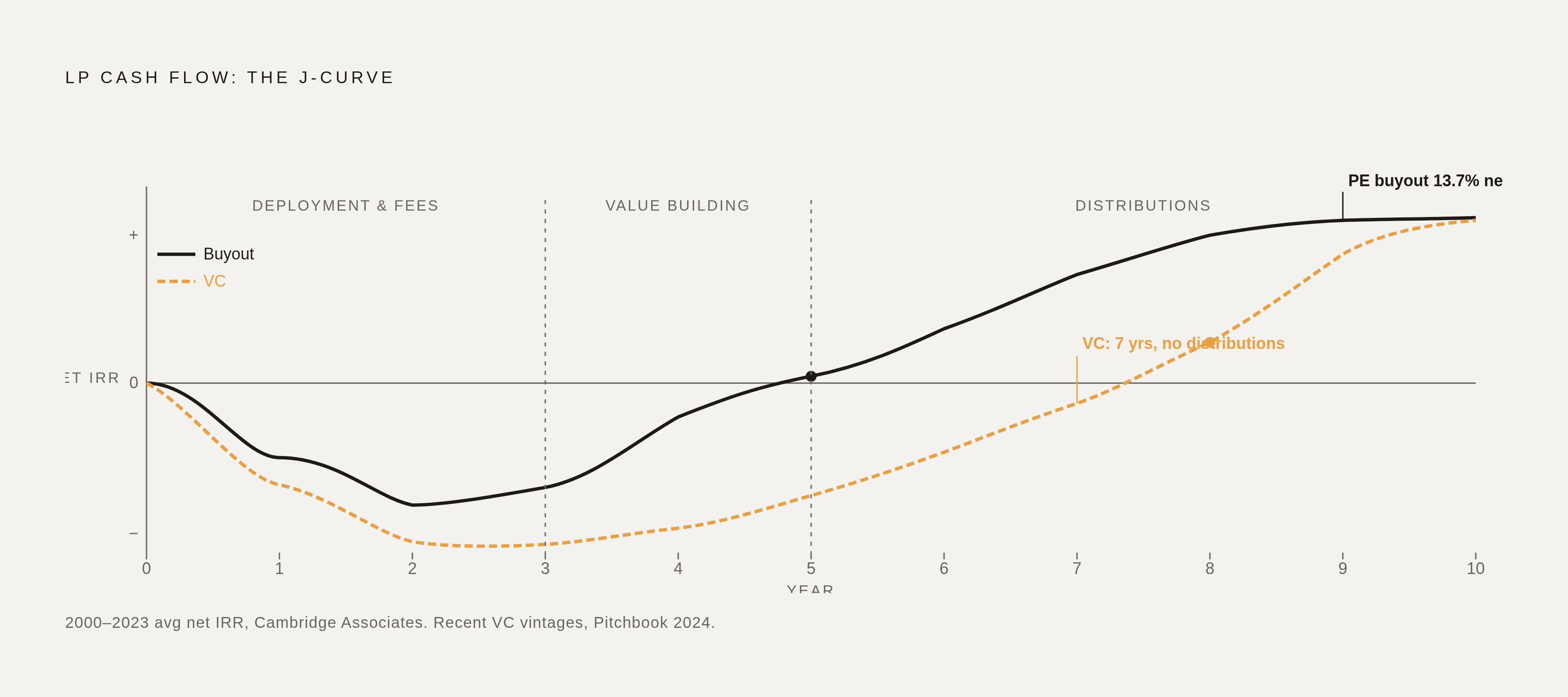
Plot an LP's cash flow across the life of a fund and it traces something close to the letter J. Years one through three run net negative as capital gets called and put to work, with management fees creating outflows the entire time. Distributions start showing up in years five through ten as portfolio companies get sold or taken public, and the cumulative cash-flow line finally turns positive.
The initial negative phase occurs because management fees and called capital are immediate cash outflows, while the value created inside the portfolio builds for years before an exit converts it into cash returned to LPs.
The depth and length of the negative phase depends heavily on asset class. Venture funds run a deeper, longer negative period than buyout funds. A large share of VC funds from recent vintages have gone years without distributing a single dollar back to investors, meaning LPs in those funds have seen paper markups but no realized returns seven or more years into the fund's life.
Buyout funds show a steadier pattern. PE buyout funds averaged a 13.7% net IRR from 2000 through 2023, though that headline number covers a wide gap between top-quartile and bottom-quartile managers. The rate environment since 2022 has compressed multiple expansion, leverage efficiency, and operational improvement simultaneously, which makes manager selection more consequential than it was when rates were near zero.
How distribution waterfalls sequence every exit dollar
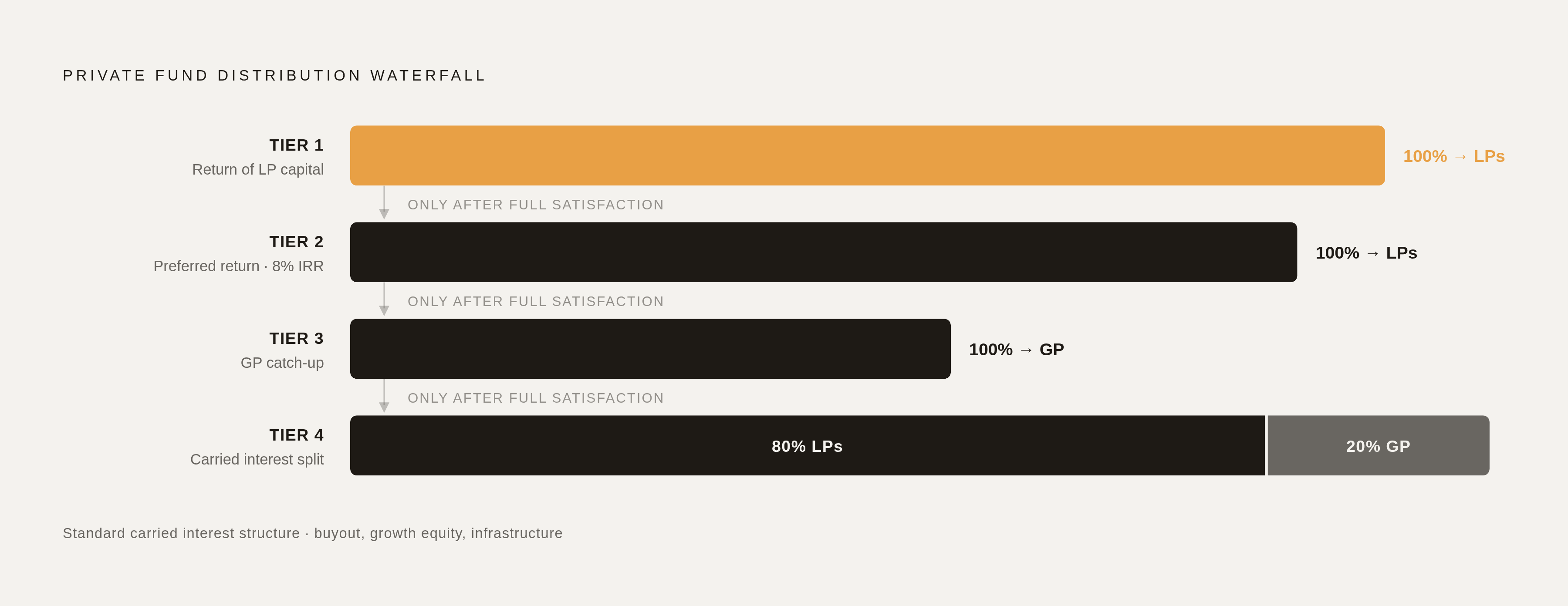
The waterfall is the contractual structure, written directly into the LPA, that determines the order, timing, and size of every dollar coming out of the fund when an investment gets sold. A properly structured waterfall ensures that LP contributed capital plus a minimum return is paid out before the GP receives any profit allocation.
The standard structure runs four tiers. Tier one returns the LPs' contributed capital before any profit gets allocated. Tier two pays the preferred return, and 8% IRR is the widely cited preferred return benchmark across buyout, growth equity, and infrastructure funds. Venture funds, investing further out on the risk curve, sometimes skip the hurdle entirely. Tier three is the GP catch-up, where proceeds flow to the GP until its cumulative share matches the agreed carry percentage. Tier four splits everything remaining 80/20 between LPs and the GP, the standard carried interest arrangement.
On a hypothetical investment that returns capital plus a meaningful profit, running the proceeds through a standard waterfall shows LPs receiving back their capital plus preferred return before the GP collects any carry, with the remaining upside split 80/20 between LPs and the GP.
The most consequential structural choice in the waterfall is American versus European structure. A European, or whole-fund, waterfall does not permit the GP to collect carry until every LP has received back all contributed capital plus preferred return across the entire fund. An American, or deal-by-deal, waterfall calculates carry investment by investment, allowing the GP to collect carry off the first exit even if later deals in the same fund lose money. The American structure increases the probability of a clawback later in the fund's life if early winners turn out to be outliers.
The notice sequence, the default terms, and the waterfall tier structure all live inside a document that is easy to skim and expensive to misread. A process with this many interdependent legal steps requires documenting the sequence carefully, identifying what needs a second review, and requiring confirmation before capital moves.

