Venture Capital Dry Powder and Deployment Pressures
Aging venture funds face mounting pressure to deploy billions before investment deadlines expire.

Venture capital is sitting on hundreds of billions in dry powder that hasn't been put to work yet, and a good chunk of it is getting old. Not old like your uncle's fantasy football league, old like "the fund is contractually obligated to spend this money or give it back" old. That's the story right now: less about how much capital exists, and much more about the clock attached to it. We're talking about a global private equity and venture capital market that raised over $476 billion in a single year at its recent low point, with U.S. dry powder alone hovering near $1.1 trillion even after a record-breaking deployment year.
The funds that raised aggressively during the 2020 and 2021 boom are now deep into their harvest phases, while the massive 2022 and 2023 vintage funds are hitting the midpoint of their investment periods simultaneously, creating a synchronized pressure wave unlike anything the industry has seen in recent memory. General partners who were too cautious during the rate-hike standoff are now running out of runway, limited partners who expected distributions years ago are openly fatigued, and founders are caught in the middle of a capital market that is both abundant and weirdly inaccessible depending on what sector you're in and which tier of fund you're talking to.
Understanding the mechanics behind all of this — how fund lifecycles work, why the 2022 to 2024 freeze happened, what snapped back in 2025, and where the pressure lands next — is the difference between reading the fundraising environment clearly and getting blindsided by it.
How fund clocks turn dry powder into obligation
A typical venture fund runs about ten years. The first half is for deploying capital, the second half is for harvesting it, exiting positions, and sending distributions back to the people who funded it (limited partners, or LPs). The investment period, meaning the window where a general partner (GP) is actually allowed to call capital and put it into new deals, is a fixed term spelled out in the LP agreement.
When that window closes, there are exactly three options: the GP has deployed the capital, the GP returns what's left, or the GP goes back to LPs asking for an extension. None of those are fun conversations. An extension request in particular tells LPs something they don't want to hear, which is that the fund didn't move fast enough.
And here's the part that makes this personal for GPs, not just procedural: raising the next fund depends almost entirely on how the current one performs. A fund that limps into its deadline with capital still sitting on the sidelines sends a signal, and the signal isn't "patient and disciplined." It's "couldn't find deals" or "couldn't make decisions." Neither helps at the next fundraise.
The aging problem is already visible in the data. Funds from the 2020 vintage are well into their harvest phase, with most of their original capital already deployed. Funds from 2022 and 2023 are now hitting the midpoint of their investment periods, and the pressure is turning from background hum to alarm bell. Capital held four years or more now makes up a growing share of total dry powder, a proportion that has risen meaningfully over just the past couple of years. The money isn't getting more patient. It's getting more anxious.
Why capital piled up and then stalled
Here's how you end up with a wall of unspent cash: firms kept raising aggressively through 2021 and 2022, even as the deals themselves slowed to a crawl. Commitments kept flowing in the front door while capital stopped walking out the back.
Then the Federal Reserve moved rates from near-zero to a range of historic highs across 2022 and 2023, and the cost of capital for everyone (LPs included) jumped overnight. New commitments got harder to justify, existing deployment slowed further, and the whole machine downshifted.
Layer a valuation standoff on top of that. Sellers were still anchored to 2021 price tags, buyers had already repriced to the new rate environment, and neither side wanted to blink first. Deal volume dropped, but the capital overhang didn't go anywhere, because a standoff doesn't destroy dry powder. It just parks it.
Meanwhile the exit doors slammed shut. IPOs mostly stopped, M&A volume fell, and portfolio companies that were supposed to exit and free up LP capital just... stayed put. GPs kept managing them longer than planned, which ate up time and attention that should have gone toward new deals. Distributions to LPs fell to multi-year lows, and LPs responded the way anyone responds to a friend who keeps promising to pay them back: they got tired of hearing it.
That fatigue shows up directly in the fundraising numbers. Global PE fundraising fell about 20% from its 2021 peak down to $476 billion, with only 531 funds closing, the lowest count since at least 2008. Venture fared worse: close rates hit a ten-year low of 39% in 2025, the weakest of any fund type, and first-time funds now take 16 to 20 months to close compared to 12 to 15 months historically. And because so much of the current dry powder is stacked into the 2022 and 2023 vintages specifically, the deployment deadlines aren't staggered across the industry the way they'd normally be. They're stacked up like flights waiting to land at the same airport.
What actually drove the 2025 rebound
Then 2025 happened, and the numbers snapped back hard. U.S. private equity logged over 9,000 transactions totaling $1.2 trillion, only the second time in history annual deal value has crossed the trillion-dollar mark. Megadeals ($1 billion or more) drove a lot of it: about 150 of them, adding up to $567.8 billion, actually topping the 2021 record of $528.2 billion despite a slightly lower deal count.
Three things unlocked this. The Fed cut rates three times in the back half of 2025, lowering the cost of capital. A tariff-driven pause that had frozen deals in the second quarter resolved itself as the macro picture cleared up. And the exit environment started improving, with double-digit growth in exit volume giving GPs a reason to believe capital might actually start moving again in both directions.
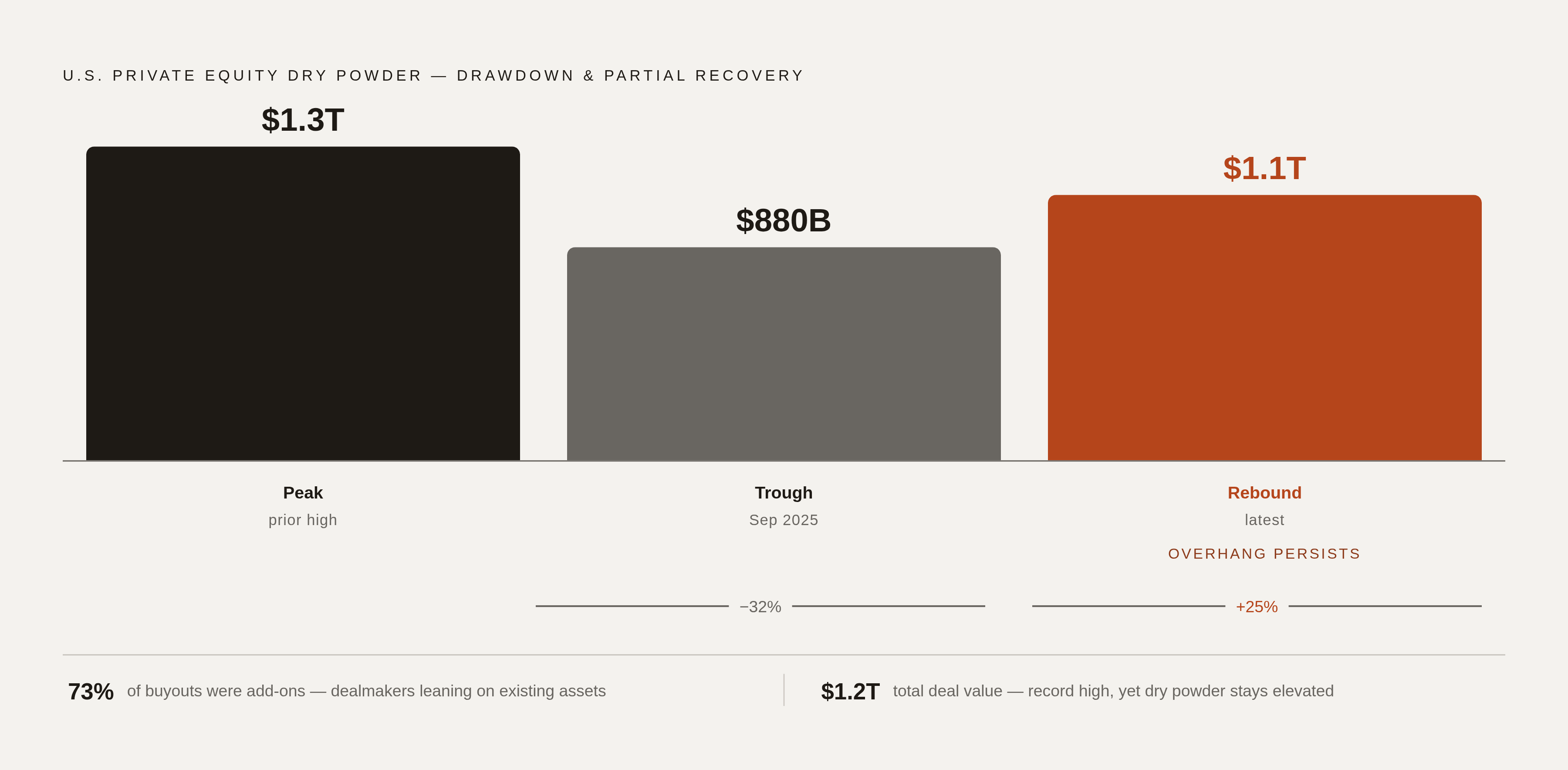
Don't mistake activity for resolution, though. U.S. dry powder fell from a peak near $1.3 trillion to roughly $880 billion by September 2025, a 32% drop, but current estimates put it back up closer to $1.1 trillion. The drawdown never actually cleared the overhang, it just took a lap around the block.
Firms are also still playing it cautious under the hood. Add-ons (smaller bolt-on acquisitions to existing portfolio companies) made up 73% of buyouts in 2025, which tells you GPs are still wary of committing to brand-new platform bets. As rates keep easing, expect a slow shift back toward those bigger, riskier platform deals. The exit environment showed meaningful improvement year over year, which sounds great until you remember it's still nowhere near enough to clear the backlog of companies waiting for liquidity. Corporate venture arms picked up some of the slack too, with corporate venture arms ramping up strategic investing in the third quarter, adding a second current of capital flow alongside traditional VC.
AI swallowed VC and left scraps behind
AI didn't just have a good year in 2025. It ate the year. AI companies pulled in a dominant share of all venture funding, capturing more mega-deal dollars than any other sector by a wide margin, though the full cross-sector breakdown remains difficult to pin down precisely. Strip AI out of the numbers, and the "rebound" everyone's celebrating looks a lot thinner.
The mechanism is concentration, not breadth. This isn't hundreds of AI startups each getting a modest check. It's a small number of enormous rounds doing the heavy lifting. In individual months throughout 2025, AI companies consistently claimed the majority of mega-deals that closed.
Why AI specifically? A few reasons line up conveniently. It's software, so it's tariff-resistant and scales globally without a physical supply chain to worry about. It gives GPs a clean story to tell LPs about why paying up at current valuations makes sense. And it can absorb enormous check sizes, which matters a lot to mega-funds that need to deploy at scale before their clock runs out. A fund with substantial capital left to place against a hard deadline doesn't want to write dozens of small checks. It wants a small number of very large ones, and AI has been happy to oblige.
Everything else is left fighting over what remains. Non-AI B2B SaaS companies in particular are facing a much tougher fundraising environment than the headline "record year" numbers would suggest. LP fatigue is real, GPs are picky, and the picky-ness lands hardest on companies without an AI narrative to lean on.
Top funds hoarding capital, everyone else scrambling
The concentration isn't just happening at the sector level. It's happening at the fund level too, and the split is getting stark. A disproportionate share of total traditional VC fundraising flowed to the top tier of established funds. That concentration has grown dramatically compared to just a few years ago, representing a sharp acceleration in how unevenly capital is distributed across the fund landscape.
Everyone else is splitting what's left, the remainder spread across a large number of funds, which works out to a much thinner slice per firm than it used to be. First-time fund formation has basically collapsed: new fund formation recently hitting lows not seen in well over a decade.
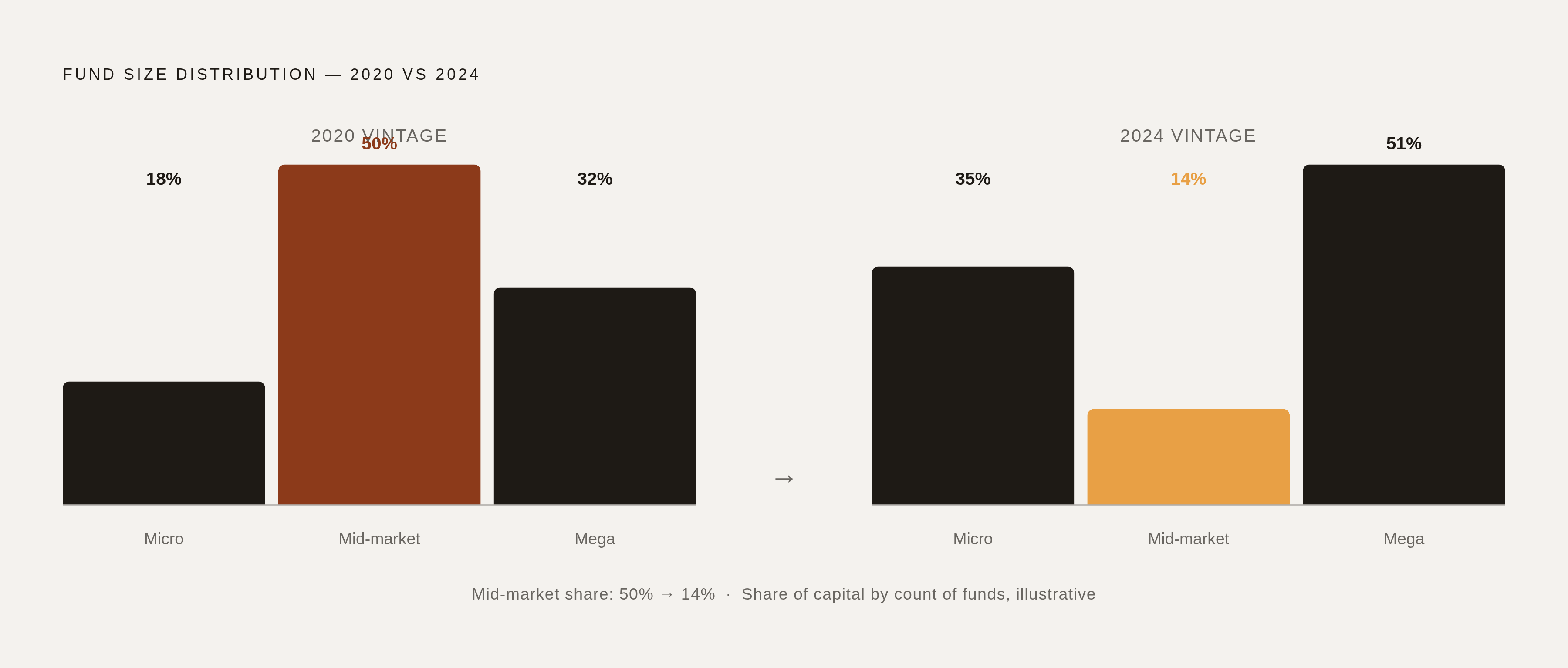
The middle of the market is hollowing out in a specific, measurable way. Funds sized in the mid-market range have dropped from a meaningful share of the 2020 vintage to a substantially smaller share of the 2024 vintage. Meanwhile smaller micro-funds rose sharply as a share of total fund formation over that same stretch. Picture the fund-size distribution as a barbell: heavy on one end with mega-funds, heavy on the other end with micro-funds, and the middle bar getting thinner every year.
That matters for founders, because the fund a company approaches determines the check size, the timeline pressure, and the growth expectations attached to the money, and that comfortable middle range of funds is exactly the part that's disappearing. It matters even more for emerging managers, who are trying to raise into a market with a 39% close rate and LPs who are openly fatigued, especially toward managers with no track record of actual distributions. When returns alone can't differentiate a manager (because distributions across the board have been weak), something else has to do that work. Visibility and reputation, built deliberately rather than assumed, become one of the few remaining levers, not a nice-to-have on the side.
How deployment pressure hits founders directly
None of this stays theoretical once it reaches the term sheet. A GP sitting on a 2022-vintage fund that's approaching its deadline has real urgency to get a deal done, urgency that a founder across the table doesn't necessarily share, and that's not a fair fight, even though it doesn't play out identically across every fund size or sector.
Synchronized deployment from all those stacked 2022 and 2023 vintages means more capital chasing the same pool of quality deals, which pushes entry valuations up, particularly in AI where the competition is fiercest. GPs are responding by leaning on more conservative leverage and more co-investment structures to manage the risk they're taking on at those higher prices.
Founders feel the timeline pressure directly, too. A VC-backed company is expected to grow on the fund's schedule, not its own. That mismatch shows up clearest in the tension around customer acquisition cost (CAC) payback. Deployment timelines want fast payback, but content marketing is a slow compounding asset, not a light switch. So founders under pressure to show quick traction default to paid acquisition channels early, even in cases where content would have built better long-term economics. It's a bit like choosing fast food on a road trip: gets you moving now, costs you later.
The distribution drought compounds the problem, because portfolio companies that should have exited years ago are still sitting on GP books, soaking up attention that could go toward new deals and sending a mixed signal to founders trying to time their own fundraise. And with GPs more selective than they've been in years, the companies that stand out are the ones that can show traction before the meeting even starts. What a firm can find and read about a company ahead of a call now carries more weight than it did back when capital was flowing to nearly anyone with a deck.
2026 looks like execution, not relief
The setup for 2026 is a mix of tailwind and unfinished business. Rate cuts at the end of 2025 have lowered the cost of capital, dry powder is still sitting near record levels, and the 2022 to 2023 vintages are staring down their deadlines with nowhere left to hide. Add in an exit environment that's improving but still constrained, and 2026 looks like a year of execution rather than a year of relief. Momentum from the back half of 2025 should carry forward, with sponsors moving from window shopping to actually writing checks across more sectors than just AI.
Global M&A volume grew meaningfully in 2025, with the Americas up sharply, and that matters more than it sounds. M&A is what kickstarts capital recycling, and recycling is what eventually rebuilds LP confidence in distributions.
The constraints haven't gone anywhere, though. Fundraising in 2025 was the weakest year since 2020, even while dry powder held near record territory around $1.1 trillion in the U.S., a gap between heavy deal activity and thin new fundraising that isn't closing on its own. LP fatigue hasn't resolved either: fund close rates fell to 57% in 2025, down from 94% back in 2020, and that kind of trust rebuilds slowly. Tariff uncertainty adds another wrinkle, with U.S. tariff rates rising sharply in early 2025 and cross-border operations carrying more risk than they used to, pushing some investment theses toward regional focus almost by necessity. And the vintage crowding problem hasn't gone anywhere: synchronized deadlines from 2022 and 2023 mean continued competition for the same scarce, high-quality targets, and continued upward pressure on their price.
One structural nudge worth watching: tax provisions built into the 2025 legislative environment (OBBBA) favor businesses that build and scale over those engineered mainly for financial return, which tilts incentives toward longer-duration, growth-oriented investing rather than quick financial maneuvering.
Put it together and the picture for founders is straightforward, if not exactly comfortable. Capital is out there, and it's under real pressure to move. But it's concentrating: by fund size, by sector, by company stage. Whether a company ends up in the room when a GP is finally ready to write that check may come down to something that happened long before the meeting was ever scheduled.