Negotiating LP Side Letters in VC Funds
LPs now demand better terms than ever, and one concession cascades across your entire investor base.

The limited partnership agreement is the fund's constitution. It governs every LP the same way, setting the baseline for fees, carry, governance rights, and reporting obligations across the board. But almost nobody actually pays the sticker price. Side letters are the bilateral contracts that quietly rewrite the deal for one LP at a time, and where a side letter and the LPA disagree, the side letter wins.
That's the whole point. It's the whole point. A state pension fund arrives with regulatory obligations a family office has never heard of. An endowment carries ESG mandates that mean nothing to a sovereign wealth fund sitting two seats down at the closing dinner. No single LPA, no matter how many pages of counsel's billable hours went into it, can flex enough to fit all of them at once.
Side letters started as a courtship tool: a way to land cornerstone investors by sweetening the pot for whoever wrote the biggest check first. Somewhere along the way, that courtship became an expectation. LPs don't wait to be offered better terms anymore. They arrive with a list, and the list has gotten long.
The 2026 fundraising environment that shifted negotiating power toward LPs
Money is not the problem. Read that number twice, though, because it hides more than it reveals.
The top ten funds soaked up 42.9% of everything committed through Q3 2025, a record concentration of capital at the very top of the market https://www.spectup.com/resource-hub/venture-capital-fund-structures. Most emerging managers are fighting over what's left in the bowl after the biggest funds have already eaten. That's a smaller bowl than it used to be, and there are more forks in it.
Closing a fund is also taking longer. The median VC fund now takes 15 months to close, the slowest pace in a decade https://www.spectup.com/resource-hub/venture-capital-fund-structures. A longer raise sounds like a scheduling headache, but it's really a negotiating problem in disguise: more months on the road means more LP meetings, more redlines, more side letter drafts circulating, and more exposure to the most-favored-nation math covered a few sections down.
LPs know what's happening. A 2025 ILPA member survey found that 69% of large LPs say they have more negotiating leverage now than in past cycles https://investorreadycapital.com/news-insights/what-is-a-side-letter-in-a-real-estate-fund-lpa-and-when-do-institutional-lps-require-one. They are not shy about using it, either. Which means the GP who treats side letters as paperwork to knock out after the term sheet is signed is bringing a calculator to a chess match. The headline numbers show $80 billion flowing into US venture capital and private equity in Q1 2026, the largest fundraising quarter since 2021, though capital remains concentrated rather than democratized.
The two-category triage that every GP needs before the first LP redline arrives
Every incoming LP request belongs to one of two buckets, and confusing them wastes weeks. Sort first, negotiate second.
Bucket one is compliance. These aren't asks, they're legal facts of life, and treating them like a negotiation is like arguing with gravity. Pension plans governed by ERISA can trigger a "plan asset" designation that imposes fiduciary obligations on the GP across every portfolio investment, so ERISA-governed LPs must secure contractual rights directly through the side letter. Public pension funds in plenty of states are subject to Freedom of Information Act requests. They'll ask for limits on what gets disclosed about the fund, or at least advance warning before it happens. Some state systems layer on their own statutory rules about placement agent disclosure or pay-to-play restrictions on top of that. None of this is up for debate. Fighting it just tells the LP the GP hasn't done this before, and it risks losing pension and endowment money entirely over a fight that was never winnable.
Bucket two is commercial. Fee breaks, carry tweaks, co-investment rights, reporting upgrades: all genuinely negotiable, but they carry downstream cascade risk that GPs routinely underestimate before modeling the full LP base.
Do that well and a side-letter round that used to eat weeks gets done in days.
LP counsel doesn't fight over every clause in the document. In practice, they push hard on maybe seven or eight of them, and the rest is settled paper that nobody's really contesting. A GP who digs in on all of it isn't being thorough, just inefficient, and it signals to the other side of the table that nobody's told this person which hills are worth dying on.
Fee and carry modifications: what LPs ask for and what concessions cost
Fee breaks are the most common ask in the book, and for good reason: they're the easiest lever to pull.
Not every LP gets one. Discounts flow mostly to anchor investors and early commitments, the LPs who commit first and write a check big enough to matter. Family offices writing large tickets are the other group that tends to walk away with a discount, even without the anchor label.
Carry is a different animal entirely, and a more dangerous one. It comes up less often than fee discounts, but the stakes are higher because carry touches upside, not just the cash the fund burns every year running the business. The asks vary: a lower carry rate, say 15% instead of the standard 20%, a bumped-up preferred return hurdle, or a reworked catch-up structure. Some managers of smaller venture funds may reduce their carried interest to 15% as a way to attract LP interest https://pipelineroad.com/blog/side-letter-negotiation.
Then there's no-fee, no-carry co-investment, which large LPs treat as one of the most prized items on the entire menu. It lets them pile more money into the strategy at a cheaper blended cost, and GPs grant it because it deepens the relationship with an LP whose check size matters. Fair enough. "No fee, no carry" costs the GP something too. It's a cost paid in future fund economics, not cash today. Large LPs routinely request 25–50 basis point reductions from the standard 2% management fee, with fee discounts appearing in roughly 70% of institutional side letters.
MFN clauses: how a single concession can multiply across your entire LP base
Most-favored-nation clauses are the single most consequential provision in this entire discussion, and they deserve to be treated that way from the first term sheet draft onward. An MFN clause lets an LP peek at what everyone else negotiated and pick whichever terms it likes best for itself, which sounds fair enough on paper, since it stops early or large investors from getting stuck holding the worse deal.
Scale is the catch. MFN provisions now show up in roughly 41% of side letters as of 2024, a sharp jump from where the market sat a few years earlier https://databento.com/compliance/most-favored-nation-mfn. The concession a GP makes to close one LP is a concession to everyone who has the right to ask for it. It's a concession to everyone who has the right to ask for it.
The mechanics actually play out as follows after final close. After final close, the GP compiles a summary of all side letter terms granted to LPs at or below each commitment tier. LPs holding MFN rights get that summary and have a window, usually somewhere between 30 and 60 days, to pick whichever terms they'd like applied to their own side letter https://pipelineroad.com/blog/side-letter-negotiation. Whatever they choose gets written into their agreement.
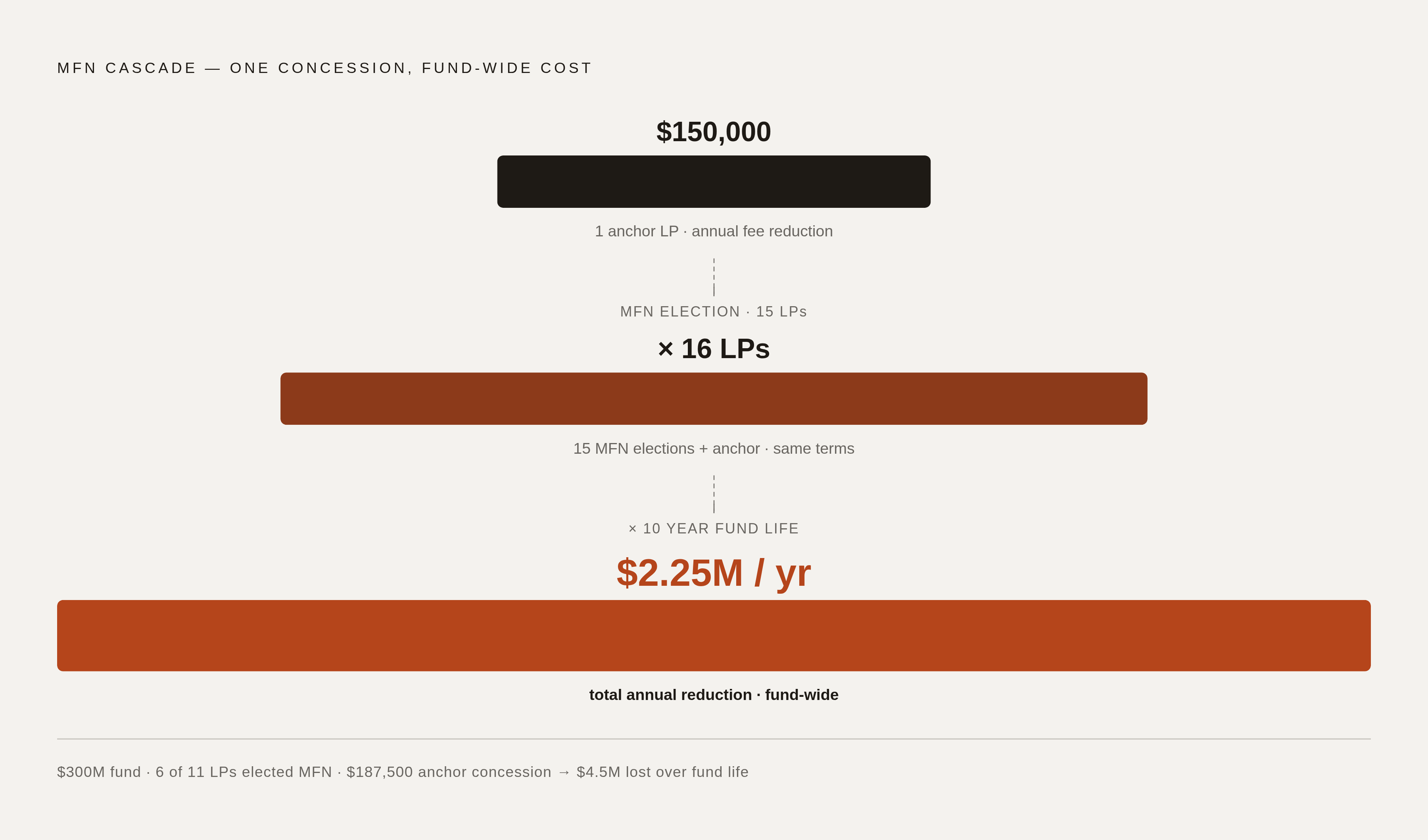
Now the arithmetic. That's not a rounding error, that's real money leaking out of the fund's economics every single year for the life of the vehicle. One handshake with a cornerstone investor, multiplied by a spreadsheet nobody built until it was too late.
The lesson isn't "never give an anchor investor a discount." It's "never give one without running the MFN math first." A concession that looks generous and cheap in isolation can be the single most expensive line item in the entire fund's fee structure once the cascade finishes running its course. The cascade math shows that a $150,000 annual fee reduction for one LP can become a $2.25M annual reduction across the fund if all MFN-eligible LPs elect it, and spectup models the same dynamic on a hypothetical $300M fund where a $187,500 anchor concession became $4.5M of lost fees over a 10-year fund life when six of eleven LPs elected MFN.
Other provisions LPs routinely request and how GPs should evaluate each one
Beyond fees, carry, and MFN rights, the shopping list keeps going. Some of it is cheap to grant. Some of it costs more than it looks like on first read.
LPAC seats are the clearest example of a provision that isn't really about money. Seats are typically limited to the fund's largest investors, and because they're finite, this is a meaningful carveout from MFN elections.
Reporting requests are the opposite problem: individually cheap, collectively expensive. LPs ask for quarterly portfolio financials, finer-grained attribution data, live access to the data room, specific ESG metrics, tax detail well beyond the standard K-1. None of that costs the fund a dollar directly. The cost to the GP is operational rather than financial, but it accumulates, so GPs must assess whether their back office can generate these reports on a regular basis before agreeing. Before agreeing to any of it, a GP needs an honest answer to one question: can the back office actually generate this, every quarter, for years, without hiring? ESG reporting in particular has stopped being a special ask and started being close to standard boilerplate in institutional side letters.
Transfer rights are loosening too. The standard LPA locks LPs in fairly tight, but side letters increasingly carve out room for specific investors to move their stakes to affiliates, successors, or approved transferees. That flexibility matters more now than it used to, because the secondary market has been on a tear: transaction value climbed 68% year over year in the second quarter of 2025 https://carta.com/learn/private-funds/management/portfolio-management/side-letter/. LPs aren't asking for secondary flexibility as a hypothetical anymore. They expect it as a baseline feature of the deal.
Co-investment rights round out the list, and this is where GPs need to think less about what's written in the side letter and more about what the LP can actually do with it. The real bottleneck isn't legal language, it's operational speed. Most institutional LPs run internal underwriting teams that can turn a deal memo around in 48 to 72 hours, and an LP that can't hit that window will keep missing co-invest opportunities no matter how generous its side letter reads https://www.spectup.com/resource-hub/limited-partner-agreement. Know which kind of LP is sitting across the table. The market shows a growing bifurcation: a passive majority accepts sponsor-led processes, while a growing cohort seeks active engagement on governance and exit mechanics. Negotiate accordingly, because a one-size-fits-all response to co-invest requests will either overpay the slow LPs or underdeliver to the fast ones. Such provisions provide a governance role, reviewing conflicts of interest and approving certain GP actions. GPs should consider that LPAC members gain real visibility into fund operations, and seats should be reserved for LPs whose governance engagement adds value, not simply as a closing incentive. GPs should consider that a co-invest right an LP cannot operationally exercise is low-cost to grant, while a right held by an LP that can move fast has real allocation implications, meaning LP capability should be evaluated rather than just the LP request.
How the Fifth Circuit's 2024 vacatur changed side letter practice without eliminating the underlying obligations
In August 2023, the SEC rolled out private fund adviser rules that would have imposed quarterly reporting, heightened requirements for adviser-led secondaries, annual audits, and a Preferential Treatment Rule prohibiting side letter arrangements resulting in preferential redemption rights or portfolio holdings disclosures where the adviser reasonably expects such terms would have a material, negative effect on other investors.
Private fund industry associations challenged the rules, and on June 5, 2024, the US Court of Appeals for the Fifth Circuit unanimously vacated the entire set of rules. Clean sweep, no rules left standing.
Case closed, right? Not quite. Some LPs had already negotiated side letter language built around the expectation that those rules would apply, and those contractual commitments didn't vanish just because the rule that inspired them did. A promise made under the shadow of a rule is still a promise once the shadow lifts.
Beyond the LPs who'd already locked in language, the vacated rules haven't disappeared from the industry's muscle memory either. Some LPs had already negotiated certain benefits and contractual rights based on the rules into side letters before vacatur, and those contractual obligations remain, with institutional LPs now rebuilding the protections they expected directly into side letter language.
So the practical result of the vacatur wasn't deregulation. It was a shift in where the protections live. Institutional LPs simply stopped waiting on the SEC and started writing the same protections directly into side letter language themselves. The rule got vacated. The behavior it was designed to produce stuck around anyway, just relocated from federal regulation to private contract.
Building a side letter process that protects fund economics from first close to final MFN election
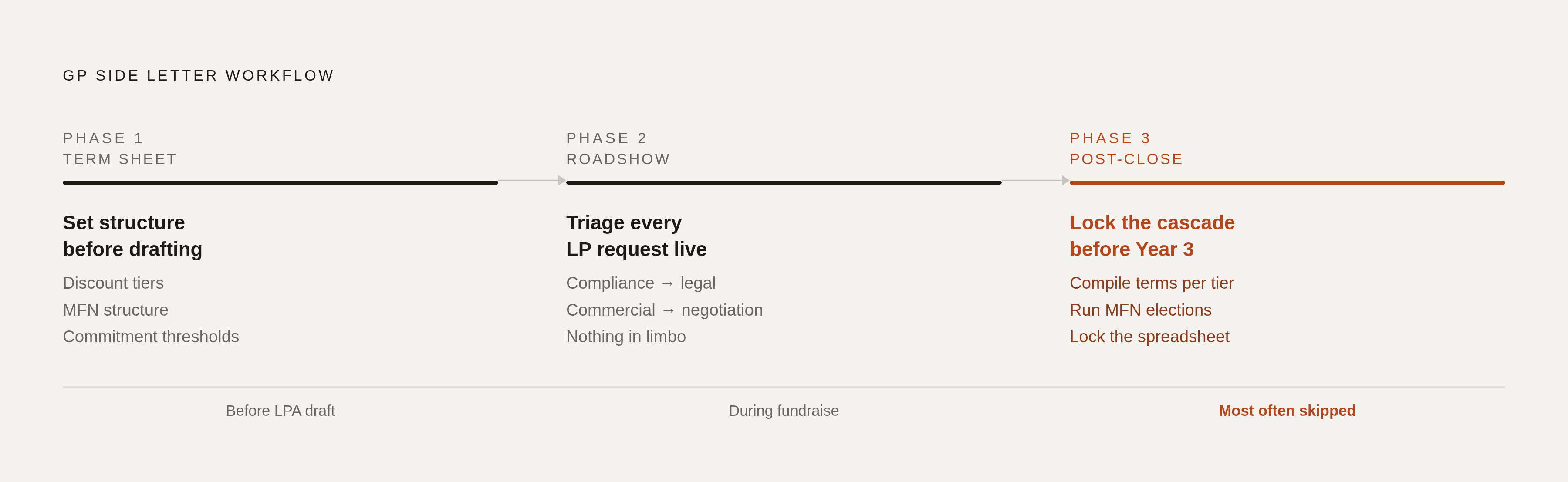
None of this works as a series of reactive fire drills. It works as a sequence, and the sequence starts before a single LP has seen the LPA.
Phase one happens at the term sheet stage, before the LPA gets drafted at all. Decide in advance where discounts will be offered, at what commitment size they kick in, and how the MFN tier structure will be built, because walking into drafting without that groundwork done just hands the whole negotiation over to LP counsel. Whoever shows up with the framework already built controls the conversation. Whoever shows up without one is negotiating against a plan they haven't seen yet.
Phase two runs through the roadshow itself. Every request that lands gets sorted the moment it arrives: compliance goes to legal, commercial goes to negotiation, and nothing sits in limbo waiting for someone to figure out which pile it belongs in. That's the same triage covered earlier, just applied in real time as term sheets circulate and LPs start comparing notes.
Phase three is the one GPs forget about because it happens after the champagne. Post-close MFN management, part of a framework that prevents Year 3 propagation surprises, involves compiling a summary of all side letter terms granted to LPs at or below each commitment tier after final close. The fund that skips this step is the fund that discovers, three years in, that a single anchor discount quietly cost millions across the LP base. The fund that builds the process from day one just checks the spreadsheet, elects nothing it can't afford, and moves on with its year. According to the VC Corner fund-activity tracker, $80 billion in capital flowed into US venture capital and private equity in Q1 2026, the largest fundraising quarter since 2021 https://www.spectup.com/resource-hub/venture-capital-fund-structures. Industry surveys suggest that 40–60% of institutional-grade venture funds have at least some side letter arrangements with major LPs https://angelinvestorsnetwork.com/capital-raising/side-letter-negotiations-with-investors-what-founders-must-know. Around 70% of institutional side letters in 2026 modify fees, with MFN tiering, ESG, and ILPA reporting as the new standard riders https://www.spectup.com/resource-hub/venture-capital-fund-structures. According to the ILPA 2024 Fund Terms Survey, fee-related modifications appear in roughly 70% of institutional side letters, with large LPs typically requesting 25–50 basis point reductions in management fees https://pipelineroad.com/blog/side-letter-negotiation. According to the ILPA 2024 Fund Terms Survey, large LPs typically request reductions of 25–50 basis points in management fees in side letters https://pipelineroad.com/blog/side-letter-negotiation. An annual fee reduction of $150,000 for one LP can potentially cascade to all 15 LPs with MFN rights https://pipelineroad.com/blog/side-letter-negotiation. A $150,000 annual fee reduction for one LP becomes a total annual reduction of $2.25M when cascaded across 15 LPs with MFN rights https://pipelineroad.com/blog/side-letter-negotiation.

