Building an LP Network as a First Time Fund Manager
Match LPs to five filters before reaching out, not afterward.

Most first-time managers get the order backwards. They spray decks at anyone whose LinkedIn bio says "allocator" somewhere in it, then wonder why the response rate looks like a bad cold-email campaign. Real LP matching runs on five filters at once, not one at a time: check size, stage alignment, sector focus, geography, and how much venture experience the LP already has. Missing on any one of those meant the meeting was a waste of both people's calendars, no matter how warm the intro felt going in.
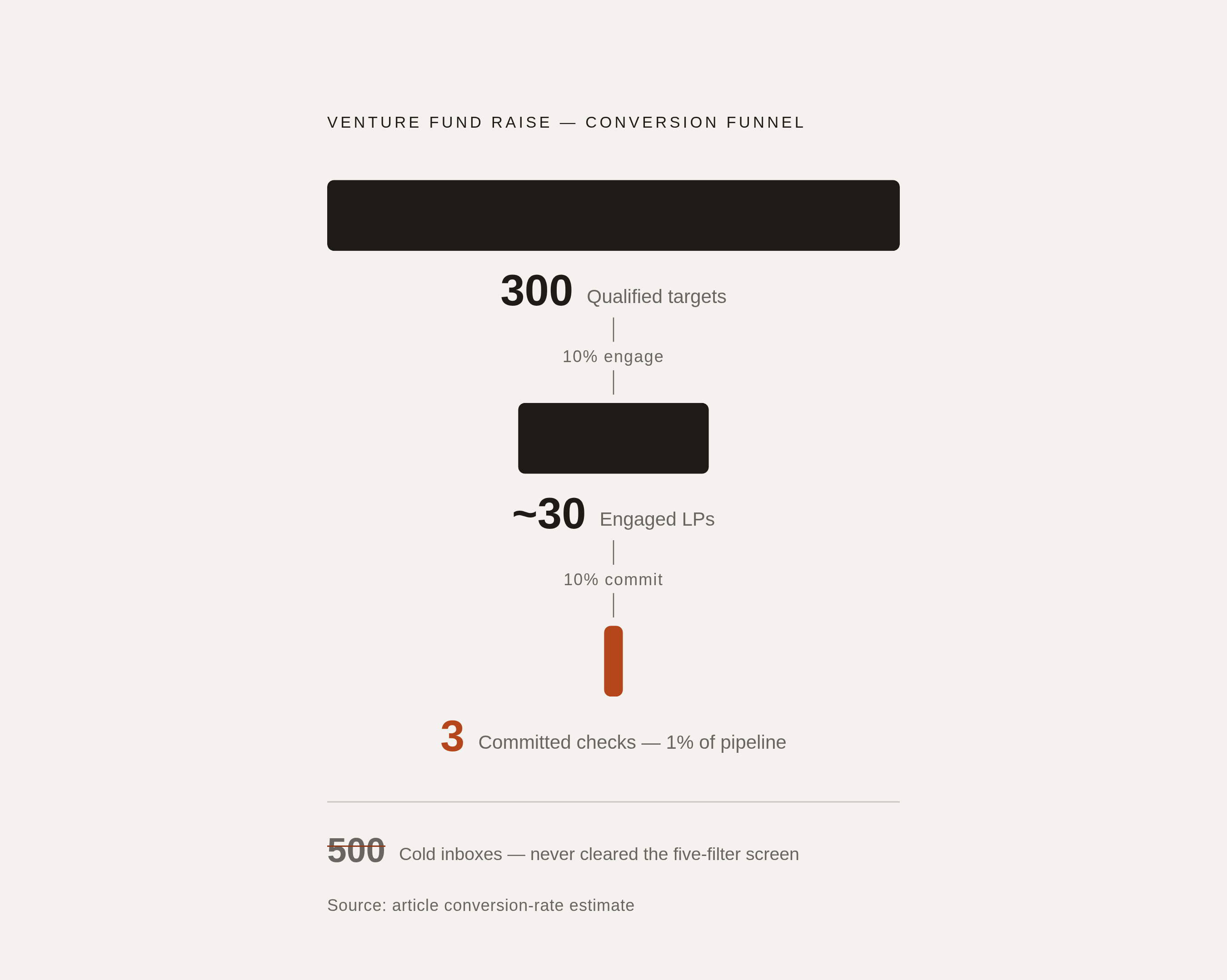
The funnel math backs this up. Conversion from target to committed check is around 1%, so a manager chasing three checks needs something like 300 qualified targets in the pipeline. That sounds brutal until you compare it to the alternative. Getting genuinely in front of 30 to 50 well-matched LPs beats blasting 500 cold inboxes, every time, because the 500-inbox list never cleared the five-filter screen before it went out.
This changes where a first-time manager should actually point the list. Data across more than 900 fund launches shows roughly 75% of LP commitments land under $150,000. Chasing institutional allocators who won't look at a manager without three prior fund vintages is often energy spent on the wrong floor of the building, while the real check-writers are one flight down, ready to meet and already writing checks in that range.
Run the five filters continuously, not once during list-building and then never again. An LP that looked like a fit in month one might drop off by month six once the sector thesis sharpens. A family office that seemed passive might suddenly activate a direct-investment mandate nobody knew existed. Keep checking the list the same way you'd keep checking a pipeline.
Start with people who already know the manager. High-net-worth individuals and angels are the fastest path to a first close, because the relationship already exists and the ask is really just a sequencing decision. According to VC Lab, managers who lead with this group reach first close in an average of 64 days. Check sizes here run sub-$150K, so the fund math has to accommodate a lot of small commitments stacking before institutional money is committed.
Family offices are the fastest-growing LP category, and also the most misread one. Out of more than 9,000 family offices tracked, roughly 2,400 run explicit direct-investment sleeves for PE and VC, and another 1,800 carry co-investment mandates. That leaves most of the remaining universe either passive or simply unreachable for a first-time manager. The largest family offices run like mini-institutions with dedicated PE and VC teams, while the rest vary wildly, which makes cold-emailing the whole category a poor use of time. Target the 2,400 with a documented direct sleeve instead. Mandate fit is still the gate, not the warmth of the intro.
Fund-of-funds operate on extended decision cycles, and their whole mandate is built around backing emerging talent. A FoF commitment does something a warm intro can't: it tells pensions, endowments, and the larger family offices, the ones that never move first, that someone with real underwriting discipline already said yes. For most first- through third-time managers, the road to broader institutional capital runs through a FoF check before it runs anywhere else.
University endowments sit at the far end of the sequence, and for good reason. Some university endowments have signaled openness to allocating PE capital toward first- and second-time funds, so the door isn't entirely shut. But Yale has allocated roughly 41% of its endowment to venture and buyouts, and Harvard has held around 34% in PE. Those are institutions that do not write first-close checks to a manager they met three months ago, and pretending otherwise wastes a fundraise's most limited resource: time.
How LPs discover managers, and what warm introduction infrastructure looks like in practice
Close to 80% of LPs say they find new managers through professional networks, and over half point to conferences and industry events as a primary channel. Meanwhile, the big institutional LPs are fielding 50 to 100 unsolicited fund proposals per month. Cold outreach doesn't fail because it's rude. It fails because at that volume, it reads as noise, indistinguishable from the other 99 pitches sitting in the same inbox.
So what actually gets read? A handful of warm-path patterns appear repeatedly in how managers get in the door.
Portfolio-backed credibility means a founder or co-investor who can speak to how a GP actually thinks and what returns they generated. One manager launching a first fund used 90-second video testimonials from portfolio company CEOs in 40% of initial LP meetings, which functions as proof of process delivered before the LP even has to ask for one.
Shared governance history involves a former board observer, a co-lead, outside counsel, anyone who watched a GP work through a hard mark or a tough board call. A one-line email from that person outweighs a 40-slide deck. One emerging climate tech GP landed a pension commitment specifically because the pension's former head of PE had sat on a board with that GP six years earlier. Six years is a long gap, and it didn't matter. The relationship didn't need to be recent. It needed to be real.
Pre-wired event adjacency means the warm intros that happen at conferences were never spontaneous. They get built weeks ahead of time, by mapping the speaker roster against an LP ideal-customer profile and quoting specific lines from an LP's own public letters in the outreach that follows. At SuperReturn International 2025, managers who pre-mapped allocators with matching mandates converted several into formal diligence, built entirely from prep work done before anyone boarded a flight.
Second-degree connectors need a link that can be diagrammed: alumni networks, former clients, FoF analysts who underwrote a manager's prior fund. The test is simple. Can the connection be explained in two sentences or less? If it takes a paragraph to justify, it's a stretch rather than a warm intro.
Something has shifted heading into 2026: warm no longer means casual. LPs have tightened their bar right alongside their operational due diligence standards, so a warm intro now needs to be traceable and verifiable.
Pre-marketing timelines and the relationship development that has to happen before the pitch exists
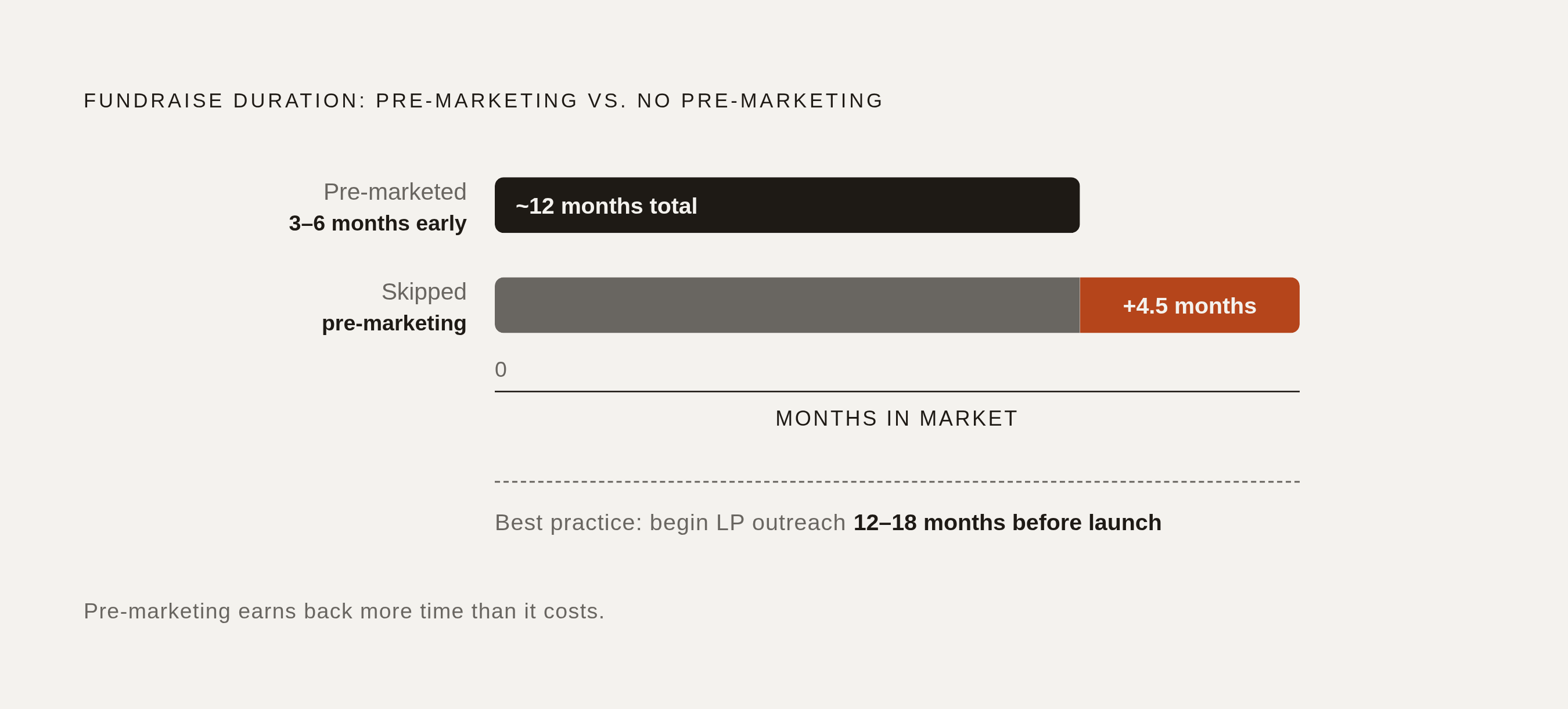
Managers who spent three to six months in pre-marketing before launching a formal roadshow closed an average of 4.5 months faster than those who skipped straight to the pitch. That gap settles the argument on its own: pre-marketing earns back more time than it costs.
Best practice now points to starting LP relationship-building well before launch, many months ahead of the formal roadshow. Marketing that starts once the PPM is finalized is reactive by definition, and by the time it starts, most of the LPs who were ever going to commit have already formed an opinion of the manager, one way or the other, based on nothing anyone controlled.
What fills those 12 to 18 months, then? Sharing real investment thinking: memos, sector takes, honest post-mortems on deals that didn't work, all before anyone asks for a dollar. Making introductions for LPs, to founders or co-investors, with zero fundraising attached. Showing up to LP-facing events as someone in the conversation, not someone working the room for a pitch. Building a record of judgment an LP can review alone, before agreeing to a single meeting.
The 2025-2026 due diligence shift makes this timeline pressure worse, not better. Operational evaluation now carries equal weight to investment performance in LP screening. LPs want a real liquidity strategy, not a portfolio marked up on paper, and the emphasis on DPI (distributions to paid-in capital, the actual cash that lands in an LP's pocket) has climbed sharply compared to just a few years back.
What LPs evaluate once they are paying attention
Track record attribution gets checked first; it has to hold up under a real look. The managers who actually got funded shared one trait: verifiable, attributed numbers, IRR and DPI, tied to specific deals from a prior role. "First-time fund manager" increasingly means first fund under their own name, not first time ever investing, and LPs expect the earlier track record documented line by line. Co-investor quality works as a proxy signal too: a believable network of people who'll vouch for how deals actually got sourced carries more weight than a logo slide ever will.
A differentiated thesis matters just as much, and generic positioning is the fastest way to get skimmed and forgotten. LPs see dozens of decks that all say "early-stage B2B SaaS" and nothing else. A thesis has to explain the structural edge: why this manager sees, and wins, a category of deal that others don't. The 2025 closes that actually got done had sharp, specific angles: Niobrara built around technology and tech-enabled services, RenWave Kore around a Korea regional specialization, SQ Capital around secondaries with an ex-Blackstone lead. None of those needed a second sentence to explain what made them different, which is exactly the point.
Operational credibility is the newer bar, and it's rising fast. Institutional LPs now scrutinize how a firm runs day-to-day almost as closely as how it invests. Unrealized paper value doesn't close institutional checks anymore on its own; a manager has to explain, concretely, how portfolio gains turn into actual cash distributions. Materials aligned to industry reporting standards, live dashboards instead of a static slide updated once a quarter, clean fund structures. All of that signals operational maturity before formal diligence even opens.
Then there's integrity, which sounds soft until you remember LPs talk to each other constantly. A reputation for missed updates or inconsistent communication as an angel investor follows a GP straight into fund formation. It doesn't reset just because the entity is new. First-time PE funds have historically outperformed established managers by 100 to 300 basis points of net IRR, and the entire evaluation process is really an attempt to guess which manager in the room is one of those outliers, before the track record exists to prove it either way.
Building a public record of investment judgment before and during the fundraise
Cold outreach and conference hopping are grinding, inefficient ways to build an LP network, especially set against the alternative: a public, dated record of judgment, deals seen, and theses tested, sitting out in the open before anyone asks for it. That record does double duty. It works as a fundraising asset, and it works as a founder acquisition channel, since the founders reading it today are the same people who'll eventually pitch the fund.
The pattern is visible clearly in a handful of well-known cases. Rex Woodbury built an audience around Digital Native before spinning out of Index Ventures to launch Daybreak. Others built loyal readerships around market analysis before launching their funds. Turner Novak built a following through memes, deep-dive writeups, and investing takes before raising Banana Capital. In every case, the content came first and the fund came after, never the reverse. The writing was the credibility that made the fundraise possible.
LinkedIn has become the default stage where this plays out, especially for institutional and family office allocators. It's where they research a manager before ever taking the meeting, and it's where a GP builds a searchable, dated archive of how they think, what they got right, and what they'd do differently next time. A memo posted eighteen months before a fund launches does something a pitch deck never can: it shows the thinking before there was anything to sell.