Managing LP Expectations During Down Markets
LPs are shifting focus from projected returns to actual cash distributions as exits stall.

Fundraising dollars are up. Distributions are not. That gap explains LP relationships in 2026, and it's why the GPs communicating clearly right now are the ones who'll raise fund IV in three years without a fight.
The headline numbers look fine, even good. Aggregate PE fundraising rose 9% in H1 2026, and 2025 closed with over 9,000 transactions totaling $1.2 trillion, only the second time deal value has crossed that mark. Reading past the aggregate, the story splits. Deal volume in H1 2026 dropped 34% while average deal size nearly quadrupled compared to H1 2025. A handful of mega-deals are propping up a topline number while the actual pace of dealmaking slows considerably.
Sponsors are sitting on 31,764 unsold assets. That backlog is the biggest single source of friction in LP relationships right now, because every one of those assets is a distribution that hasn't arrived yet. Add 2026's geopolitical shocks, Middle East tensions, and a single trading session that wiped $285 billion off software stocks on AI concerns, and the exit window didn't just narrow. It closed for many funds entirely.
LPs Now Prioritize Cash Over Paper Returns
IRR used to be the number GPs led with, and it's a flattering one when marks are rising and exits are still theoretical. LPs have shifted away from that. LP emphasis on DPI as the critical performance metric now sits 2.5 times higher than it did three years ago. The reason is straightforward: DPI only counts cash that has actually left the fund and landed in an LP's account. No marks, no projections, no unrealized gains. Just cash, and for many vintages, the cash isn't there.
Top-quartile 2016-vintage funds had reached only 1.55x net DPI as of the end of September 2025, nearly a decade after the fund started deploying. Every vintage since 2018 sits below 1x. For a large portion of the market, that means LPs have put in more than they've gotten back, a decade later, in funds that are nominally top quartile.
LPs have adjusted their expectations accordingly. Fund-level net MOIC targets are now around 1.8x to 2.3x, with top-quartile funds clearing roughly 2.3x net, and performance is still falling short of even those reduced bars. When a GP sits down to write an LP letter this year, the person reading it isn't asking what the IRR is. They're asking when they will see cash.
Fundraising Consolidates Around Proven Managers
Aggregate fundraising dollars grew, but the number of funds actually raised in H1 2026 declined slightly, and the gains went almost entirely to a shrinking group of managers who already had the track record to demonstrate it.
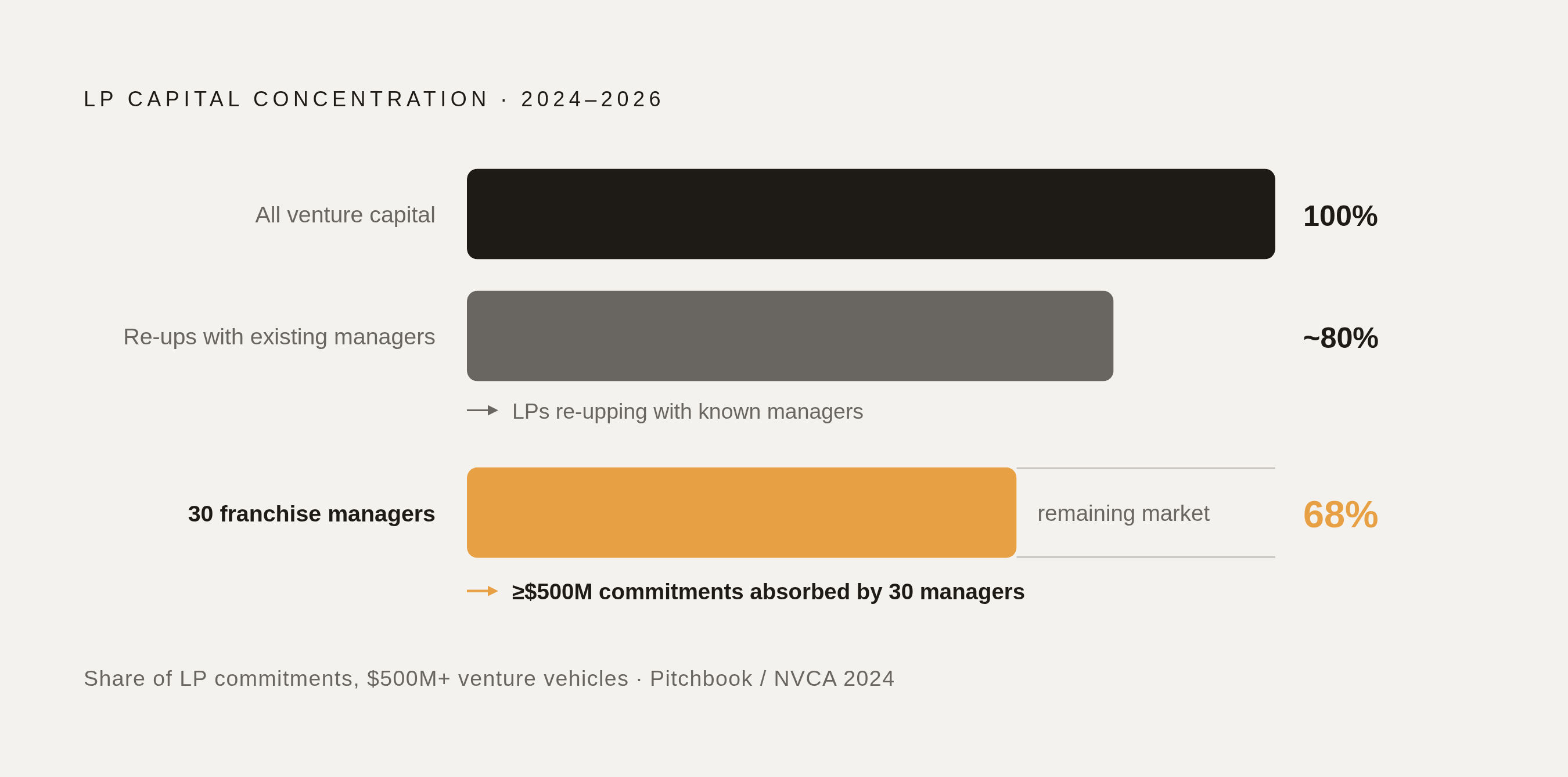
The PitchBook–NVCA Q4 2024 Venture Monitor found that just 30 franchise managers captured 68% of commitments of $500 million or more. Nearly 80% of all dollars committed to venture vehicles in 2024 came from LPs who were already backing the same managers they had backed before. In a tight market, LPs write re-up checks to managers they already trust rather than take chances on unfamiliar relationships.
Flor Kassai, Managing Partner at Inflexion, put it directly in Private Equity International: "Managers with a good track record of exits and cash returns will raise. Those with limited liquidity and heavier reliance on valuation marks will find fundraising materially more difficult, and will increasingly rely on fund extensions, asset transfers and smaller vehicles to remain active." That split is already visible on the fundraising trail.
ILPA 2026 Standardizes What LPs Can Compare
The ILPA 2026 Performance Template, released in January 2025, becomes mandatory for funds starting operations on or after January 1, 2026. It's the biggest overhaul of LP reporting standards since 2011. It's a template rather than a law, but the market is not treating it as optional.
Three pieces make up the new standard: a Capital Account Statement covering fees, a Capital Call & Distribution Notice, and a Performance Report that standardizes IRR, TVPI, and MOIC with options for granular or gross-up reporting. Previously, every GP ran its own spreadsheet format, its own definitions, its own way of presenting numbers. That variation is going away, and LPs will be able to compare funds on a consistent basis for the first time.
An ILPA survey found over 74% of LP respondents cited standardized fee reporting as a significant factor in manager selection, up from 58% in 2021. Compliance used to signal sophistication. Now it's a baseline requirement.
Down-Market Letters Fail for Structural Reasons
Most down-market LP letters make the same mistake, and it's structural rather than stylistic: they lead with the macro environment. Several paragraphs on tariffs, rate cuts, and geopolitical noise appear before the letter mentions the fund itself. LPs lived through the same quarter. They don't need it recapped. They opened the letter to learn what happened inside the portfolio, and burying that under market commentary signals the letter wasn't written for this LP or this quarter specifically.
Apologies without analytical framing create a different problem. An apology that isn't tied to a specific attribution, a specific decision, and a specific forward plan reads as an admission of failure with no evidence and no corrective action attached.
Re-explaining fund strategy to LPs who have been in the fund for two or three years is similarly counterproductive. It signals the letter wasn't written for this audience; it was pulled from a folder and reused.
Inconsistent cadence may be the most corrosive failure mode. Updates that appear only in good quarters, or explanations that arrive after the LP has already spotted a problem on their own monitoring dashboard, erode trust faster than a lean letter that arrives on time every quarter. Silence during a down quarter reads as avoidance.
Honest Exit Communication Requires Portfolio Specificity
Predictability is the governing principle. Quarterly structured reports plus an annual GP letter is the floor, and that floor matters most in quarters carrying bad news, since those are exactly the quarters when GPs are most tempted to reduce communication.
Lead with fund-specific attribution: what happened in the portfolio, why it happened, and what decision the GP made in response. Market context belongs in the letter only when it explains a specific positioning choice, not as introductory framing before the substantive content arrives.
LPs now expect quarterly valuation bridge analyses that break returns down into their actual sources: revenue growth, margin expansion, multiple expansion, and leverage. That breakdown separates genuine value creation from multiple expansion that occurred because interest rates moved in the fund's favor. A bridge analysis lets an LP identify whether a GP built something durable or benefited from favorable timing, and those are two different stories that warrant two different levels of confidence.
For assets still sitting in the portfolio unrealized, specificity carries the most weight. What has changed about the holding thesis since the last update? What does the exit pathway look like now, not the one pitched at close? What is the realistic timeline? Restating the original investment memo answers none of those questions.
Communication History Shapes Successor Fund Raises
Communication that holds up over a full fund cycle tends to share three traits: transparency that is consistent rather than appearing only when results are positive, genuine insight into how decisions were made rather than summaries of outcomes, and a narrative that connects across years rather than resetting each quarter independently.
That record compounds in both directions. By the time a GP returns to market for a successor fund, LPs review all prior letters together, checking for consistency. A strong record reduces friction in due diligence. A spotty one means the GP spends the fundraise explaining gaps rather than presenting the next thesis.
The annual GP letter is one of the few places an LP can observe how a GP processes a difficult year rather than simply reporting a final number. Across multiple fund cycles, those letters become a cumulative record of how a GP reasons under pressure and adapts when the original plan requires revision.
Research consistently finds that decision-makers weight substantive thought leadership heavily when evaluating organizations. For an LP, thought leadership is every quarterly update, every investment memo, and every proactive call a GP makes during a difficult quarter rather than waiting to be contacted. The shift from IRR-first to DPI-first reporting reflects a preference for verified cash outcomes over projected returns, and that preference extends to how GPs communicate: documented, specific, consistent evidence of sound judgment compounds in value over time in a way that optimistic framing does not.
Sources
- Private Markets Outlook 2026
- Private Equity LP Perspectives | Private Equity International
- Private equity: US Deals 2026 midyear outlook: PwC
- LPs are lowering their return expectations, but don't expect fundraising to get easier - PitchBook
- Private Equity Report: 2025 Trends and 2026 Outlook
- Private Equity IRR Reporting: What GPs Must Disclose in 2026
- vantage.firstrate.com
- natlawreview.com

