SAFE Notes vs Priced Rounds for Early Startups
Understand SAFE mechanics and dilution risk before stacking multiple rounds at early stages.

If you are building a company right now and someone hands you a SAFE to sign, there is a good chance you will sign it without fully understanding what you agreed to. That is not an indictment of founders. It is the reality of how fast early-stage deals move and how deceptively simple these documents look. A SAFE is roughly five pages. But those five pages have delayed consequences: dilution that is invisible while SAFEs are outstanding, then materializes all at once right before your Series A when you finally look at your cap table. This piece breaks down what SAFEs and priced rounds actually do, where each one makes sense, and what the math looks like when founders are not paying close enough attention.
SAFEs Have Basically Won at the Earliest Stages
The data makes this clear. Per Carta, SAFEs made up 90% of all pre-seed deals in Q1 2025. At the seed stage, SAFEs accounted for 64% of rounds over the twelve months ending Q3 2024, compared to 27% for priced equity and 10% for convertible notes.
The clearest predictor of which instrument gets used is deal size:
86% of seed rounds under a few hundred thousand dollars used a SAFE
At rounds above a few million dollars, only 20% were SAFEs; 70% were priced equity
That split reflects something real about where SAFEs make sense versus where a priced round starts to look like the smarter call. SAFE dominance at small check sizes is a rational response to stage, speed, and the fact that most early companies cannot defend a valuation in a negotiation. The problem is when founders keep using SAFEs past the stage where they fit.
The Key Terms Inside a SAFE and What They Actually Do to Your Ownership
SAFEs are short, but they are not simple. A few terms do the heavy lifting.
Valuation cap. This is the ceiling at which the SAFE converts into equity. If your company's valuation rises before the priced round, the SAFE holder still converts at the lower cap price, meaning they get more shares per dollar than new investors. Per Carta's Q2 2025 data, median caps are $7.5 million for rounds under a quarter million dollars and $10 million for rounds between a quarter million and a half million dollars. A lower cap is more investor-friendly, and founders should treat cap-setting as a real negotiation.
Discount rate. Typically 10 to 25% off the share price at the next round. Sometimes paired with a cap, sometimes standalone. It compensates early investors for taking on more risk.
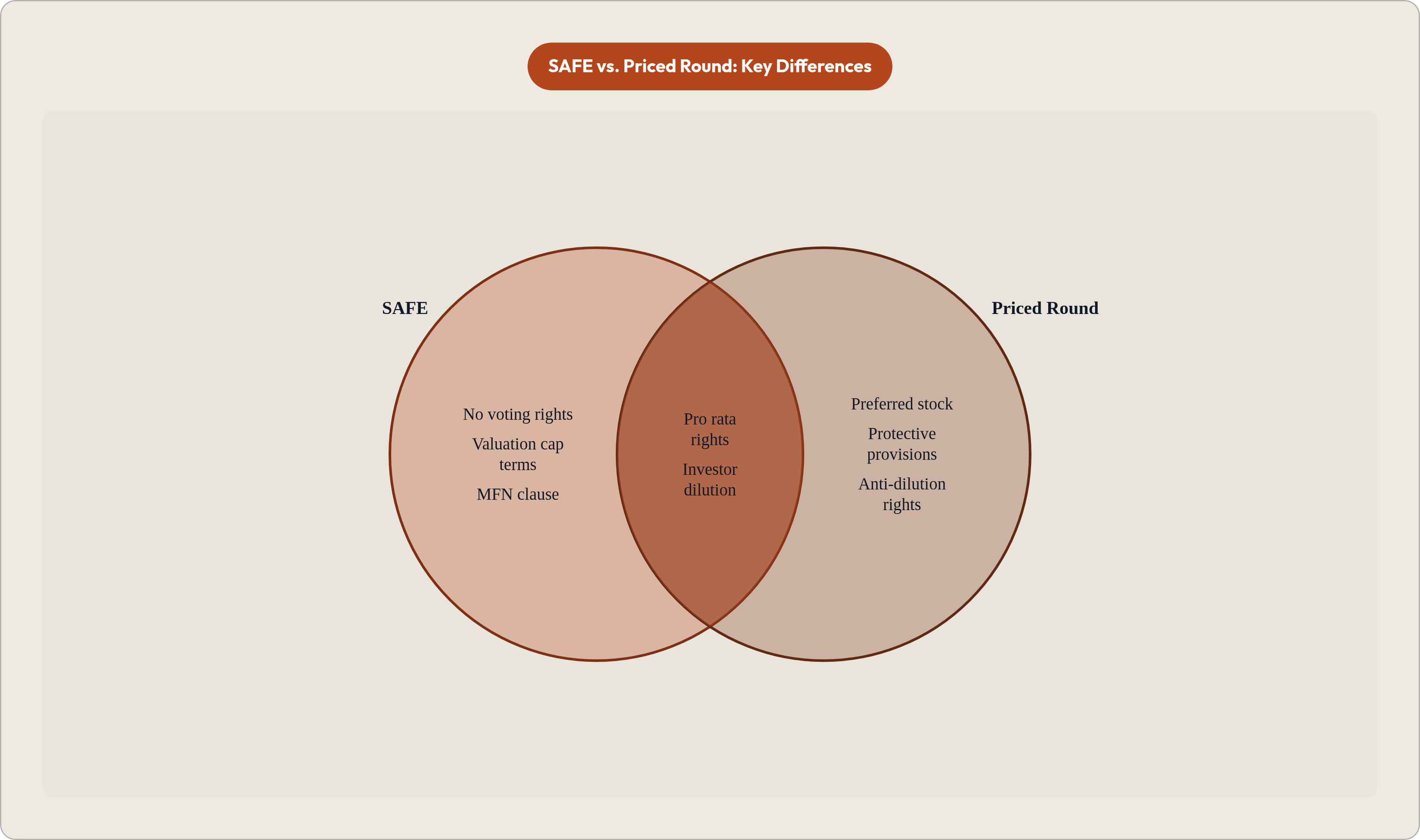
MFN clause. MFN stands for "most favored nation." If you later issue a SAFE on better terms, earlier investors automatically get those terms too. This matters when you are stacking multiple SAFEs over time, because each new deal can retroactively improve the terms of the ones before it.
Pre-money vs. post-money SAFEs. In a post-money SAFE, the cap is applied after the round closes, and every new SAFE you issue dilutes you, the founder, exclusively. Other SAFE holders are not touched. In a pre-money SAFE, dilution spreads more broadly across existing holders. Per Carta, 87% of all SAFEs in Q3 2024 were post-money, up from 43% at the start of the decade. That shift has real consequences for founders raising in multiple tranches.
One additional pattern worth knowing: in 2024, 61% of SAFEs used a valuation cap only, 30% combined a cap and a discount, 8% used a discount only, and just 1% used neither. Some form of investor protection is essentially a given now.
What a Priced Round Actually Requires and What Investors Get for It
A priced round requires you and your investors to agree on a valuation before anything closes. That number becomes the foundation for everything else. Post-money valuation is the pre-money number plus the capital you are raising.
The documentation is heavier. A typical priced round involves five to six legal documents, including a stock purchase agreement, investor rights agreement, voting agreement, and an amended certificate of incorporation. It is not something you close over a weekend.
In exchange, investors receive preferred stock, which is a different class from the common stock that founders and employees hold. Preferred stock comes with real rights:
Liquidation preference. The standard is 1x non-participating, meaning investors get their money back first in a sale, then choose between keeping that preference or converting to common stock and participating in the upside. They do not get both.
Anti-dilution protection. If you raise a future round at a lower valuation, this clause adjusts the investors' share price to protect them.
Protective provisions. A list of company actions that require a separate vote from preferred stockholders, including issuing new shares, changing the board size, selling the company, or taking on significant debt. Founders cannot do these things unilaterally.
Information rights, pro rata rights, and sometimes a board seat.
Even without board control, protective provisions represent a meaningful transfer of power. That is the trade you make for the certainty and legitimacy that a fixed valuation provides, and founders should go in understanding it.
The Speed and Cost Gap Is Real, but It Has a Catch
Here is the comparison in plain numbers:
SAFE: Legal cost is roughly a few thousand dollars or less using standard templates. Can close in as little as one to seven days.
Priced round: Legal fees start around $15,000 and can reach $40,000 once both sides have counsel negotiating. Timeline is typically six to twelve weeks.
For a seed-stage company, that gap matters. In a competitive deal or a fast-moving market, closing in days versus weeks can determine whether a committed investor stays committed.
However, SAFEs defer costs rather than eliminate them. A cap table full of unconverted SAFEs requires reconciliation work at your Series A, and institutional investors may require cleanup. That work costs money and time, and it happens precisely when you are trying to close a meaningful raise.
The Dilution Problem Nobody Talks About Until It Is Too Late
SAFE holders are not shareholders yet, so the cap table looks clean while SAFEs are outstanding. When you raise three or four SAFEs at progressively higher caps over 18 months, the dilution is invisible until conversion. Then your Series A lead opens the model, and everyone sees the commitments you have already made. Founders who go through this process often report seeing their ownership compress all at once, right when they expected to celebrate a milestone.
Per Carta benchmarks:
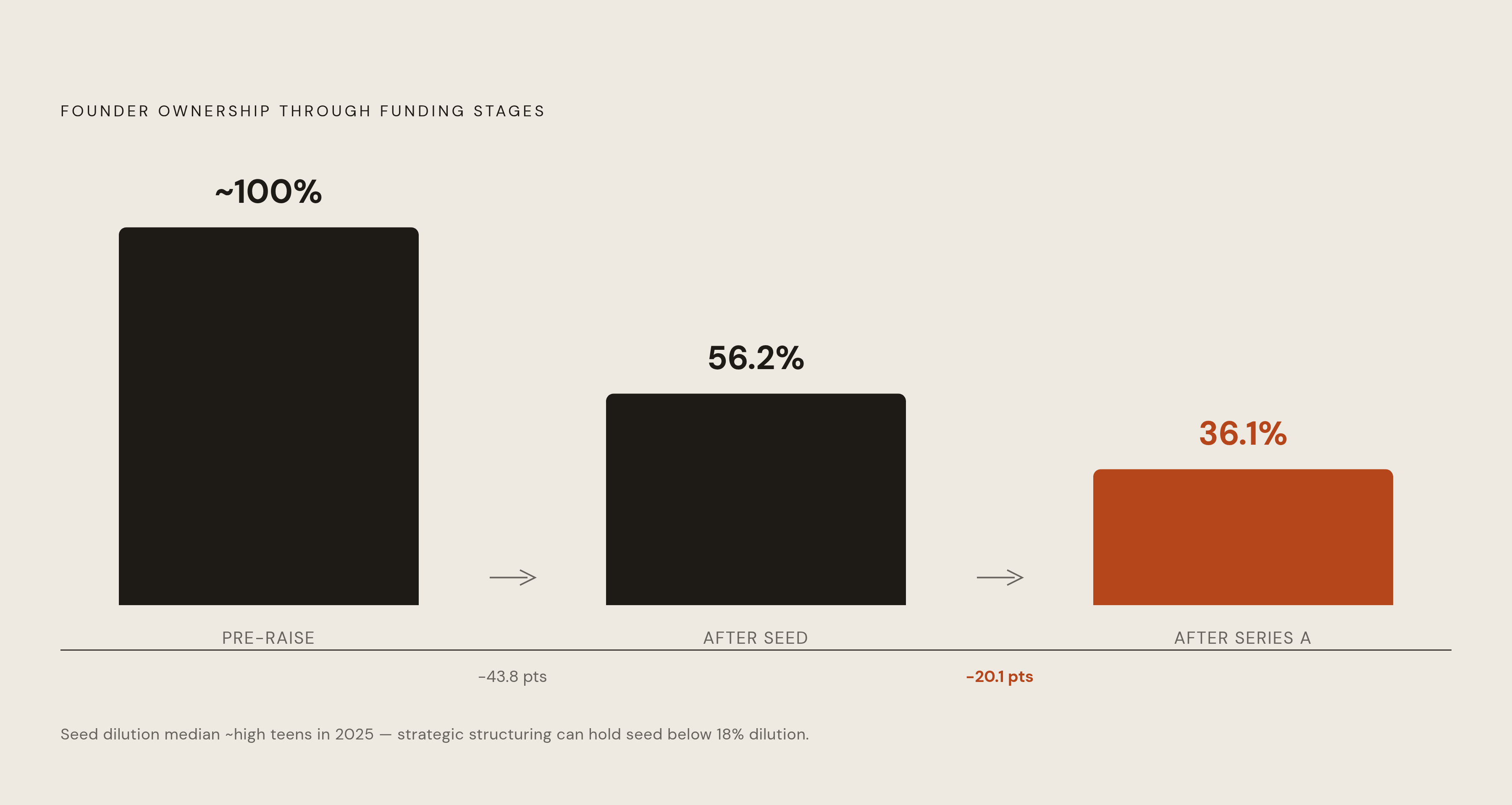
The median founding team owns 56.2% after a seed round
That falls to 36.1% by Series A
Median seed dilution has come down to roughly the high teens in 2025, and strategic structuring can keep founders under 18%
The stacking problem is specific to post-money SAFEs. Each new SAFE you issue dilutes you, not other SAFE holders. Raise enough of them and you arrive at your Series A with a significant percentage of the company already committed before the new lead even models their preferred return. Priced rounds work differently: dilution spreads across all existing shareholders, including prior investors, which limits how much of the burden falls exclusively on founders.
One SAFE, managed carefully, is a clean and useful instrument. Multiple SAFEs stacked over two years in post-money format create a materially different dilution risk.
What Investors Are Actually Thinking When They See Your Cap Table
SAFE holders have no voting rights, no board seat, and no information rights until the SAFE converts. Seed funds have largely adapted to this and use SAFEs routinely. The friction point is institutional Series A funds who walk into due diligence and find a SAFE stack that is hard to model, has inconsistent terms, or has MFN clauses that interact in ways even the founder cannot fully explain. Seed funds do not hate SAFEs, but Series A funds dislike cap tables they cannot reconcile quickly.
A few other shifts in investor preferences worth knowing:
Pro rata rights are now included in 67% of SAFEs, per NVCA's 2024 data, up from 23% in 2020. Investors are negotiating more protection into instruments that were designed to be lean.
Side letters adding further protections are now common with institutional pre-seed investors.
The word "simple" in SAFE increasingly describes the base document, not the full negotiated package.
There is also a tax consideration that matters to certain investors. A priced round issues shares immediately, which starts the Qualified Small Business Stock (QSBS) clock right away. QSBS can allow investors to exclude up to $10 million or 10 times their original investment from federal capital gains after five years. With a SAFE, no stock changes hands until conversion, so the QSBS timing is less certain. Investors who care about that exclusion may prefer the clarity of a priced round.
When a SAFE Is the Right Call and When It Genuinely Is Not
The right instrument depends on your stage, your leverage, and how much certainty you can establish around valuation.
A SAFE makes the most sense when:
You are pre-revenue or pre-product and cannot credibly defend a specific valuation
The round is small (the data consistently shows SAFEs dominating rounds under a few million dollars)
Speed is a competitive advantage and an investor is ready to move
You want to avoid governance entanglement before you have meaningful leverage
This is a single raise, not the first of several, since stacking multiple post-money SAFEs creates a different risk profile
A priced round makes more sense when:
The round exceeds roughly $2 to $5 million, where the governance trade-off is matched by what a fixed valuation gives you
You have traction data (revenue, growth rate, customer count) that makes a valuation defensible and potentially favorable
You have already raised via SAFE and another unpriced instrument would compound your dilution exposure
Institutional investors are at the table and expect clean mechanics
QSBS eligibility is meaningful to your investors and the five-year clock matters
A SAFE makes sense when valuation is genuinely uncertain. Using a SAFE to avoid a valuation conversation you could actually win feels easier in the short term but costs more later. Stage and leverage together determine the answer. Know what stage you are at, know what you can defend, and if someone hands you a five-page document and says it is simple, take another twenty minutes to read it carefully.