IPO and Acquisition Exit Trends for Venture Backed Startups
VC exits doubled in 2025, but structural shifts are reshaping how founders access liquidity.

Venture exits pulled in $297.6 billion across roughly 1,635 deals in 2025, the fourth-highest total of the past decade. That figure nearly doubled year over year, yet it still wasn't enough to meaningfully reduce the backlog of companies waiting for liquidity. Understanding why requires looking beyond the headline numbers at the structural forces reshaping each of the three main exit paths available to venture-backed companies: M&A, IPOs, and secondaries.
Each path is functioning very differently in 2025 than it did during the 2020 and 2021 peak, and the companies best positioned for an exit are the ones that understand those differences in detail rather than planning around outdated assumptions. For founders managing cap tables and timelines, and for LPs waiting on cash distributions from funds that have been slow to return capital, the gap between what the numbers suggest and what the exit environment can actually absorb is the central problem this piece examines.
Why M&A is the exit most founders see
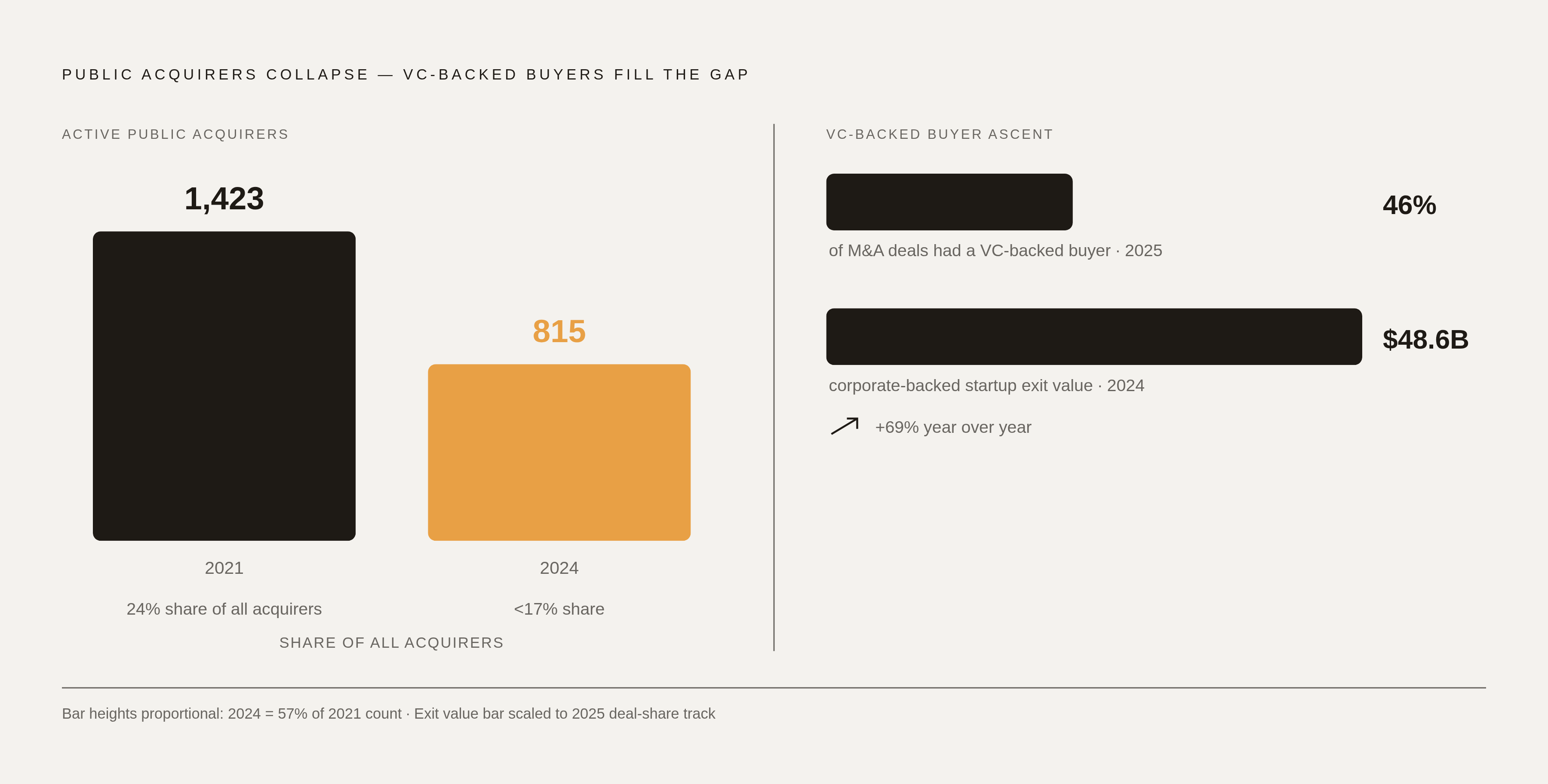
85% of VC-backed exits happen through acquisition, not IPO, according to RaiseSummit's analysis of venture exit data. That share has remained consistent over time, even as the composition of buyers has changed significantly. Public company acquirers, the large strategics that founders typically assume will drive M&A activity, fell from 1,423 active buyers in 2021 to just 815 in 2024, per PitchBook. Their share of all acquirers dropped from nearly 24% to under 17% over the same period. Higher borrowing costs, compressed acquisition multiples, and heightened regulatory scrutiny all contributed to that retreat.
The gap left by retreating public company acquirers has been filled primarily by venture-backed companies buying other venture-backed companies. In 2025, 46% of M&A deals included a VC-backed buyer, and corporate-backed startup exit value reached $48.59 billion in 2024, a 69% increase from the prior year. PE sponsors have also grown more active as acquirers in categories where public company buyers have pulled back. For founders mapping out exit strategy, prioritizing relationships with VC-backed peers and PE sponsors in their category is now more likely to produce results than concentrating outreach on large public company business development teams.
AI acquihires are their own high-stakes category
AI M&A volume reached 782 acquisitions in 2025, roughly 1.5 times the 2024 count. A significant portion of these transactions are structured as acquihires, in which the buyer compensates the target primarily to absorb its engineering and research talent rather than to operate its product. In most acquihires, the product is discontinued shortly after closing. Google's acquihire of key personnel from AI code editor Windsurf was valued at $2.4 billion in July 2025. Google also paid $2.7 billion to acquihire the team behind Character.AI. Microsoft's acquihire of Inflection's core staff came in at $650 million.
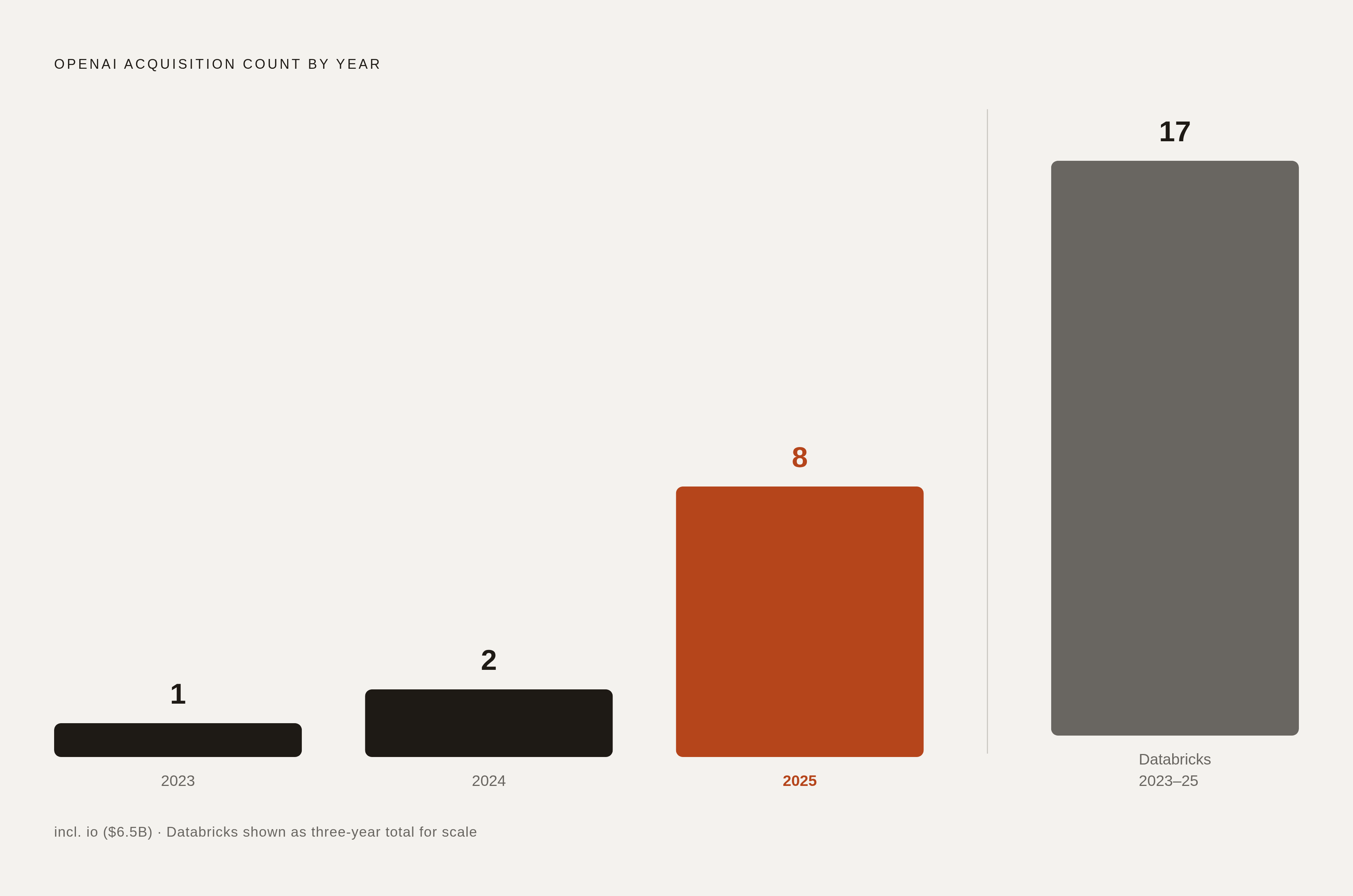
The pace of acquisitions at OpenAI illustrates how quickly consolidation is accelerating in AI: one acquisition in 2023, two in 2024, and eight in 2025, including the nearly $6.5 billion purchase of Jony Ive's hardware startup io. Databricks closed 17 acquisitions over the same stretch. Traditional acquisitions above roughly $120 million trigger mandatory premerger notification under the HSR Act, which introduces regulatory review timelines and scrutiny. In response, an increasing number of AI talent transactions are being structured as licensing agreements or direct employment arrangements specifically designed to stay below that threshold, which means the legal form of these deals is being engineered to avoid regulatory friction rather than to reflect the underlying business logic of the transaction.
Founders and employees holding equity at AI startups should treat the Windsurf transaction as a detailed case study rather than simply a data point about large deal values. It was the fourth major acquihire in approximately one year in which employees received little to no proceeds despite headline valuations in the billions. Acquihire deal structures typically concentrate proceeds at the top of the cap table, and standard employment agreements for incoming talent do not automatically provide equity protections equivalent to what employees held in the acquired company. Any founder or employee reviewing an acquihire term sheet should retain independent legal counsel with M&A experience before signing, specifically to analyze how proceeds are allocated and what protections exist for option holders and common stockholders.
IPOs are open but the bar is high
By mid-August 2025, 13 domestic venture-backed companies had gone public at valuations of $1 billion or more, compared to eight for all of 2024. The total number of VC-backed IPOs in 2025 reached only 66, the lowest annual count since 2016. Ran Ben-Tzur, co-head of the capital markets and public companies group at Fenwick, who advised on both the CoreWeave and Figma offerings, noted that the market is "certainly not back to a normalized level by any stretch of the imagination."
The companies that did go public in 2025 performed well. Figma's stock rose more than 100% on its first trading day and closed near a $68 billion valuation, far above its $12.5 billion private valuation from 2024. Circle also gained over 100% on its opening day. CoreWeave's stock continued appreciating in the months following its IPO. These results reflect a public investor base that is willing to pay significant premiums for companies with credible AI-integrated growth models and demonstrated revenue at scale.
Public market investors in 2025 are evaluating AI companies from two directions simultaneously. They want evidence that AI is driving growth within the business, and they are also conducting detailed diligence on whether AI tools or competitors could erode the company's revenue base over the next several years. Ben-Tzur identifies disruption risk from AI as a core diligence topic in current IPO processes, not a secondary concern. Rory O'Driscoll of Scale Venture Partners observed that Figma's IPO pop reflected the relocation of cheap capital from private funding rounds to the public markets, a structural shift that makes the current window attractive for companies that can meet the bar. Waiting for conditions to improve further carries its own risk, since public market appetite is not unlimited and the backlog of companies seeking to go public is large.
The profile required to successfully complete an IPO in this environment is specific: a clear AI integration story tied to measurable revenue growth, a business model that can withstand public scrutiny on AI disruption risk, and governance infrastructure mature enough to support a public board. That combination applies to a limited number of the unicorns currently in the backlog. Overseas, the IPO market is even more constrained. IPOs accounted for 14% of EMEA exits in 2021 and had declined to just 2% by the first half of 2025, per Morgan Stanley's EMEA Exit Report, while M&A climbed from 90% to 98% of EMEA exits over the same period.
The unicorn backlog is crushing fund math
859 domestic unicorns are currently waiting for an exit, and the World Economic Forum counts 1,920 privately held unicorns worldwide. The aging of this backlog compounds the problem: 59% of all unicorns were founded more than a decade ago, and PitchBook estimates the value locked in that aging cohort exceeds $1 trillion. Only a small fraction of unicorns completed exits from private markets in 2025, and projecting the current exit rate forward implies that clearing the existing backlog would take many decades at the present pace.
The backlog is placing direct pressure on fund performance metrics. DPI, meaning cash actually distributed back to limited partners rather than paper value reported on the books, remains severely depressed across recent vintage years. Many funds raised during the 2018 to 2022 period have not yet returned the capital their LPs contributed, which is the most fundamental measure of whether a fund has worked. This situation is not isolated to a few underperformers; it reflects a broad structural gap between the volume of capital deployed and the volume of exits that have occurred.
The recovery being observed in 2025 is heavily concentrated rather than broadly distributed. AI, cybersecurity, datacenter infrastructure, and select fintech categories are generating meaningful exit activity and drawing active acquirer interest. Crowded horizontal SaaS verticals, consumer technology, and capital-intensive business models are seeing far fewer exits, and companies in those categories face valuation resets that have often not yet been formally acknowledged in fund reporting. The disproportionate share of 2025 venture capital flowing into AI further concentrates the recovery rather than broadening it. For most of the 859 unicorns in the backlog, the immediate priority is generating some form of liquidity before the fund holding their equity is required to wind down, which makes secondary transactions increasingly relevant as a planning tool.
Secondaries are now a legitimate third exit path
Secondary transactions have grown from a niche liquidity mechanism into a major exit channel. Recent volume estimates place secondary activity in striking distance of IPO and M&A activity measured over comparable periods, and secondaries now represent a meaningfully larger share of overall venture deal activity than they did earlier in the decade. The growth reflects genuine demand: LPs need liquidity from funds that are not generating distributions, founders and early employees need partial cash before a formal exit materializes, and buyers in the secondary market are willing to provide that liquidity in exchange for purchasing stakes at a discount.
That discount is the critical variable any founder or LP needs to model accurately. Throughout late 2024 and into 2025, stakes in VC funds traded at significant discounts to reported net asset value, reflecting a market correction that is not always visible in quarterly LP reports because formal write-downs lag actual market conditions. Only a minority of 2020-vintage VC funds were generating cash distributions to LPs by early 2025, which illustrates the scale of the liquidity gap that secondaries are filling.
Secondaries offer specific structural advantages that IPOs and M&A do not. They allow founders and early employees to access partial liquidity without requiring a full company sale, they give LPs a mechanism to rebalance their portfolios before a fund reaches its termination date, and they provide price discovery on private company valuations at a point in time when other mechanisms for establishing market value are not available. They do not, however, impose the public accountability and forced valuation transparency that accompany an IPO. A company whose private valuation is significantly above what public markets would support can continue operating and raising secondary capital for years without confronting that discrepancy, which is one reason the backlog has persisted as long as it has.
What founders and investors should do now
The IPO market is open in 2025, but it serves a narrow profile of company. Founders pursuing a public offering need a demonstrable AI integration story tied to revenue growth that is already occurring, a business model that can withstand detailed investor diligence on AI disruption risk to their own category, and governance structures capable of supporting a public board. Companies that do not yet meet that profile should not plan their timelines around the assumption that the IPO window will remain open or become more accommodating. The bar in 2025 is materially higher than it was in 2020 and 2021, and the number of companies that can successfully clear it in any given year is limited.
M&A is the exit path most companies will actually experience, and the preparation required has changed. Because the buyer pool has shifted toward VC-backed peers and PE sponsors, founders should be actively building relationships with potential acquirers in those categories now, rather than concentrating relationship-building on large public company business development contacts. In AI specifically, founders should treat acquihire deal structure as a distinct negotiation rather than a standard M&A process. Protecting employee equity holders requires explicit contractual terms negotiated before signing, not assumptions based on headline transaction values.
Secondaries should be incorporated into exit planning from an early stage, not treated as a fallback option when other paths have closed. They are most effective as a tool for providing partial liquidity to founders and early employees before a formal exit, and for giving LPs a mechanism to rebalance ahead of a fund's close date. Any secondary modeling should incorporate a realistic discount to current reported valuation; using reported NAV as the baseline produces inaccurate projections of net proceeds.
The 859-unicorn backlog reflects a broader mismatch between the volume of companies that were funded during the 2018 to 2022 period and the capacity of the current exit environment to absorb them. Companies in crowded horizontal SaaS categories or capital-intensive business models face the most severe version of this problem, with limited active acquirers and a public market that is not interested in their profiles at current private valuations. For those companies, exit strategy increasingly means identifying a specific acquirer relationship to develop, structuring the cap table to facilitate secondary transactions, or making the product and data investments required to reposition into a category that is generating active exit activity. Waiting for general market conditions to improve is a strategy that depends on timing forces outside any founder's control, and the backlog data suggests that timeline is longer than most fund schedules can accommodate.


