Geographic Expansion of Venture Capital Beyond Silicon Valley
Bay Area capital share rebounded to 48% in 2024 as AI mega-rounds overwhelmed regional gains.

- Written by
- Dana Ashworth
- Updated
- October 12, 2026
- Reading time
- 9 min read
- Sources cited
- 5 sources ↓
What this covers
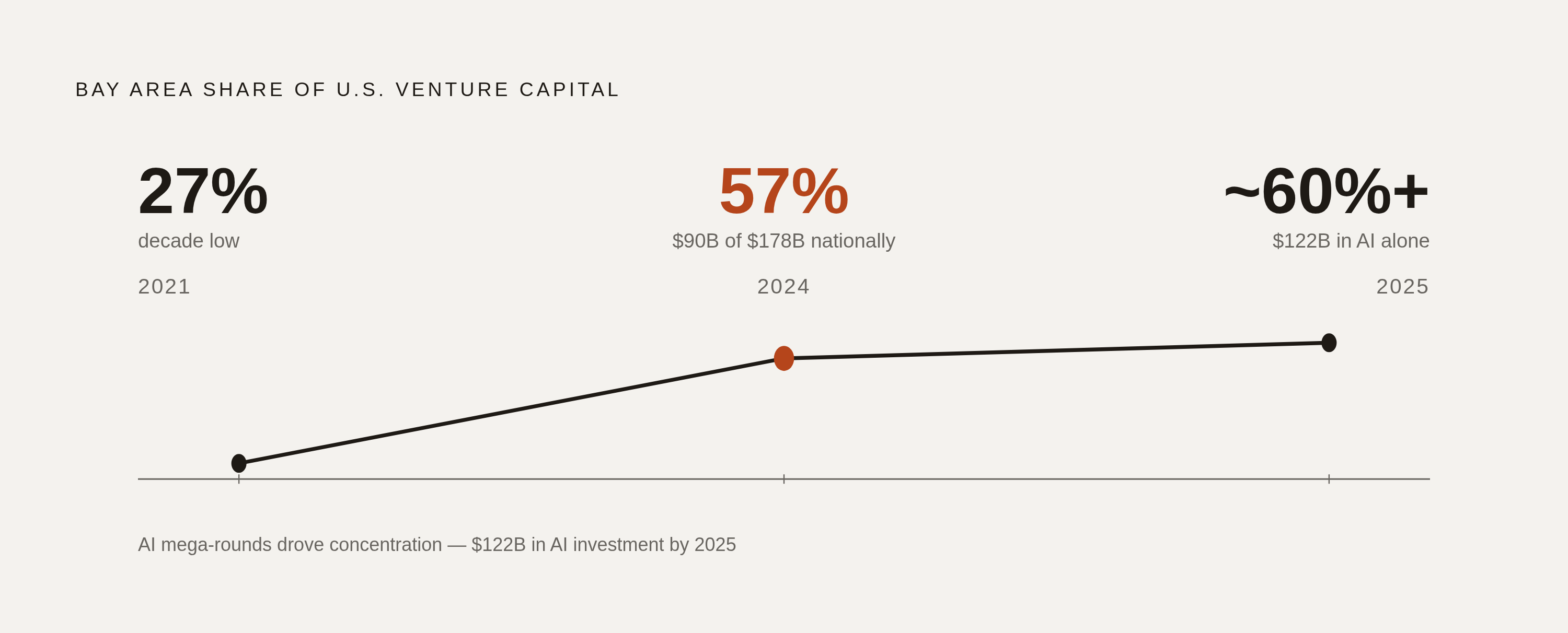
The Bay Area's share of U.S. venture capital hit 27% in 2021, the lowest in over a decade, and by 2024 it was back over half. That reversal is the actual news here, more than the dispersion story everyone was telling three years ago.
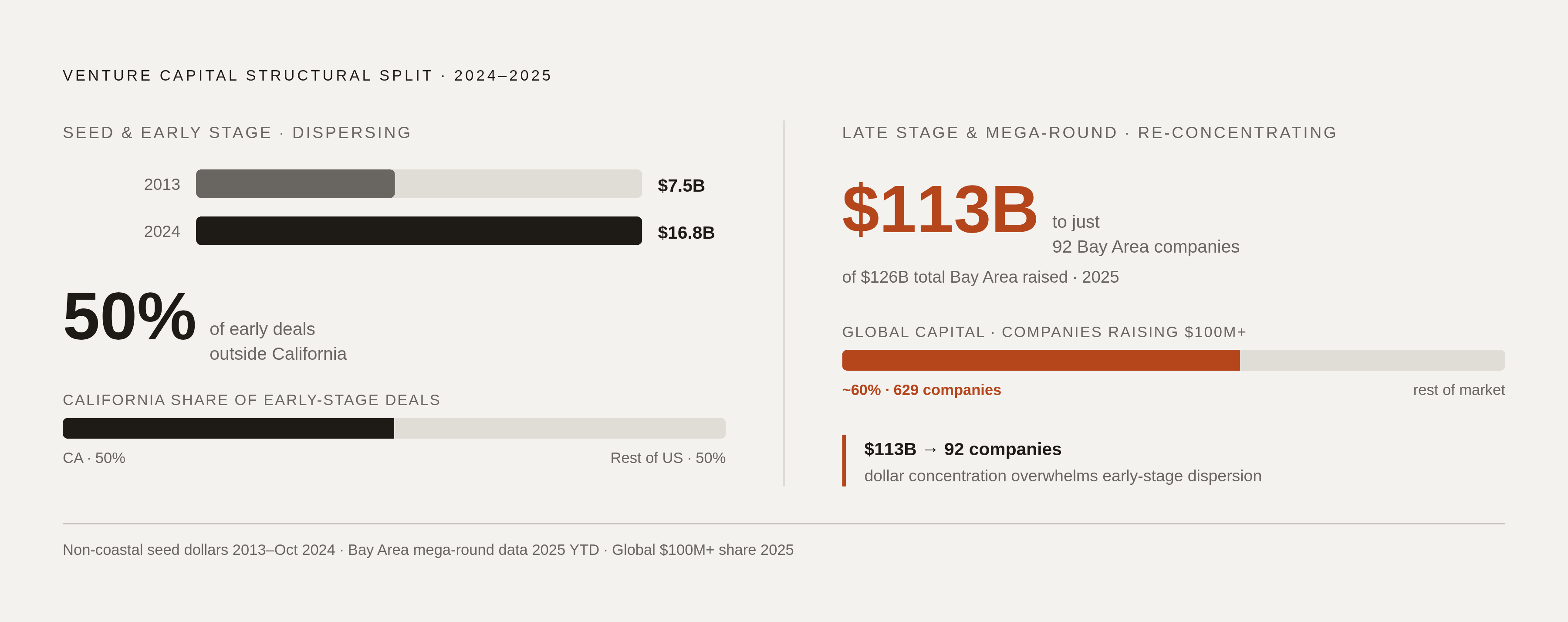
What happened in between matters more than the headline number. Remote work broke the old rule that founders had to sit across the table from their investors, and Bay Area rent pushed a lot of teams to build somewhere cheaper. Local angel networks and regional accelerators showed up in cities that never used to register on a VC map. Revolution's Rise of the Rest report has the receipts: seed and early-stage dollars outside California, New York, and Massachusetts more than doubled, from $7.5 billion in 2013 to $16.8 billion through October 2024.
Here's the distinction that explains almost everything below: more cities got a credible ecosystem, but the money did not spread out evenly to match. Dispersion was strongest in deal count and early-stage dollars, and it was never as strong in total dollars. Those are two different stories, and 2024 is the year they stopped rhyming.
Where U.S. Capital Actually Landed in 2024
Here's the number that guts the optimistic version of this story: over 72% of all capital raised on Carta in 2024 went to startups in just four states. Only 12 states cleared even 1% of total cash raised. California alone took 48.79%, nearly half the country's startup funding sitting in one line item.
The South's reversal tells you the most about how fragile some of that earlier growth actually was. The South census region fell from 16.3% of venture dollars in 2023 to 11.6% in 2024. Florida fell harder and faster, dropping from 4.26% down to 1.5%. That decline suggests the pandemic-era migration to Austin and Miami was partly real and partly a temporary reshuffle, because once things normalized, a chunk of that capital drifted back to the coasts.
Then there's the part of the map that never lit up at all. Mississippi and Louisiana got zero venture funding in 2024, and a cluster of states, South Carolina, Arkansas, Oklahoma, Iowa, Idaho, Wyoming, the Dakotas, and Nebraska, together captured just 0.1% of national VC, per Revolution. These aren't ecosystems that shrank; they never got built.
One data point breaks the pattern cleanly: Silicon Valley Bank's Future of Frontier Technology report found the U.S. Midcontinent surpassed the East Coast in total VC funding in 2024. Massachusetts, meanwhile, dropped from 12.92% to 8.06%, too large a swing to file under normal noise. The map has a few bright spots and a lot of blank space, and calling uneven dispersion a national trend flattens a picture that is actually quite lumpy.
Cities That Built Real Alternative Ecosystems
Miami gets talked about more than any other alternative hub, and for once the chatter has numbers behind it. Florida startups raised $4.13 billion in 2024, and Miami-Fort Lauderdale landed among the top ten metros nationally by deal count. StartupBlink ranked its growth rate fastest among the top 25 ecosystems globally. What separates this wave from Miami's earlier hype cycles is that publicly traded enterprise AI vendors and cybersecurity firms are moving full executive headquarters there rather than opening a satellite office. Worth saying plainly, though: Florida's state-level VC share collapsed in that same Carta dataset during the same year, which means Miami's growth is real but has not yet moved the needle on the state number.
Austin is messier, and the mess is the story. Total funding more than doubled 2023's totals, but that growth came almost entirely from a handful of large late-stage rounds. Deal count fell from 312 in 2024 to a lower figure in 2025, and SignalFire tracked the city losing startup talent heading into 2025. Austin is placing fewer, bigger bets rather than broadening its base.
Denver and North Carolina's Research Triangle both more than doubled VC investment over the prior year, per Dealroom and Smash.vc, representing real velocity even with dollar figures still small next to the coasts. The Southeast as a whole pulled in several billion dollars in the first half of 2025 alone, a sharp year-over-year jump according to BIP Ventures. That reflects early-stage infrastructure getting built in real time, beyond just a few headline deals inflating a regional average.
What these cities share: university pipelines, cheaper office and salary costs, and policy support that shows up in the funding numbers instead of just a press release. What they still lack is deep late-stage capital and repeat-founder density, the ingredient that lets a city recycle its own exits into the next generation of startups instead of exporting its winners.
How AI Mega-Rounds Reversed Dispersion
Bay Area startups absorbed $90 billion in 2024, representing 57% of the $178 billion raised across the entire U.S. that year. Three years earlier that number was 27%, and the gap closed fast in the opposite direction everyone expected.
The mechanism is AI specifically, not tech optimism generally. AI made up 61% of all global VC investment in 2025, about $258.7 billion of $427.1 billion total, per OECD figures. Roughly 79% of that AI money, around $159 billion, went to U.S. companies, and San Francisco and the Bay Area alone pulled in $122 billion of it, which amounts to 60% of global AI investing concentrated in one metro area. Inside Silicon Valley, AI consumed $103.5 billion of the $111 billion raised by scaleups in 2025, or 93% of all scaleup capital in the region.
The mega-round structure makes this concentration tighter still. Of the $126 billion invested in Bay Area startups in 2025, $113 billion went to just 92 companies raising very large rounds, with names like OpenAI, Anthropic, xAI, and Scale AI among them. Frontier AI keeps landing in the same zip code because of talent density, proximity to the labs actually building the models, and investor networks that fund every layer of the same stack at once, from chip designers to model labs to the application layer sitting on top. Those forces reinforce each other in a way no emerging hub can simply decide to replicate. A city can build a good university pipeline in five years, but it cannot build forty years of accumulated AI research talent on that same clock.
This dynamic extends beyond geography as well. Nearly 60% of all invested capital globally in 2025 went to the 629 companies that raised $100 million or more, which means concentration is increasingly about the size of the check, not just where the money lands.
Global VC Growth Outside the United States
Europe is growing and re-concentrating at the same time, which sounds like a contradiction until you look at where the growth actually sits. The UK and France together accounted for more than half of European VC funding in Q2 2024, with the UK up sharply year-over-year, so even inside a story about Europe catching up, the money is really moving toward two capitals. Berlin is the exception worth naming, because it has developed a real fintech, healthtech, and deep tech cluster that raised many billions of euros in 2024, per Dealroom. KPMG's Q4 2024 Venture Pulse found Asia sliding to record lows the same quarter Europe posted modest gains, so the regional comparison matters almost as much as the raw totals.
Asia is splitting in two directions at once. India was the fastest-growing VC market in 2024, up sharply year-over-year, and Bangalore and New Delhi both ranked among the top global startup cities, ahead of Tokyo, Berlin, and Seattle. OpenAI picking Singapore as its Asia-Pacific headquarters signals where AI infrastructure is clustering in the region. Beijing's ecosystem stays large and active in AI, but geopolitical friction caps how much global LP money is willing to flow there, and by Q1 2026, Asia held a meaningful slice of global VC still well under its historical share, with pockets growing while the region as a whole shrinks.
Latin America climbed back from a genuinely deep hole. Funding hit roughly pre-pandemic levels by 2023, well down from the 2021 peak but no longer in free fall, and 2024 posted 26% growth over 2023. Brazil leads on total dollars with fintech as the anchor sector, but software, climate tech, and proptech are broadening the base underneath it. Q4 2024 posted the highest LatAm funding volume in over two years, a real sign of life even if the scale still trails the rest of the world by a wide margin.
The pattern repeats everywhere you look. Every region shows the same internal dynamic as the U.S., where capital pools into one or two dominant cities instead of spreading evenly across a country or continent. Geographic concentration is not an American quirk; it is simply how venture capital behaves.
Why Dispersion and Re-Concentration Coexist
Both things are true at once because they describe two different markets. Early-stage dollars and deal counts are dispersing, while late-stage and mega-round dollars are re-concentrating. These operate under different rules with different gravitational pull, and conflating the two is where most analyses of this topic go wrong.
Early-stage dispersion holds up because the mechanics genuinely changed. A seed investor can evaluate a founder over Zoom just fine, and local angels and micro-VCs have shown up in cities that had none a decade ago. A founder can build an MVP out of Columbus as easily as out of Palo Alto. Revolution's decade of data on non-coastal early-stage dollars more than doubling reflects a structural shift rather than a one-year blip. California still accounted for half of all early-stage deals in 2024, per Revolution, but the other half went everywhere else, and a decade ago that split looked nothing like it does now.
Late-stage re-concentration runs on a completely different engine driven by AI's appetite for capital. Frontier AI needs compute infrastructure, talent clusters, and investor networks that only a handful of cities can supply at the required scale. The $100 million-plus round is exactly where Bay Area gravity snaps back hardest, and the 2025 numbers make that unambiguous.
So what should an emerging hub actually take from this? Building a real ecosystem at seed and Series A is achievable, and the data prove it is already happening. Competing for the AI mega-round is a different sport entirely, one that requires infrastructure most cities cannot stand up in a few budget cycles. That leaves a real strategic fork: chase AI infrastructure and hope to close the gap, or double down where re-concentration pull is weaker, in sectors like biotech, climate, and manufacturing.
What Founders Outside Top Hubs Should Expect
Start with the plain baseline, because it is not up for debate: building an AI scaleup and hoping to raise $100 million or more still means geography pulls hard toward San Francisco, and the 2025 numbers leave no room to argue otherwise.
Outside that one lane, the picture for non-Bay-Area founders is genuinely better than it was ten years ago. Early-stage capital is more available outside the traditional hubs than at any point in the past decade, and the doubling of non-coastal seed dollars is a measured trend, not a marketing line. Sector-specific hubs are developing real depth: biotech in Boston and San Diego, energy and industrial in Houston, defense tech in the DC corridor. That represents genuine local depth built around a named industry, distinct from a hype cluster with favorable real estate prices. Lower burn rates in cheaper cities also stretch runway further, which changes how a founder times a raise instead of chasing the fundraising calendar out of desperation.
For investors, the growth in Miami, Denver, and the Research Triangle signals real, still-early ecosystems worth tracking. Late-stage follow-on capital often still has to come from a coastal fund, because that is where the check sizes and risk appetite for growth rounds actually live. The Southeast's improving deal velocity and check sizes, per BIP Ventures, suggest the infrastructure is maturing rather than a few deals getting lucky in isolation.
The investment deserts are not the result of bad luck either. States with zero venture funding lack university pipelines, anchor companies, and investor density, the self-reinforcing elements that take decades to build and that no single state grant program manufactures on demand. Distinguishing which cities built genuine depth through founding talent, investor density, and repeat-founder networks from which ones simply had a good news cycle requires more than a glance at a funding total.
Geographic expansion of VC is real and worth taking seriously at the seed and sector-specialist level, while at the mega-round level, re-concentration is winning plainly and by a wide margin. Treating those two facts as the same story leads to misjudging both the opportunity in front of you and the risk sitting right behind it.
Methodology & sources
- https://carta.com/data/VC-funding-geography-2024/
Provided the state-level and regional breakdown of U.S. venture funding in 2024, including California's 48.79% share, the South's decline, Florida's drop, and Massachusetts's contraction.
- https://endeavor.org/stories/400-investment-endeavor-catalyst/
Provided figures on the share of global AI investment going to U.S. companies and the Bay Area's concentration of that AI capital.
- https://www.bipventures.vc/state-of-startups/2025
Provided data on the Southeast region's venture funding in the first half of 2025 and improving deal velocity and check sizes.
- https://news.crunchbase.com/venture/funding-data-third-largest-year-2025/
Provided the figure that 60% of global AI investing was concentrated in the Bay Area metro area.
- https://assets.kpmg.com/content/dam/kpmgsites/az/pdf/2025/Q4-2024-Venture-Pulse.pdf
Provided Q4 2024 data showing Asia sliding to record lows while Europe posted modest gains, used in the global VC section.