Founder Dilution Management Across Funding Rounds
Predictable dilution patterns show which early decisions cost founders the most.

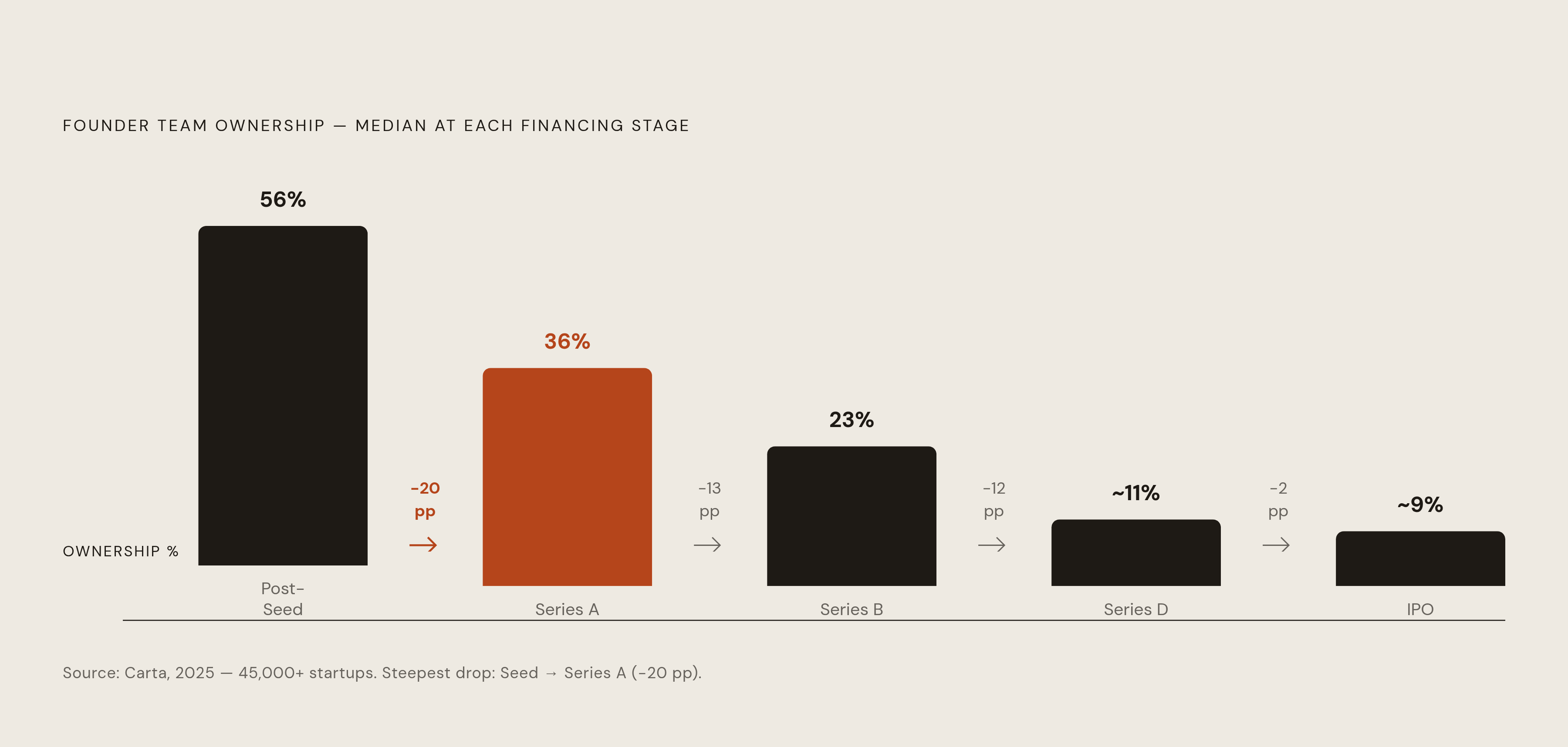
Most founders know they're going to get diluted. What most don't know is exactly how much, when it happens, and (most importantly) what they can actually do about it before the term sheet lands on their desk. The good news: dilution is largely predictable. Carta's 2025 dataset of over 45,000 startups shows the median founding team holds about 56% after seed, 36% after Series A, 23% after Series B, and just over 10% after Series D. At IPO, a founder-CEO typically owns somewhere in the 8–10% range. The arc is steep early and flattens late — like a ski slope that gradually becomes a bunny hill, but by then you've already done most of your falling. That single structural fact is the foundation for every dilution decision you'll make.
These are medians, not sentences. Every inflection point has levers a prepared founder can pull. This piece walks through each of them.
Early-Stage Dilution Is Way More Expensive Than It Looks
Here's the uncomfortable math: giving up equity at a low early valuation costs you far more in absolute dollars than giving up the same percentage at a much higher later valuation. David Van Horne at Goodwin Procter puts it plainly. The money you raise early on is the most expensive money you'll ever take. The equity is cheap to give away at the time, and expensive to have given away forever.
Pre-seed and seed rounds typically produce 20–25% dilution per round. Series B and beyond typically produce 10–15%. Yet early rounds happen at the lowest valuations, when each percentage point represents the least current value and the most future value. The combination is brutal if you're not watching it.
The Carta data backs this up. About 28% of seed and Series A rounds involve selling 20–24% of the company. Nearly 10% sell a substantial portion over 30%. That's a lot of founders agreeing to terms that start them behind the median before the real game begins.
There's a counterintuitive trend worth noting here. Per-round dilution has actually been declining recently. The Series A median dropped from around 20.9% to 17.9% year over year, and Series B fell to roughly 13% in full-year 2025. Part of that is rising valuations. The median seed pre-money reached $16 million in early 2025, about 18% higher than the prior year. Part of it is time. The median startup waited 774 days after seed before raising a Series A (Carta, 2024). More time between rounds means more value built before the next dilution event.
The structural lesson here is this: compounding dilution across multiple early rounds is where most founders lose ground. Not in any single late-stage round. The first two years of fundraising set the trajectory for everything that follows.
The SAFE Stacking Problem Most Founders Don't See Coming
SAFEs are now the default early instrument. They accounted for 90% of pre-seed deals and 64% of seed deals on Carta's platform in Q1 2025. They're fast, cheap to issue, and founder-friendly in their simplicity. They're also the mechanism through which a lot of founders quietly give away more of their company than they intended.
The specific danger is stacking. Here's how it plays out in practice.
A founder raises a SAFE at a low cap. Six months later, another at a higher cap. Then a bridge SAFE at a higher cap still. Each one feels manageable in isolation. Then they go to raise a priced seed round and sit down with a new lead investor who's trying to model their ownership post-close. All three of those SAFEs convert at once. Founders who've gone through this process in recent years often describe the cap table as a surprise. In a bad way. It's a bit like ordering three "small" desserts at a restaurant — each one seems fine, until the bill arrives and you realize you've eaten an entire cake.
A few mechanics to understand:
- Post-money SAFEs lock in the investor's ownership percentage at signing. Every subsequent SAFE dilutes only the founders and common stockholders. Not the earlier SAFE holders.
- Pre-money SAFEs spread the dilution across all SAFE investors as well as founders. They're more dilutive to early SAFE investors but less concentrated on founders.
- 96% of SAFEs issued in the first half of 2025 included a valuation cap (up from 86% in 2024). The cap negotiation is the whole game.
Founders who sign three or four post-money SAFEs over 18 months at progressively higher caps can arrive at Series A diligence with 35–45% already committed to SAFE holders before a new lead models their position. That's not a hypothetical edge case. It's a common pattern.
Two rounds of SAFEs each giving away roughly 20% are not the same as two priced equity rounds at 20% each. The math can leave founders with far less than expected because of how conversion timing and post-money mechanics interact.
The lever: Before signing each new SAFE, model the total conversion as a single cap-table event. Treat the aggregate cap exposure as a priced-round equivalent and check it against the benchmarks in this article. If the combined conversion would produce more dilution than a priced seed round would, ask yourself whether you'd agree to those terms in a term sheet. Because you just did.
How Option Pool Sizing Quietly Moves Dilution Onto Founders
Over 70% of equity financings include an option pool top-up as part of the deal. This is close to universal, so understanding how it works is not optional.
The mechanics are simple. Investors require an employee option pool to be created before the financing closes. That's important. Because the pool is established pre-investment, it comes entirely out of the founders' ownership. Incoming investors are unaffected. They invest into a company that already has the pool baked in, so their percentage is calculated after dilution has already hit the existing holders.
Seed-stage pools typically land in the 10–15% range of fully diluted shares. By Series C, employee ownership has grown to 15–20% as teams scale. Carta's data shows the median founding team retains about 56% after a seed round, and most seed option pools land close to 15%. The pool size and the ownership outcome are directly linked.
Here's where founders give ground unnecessarily. Investors often request a pool size based on a round number or general practice rather than a specific hiring plan. "We'd like to see a 15% option pool" sounds reasonable until you realize that moving from 15% to 10% has a direct, calculable impact on your ownership that you can quantify before the negotiation starts.
How to push back effectively:
- Build a specific hiring plan before the round closes. Name the roles, project hire dates, and use market-standard grant sizes.
- A generic ask for 15% is hard to defend against a detailed model showing you need 9.5% for 12 months of realistic hiring.
- Unused options eventually expire or get re-granted. A larger-than-needed pool today is a permanent transfer of optionality from founders to a pool that may not even get used for years.
There's also a secondary lever here that most founders don't know to ask about. Whether the pool is set pre-money or post-money matters. A pre-money pool expansion dilutes existing shareholders, primarily founders. A post-money pool dilutes the incoming investor as well. It's worth asking.
Valuation Negotiation Is the Most Direct Lever You Have
The dilution math is not complicated. Say founders hold 8 million shares out of 10 million total (80% ownership). The company issues 2.5 million new Series A shares. Founders now own 8 million out of 12.5 million — that's 64%. The pre-money valuation determines how many new shares get issued for a given dollar amount. Higher valuation, fewer shares, less dilution. That's it.
This is why rising valuations have driven the recent decline in per-round dilution. The median seed pre-money reached $16 million in early 2025, roughly 18% higher than the prior year. Higher starting points mean every subsequent round dilutes less in percentage terms.
What gives you negotiating leverage on valuation:
- Revenue traction and growth rate relative to what's normal for your stage.
- Competitive dynamics. Multiple term sheets compress the valuation range upward. One term sheet is a take-it-or-leave-it. Two term sheets is a negotiation.
- Time pressure. Founders who need capital urgently accept lower valuations. Founders with runway can shop. The 774-day median between seed and Series A isn't just a fun data point. It's a signal that the founders who build the most before going back to market are the ones negotiating from strength.
Round size also matters more than founders typically treat it. A larger raise at the same valuation means more shares issued and more dilution. Right-sizing the raise is a dilution lever as meaningful as valuation negotiation itself. Staging capital through milestone-based tranches or bridge rounds can also preserve ownership if the next round's valuation will be materially higher.
Raise what you need. Not what sounds impressive in a press release.
Anti-Dilution Provisions and What They Actually Do to You in a Down Round
Anti-dilution clauses are standard. They protect investors if the company raises money at a lower valuation than the previous round. The economic cost of that protection falls on founders and common stockholders. Worth understanding before you sign.
Down rounds aren't theoretical. They reached a decade-high of 24.2% of all venture rounds in 2024 before declining to 17.4% by mid-year (PitchBook, 2024). By Q4 2025, they had fallen to under 14% (Carta, 2025). Down rounds are uncommon in good markets. They are not rare in bad ones.
There are three main types of anti-dilution protection:
- Full ratchet: Recalculates the investor's share price to match the lowest new price in a down round, regardless of how small that round is. Maximum investor protection. Maximum founder pain.
- Broad-based weighted average: Recalculates based on all shares outstanding and total funds raised. This is the market standard. Significantly less punishing to founders.
- Narrow-based weighted average: Considers only investor-issued shares. More dilutive to founders than broad-based, less extreme than full ratchet.
The practical danger of aggressive anti-dilution terms is that they can nearly wipe out founder holdings in a serious down round. That's actually a problem for investors too, since a founder with no equity has no reason to keep building. But you shouldn't rely on that logic to protect you. Negotiate the terms.
What to ask for:
- Broad-based weighted average as the default. This is achievable in most competitive processes.
- Sunset clauses that end anti-dilution protections after a set timeframe or when specific milestones are hit.
- Exclusions for bridge rounds and strategic financings from automatic anti-dilution triggers.
- Pay-to-play clauses that require existing investors to participate pro-rata in new rounds to keep their anti-dilution rights. This turns the mechanism into a commitment device rather than a free option.
Pro-Rata Rights and the Compounding Problem Nobody Talks About
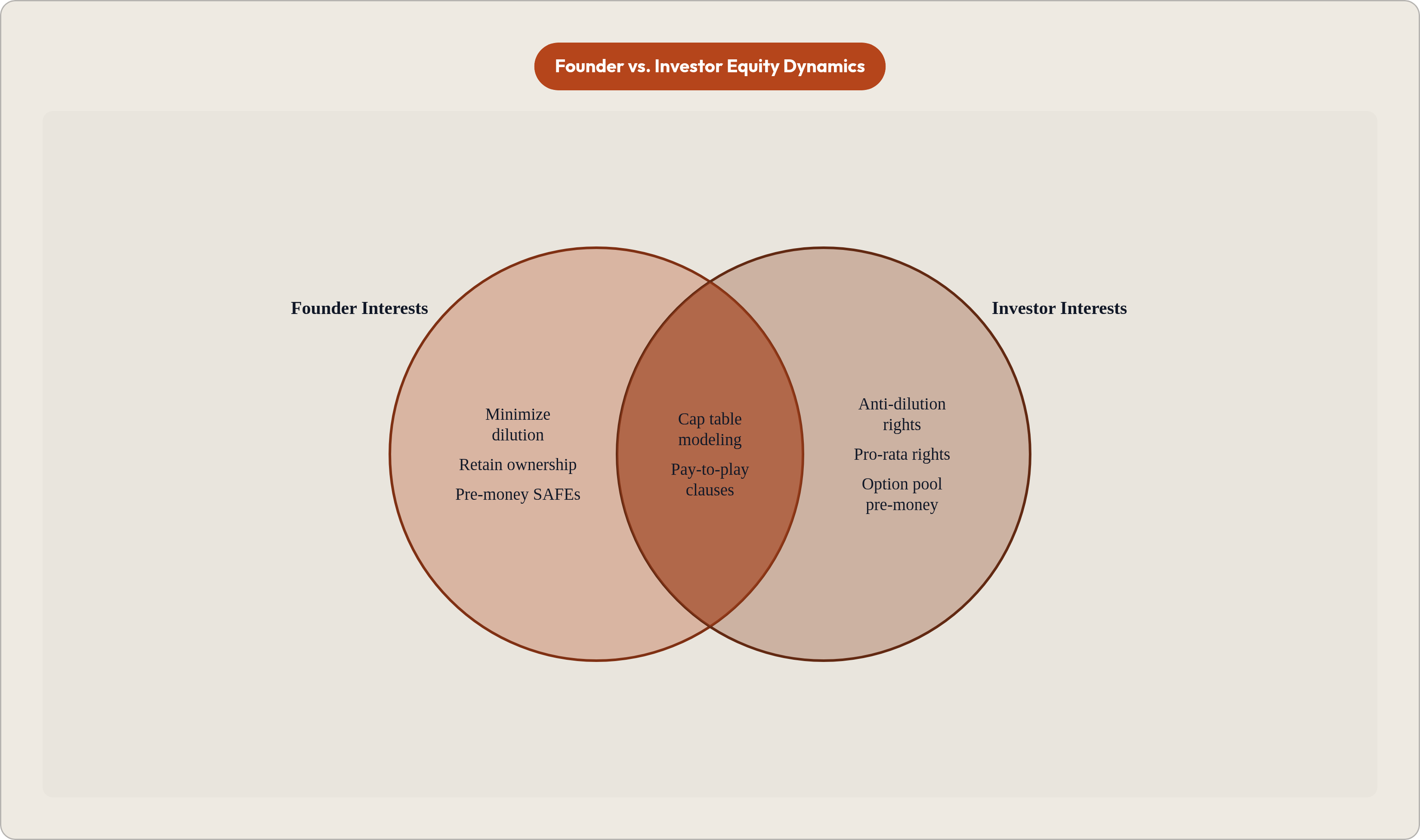
Pro-rata rights let existing investors maintain their percentage ownership by participating in future rounds. From an investor's perspective, this is completely reasonable. They took the early risk. They want to stay in the game.
From a founder's perspective, the issue is what happens when everyone has them.
Here's the compounding problem. If every investor from seed through Series B holds pro-rata rights into the Series C, a meaningful chunk of the new round is pre-allocated before a new lead can build a clean position. That can make rounds harder to close. It can also crowd out strategic investors you'd actually want at the table. And it reduces your flexibility to use round allocation as a relationship tool.
Small seed checks with unlimited pro-rata rights are a particularly sneaky version of this problem. An angel who wrote a small check at pre-seed now has the right to follow on into every future round. That might be fine. It might also mean you're managing fifteen pro-rata requests in your Series B and spending time you don't have.
How to handle pro-rata rights thoughtfully:
- Limit pro-rata to lead investors or those above a minimum check size. A small check shouldn't carry the same rights as a substantial lead investment.
- Negotiate pro-rata on a fully diluted basis rather than just issued shares. The calculation method affects how much of each round gets effectively reserved.
- Sunset pro-rata rights after a defined number of rounds or years.
Pro-rata rights are a legitimate ask and worth granting selectively to investors who add real ongoing value. The mistake is granting them indiscriminately in early rounds when the downstream cap table consequences aren't yet visible. You're agreeing to a future obligation when the cost of that obligation feels hypothetical. It won't always feel that way.
A Round-by-Round Reference: Target Dilution and Red-Flag Thresholds
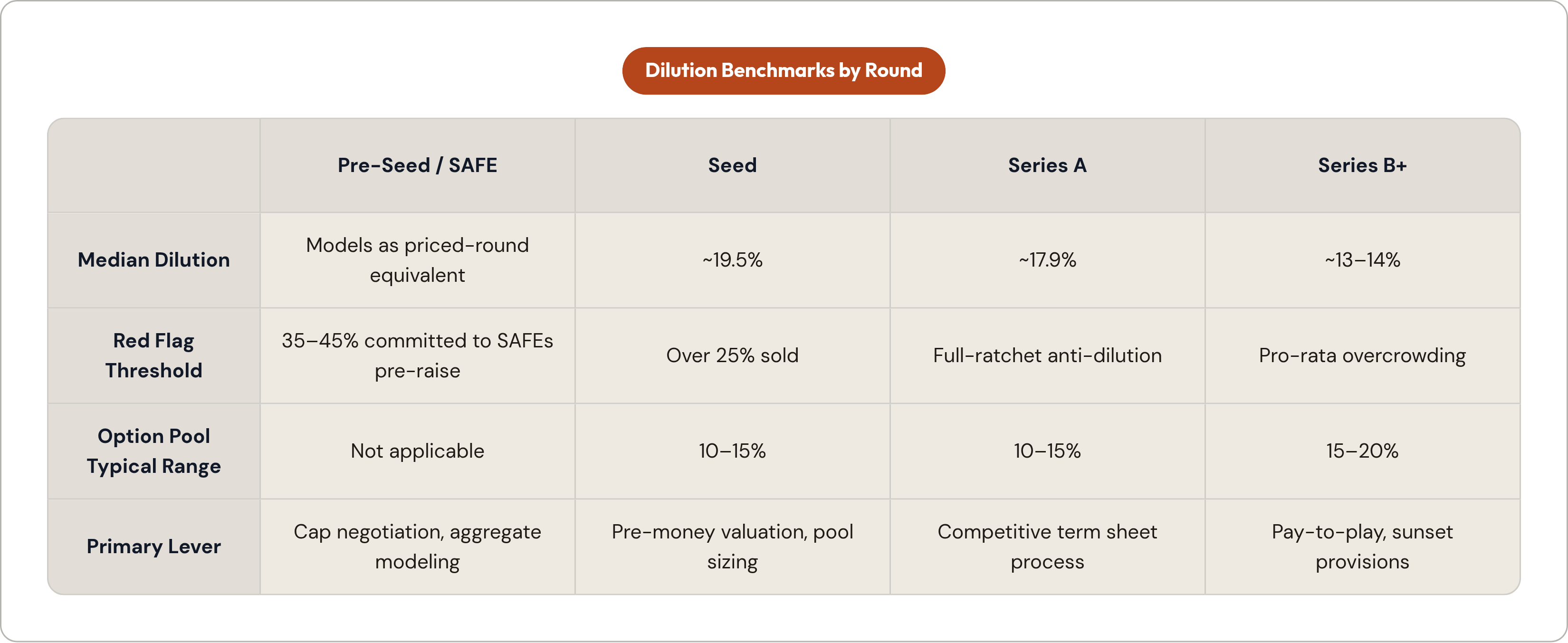
Here's a practical summary of what the benchmarks look like and where to push back.
Pre-Seed and SAFE Stage
Target: Keep aggregate SAFE conversion below what a seed priced round would produce. Model all outstanding SAFEs as a single conversion event before adding any new instrument.
Red flag: Post-money SAFEs that collectively commit 35–45% before you've reached a priced round.
Key levers: Valuation cap negotiation. Choosing between post-money and pre-money structure. Knowing your aggregate exposure before you sign.
Seed
Benchmark: Median dilution 19.5% (Carta, 2025 analysis of 2,005 US software startups). Staying under 18% is achievable with preparation.
Red flags:
- Selling over 25% at seed.
- An option pool over 15% without a specific hiring plan that justifies it.
Key levers: Pre-money valuation, right-sizing the option pool, round size discipline.
Series A
Benchmark: Median dilution 18% (Carta), with a recent trend toward 17.9% as valuations rise.
Founders who reach Series A with 56% or more ownership (the median post-seed) have more room to absorb Series A dilution and still hold a meaningful stake at the end of it.
Red flags:
- Agreeing to full-ratchet anti-dilution.
- Option pool expansion that goes beyond genuine 12-month hiring needs.
Key levers: Running a competitive term sheet process, scoping pro-rata rights carefully, negotiating anti-dilution clause type.
Series B and Beyond
Benchmark: Series B median 14% dilution (13% in full-year 2025). Series C around 10%. Per-round dilution keeps declining from here.
By Series B, investors collectively own more of the company than the founding team. That's not a failure. It's the median outcome. But the focus shifts. You're no longer trying to minimize per-round dilution as aggressively. You're protecting absolute ownership percentage and keeping incentive alignment intact across the whole cap table.
Key levers:
- Pay-to-play clauses to keep existing investors engaged in supporting future rounds.
- Sunset provisions on earlier anti-dilution rights.
- Cap table hygiene to prevent pro-rata overcrowding.
The through-line across all of this is simple. Founders who model their cap table forward before each round (not after the term sheet arrives) retain the most ownership and the most negotiating flexibility. The numbers above are medians, not fate. Every data point in this article represents founders who did better and founders who did worse. The ones who did better mostly knew what they were agreeing to before they signed. Carta makes the ongoing modeling work significantly more tractable. The point isn't to become a cap table lawyer. The point is to know your numbers before someone else defines them for you.