How to Communicate Bad News to Investors
Honest updates build trust with investors far faster than silence or spin ever could.

Bad news is a trust transaction, and most founders get the exchange rate wrong. Tobi Lütke, CEO of Shopify, has a mental model for this: think of trust like a battery. When an investor wires you money, that battery starts around 60% charged, not full. It charges slowly, through consistent and honest updates, and it drains fast, through silence or surprise or spin. A single hard conversation, handled straight, can charge that battery more than three good quarters ever could.
Most founders instinctively do the opposite. They manage perception, delay the call, and wait for the bad number to look a little less bad before they share it. Every one of those instincts drains the battery they're trying to protect.
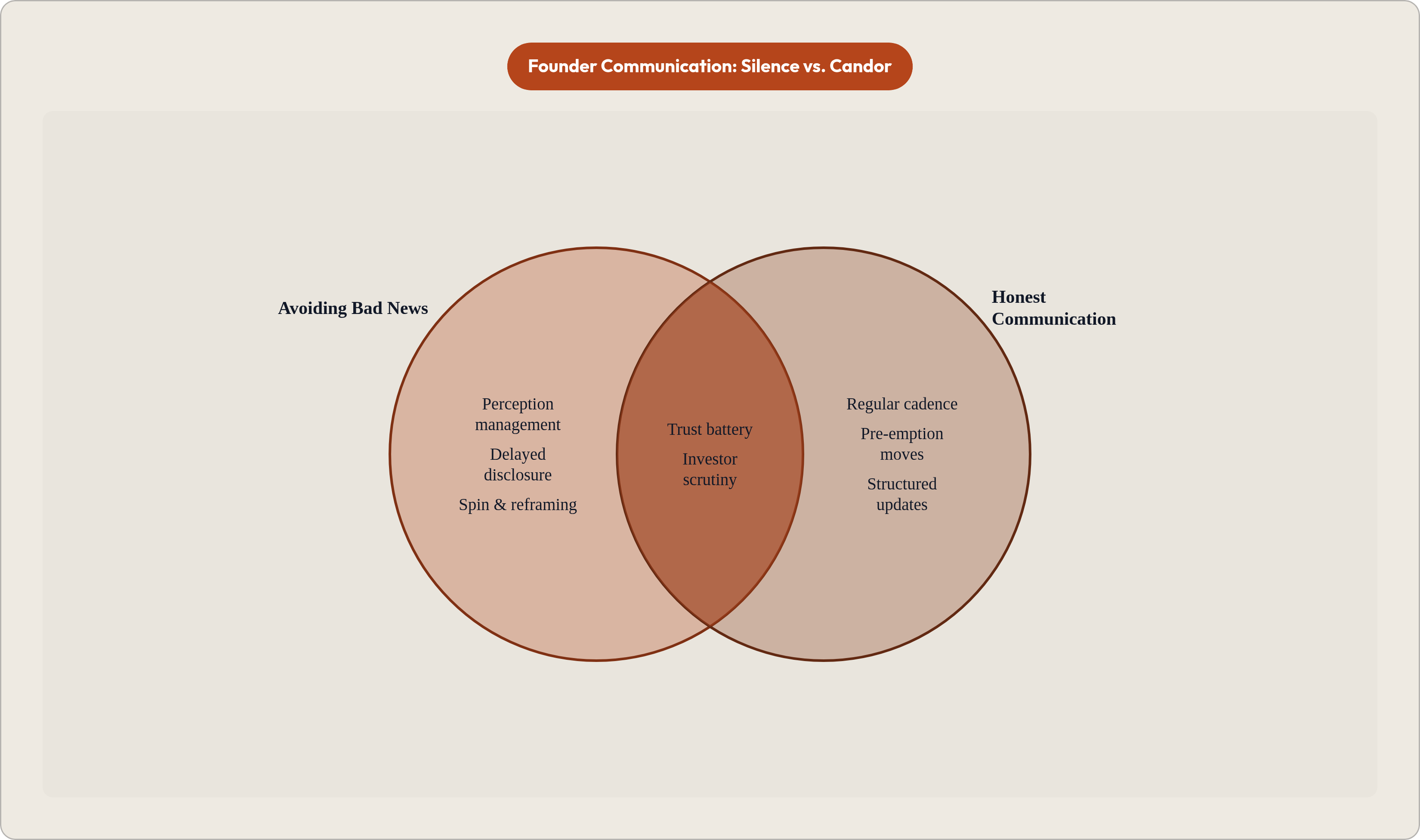
Why founders go quiet when investors most need to hear from them
Here's the pattern, and it shows up almost every time: founders talk a lot when things are going well, then go quiet the second something breaks. That's exactly backwards, since investors need more from you when things are hard, not less, and yet the silence kicks in right on cue.
Some of that comes down to math. Research out of the University of Iowa's Tippie College of Business (the study won a 2020 American Accounting Association Outstanding Dissertation Award) found that managers presenting to larger groups share less bad news, because a big audience triggers a kind of self-focused freeze. It gets harder to picture the individual people in the room and easier to just picture "the room." That's an inconvenient finding, given that the standard board meeting is one founder facing a table of investors on the exact day the stakes are highest. Structurally, that's the worst possible format for candor, and nobody designed it that way on purpose.
A second force is also at work. Graham and colleagues (2005) found roughly 80% of CFOs would trade long-term value for a short-term earnings number that looks clean. That's an incentive problem baked into how these conversations get set up.
The instinct to stay quiet backfires almost immediately, because investors left in the dark don't relax; they spiral. Silence reads as danger, and danger triggers oversight, which is a polite word for investors suddenly showing up in your Slack asking about churn numbers you haven't looked at in three weeks. Here's the twist nobody expects: seasoned investors already assume roughly 20% of new companies fail in year one and about half fail within five years. A spotless update with zero problems doesn't calm anyone down. Instead, it makes them wonder what you're not saying.
What happens when bad news accumulates instead of flows
Enron, Lehman Brothers, Wirecard, FTX: four different decades, four different business models, one identical mechanism. Bad news got held instead of shared, until the incentive to keep hiding it collapsed under its own weight, and then it all came out at once.
Meta's stock fell sharply in a single day on February 3, 2022, wiping out hundreds of billions of dollars in investor value and tens of billions of dollars of Mark Zuckerberg's own net worth. One disclosure event, one day, one enormous release of information that should have arrived in smaller pieces over time.
Founders run a smaller version of the same experiment constantly, usually without realizing it. If a problem only becomes visible once it's undeniable, an investor's next thought isn't "that's unfortunate." It's "what else haven't they told me," and that's the moment credibility collapses, and it doesn't come back with an apology email.
Spin does the identical damage, just slower. Dress up a miss as a "learning" or bury it under three wins that don't matter, and investors clock it instantly; they've seen the move a hundred times before. When the real number eventually surfaces, the trust breaks the same way silence breaks it. A steady cadence, a regular drip of reality, is what keeps the bad news from piling up long enough to explode.
Building a regular cadence before the crisis arrives
Trust gets built in advance, not on demand. A founder who's been sending honest updates for a year walks into a hard conversation with a bank of goodwill already sitting there. A founder who's been quiet for six months walks in with nothing, and has to build credibility and deliver bad news in the same breath, so guess which one goes worse.
There's a number behind this too: according to Visible's platform data, startups that send consistent investor updates are twice as likely to land follow-on funding. Cadence is a financial lever with a return you can actually measure.
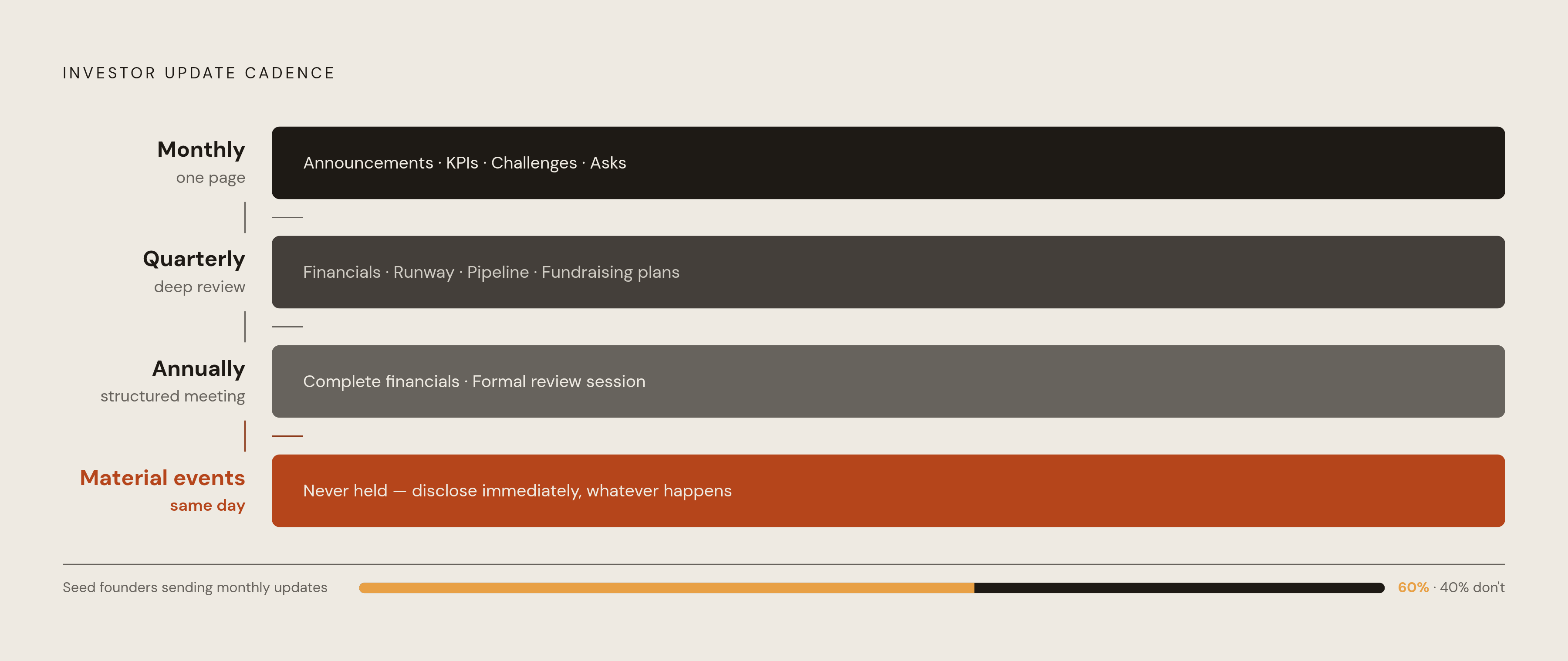
A workable rhythm looks something like this:
- Monthly: a one-page update. Short bullets on announcements, KPIs, product progress, current challenges, and one or two direct asks.
- Quarterly: the fuller version, including financial statements, runway, sales pipeline, and fundraising plans.
- Annually: complete financials, paired with an actual structured meeting, not a calendar hold that gets rescheduled twice.
- Material events: shared the day they happen, good or bad, never saved for the next scheduled update.
Your board packs should carry the real metrics: ARR, burn and runway, net dollar retention, gross margin, clear wins and clear risks, two or three specific asks, hiring pipeline, and a 12-month forecast. Board updates lean into fiduciary duty; advisory board updates lean into strategy. Same underlying facts, different emphasis depending on who's reading.
Roughly 60% of seed-stage founders send monthly updates, based on industry data, which means a meaningful chunk of a meaningful portion of the rest are sitting on trust they could be building for free. The cadence does something quieter, too: it trains investors to expect the truth as a matter of routine, so when a bad-news month shows up, it reads as a data point on a chart, not a five-alarm surprise.
The pre-emption move: flagging problems before they become crises
The best bad-news update is the one you send before the news has finished going bad. Sales are off pace three weeks into the quarter? Say something now, rather than waiting for the quarter to close so you can present a fully-formed disaster with a bow on it.
This does something structurally useful: it turns the outcome into a shared problem instead of a solo failure. Investors who get looped in early stop grading you and start helping you, and that shift, from accountability to co-ownership, changes the entire tone of the relationship.
It also signals something bigger about you as an operator. Catching a problem while it's still small tells investors you're actually watching the dashboard, not just checking it once a month before the board deck is due.
The catch is that pre-emption requires killing the "let's wait and see if this fixes itself" instinct, and that instinct is strong. That waiting period, the one where you're hoping the number turns around before anyone notices, is where almost all the damage gets done. Knowing you should speak up early is one thing, but knowing how to structure that conversation, what channel, what audience, what words, is the part that actually determines whether it lands.
Choosing the right channel and audience size for the delivery itself
Email is fine for a minor update, but for real bad news, it reads as hiding. Sending a rough quarter over email tells investors you didn't want to be in the room when they reacted to it, and they'll notice.
Real bad news calls for a phone call, a video chat, or a face-to-face conversation, something that lets you read the reaction in real time and respond to it like a human instead of a press release.
Audience size matters more than most founders think, and it's not just a logistics question, since big groups suppress candor, even when nobody intends it, as the University of Iowa finding shows. So work backward from that. Pick one or two investors you trust most, loop them in first, build the message with them, and only then bring it to the full group. You don't want all of them in the kitchen at once. When a group setting is unavoidable, like an all-hands investor call, personalize it: use names, reference specific context, acknowledge people directly. That small effort counteracts the anonymity that makes people go quiet.
Never, under any circumstance, drop bad news cold in a board meeting. Hearing something for the first time in front of six other people is the single worst opening a board meeting can have, because it manufactures uncertainty on the spot, and uncertainty is just fear wearing a nicer outfit. Pre-brief your key investors one-on-one before the group ever convenes, so nobody in that room is hearing the news for the first time.
What to actually say: structure of a credible bad-news update
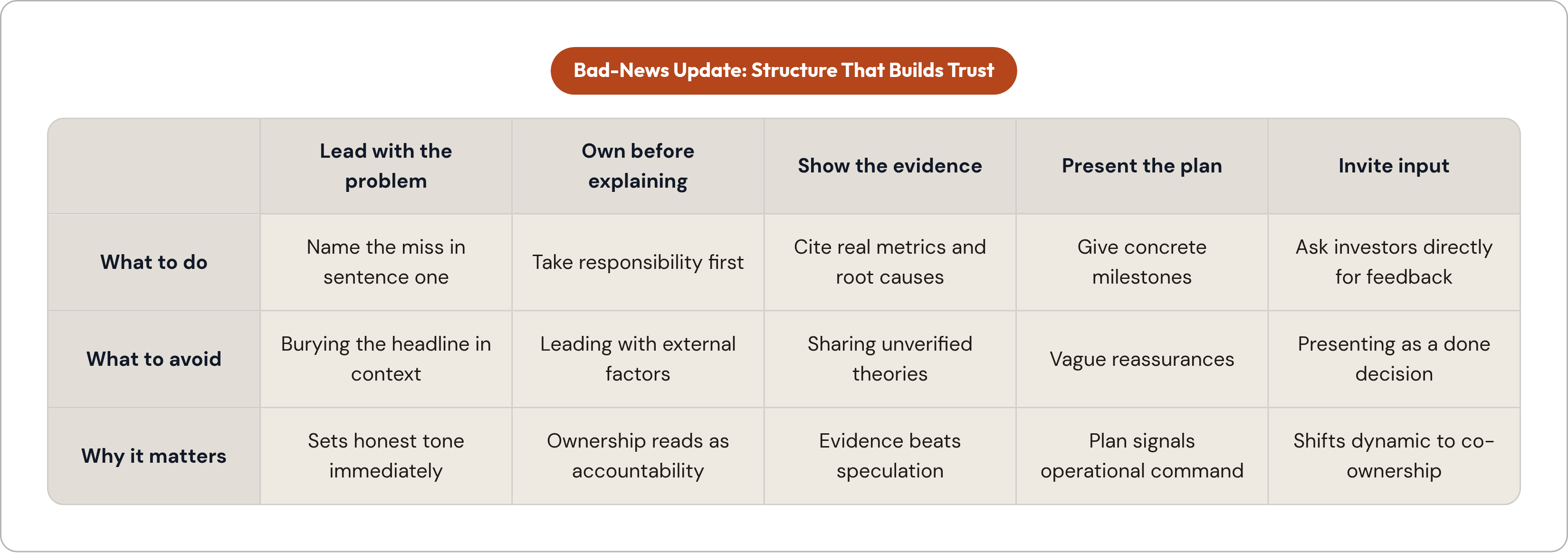
Lead with the problem. First sentence, no warm-up, no soft landing, no three paragraphs of context before you get to the part that matters, because investors should know exactly what missed before you've finished your second sentence.
Own it before you explain it. Sequence matters here more than people realize: explanation-first reads as deflection, ownership-first reads as accountability. Say what happened, take responsibility for it, then walk through why.
From there, get specific. Name the metrics that missed, show what drove the gap with actual evidence rather than a theory you came up with on the drive home, and be honest about what you already tried that didn't work.
Then pivot to the plan, and make it concrete. "We're going to figure it out" is a shrug in a suit, not a plan. Give milestones. Be upfront about what you know and what you're still working out; something like "here's what we're doing, here's what we're still sorting through" builds more trust than false confidence ever will. Ask investors directly for input on the plan. That single move turns an update into a working session instead of a lecture.
Timing is its own skill. Send the update once your diagnosis actually holds up, not the second panic sets in, because a half-baked update sent too fast does its own kind of damage, it just does it faster.
One thing to leave out entirely: spin. Don't reframe the miss as secretly good news, and don't bury it under three unrelated wins hoping nobody notices the headline. Investors notice, and it tells them you can't read your own business clearly, which is a scarier signal than the bad news itself.
There's evidence for the infrastructure side of this too. Research published in The Accounting Review (American Accounting Association, 2021) found that companies with a dedicated investor relations function saw less market damage from bad earnings news, because the message got more precise. Precision, it turns out, is worth more than optimism.
How handled bad news becomes the strongest evidence of founder quality
Investors already expect adversity, and nobody invests in a startup thinking the road is smooth. The real question they're asking, quietly, every single update, is whether you can walk through the hard stuff honestly, and that's the actual audition.
A founder who delivers a clear, early, well-diagnosed bad-news update with a real plan attached proves three things no glowing quarter ever can: self-awareness, operational command, and reliability under pressure. Anyone can look competent when the numbers are up, but the stress test only runs when they're not.
That's why the battery charges faster after a hard, honest conversation than after a string of good ones. The good quarters are nice, but the hard quarter is the one that actually tells an investor who you are.
Founders who miss their goals are exactly the ones who most need to speak up. Investors are bought into the future of the company and they want to help, but they can't help with a problem they don't know exists. The return also compounds: per Visible's data, startups with regular investor updates, the same infrastructure that makes a bad-news conversation possible in the first place, are twice as likely to land follow-on funding from their existing backers.
None of this is a technique you deploy once and move on from. It's a posture. Every update, good news or bad, is a deposit in the same account, and the hard ones just happen to pay the best interest.