Using Investor Networks for Business Development
Leverage your investors' networks as a high-trust business development channel most founders ignore.

Most founders treat their investors like a bank. You go in when you need money, say thank you, and leave them alone until the next round. That's a massive waste. The investor relationship is one of the highest-trust, highest-leverage BD channels you have. Almost nobody uses it that way.
An introduction from an investor arrives pre-loaded with credibility no cold email can manufacture. When an investor connects you to someone, it implies they've already vouched for you. The person on the receiving end knows this. It completely changes how they engage with you from the first message.
So let's start with what you actually have access to, because founders consistently get this wrong.
There are over 300,000 active angel investors in the U.S. alone. The Angel Capital Association counts more than 14,000 accredited investors across 250-plus angel groups, platforms, and family offices. Your direct investor roster might be five or ten people. But your second-degree reach through those investors is a completely different number. A single partner at a major venture firm has backed hundreds of portfolio companies over their career. One relationship gives you a potential path into that entire graph.
Angel syndicates expand this further. Roughly 40% of U.S. angel capital now flows through syndicates and SPVs. A single syndicate lead might bring a dozen or more co-investors, each with their own separate networks. A seed-stage company with five investors may have indirect access to thousands of executives, customers, and partners. Most of those connections are sitting there completely untouched.
The question isn't whether the network exists. It does. The question is whether you have a system for using it.
What "Smart Money" Actually Contributes Beyond the Wire Transfer
"Smart money" is one of those phrases that gets thrown around in pitch decks without anyone really nailing down what it means in practice. Most founders nod along. Few actually push on it.
Here's what it looks like when it's real:
- Industry-specific connections. Direct introductions to potential customers, channel partners, or enterprise decision-makers in your category.
- Pattern recognition. Investors who have watched a category scale know which partnerships actually move the needle. That judgment is genuinely useful when you're trying to prioritize BD bandwidth.
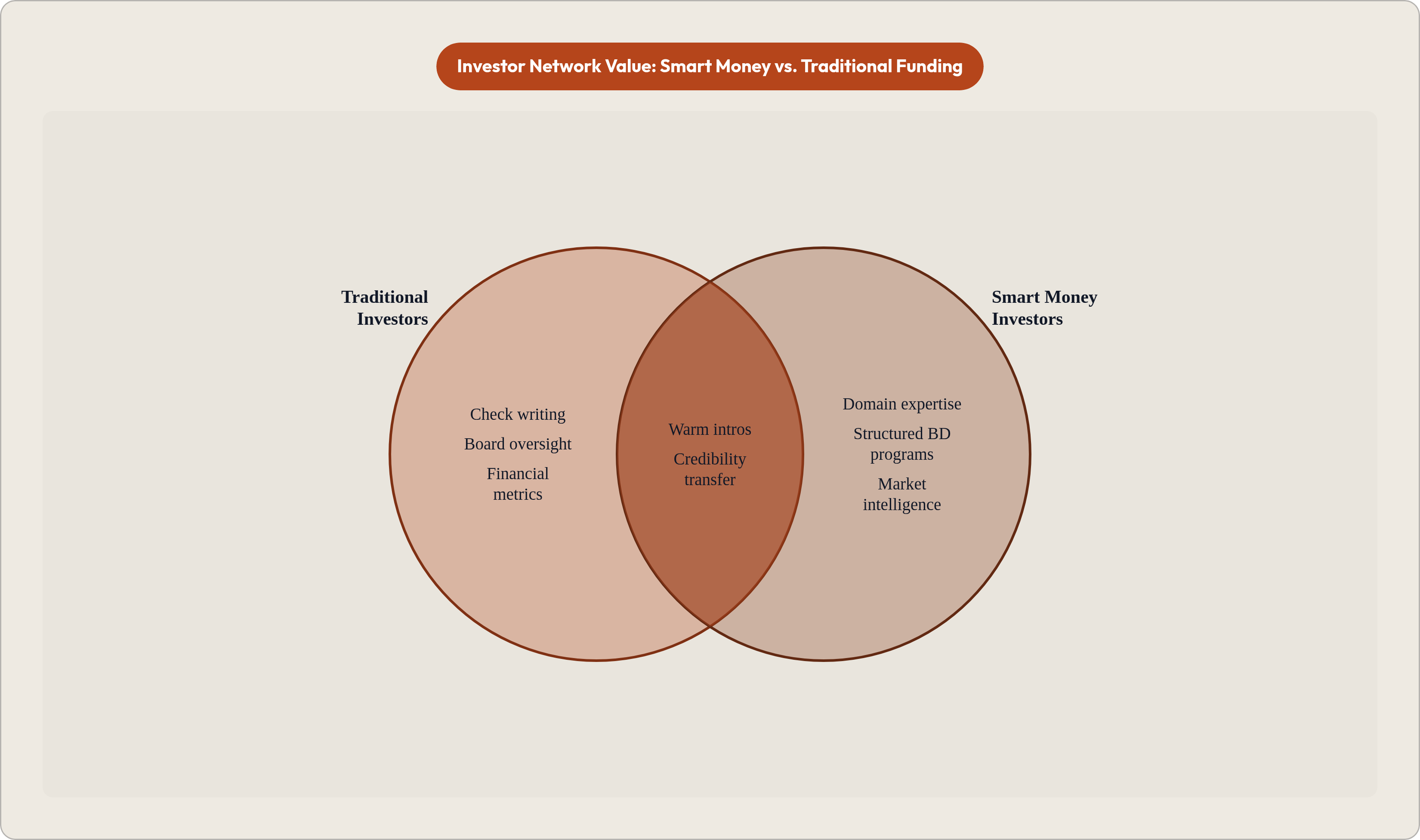
- Credibility transfer. Being in certain firms' portfolios signals something to the market. Doors open that the product alone might not open.
Sector-matched investors aren't just more helpful in theory. Firms with deliberate portfolio construction and active facilitation programs see their companies collaborate at rates well above industry average. That's not accidental. It reflects intentional relationship-building by the firm, which means who backs you shapes what BD opportunities become structurally available to you.
Accel's cybersecurity expertise, for example, helped Snyk grow from $1M to $100M ARR in five years through strategic connections, not just capital.
The distinction that matters for your BD strategy is this: some investors are connectors, some are deep domain experts, and some are door-openers in specific verticals. These are different things. You need to know which of your investors is which before you can activate any of them.
How to Map Your Investor Network Before Trying to Use It
You can't activate something you haven't mapped. This is the step most founders skip, and it shows.
Most founders have an intuitive sense of who their best-connected investor is. But intuition misses things. The quieter investor with deep enterprise relationships. The board observer who happens to golf with the head of procurement at your dream account. The syndicate LP who runs a relevant industry association. You don't find those nodes by feel. You find them by actually going through the list.
Map each investor across three dimensions:
- Relationship depth. Who do they know well enough to make a genuine warm intro, versus forwarding an email that gets ignored?
- Domain relevance. Which industries, functions, or buyer personas actually match your ICP?
- Activation history. Have they made introductions before? To whom? Did those leads go anywhere?
The practical method here is structured investor interviews. Not your normal status update call. A targeted conversation where you ask specifically who in their network might benefit from what you're building right now. It sounds like a small distinction. It produces completely different answers.
Portfolio overlap is a natural starting point. Go through the firm's portfolio page and identify companies that serve adjacent buyers, use complementary technology, or sell into the same enterprise accounts. The investor already has incentive to see both companies succeed. These are your most natural co-BD targets.
Then categorize your investors by BD utility, not by check size:
- Connector investors. Broad relationships, willing to make intros frequently, move fast.
- Domain experts. Fewer connections but extremely high relevance to your specific category.
- Platform investors. Firms that actively facilitate introductions through structured programs and dedicated staff.
The output of this exercise is a prioritized shortlist. You know who to activate, and you know what to ask each one for.
Asking for Introductions in a Way That Gets Results
Here is the most common failure mode. A founder sends a note to their investor that says something like: "Let me know if you know anyone who might be interested in what we're doing." The investor thinks about it vaguely, means to follow up, and forgets. Nothing happens.
The problem is cognitive burden. You've handed the investor a job: figure out who in my network is relevant, remember who you know, draft a message, send it. That job competes with everything else on their plate. It loses. Every time.
The fix is a specific, low-friction ask. Make it easy to say yes and act immediately.
- Name the specific person or company you want to reach. Not a category. A name.
- Explain in one sentence why the introduction benefits the person being introduced to. Not why you want it. Why they would want it.
- Write a forwardable email the investor can send with minimal editing.
That last one is the single most important artifact in investor-led BD. The forwardable email should frame the value to the recipient. It should make the investor look good for making the connection. Two or three sentences, then the ask. Done.
Timing matters too. The best moment to ask is shortly after a positive milestone. A new product launch, a notable customer win, a round closing. The investor is already engaged and thinking about you. The ask feels natural rather than transactional.
And think about reciprocity as a long-term mechanism, not a courtesy. Founders who consistently return value to their investors, sharing market intelligence, flagging relevant deals, making introductions in the other direction, get more and better introductions over time. The relationship builds in both directions. It works exactly how you'd expect it to work between two people who are genuinely helping each other.
Using Investor Networks to Develop Partnerships, Not Just Sales Leads
Most founders, when they think about investor introductions, think about sales leads. Get me in front of a buyer. That's valid. But partnership introductions are often more durable and more valuable over time, and investors are frequently better positioned to make them.
Here's the distinction. A sales intro compresses time to pipeline. A partnership intro compresses time to a structural relationship that generates ongoing pipeline. Investors often have stronger relationships with executive decision-makers at potential partners than with frontline buyers. That maps better to partnership conversations than to sales ones.
Portfolio-to-portfolio collaboration is the most natural starting point. Two companies in the same portfolio already share a common investor who has incentive to see both succeed. The investor can position the introduction as value creation for both parties rather than a favor to one. That framing changes how the conversation starts.
The types of partnerships investor networks are well-suited to surface:
- Technology integrations. Complementary products that serve the same buyer and can deliver more value together than separately.
- Channel partnerships. A more established portfolio company that sells to your target customer and could resell or co-market your product.
- Co-development arrangements. Shared roadmap investment where one company's product gap matches another's strength.
One practical note worth flagging early: when partnerships involve connecting product workflows or embedding integrations, the operational burden of maintaining those connections is often what kills momentum, even after the relationship is established. Surface that question before you've already shaken hands. Addressing integration infrastructure after you've signed is a lot harder than addressing it before.
Investors actively want portfolio companies to use partnerships to scale faster. Founders who bring partnership proposals to investor conversations are already aligned with what investors want to facilitate.
Extracting Market Intelligence from Investor Relationships
Investors sit at an unusual information intersection. They're talking to your competitors, your potential customers, your potential partners, and other operators in your category, often in the same week. They see patterns across their whole portfolio that you can't see from inside your own company. And they're almost never going to just hand that over unprompted.
Specifically, they often know:
- Which companies in adjacent categories are actively evaluating new vendors right now.
- Which enterprise buyers are unhappy with incumbent solutions, surfaced through other portfolio company conversations.
- Which partnership structures are working or failing across comparable companies they've backed.
- Emerging category trends before they show up in public analyst reports.
You have to draw this out through the right questions. "Are you seeing other companies in your portfolio run into the same buyer objection we're hitting?" is a much better question than "anything interesting happening in the market?" The vague question gets a vague answer. Every time.
Frame these conversations as a two-way exchange. Investors are more forthcoming when founders are also sharing intelligence. What you're seeing in competitive dynamics. How buyer sentiment is shifting. Which channels are working. The more you give, the more you get back. This is not a revolutionary insight. It's just how conversations between people who trust each other actually work.
The intelligence you extract translates directly into BD action. A signal that a category is consolidating tells you which potential partners are motivated to do deals now. A pattern of buyer dissatisfaction with an incumbent tells you where to focus outbound. Knowing which enterprise accounts are active in the market saves BD bandwidth otherwise spent on accounts that aren't buying.
Operator-led syndicates are especially valuable here. Operator angels are actively embedded in the industries they invest in. They're richer intelligence sources than financial-only investors. If you have one in your cap table, you're probably not using them enough.
Building a Repeatable System for Investor-Led BD, Not a One-Time Ask
The episodic mistake looks like this: founders ask for introductions around fundraising events, then go quiet. This trains investors to expect asks only when the company needs something. Every future ask feels transactional because that's the only context in which asks appear.
The fix is a standing communication cadence that keeps relationships warm between asks.
Monthly or quarterly investor updates should include specific BD context. Not just financial metrics. What kinds of introductions would be most valuable right now. A consistent "we're looking for" signal means investors can make introductions opportunistically, without waiting to be formally asked. That's when the best introductions tend to happen.
Track investor-sourced BD the same way you track any other pipeline source:
- Which investors generate the most introductions?
- What do conversion rates look like from investor-sourced leads versus other channels?
- Which types of asks produce the best results with which investors?
Always close the loop. When an investor makes an introduction, report back on what happened. Whether it converted. What you learned. What would have made the intro more effective. This feedback makes future introductions better and reinforces that the relationship is genuinely working. Most founders never do this. It's one of the cheapest ways to differentiate yourself as someone worth helping.
Assign internal ownership. Investor-led BD works best when one person on the team owns investor relationships as a BD function, not just as an investor relations function. The framing changes what they optimize for. An IR mindset optimizes for reporting. A BD mindset optimizes for activation. Those are not the same job, and conflating them is how this whole system stalls out.
When Investor Network BD Is Hardest and How to Work Around Those Limits
Investor-led BD isn't always smooth. There are real constraints worth naming, because pretending they don't exist doesn't help anyone.
The disengaged investor. Some investors write checks, maybe take a board seat, and then largely disappear. Their network exists. It just isn't accessible through normal update emails. You have to earn re-engagement. Schedule a call. Bring something specific and relevant. Ask for 20 minutes rather than hoping they'll respond to a note.
Conflict of interest constraints. Investors with competing portfolio companies may be structurally unable to make certain introductions, even when they genuinely want to help. Acknowledge it directly and move on. Don't push on introductions that put the investor in an uncomfortable position. It damages the relationship and rarely produces anything useful anyway.
Geography and industry mismatch. A U.S.-focused investor's network may have limited reach into specific international markets or niche verticals, even when your BD needs are squarely there. This is a real gap. It's not a character flaw. It just means that investor isn't the right activation point for those specific targets.
Early-stage network thinness. Pre-seed and seed investors often have strong founder networks but weaker enterprise buyer networks, which is usually the opposite of what BD needs. Knowing this ahead of time saves you from spending a month on the wrong asks.
A few ways to work around these limits without straining relationships:
- Ask investors to identify the right node in their network to reach, even if they can't make the intro directly. Sometimes they know who knows the person you need. That second-degree pointer is still useful.
- Supplement investor networks with platform resources. Accelerator alumni networks, co-investor communities, and industry-specific groups extend your reach into areas where your direct investor network has gaps.
- Be honest with yourself about which investors are genuinely activatable for BD and which are not. Spending energy trying to re-engage a disengaged investor often produces less than redirecting that energy toward the two investors who are already willing and connected.
The investor network you have is bigger and more useful than you're treating it. It just requires a system, some specificity, and the willingness to treat it like the BD channel it actually is.