Due Diligence Preparation for Startup Founders

The formal timeline runs 4 to 10 weeks from kickoff. But there are really two phases, and most founders only prepare for one of them.
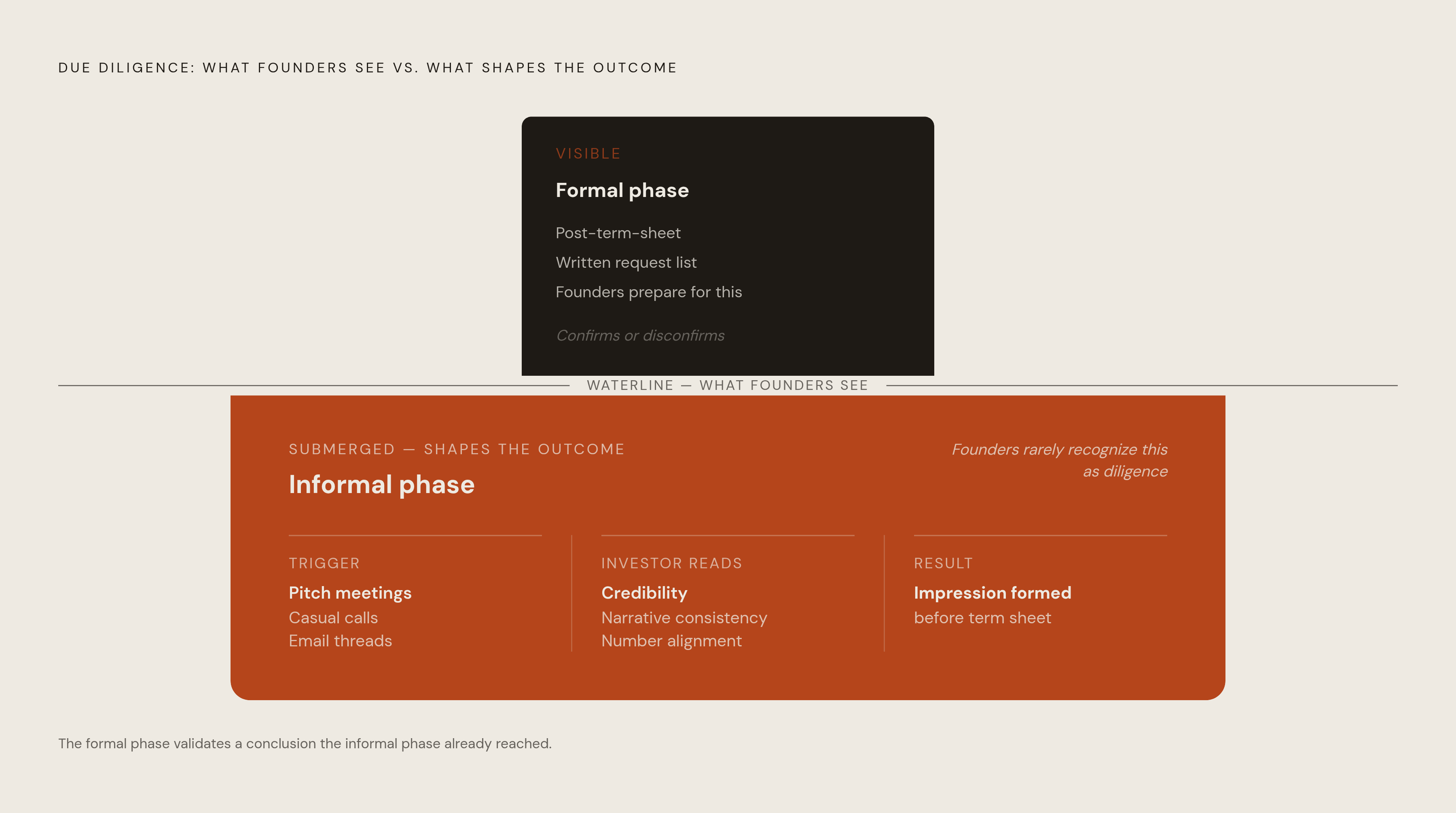
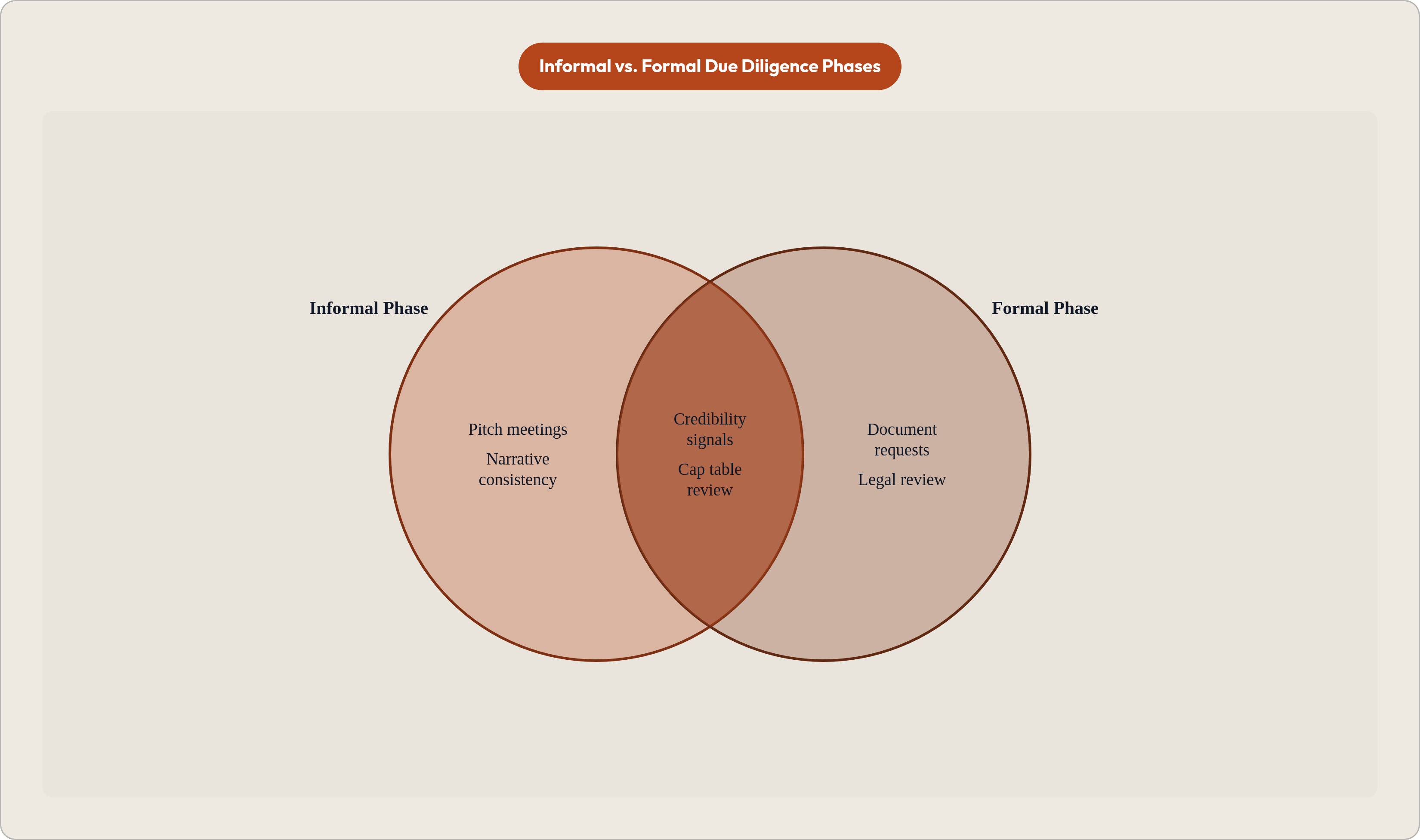
Phase one is informal. It starts the moment an investor asks you anything. In pitch meetings, on casual calls, in email threads where you think you're just "getting to know each other." The investor is pattern-matching the whole time. Are you credible? Is your narrative consistent? Do the numbers you drop in conversation match the numbers in your deck? This phase doesn't feel like diligence, which is exactly why it catches people off guard.
Phase two is formal. It begins post-term-sheet, with a written request list covering every major domain. By that point, though, impressions have already formed. The formal phase mostly confirms or disconfirms what the investor already suspects. Think of it like an iceberg: founders obsess over the tip they can see, never knowing the mass beneath is what sinks ships.
The deal delays founders complain about are almost never caused by investor hesitation. They're caused by issues the founder never looked at: incomplete financials, outdated contracts, missing IP assignments. Things that were always broken and nobody fixed.
Stage matters here too, and knowing your stage tells you where to put your energy first.
- At pre-seed, nobody expects audited financials. Diligence focuses on founder credibility, problem-solution fit, and early signals.
- At seed and Series A, unit economics, legal structure, cap table, and early customer evidence move to the front.
- At later stages, everything gets scrutinized: performance track record, scalability, regulatory compliance, technical architecture. All of it.
One study put average founder readiness going into diligence at around 5.7 out of 10. That's not a rounding error. That means the typical founder entering this process is already behind before the first document request lands in their inbox.
The Seven Domains Every Investor Reviews, and How They Weight Them
No investor skips any of these. What changes is depth and emphasis based on stage and sector.
Financial due diligence covers historical financials, burn rate, and cash flow. Unit economics get interrogated hard: customer acquisition cost, lifetime value, contribution margins, payback period. Revenue model matters for valuation too. Recurring revenue companies commanded 34% higher valuation multiples than project-based businesses at Series A, per Silicon Valley Bank's 2025 Startup Outlook. In 2025, investors increasingly want real-time access to cloud-based accounting systems, not spreadsheet exports sent three days after the meeting.
Legal due diligence covers corporate structure, material contracts, IP ownership, tax filings, and equity agreements. Common misses include unsigned option agreements, unfiled tax returns even for zero-income years, and IP that was never formally assigned to the company. (More on that last one in a minute, because it deserves its own section.)
Team and management involves background checks and reference calls with former colleagues. Inflated resume details that surface during reference checks typically kill the deal. What early-stage investors are actually weighing is adaptability and learning velocity, not just pedigree. "Wrong team" shows up in nearly a quarter of startup failures.
Market and product covers TAM, SAM, and SOM framing, the pathway to growth, and product-market fit evidence. For software companies, this includes source code review, architectural choices, and moat durability.
Technical and cybersecurity is a growing category. The vast majority of late-stage deals now include a dedicated technical review, up sharply from just a few years ago. For AI startups specifically: EU AI Act compliance deadlines arrive in 2026. Startups training on unlicensed or scraped data are already hitting walls in EU-focused rounds.
Customer and commercial traction tests repeatability of customer acquisition, engagement metrics, contract terms, and renewal rates.
Exit strategy is about alignment. Investors verify that your exit thesis matches their fund timeline and return expectations. A great company with an exit horizon that doesn't fit the fund structure is still a problem for that investor, regardless of how good the company is.
Why IP Assignment Failures Kill More Deals Than Any Other Legal Issue
Here's the core misconception: building something does not mean your company owns it.
IP law doesn't assume that the person who paid for the work owns it automatically. Without a written assignment agreement, the creator personally owns what they built. The company owns nothing. This is not a technicality or an edge case. It's the actual legal default. You say the company is a ghost landlord — collecting rent on a house it doesn't actually own.
Everyone who touched the product must formally assign their IP to the company:
- Every founder at formation
- Every co-founder, including ones who left after three months
- Every contractor or freelancer, regardless of how short the engagement was
Pre-formation work is especially exposed. Code written before the company was incorporated requires explicit retroactive assignment agreements. Very common situation. Very commonly overlooked.
Open-source risk adds another layer. Fenwick & West's 2025 Startup Survey found that open-source license conflicts delayed or blocked 1 in 5 Series A closings. That's not a niche problem for edge cases.
The fix is not complicated. Audit every person who contributed to the product. Confirm signed assignment agreements exist for each of them. Address gaps before you start raising. Doing this during diligence, under time pressure, while a term sheet is sitting on the table with an expiration date, is a different and much worse experience than doing it on a quiet Tuesday six months before you raise.
Ask any founder who's tracked down a former contractor who moved abroad to get a signature. They'll tell you.
Cap Table Errors That Quietly Accumulate Into Deal-Breaking Problems
Around a third of deals collapse at the final stage due to preventable cap table or equity history gaps. The dangerous errors aren't dramatic fraud. They're administrative gaps that compound quietly over time.
Common ones:
- A founder grant recorded but never formally approved by the board
- An advisor promised 1% verbally, with the final agreement showing 0.25%. That discrepancy lives in writing somewhere.
- An employee who departed before vesting completed, but the cap table still shows the full grant as active
- A departed co-founder holding unvested equity with no repurchase rights. Real ownership. Zero contribution.
Standard institutional vesting is a 4-year schedule with a 1-year cliff. Any deviation without clear documentation raises immediate questions. Missed 83(b) filings create tax exposure and surface during diligence in ways that are awkward to explain in the moment.
In 2025, median dilution at Series B dropped to 12.9% per Carta's State of Private Markets data. That reflects tighter capital efficiency expectations. Investors are scrutinizing cap table structure more carefully than in prior cycles.
Practical hygiene:
- Start the cap table audit at least six months before raising
- Every equity event (grants, exercises, transfers) needs to match board-approved documentation
- One source of truth. No side promises. No informal commitments that live outside the system.
- Review the full model before any investor conversation, not during it
What Financial Diligence Actually Tests, Beyond the Numbers on the Page
Historical financials are the starting point, not the destination. Investors use them to check whether the numbers you cited in your pitch are consistent with what your books actually show. Gaps between board-reported metrics and actual financials are one of the fastest ways to lose trust. Not slow it down. Lose it.
The real interrogation is your financial model. Specifically:
- Are revenue projections built from defensible assumptions, or are they aspirational guesses dressed up in spreadsheet formatting?
- Does the burn rate reflect a clear theory of capital deployment, or is cash depleting without a visible revenue mechanism?
- What do your unit economics actually say? A low LTV-to-CAC ratio signals a non-viable business model regardless of how impressive the top-line growth looks.
Revenue structure is also a valuation input, which founders often don't think about explicitly until it's too late to change it. Recurring revenue commands a meaningful premium over project-based revenue. How your revenue is structured affects how you're priced, full stop.
What gets founders flagged: missing internal controls, no audit trail for key numbers, and inconsistencies between what leadership has been reporting to the board and what the actual financials show. That last one, when it surfaces, ends conversations quickly.
Meticulous bookkeeping and formalized internal controls are not bureaucracy. They're evidence that your team can manage capital responsibly at the next stage of growth.
How a Well-Structured Virtual Data Room Changes the Investor's Experience of Your Company
The vast majority of investors now require secure digital access to diligence materials via a virtual data room. This is no longer a late-stage formality. It's expected from seed onward.
Founders with organized data rooms close funding rounds meaningfully faster on average. But the time savings are secondary to what the data room communicates before the investor reads a single document. It tells them this team is organized, has nothing to hide, and is ready to operate at institutional scale. That impression forms in the first two minutes of navigation.
A useful folder structure mirrors investor review tracks:
- Company and legal: incorporation documents, cap table, board consents
- Financials: historical statements, model, unit economics
- Product and IP: architecture overview, assignment agreements, open-source audit
- Customers and traction: contracts, engagement metrics, case studies
- Team: bios, reference contacts, org chart
The contrast between a good and bad data room experience is stark. A folder of 140 unstructured files with names like "deckfinalv3FINALUSE_THIS.pdf" communicates something very specific to the investor. It communicates that the founder hasn't thought about anyone else's time. A clean, navigable room where everything is where it should be communicates the opposite. Same underlying company. Very different impression. A messy data room is like handing someone a jigsaw puzzle of your financials and asking them to trust the picture on the box.
A data room does two things simultaneously. It speeds up the fundraise by answering investor questions before they're asked. And it eliminates the low-grade sense of disorganization that quietly kills deal momentum before you even know you've lost it.
Treating Diligence as a Continuous Practice Rather Than a Pre-Raise Scramble
The common failure mode is treating diligence as something that happens to you at the end of a fundraise. You finish your pitch, you get interest, you get a term sheet, and then you discover your own problems for the first time under maximum time pressure, when fixes are most expensive and least elegant. Everyone involved is miserable and the outcome is worse than it needed to be.
This is the wrong sequence.
What continuous readiness actually looks like:
- Cap table audit at least six months before any raise, updated after every equity event
- IP assignment agreements collected at the moment of hiring or contracting, not retroactively six months later when the contractor is unreachable and has no particular reason to be helpful
- Financials maintained with the rigor of a company that expects to be audited. Clean books, clear audit trail, formalized internal controls from early on.
- Data room kept live and current. Not assembled in a frantic two-week sprint before investor meetings start.
- Technical and compliance posture reviewed regularly, especially for AI startups navigating EU AI Act timelines that are arriving faster than most founders realize.
The compounding benefit here is real. Founders who maintain readiness find their own problems early, when they have time and leverage to fix them. That's a fundamentally different situation than discovering those problems in week one of investor diligence, when the term sheet has an expiration date and your options are limited.
Investors are paid to find problems. That's their job. The founders who close deals consistently aren't the ones who had no problems. They're the ones who looked first.