Building Relationships with Investors Between Rounds
Consistent investor updates between rounds shape your next fundraise more than your pitch deck will.

Raising a round feels like the finish line. The wire clears, the announcement goes out, and the immediate pressure lifts. But the moment that round closes, the clock on the next one starts running, and what founders do in the months between rounds shapes everything about how that next raise goes.
The median seed-to-Series-A gap is 616 days, roughly 20 months, per SaaStr and Carta's 2025 numbers. That's nearly two years during which most founders are heads-down on product, hiring, and revenue, and during which investor relationships quietly strengthen or quietly decay.
The founders who raise their next round quickly and on favorable terms are almost never the ones who showed up with the best deck. They're the ones whose investors already believed in them before the pitch started. That belief gets built, or doesn't, in the gap between rounds, through consistent communication, honest reporting, and genuine relationship maintenance.
This isn't about performative investor relations or sending polished updates to make things look good. It's about the basic mechanics of trust: investors back founders they know, understand, and have watched execute over time. A founder who disappears after the seed close and resurfaces 20 months later asking for a Series A is effectively a stranger asking for a favor. A founder who stayed in contact is a known quantity taking the next logical step. What you do in those 20 months determines whether your next round takes six weeks or six months.
Silence Between Rounds Reads as a Red Flag
Investors don't stop paying attention after the wire clears. They're running a background model of where your company is headed, and it updates every time they hear from you, or don't.
Silence isn't neutral. When founders go dark, investors fill the gap themselves, and they rarely fill it in your favor. Visible found that no news reads as bad news and often gets interpreted as something being actively hidden.
There's a useful principle in IR circles: investors back lines, not dots. One data point at re-raise time tells an investor almost nothing. Eighteen months of monthly updates tells them nearly everything. By the time a founder who kept up that rhythm sits down for the Series A pitch, the investor already has a formed opinion, and if the founder did the work, it's a good one.
Bridge rounds make this dynamic sharper, now representing a large share of seed-stage activity. The investors who show up for a bridge are almost always the ones who never left the conversation. Nobody wants to write a check after a message out of nowhere following a long silence.
Founders also underestimate how often new investors call existing investors before wiring anything. Those reference calls run entirely on the relationship a founder did or didn't maintain, and you cannot fake 18 months of trust in a 20-minute phone call.
Monthly Updates Are Your Core Relationship Tool
NFX surveyed over 870 founders and found 60% send updates monthly, with another 21% going weekly. Monthly is the consensus pace for good reason: long enough that you have something to report, short enough that you stay on people's radar.
Quarterly is too slow at the seed stage. The relationship cools between check-ins, and warming it back up takes more effort than simply sending the email would have. Visible's platform data found startups sending consistent updates are twice as likely to land follow-on funding.
Cadence should flex with what's happening. Under six months of runway or mid-crisis, go monthly or biweekly. Actively raising, go biweekly or weekly. Series A and beyond, quarterly makes sense since bigger bets take longer to show results.
The most important rule is that consistency beats frequency. A monthly update you stick to beats a weekly one that dies after six weeks. Investors notice broken promises and remember them.
SeedLegals found that for many portfolio companies, the only time investors hear anything is when the company wants more money. That pattern trains investors to expect an ask every time your name appears in their inbox, and it kills their appetite to reinvest.
What a Useful Investor Update Contains
Most founders who do this well use the same four-section structure: Overview, Performance, Challenges, Asks.
Performance needs real metrics that reflect actual business health: MRR, burn rate, runway, churn, CAC, and ARR growth. Hustle Fund recommends cutting vanity metrics like app installs without conversion rates, social follower counts, revenue booked but not collected, and round size presented as traction. Reporting those signals that you may not fully understand your own business.
Numbers alone don't land, though. qubit.capital found that 69% of investor relations officers rank storytelling as a top strategic priority. Explaining why churn ticked up and what you're doing about it is what makes an update worth reading.
Bad news should come first, not buried in paragraph four. Investors who learn about problems secondhand don't feel informed, they feel managed, and that feeling outlasts the problem itself.
On asks: 81% of investors say they want to be asked for specific help, but only 30% of founders feel comfortable doing it. "Let me know how I can help" hands the investor homework. "Can you introduce me to [named person] at [named company]" gives them something they can act on immediately.
Format matters because investors are skimming a dozen of these a week. Write for a 90-second read: TL;DR up top, then narrative, metrics, and ask.
Personalize Outreach So It Feels Human
One master update sent to everyone is efficient. What makes it feel like a relationship rather than a newsletter is the personal layer on top.
SeedLegals suggests using early touchpoints to learn how each investor prefers to communicate and what they actually care about. Skipping that step means every update afterward is a guess.
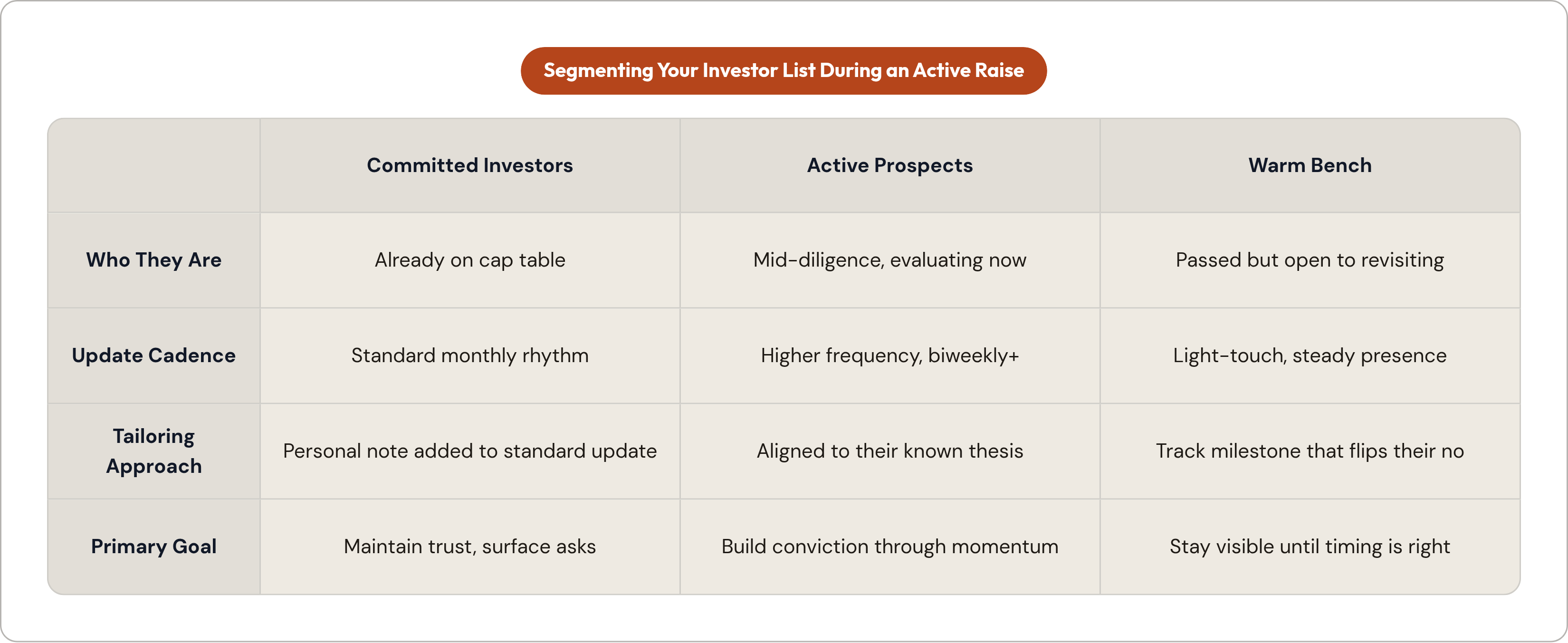
During an active raise, segment your list. Committed investors get the standard update plus a personal note. Prospects in diligence get higher cadence, tailored to their thesis. Funds that passed but said "come back later" should stay in the loop quietly, because they're watching for the milestone that flips their no into a yes.
A short personal paragraph, such as a callback to something an investor mentioned three months ago or a note that you acted on their advice, takes two minutes to write and signals that they're a partner, not just an entry on a mailing list.
Only about half of companies globally have a documented investor relations strategy, per a survey of 876 IR professionals cited by qubit.capital. A founder with even a basic written plan is already ahead of most of the field.
Build Your Next Investor Relationships Now
Experienced founders typically start warming up Series A investors 6 to 12 months before they plan to open the round. Partners want to watch execution across multiple touchpoints over time, not evaluate a single pitch.
Warm intros convert at 3x the rate of cold outreach, according to qubit.capital, and they come from the seed investors you've kept in contact with. Your existing investors are effectively an unpaid extension of your Series A team, making introductions, backing you on reference calls, and generating competitive interest among funds, but only if the relationship is alive.
Press coverage and industry recognition that accumulate during the gap create interest among investors watching from the sidelines. Visible progress serves double duty: proof for investors already in, and a signal to those not yet in.
If a VC passed at seed with "come back when you have more traction," regular updates let them watch that traction develop in real time. The conversation doesn't need a cold re-approach; it just needs to keep running.
Engaged Investors Offer More Than Capital
A check is the floor, not the whole deal. Engaged investors bring strategic advice, introductions, recruiting help, customer referrals, and operational feedback that's hard to get from anyone who isn't financially tied to your outcome.
A PitchBook survey cited by Vestbee found startups with high investor engagement in operational support scale three times faster than those relying on capital alone.
Visible's survey of VC portfolio operators found 27% of portfolio support needs get identified through regular investor updates. Skipping the update means skipping the help that would have come from it.
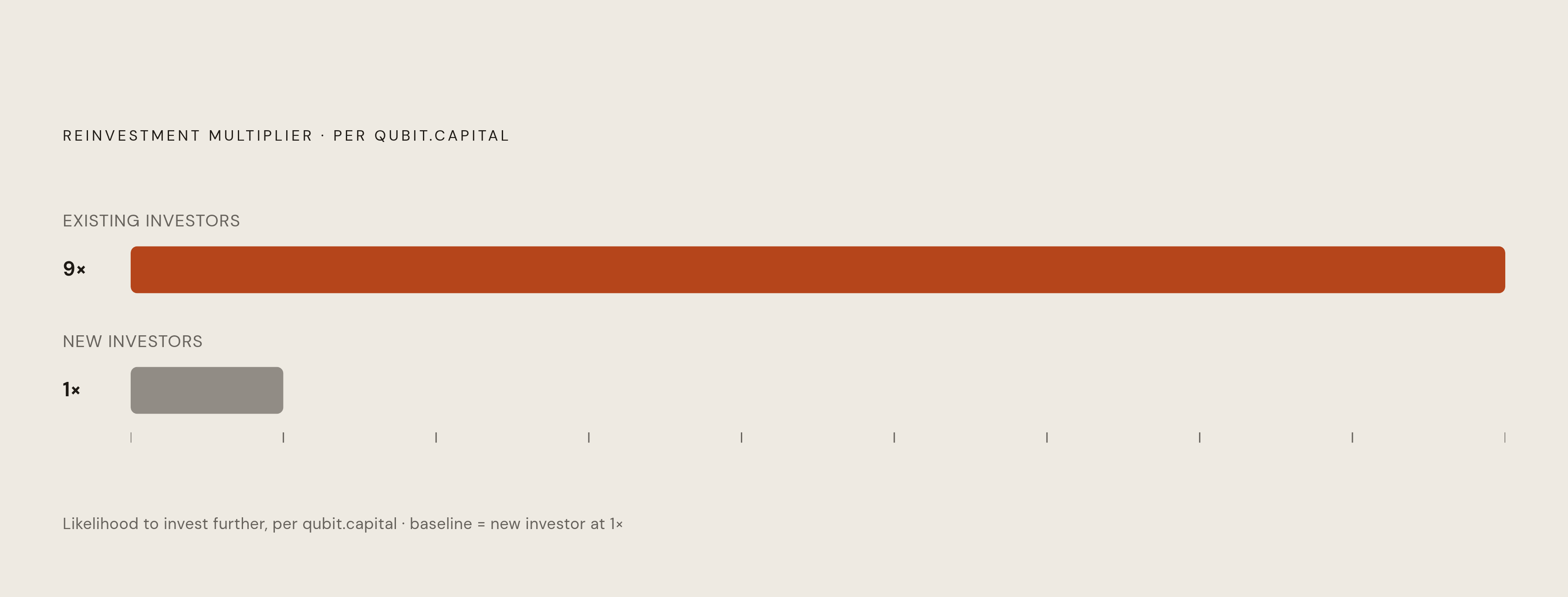
Current shareholders are 9 times more likely to invest again than new investors, per qubit.capital. That number alone should push existing investor relationships to the top of the priority list.
Affinity's 2025 portfolio management research found top-performing VC firms make 16% more introductions year over year than average firms. The investors doing the most for their portfolios are also the ones paying closest attention, so staying visible gets noticed and rewarded.
These Habits Quietly Destroy Investor Trust
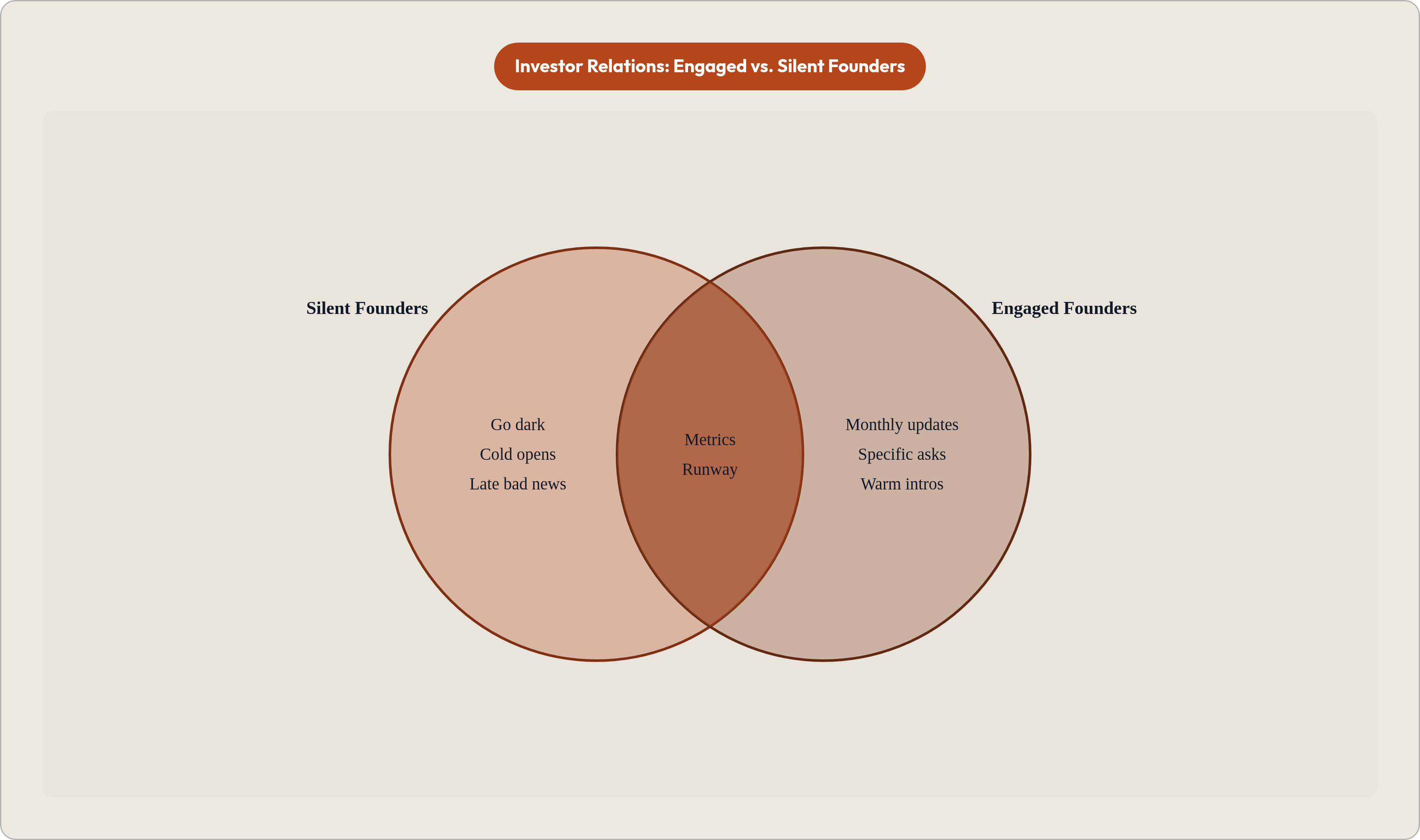
The most common failure is going dark after a round closes and resurfacing only when the next check is needed. It's the most reliable way to guarantee a cold reception at your next raise.
Closely related is contacting investors only when you want something from them. Do this repeatedly and you've trained them to brace for an ask every time your name appears in their inbox.
Inconsistent updates send a negative signal even when nothing is operationally wrong. Sporadic communication makes founders look disorganized, regardless of what's actually happening.
Sharing bad news late does lasting damage. Investors who hear about problems through the grapevine lose confidence not just in the situation but in you as a reliable source of truth about your own company.
Burying problems under positive framing doesn't work with experienced investors. They read straight through the spin, and it marks you as someone managing perception rather than managing the business.
All of these lead to the same outcome: the founder arrives at the next raise looking like a stranger asking for a favor, rather than a known quantity taking the next logical step.
Treat the Gap as Structured Work
Twenty months is long enough to build real trust, or long enough to let it quietly erode. Which one happens depends almost entirely on whether a founder treats that time as actual work.
A workable minimum looks like this: a monthly written update in a consistent format, sent on the same day each month; one or two specific asks per update matched to what each investor can realistically deliver; quarterly one-on-one calls with lead investors and board members; a simple tracking system logging touchpoints and investor priorities; and a parallel track for warming up Series A targets.
qubit.capital found startups sending monthly updates raise their next round roughly 30% faster. The 20-month gap isn't neutral waiting time; it's compounding, either for you or against you.