Succession Planning and Firm Continuity for VC Funds
LPs now treat succession as a dealbreaker, but most firms lack the documented plan they demand.

- Written by
- Elise Beck
- Updated
- September 10, 2026
- Reading time
- 10 min read
- Sources cited
- 7 sources ↓
What this covers
Venture funds run fifteen years, sometimes longer. Partners burn out, get recruited away, or simply decide they want to build something new. LPs write checks based on trust in specific people and their track records, not a generic process chart or a strategy deck. Yet most fund structures are designed around a fixed partnership that was never meant to accommodate meaningful personnel change. That mismatch between fund duration, human career cycles, and LP expectations is the reason succession planning in venture capital stopped being an HR afterthought and became a structural problem with direct consequences for fundraising, portfolio continuity, and fund performance. Most firms still haven't solved it.
How LP expectations on succession hardened
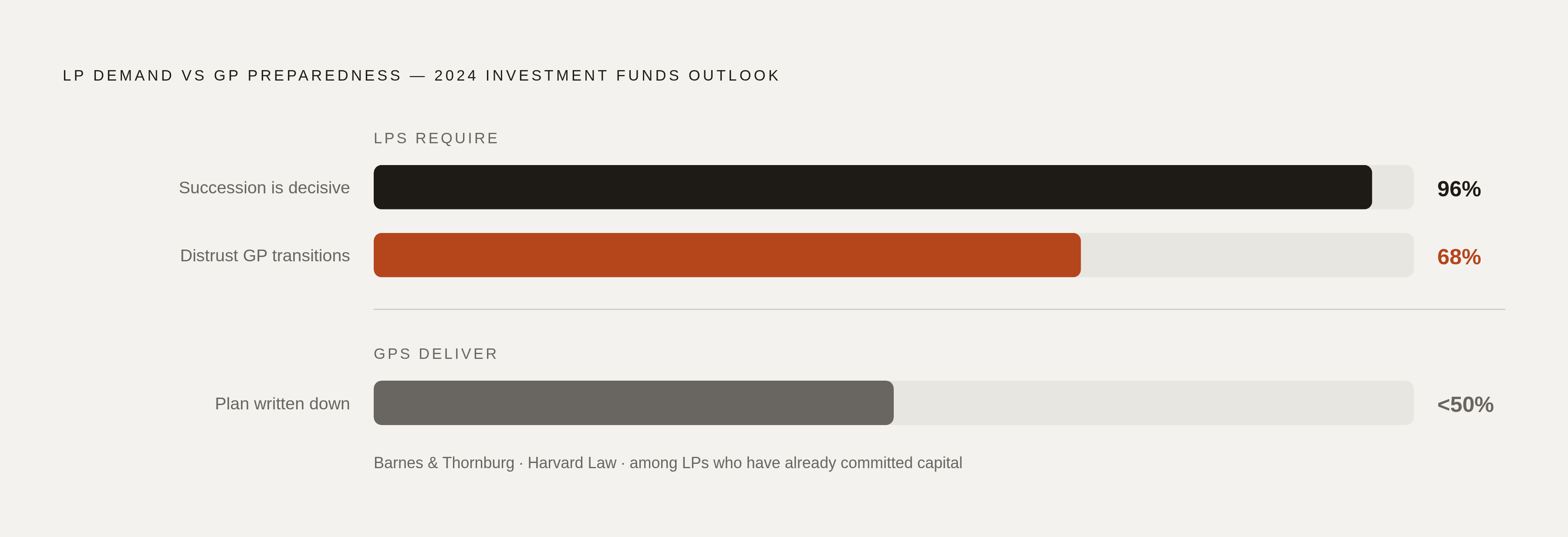
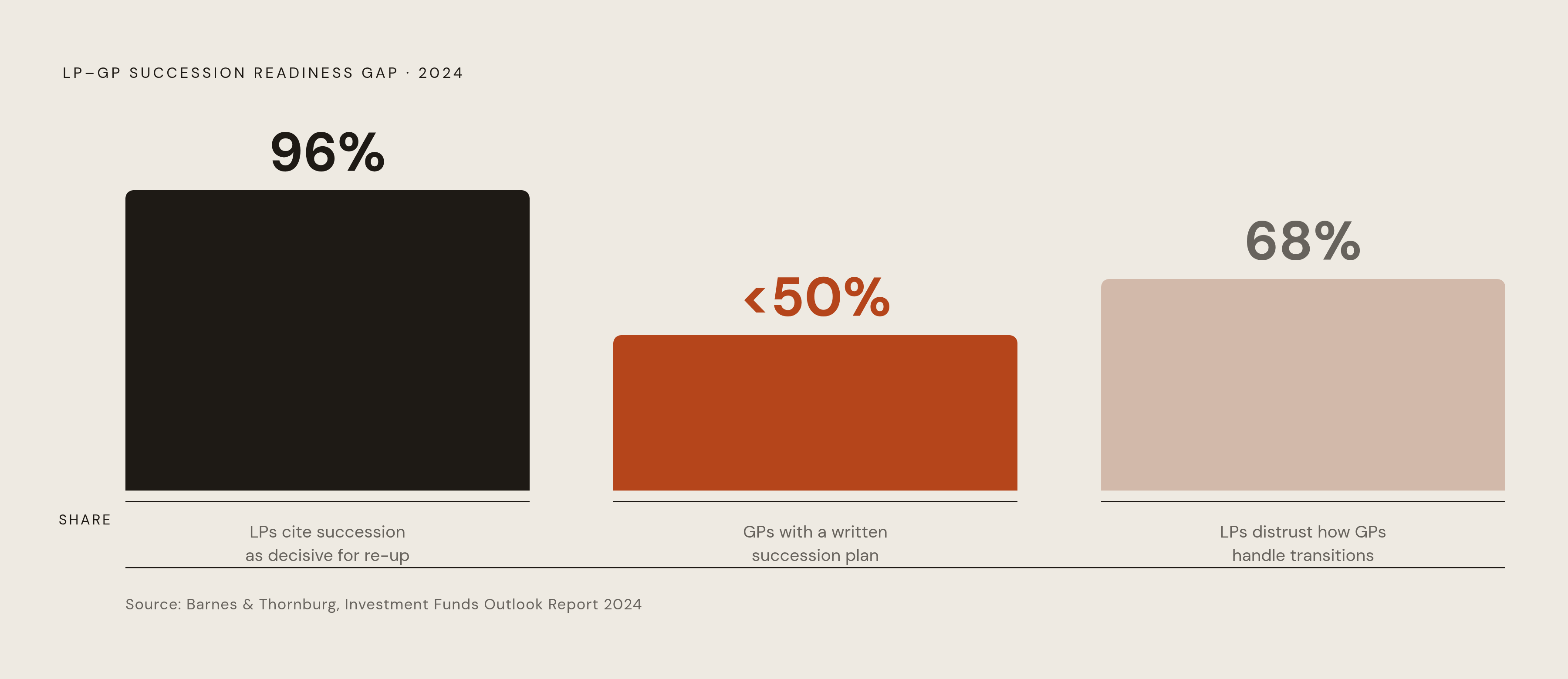
Succession readiness sits on almost every LP's re-up checklist now. Barnes & Thornburg's 2024 Investment Funds Outlook Report (cited by Harvard Law) found succession is a decisive factor for 96% of LPs deciding whether to back the next fund, while fewer than half of GPs have anything written down.
The same report found 68% of LPs don't trust how GPs handle transitions. These are people who already wired tens of millions of dollars into a fund, and more than two thirds of them still believe the exit plan is inadequate.
LPs stopped accepting a name on a slide as a satisfactory answer. They want to know how carry actually splits among partners, whether a talent pipeline exists below the named partners, and whether a proposed successor has genuine deal and LP relationship experience. Edelman Smithfield's 2024 LP Survey confirmed that soft factors, including reputation, leadership quality, and succession clarity, play a key role alongside hard performance numbers when LPs allocate capital.
GPs face a real tension here. LPs want a documented plan, but they also want the exact people they backed to stay in place and keep doing whatever produced returns. Announcing a leadership transition too loudly and too early can unsettle the investors a firm is trying to reassure. The question was never whether to communicate about succession, but how to do it without signaling instability.
Unhappy LPs almost never file a formal complaint or call for a GP vote. They quietly decline the next fund. By the time a firm notices its raise is stalling, it is often impossible to identify the specific conversations that went wrong.
Three conditions that make succession work
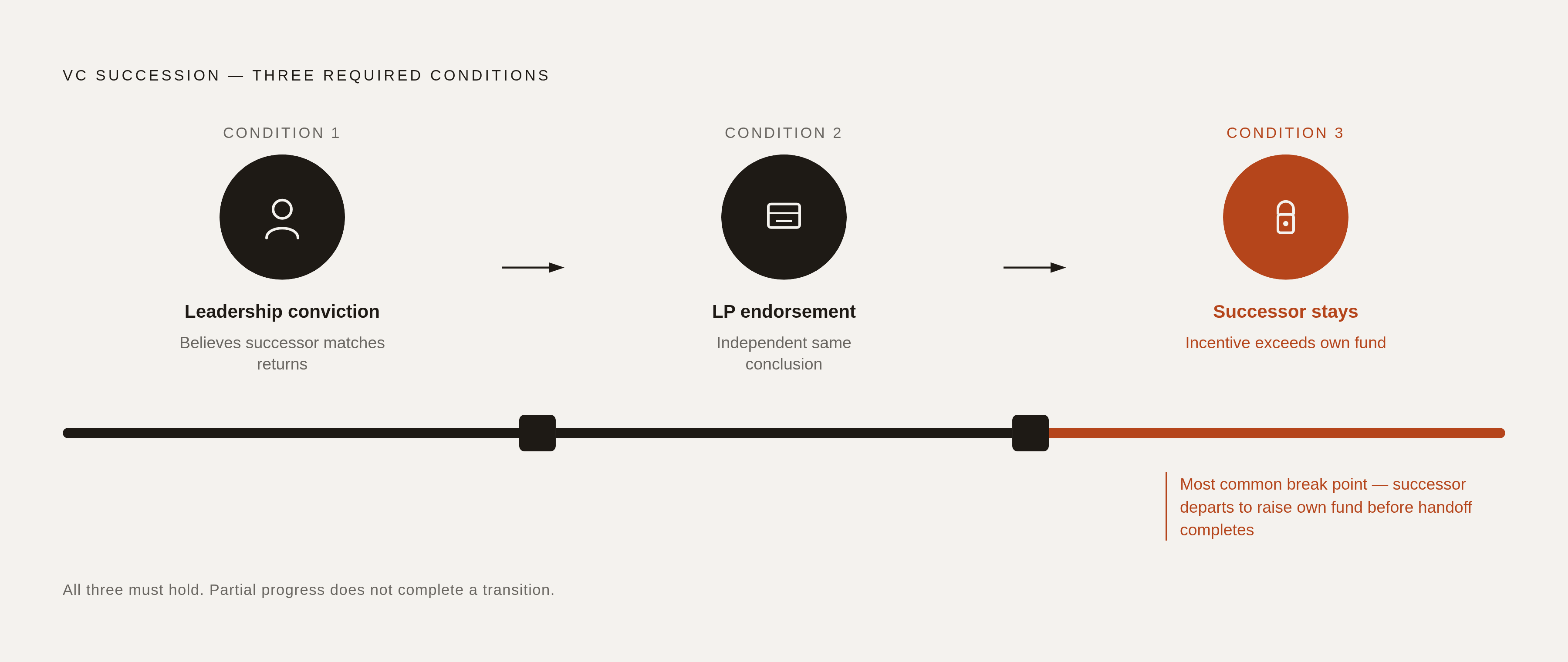
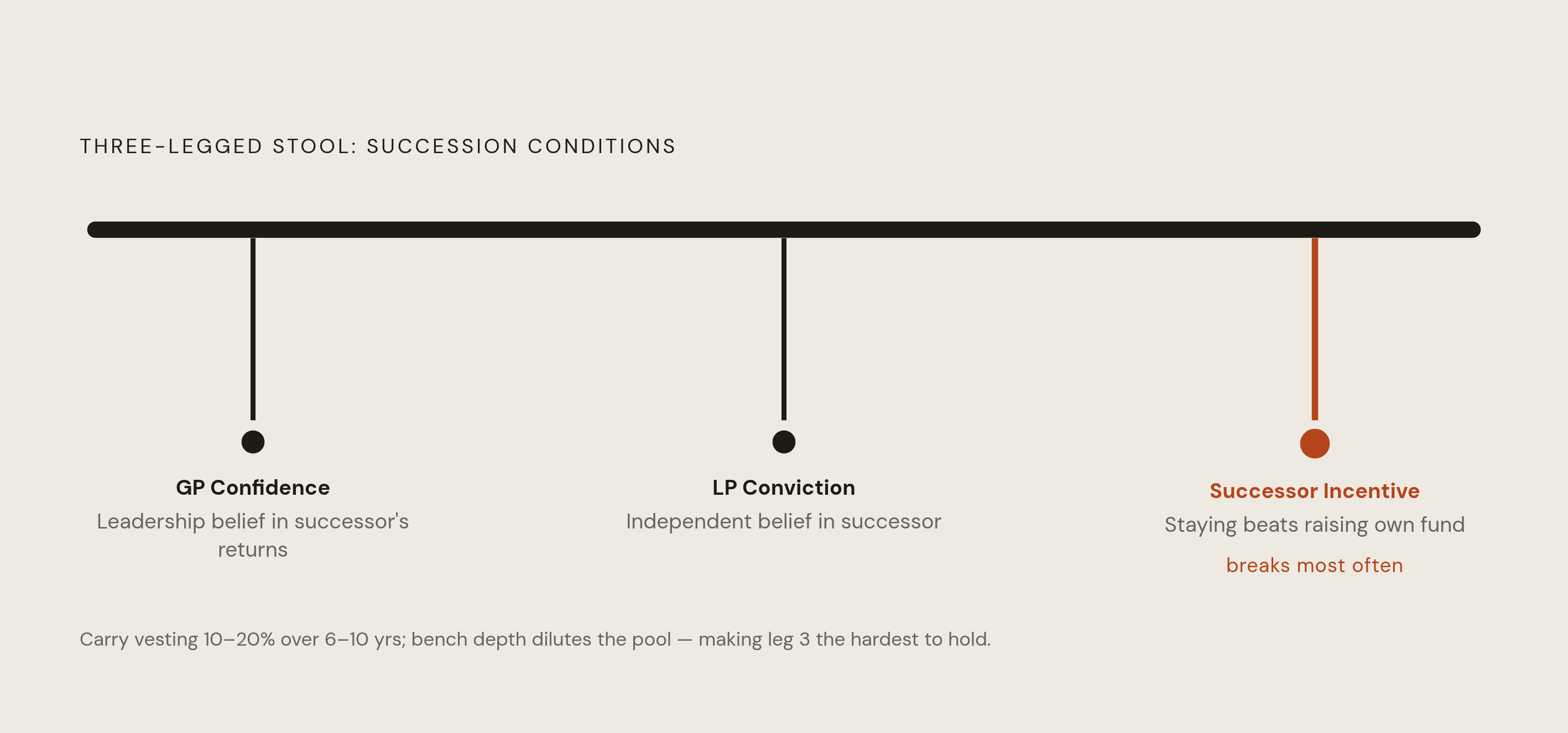
Succession planning requires three things to align simultaneously. The existing leadership must believe the successor can generate returns comparable to what came before. LPs must reach the same conclusion independently, not simply on the GP's assurance. And the successor must find staying at the firm more financially and professionally compelling than leaving to raise their own fund. That third condition is the one most firms underestimate and underinvest in.
All three conditions are necessary. Partial progress across all three does not produce a successful transition. The most common failure pattern is that leadership selects a successor, LPs approve, and then that person departs to start their own firm before the handoff completes.
Carry economics make the third condition particularly difficult. Partners typically vest into 10% to 20% of carry over six to ten years, and every new partner a firm develops to build succession depth dilutes the pool for existing partners. The same activity succession requires gives current partners a financial incentive to delay it.
In founder-led firms, culture, deal judgment, and governance are often so embedded in one person's approach that a leadership change effectively requires changing all three at once. Heidrick & Struggles has noted that no one wants to be the person who tells a founder it is time to step back, and there is rarely a clear process for initiating that conversation.
Linus Dahg at Inventure has described what he calls the "cowboys" problem in venture. Partners have historically run their own deals, held their own board seats, and managed their own LP relationships with little coordination. That structure produces sharp individual investors but creates a firm that is highly exposed when any one of them leaves.
None of these three conditions align on their own. Reaching them requires deliberate work across partner development, legal documentation, LP communication, and governance design.
Building a pipeline that makes successors credible
Most venture firms still promote from within based on deal performance alone. A partner closes several good investments, receives more carry, and gets the title. What is usually missing is any structured development in fundraising, portfolio oversight, or LP relationship management, the capabilities a future GP needs before anyone can credibly hand over responsibility for a fund.
Sequoia is the most cited counter-example. The firm keeps partners working across deals rather than in isolated silos, pairs junior partners with senior partners throughout the investment process, and structures leadership changes so that, in Doug Leone's words, they happen "in a way that nobody notices." The goal is a firm that outlasts any individual partner, including its founders.
Index Ventures developed Shardul Shah, Nina Achadjian, Martin Mignot, and Jan Hammer over years through deliberate exposure to all parts of the business. Index also operates on an equal-partnership model that distributes decision authority across the team rather than concentrating it in a single founder. That structure alone reduces the single-point-of-failure risk that undermines most transitions. Kleiner Perkins, by contrast, experienced real talent loss due to planning gaps and spent years rebuilding institutional knowledge that could have been preserved.
LocalGlobe formalized the timeline. In 2021 the firm launched a four-year internal development program, its "next gen" project, built specifically to develop leadership below Robin and Saul Klein, with a defined start date and end date.
A functional pipeline requires several concrete elements:
- Early, direct exposure to LP relationships, because a partner who has never participated in fundraising cannot be credibly presented as the face of the next fund
- Board seats initially held under senior partner oversight rather than solo placement, so successors build a supervised track record before taking on full accountability
- Explicit carry grants structured to make staying at the firm the financially rational choice, which directly addresses the retention problem created by dilution concerns
- A known development timeline, because ambiguity gives a high-performing partner every incentive to leave and raise capital independently
Firms also need to be direct about capacity. There is rarely room for every strong performer to reach the partner level. Avoiding that conversation for years does more damage to trust than stating the firm's actual promotion capacity clearly, even when the answer disappoints someone.
What key-person clauses do and cannot do
Key-person clauses appear in nearly every venture and private equity fund document because an LP commitment is fundamentally a bet on specific individuals, not a strategy document.
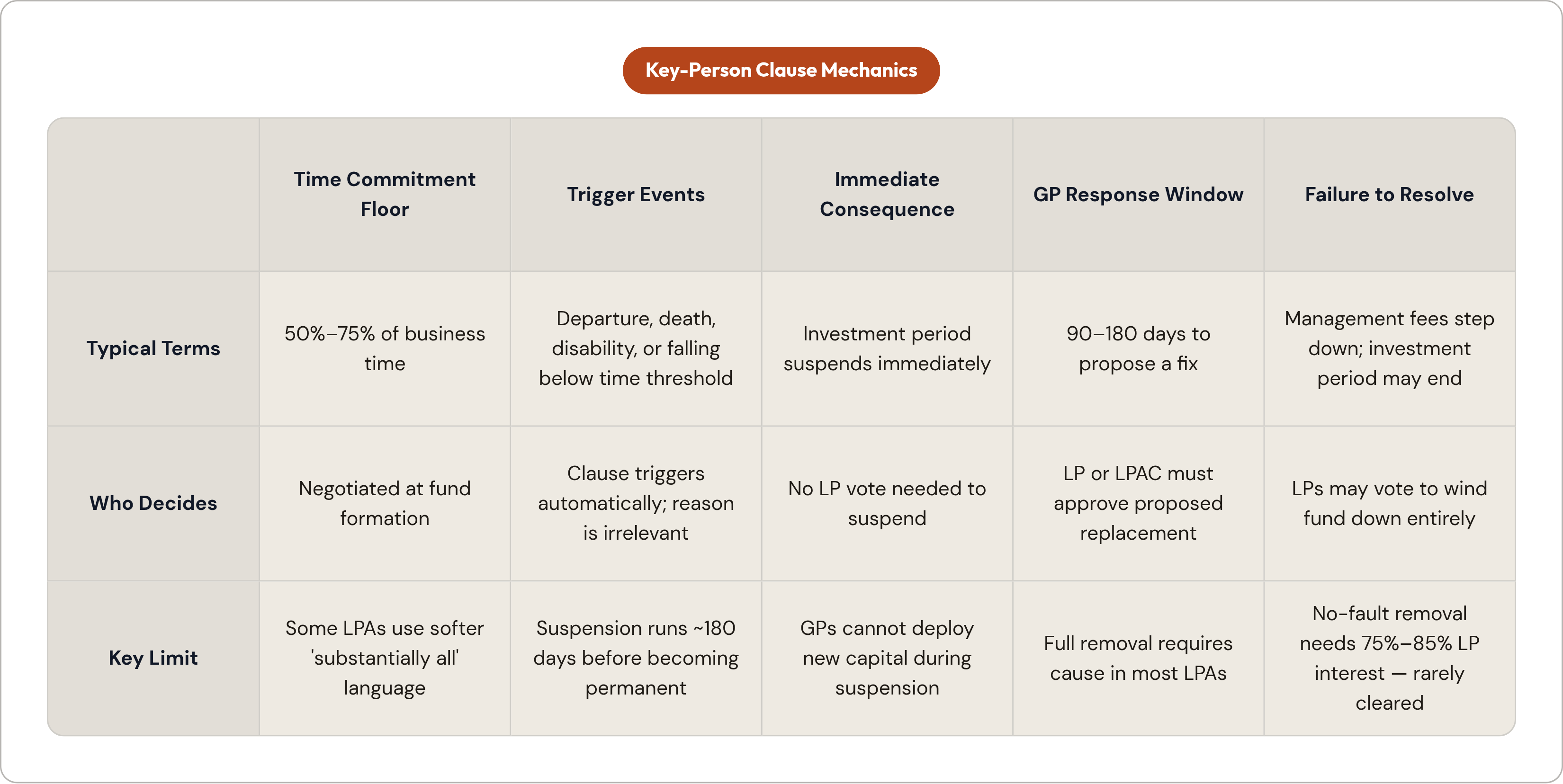
The clause names the individuals whose ongoing involvement the LPA treats as essential to the fund, typically founders, managing partners, and senior investment professionals. Time commitment requirements vary. Some LPAs require a named person to spend at least 80% of their professional time on the fund; others use language like "substantially all" of their time. Contractual floors typically fall between 50% and 75%.
A key-person event is triggered by departure, death, disability, or falling below the time threshold, regardless of the reason. Once triggered, the investment period suspends immediately. The GP cannot make new investments until the LP advisory committee or a majority of LPs votes to reinstate it. That suspension typically runs 180 days before becoming permanent, and GPs usually have 90 to 180 days to propose a remedy, most commonly a replacement key person or a restructured leadership team, subject to LP or LPAC approval.
Missing that window accelerates serious consequences. Management fees can step down, the investment period can end outright, and in some structures LPs gain the right to wind the fund down entirely.
Full GP removal remains rare by design. Most LPAs require cause, and no-fault removal typically requires 75% to 85% of LP interest voting in favor, a threshold that is genuinely difficult to reach. That is partly why LPs bypass the formal process and simply withhold their next commitment rather than forcing a vote.
A key-person clause protects LPs from the consequences of a leadership failure after it has already occurred. It does nothing to prevent the failure itself. The succession plan is what keeps the clause from being invoked in the first place.
Governance structures that reduce single-point risk
AlixPartners found that private equity firms with unstable leadership underperform peers with stable leadership by 15% to 20% in IRR. Leadership instability is ultimately a performance problem, not just an organizational one.
The underlying risk is concentration. When investment decisions, LP relationships, and day-to-day management all flow through one or two people, the firm remains exposed even after a successor is named, because that person has not yet been doing the job in practice. Naming someone in a document is not equivalent to having them run the firm under real conditions.
Several governance choices change that exposure:
- An investment committee structure where decisions are made at the committee level rather than by individual partner authority, which distributes institutional knowledge so that no single departure erases the firm's decision-making record
- A management or operating committee that separates firm governance from investment decisions, which is particularly important when a founder-GP is simultaneously responsible for running the firm and managing the portfolio
- Documented partner roles that specify who owns which LP relationships, who holds signatory authority, and who represents the firm externally, documentation that feels unnecessary at a five-person firm and becomes critical the moment a transition begins
- Active engagement of the LPAC during normal fund operations rather than only as an emergency mechanism, so LPs are informed enough to vote constructively if a key-person trigger actually fires
Carry and ownership structure belong in this analysis as well. A successor who holds no meaningful carry stake has limited financial reason to act with the commitment and long-term orientation the role requires.
Institutional knowledge also needs to be captured deliberately and transferred intentionally: deal theses, portfolio company relationships, the history of difficult LP conversations. All of it needs to exist somewhere more durable than a founder's memory.
A 2025 Heidrick & Struggles report found that only 16% of private equity-backed firms treat succession planning as a strategic priority, which indicates that most of this governance work is not yet happening across the industry.
Communicating succession plans without triggering alarm
GPs navigate a genuine tension in how they communicate about succession. LPs say they want a documented plan, but learning that a transition is coming can unsettle the relationships a firm depends on. How and when a firm communicates about succession matters almost as much as the substance of the plan.
Trust with LPs accumulates slowly across multiple fund cycles. Firms that introduce potential successors gradually, at annual meetings, during co-investment discussions, and in portfolio reviews, well before any formal announcement, tend to experience smoother transitions when the change actually occurs. By the time it is official, LPs have been observing the successor for years rather than encountering them for the first time in a formal announcement.
Worth communicating proactively: that a succession framework exists, which team members are being developed and through what mechanisms such as board seats, deal attribution, and direct LP-facing responsibilities, and what governance protections are in place regardless of who leads the firm.
Annual meetings are the natural venue for this. Regular updates on team development normalize succession as an ongoing part of firm management rather than a signal of impending disruption.
Several approaches consistently backfire. Naming a successor before that person has any LP-visible track record creates a credibility gap they must then close under increased scrutiny. Framing succession as a response to a health event, an age milestone, or an unexpected departure signals that planning began too late to be meaningful. And offering vague reassurance without structural documentation fails to satisfy LPs who can distinguish between a firm that has genuinely worked through the question and one that is deferring it.
The real indicator of successful communication appears in re-up behavior across fund vintages. If it worked, the LP relationship feels continuous through the transition rather than reset.
What a complete continuity plan actually covers
A complete continuity plan is not a document stored in a shared folder. It is a set of active practices across four areas: partner development with named individuals on a defined track with carry participation, LP exposure, and a known timeline; legal structure with LPA key-person provisions negotiated around realistic succession scenarios rather than carried forward as boilerplate; governance design that includes investment committee structure, documented role ownership, institutional knowledge capture, and active LPAC engagement; and LP communication that is proactive, incremental, and integrated into normal reporting rather than reserved for a crisis.
Timing determines most of the outcome. Starting succession planning while a fund is being raised gives a firm years of runway to develop successors and introduce them to LPs under normal conditions. Starting once a departure is already imminent leaves almost no runway at all.
Sequoia, Index, and LocalGlobe share a common characteristic: each treated firm-building as a genuine strategic investment, not as something that happens automatically because individual investment performance was strong enough. Firms that have struggled with succession have generally treated it as secondary, addressed only after a problem was already visible.
Emerging managers face a different set of constraints but the same underlying logic. A two-partner firm cannot build a deep bench immediately, but it can document how decisions are made, involve LPs in team development conversations early, and negotiate LPA provisions that create response time following a key-person event rather than freezing the fund immediately.
Continuity planning ultimately comes down to one question: does the firm's commitment to its portfolio companies and its LPs outlast any single person's tenure? That is a fiduciary obligation, not an optional value statement.
Methodology & sources
- https://sifted.eu/articles/vc-succession-survival
Provided the carry vesting range figures (10% to 20% over six to ten years) cited in the section on why the third succession condition is hardest to meet.
- https://corpgov.law.harvard.edu/2026/02/21/succession-planning-in-private-equity-a-strategic-imperative-for-gps-and-lps/
Sourced the Barnes & Thornburg 2024 Investment Funds Outlook Report statistic that succession is a decisive factor for 96% of LPs.
- https://www.ainvest.com/news/future-venture-capital-succession-leadership-high-performance-firms-2601/
Sourced the 2025 Heidrick & Struggles finding that only 16% of private equity-backed firms treat succession planning as a strategic priority.
- https://www.ainvest.com/news/cvc-capital-partners-succession-planning-leadership-transitions-impact-private-equity-performance-2509/
Provided the AlixPartners finding that firms with unstable leadership underperform peers by 15% to 20% in IRR, and the statistic that 68% of LPs distrust how GPs handle transitions.
- https://www.lecocqassociate.com/publications/2-key-person-provisions-aligning-interests-managing-risk-and-preserving-continuity-in-fund-structures
Provided detail on key-person clause mechanics including the 80% time commitment threshold and the structure of LPA key-person provisions.
- https://pipelineroad.com/glossary/key-person-clause
Supplied the contractual floor range of 50% used in describing typical key-person time commitment thresholds.
- https://www.heidrick.com/en/insights/private-equity/succession_planning_comes_to_founder_led_investment_firms
Provided the observation that no one wants to tell a founder it is time to step back and that there is rarely a clear process for that conversation.