Investor Rights and Information Obligations for Founders
Founders must track investor reporting obligations that outlast every funding round.

The Investors' Rights Agreement is the one document from your closing binder that keeps emailing you after everyone else has gone home. Founders sign five things at a priced round, and four of them get filed away. The IRA sends quarterly reminders for the next seven to ten years.
I've watched founders realize this the hard way, usually around month eight of their Series B, staring at a spreadsheet trying to figure out why they owe three different investors three different reports on three different Tuesdays. The stock purchase agreement closes and everyone moves on. The IRA doesn't close. It runs for as long as those investors hold stock, and every new round stacks another layer on top of the last one. Miss that distinction early and you'll find yourself sending quarterly financials to eleven people on eleven schedules, wondering when exactly you signed up to be a part-time bookkeeper for strangers.
How the five NVCA model documents split up the work
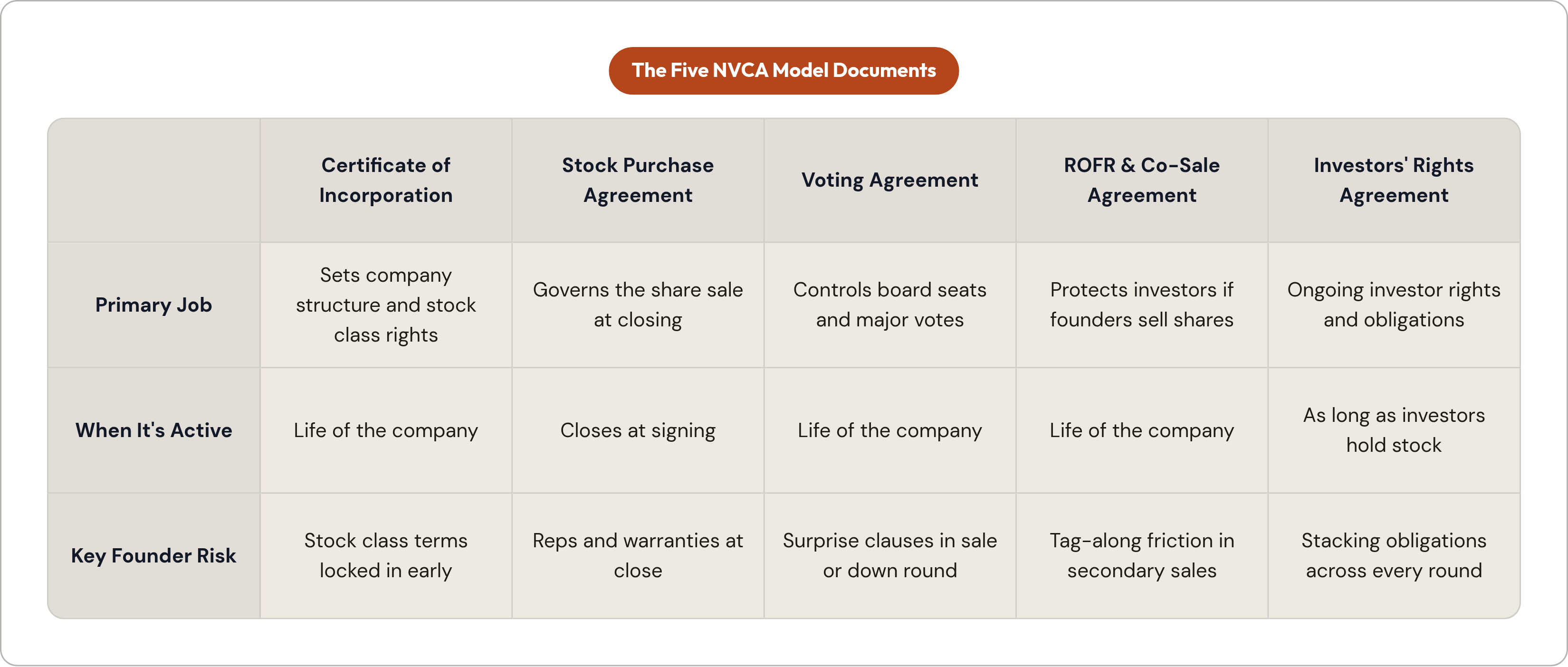
Most US venture deals start from the National Venture Capital Association's model documents. There are five, and founders tend to lump them together as "the legal stuff," which is a mistake, because they do very different jobs.
The certificate of incorporation sets up the company's structure and the rights tied to each class of stock. The stock purchase agreement handles the sale itself: price, share count, and a set of promises the company makes about itself at closing. Once that closes, this document has basically clocked out.
The voting agreement decides how shareholders vote on board seats and major corporate moves, including who gets to name a director. The right of first refusal and co-sale agreement gives existing investors first dibs if a founder wants to sell shares, plus the right to tag along. Then there's the investors' rights agreement, the one that keeps working long after the ink dries. It covers information rights, registration rights, pro rata rights, and a pile of ongoing promises to investors.
Treat the NVCA forms as a starting point, not scripture. Terms shift a lot by stage and by who's got leverage at the table; a seed round and a Series D look nothing alike once you're deep in redlines. Founders who assume all five documents say roughly the same thing get blindsided later, usually by some clause in the voting agreement or the ROFR that surfaces right in the middle of a sale process or a down round, when nobody has the bandwidth to be surprised.
Information rights: what you owe, and who you owe it to
Information rights spell out who sees your numbers, how often, and in what detail. Not every investor gets the same view. Most IRAs define a "Major Investor" threshold, tied to ownership percentage or check size, and that threshold decides whether someone gets monthly detail or a once-a-year summary.
For early-stage companies, the standard package usually runs:
- Unaudited quarterly financials (income statement, balance sheet, cash flow), due within a set window after quarter close
- Monthly cash burn and runway updates, often on a tight deadline
- An updated cap table, at least yearly, or sooner if a Major Investor asks
- An annual board-approved budget, which the 2024 NVCA update made mandatory instead of optional
That last one matters more than it sounds. Under the old language, companies could sometimes negotiate the budget requirement out entirely. That door's closed now. If you're on a current form, your board gets an approved budget every year, with no exceptions and no side deals.
There's also a "reasonable request" clause buried in most IRAs, letting Major Investors ask for extra information outside the normal schedule. Sounds harmless until you live it: share one number that makes an investor raise an eyebrow, and the follow-up email asks for three more numbers to explain the first one. Data invites more data requests, every time.
The burden scales with headcount, not revenue. Each Major Investor is another reporting relationship, and those relationships don't expire when you raise your next round. A seed investor who never sells keeps their information rights straight through Series B and C. Write a $50,000 check in 2021, and that same investor can still be in your inbox in 2027 asking where the board deck is.
One small mercy: the 2025 NVCA update clarified that the IRA doesn't force you to generate information you don't already have. You share what exists, and building a new dashboard from scratch because someone asked for a metric you've never tracked isn't required, thankfully.
The 2024 and 2025 NVCA updates founders need to know about
The NVCA revises its model documents on a regular cycle, and the 2024 and October 2025 rounds changed enough that older templates aren't a safe read of current market terms anymore. If your lawyer pulls up a form from 2019, parts of it are quietly stale.
From 2024, the changes worth flagging:
- The annual board-approved budget went from optional to mandatory in the IRA
- New optional language for a cash management policy
- Board designation rights no longer pass automatically to whoever buys an investor's shares, unless the parties write that transfer in on purpose
October 2025 went further:
- The minimum offering size that triggers an S-1 registration demand went up, cutting the odds of a premature registration demand nobody wants
- Observer rights now come with wider carve-outs, so companies can exclude an observer when there's real competitive risk or a conflict
- "Requisite holders" now excludes sanctioned parties, tied to updated OFAC guidance
- New monitoring duties around foreign person status, linked to outbound investment rules
- Severance above a set dollar threshold can be restricted through an optional covenant
- "Competitor" got a carve-out option for large venture funds, since a giant multi-stage fund often holds stakes in companies that technically compete with each other
Check your IRA line by line against the current standard if it came off an older template. Sometimes the gap favors the company, and sometimes it doesn't. Either way, you want to know which before you're mid-negotiation on the next round, not during.
Pro rata rights: what they actually commit the company to
Pro rata rights let an investor buy enough new shares in a future round to hold their ownership percentage steady. Key word there is right, not obligation. Nobody's forced to write a check, but the company has to give them the chance before locking the round with someone else.
Who gets this right comes down to the Major Investor threshold in the IRA, usually tied to a minimum stake or a minimum check from the original round. At Series A and later, giving pro rata to leads and the biggest checks is close to automatic. At seed, it's closer to a coin flip. Roughly half the deals write pro rata into the IRA formally; the rest lean on side letters or a verbal nod that may or may not hold up when it counts.
Y Combinator's standard SAFE skips pro rata entirely, which is exactly why seed investors on SAFEs so often ask for a side letter to lock the right in separately. Worth knowing if you assumed pro rata came bundled in with the SAFE, because it doesn't.
Extending pro rata to smaller "minor" investors has fallen out of favor since the market correction that started in 2022. Founders and their counsel increasingly treat it as a cap table headache with limited upside; every extra investor holding pro rata is one more allocation call to make at every future round.
Two provisions deserve real suspicion at the table. Super pro rata lets an investor grow their stake beyond where they started, not just protect it, which eats into the room you need for new investors who want a stake big enough to matter. Pro rata with no sunset clause feels harmless at seed but turns into real friction later, right when you need flexibility most. The fix is simple enough: define "Major Investor" tightly, limit pro rata to that group, and build in an expiration wherever you can.
Board and observer rights, and the governance layer underneath them
Board observer rights let an investor send someone to sit in on meetings and read the board packet, without a vote attached. Sounds minor, but it isn't. An observer seat is a direct window into everything the board discusses, and that access shapes how an investor behaves even without a formal vote on the table.
The 2025 NVCA updates widened the situations where a company can legitimately keep an observer out of the room, mainly around competitive harm and conflicts of interest. You've now got clearer footing to say no when it matters if an investor's portfolio includes a direct competitor.
Alongside board seats, IRAs often carry reserved matters, meaning investor consent is required before the board acts on certain big items: taking on debt past a set amount, changing the fiscal year, approving a large severance package. That's the real tension running under all of it. Investors want enough visibility to protect their money, while founders want enough room to run the company without asking permission for every routine call.
Delaware law had its own reckoning with this exact issue. The Court of Chancery's ruling in West Palm Beach Firefighters' Pension Fund v. Moelis & Co. struck down certain founder-protective approval rights in a stockholder agreement, on the theory that requiring founder sign-off before the board could act on things like debt, dividends, or fiscal year changes stripped the board of its own judgment. Under Delaware corporate law, the board runs the company, and it doesn't defer to a side agreement, no matter how well-lawyered.
The 2024 amendments to the Delaware General Corporation Law were the legislature's direct answer, clarifying which stockholder agreement provisions actually hold up. That restored some flexibility, but if your company's still running on an agreement drafted before 2024, get counsel to check it against current law. What passed as standard practice a few years back doesn't automatically pass today.
One more instrument worth knowing: the Management Rights Letter, a separate document some VC firms require alongside the IRA. It's not a power grab, even though it can feel like one at first glance. Funds need it to qualify as a Venture Capital Operating Company under ERISA's plan-asset rules, which governs how they're allowed to invest pension money. It's a box the fund has to check for its own regulators, not a founder-specific demand.
What federal securities law requires when you raise under Regulation D
Private companies skip the ongoing disclosure treadmill public companies live on. That's not the same as being exempt from disclosure rules altogether. Nobody, ever, gets a pass on anti-fraud law, and that holds whether you're a two-person startup or a company six months from an S-1.
Most startups raise under Rule 506 of Regulation D, which preempts state Blue Sky laws and lets companies raise from accredited investors without a full registered offering. Rule 506(b) also allows up to 35 non-accredited but sophisticated investors, though it comes with real disclosure obligations, financial statement delivery, and a duty to actually answer their questions instead of dodging them. Rule 506(c) only allows accredited investors, but lets you publicly advertise the raise in exchange. The catch with 506(c): you've always had to verify accreditation with real documentation, not just an investor's word. Self-certification has never satisfied 506(c), and that hasn't budged.
The anti-fraud floor sits under all of this no matter which exemption you use. Both the SEC and the Department of Justice treat material misrepresentations to investors as securities fraud, private company or not. "We're not registered, so the rules don't apply" isn't a defense, and it's not even a sentence a lawyer would let you finish.
Regulatory pressure here keeps building. SEC Commissioner Caroline Crenshaw called in early 2023 for stronger disclosure rules around Rule 506 raises, including a two-tiered framework that would scale disclosure to deal size. Wherever that ends up landing, the direction is toward more accountability for private companies, not less.
Watch for one more threshold as the company grows: once you cross set limits on total assets and number of shareholders of record, Section 12(g) kicks in and triggers mandatory SEC reporting, even without an IPO. Track your shareholder count as you scale, especially if you've handed out equity broadly through option pools or a long list of small SAFE holders.
What you say to investors, in decks, in monthly updates, in board meetings, sits under securities law, not just under whatever the IRA says. Accuracy isn't a nice-to-have here, it's the floor everything else is built on.
How the obligations pile up across rounds, and what to do about it before you sign
Every financing round adds a new class of preferred shareholders, and each class brings its own IRA rights. These don't replace the old obligations; they stack on top, like sediment.
By Series B, it's common to be running monthly financials to Series A Major Investors, quarterly financials to seed investors, and an annual summary to smaller holders, all on different clocks, all in different formats. Nobody mentions this at the seed stage, when it's a paragraph buried on page 40 of the IRA that nobody reads twice.
The cap table stops being a spreadsheet you check once a quarter and turns into something you actively manage. Pro rata rights, observer seats, and information rights all multiply as investor classes pile up, and just keeping track of who's owed what, on what schedule, becomes a job in itself.
Founders have real leverage here, but only before signing:
- Define "Major Investor" narrowly in the term sheet. Fewer qualifying investors means fewer reporting cycles to run every quarter.
- Push for a sunset clause on pro rata instead of letting it run forever.
- Negotiate observer carve-outs for competitive harm, since the 2025 NVCA update makes this a normal, market-standard ask now.
- Skip minor investor pro rata and super pro rata provisions, since both cost you flexibility down the road far more than they help anyone today.
- Check whether the annual budget requirement is mandatory or optional in the actual version of the IRA on the table, and confirm what "board-approved" means for how your company operates.
None of this makes you the difficult founder in the room. An investor getting clean, accurate numbers on time is easier to work with than one left guessing, and that's true in both directions. Set up the reporting rhythm early, before the second and third rounds start stacking rights on top of each other, and you'll spend a lot less time scrambling every quarter. The IRA sets the floor. What you build above it is still yours to decide.