Managing Conflicting Advice from Multiple Investors
Understand each investor's incentives to filter conflicting advice into decisive action.

Every investor in the room means well, and that's the annoying part. This piece is about what to do when three well-meaning people give you three incompatible answers, and the job is to build your own machine for turning that noise into a call you can actually stand behind.
Rounds get crowded fast. Single-investor deals drop from 61.0% at pre-seed to 47.8% at seed to just 18.9% by Series A/B, according to research on startup funding rounds. Board seats follow the same curve: founder-controlled at pre-seed, three seats at seed, five by Series A, and by Series B, investors can outnumber the people who actually built the thing.
Add advisors and the room gets louder still. Most early-stage startups run with one to five of them, though some founders go bigger on purpose, building networks of 30 to 50 advisors with smaller equity grants just to pressure-test the market. Every one of these people shows up with a favorite industry, a favorite company stage, a favorite way of engaging. The advice pool is a mixed bag, and pretending otherwise is how founders end up frozen.
Here's the actual shift nobody warns you about: as the company grows, the job of "raise money" gradually gives way to a job best described as "filter signal." That doesn't mean filtering out investors, that's a different (worse) problem. It means filtering the advice itself, so it produces a decision instead of a standoff. That skill doesn't show up automatically just because you've raised a Series B, either. You have to build it on purpose, the same way you'd build any other muscle you didn't have at incorporation.
Why investor advice conflicts even when every investor means well
It's math, and it's not even complicated math. You have one company, and your investor has a portfolio where most positions are expected to lose money, full stop.
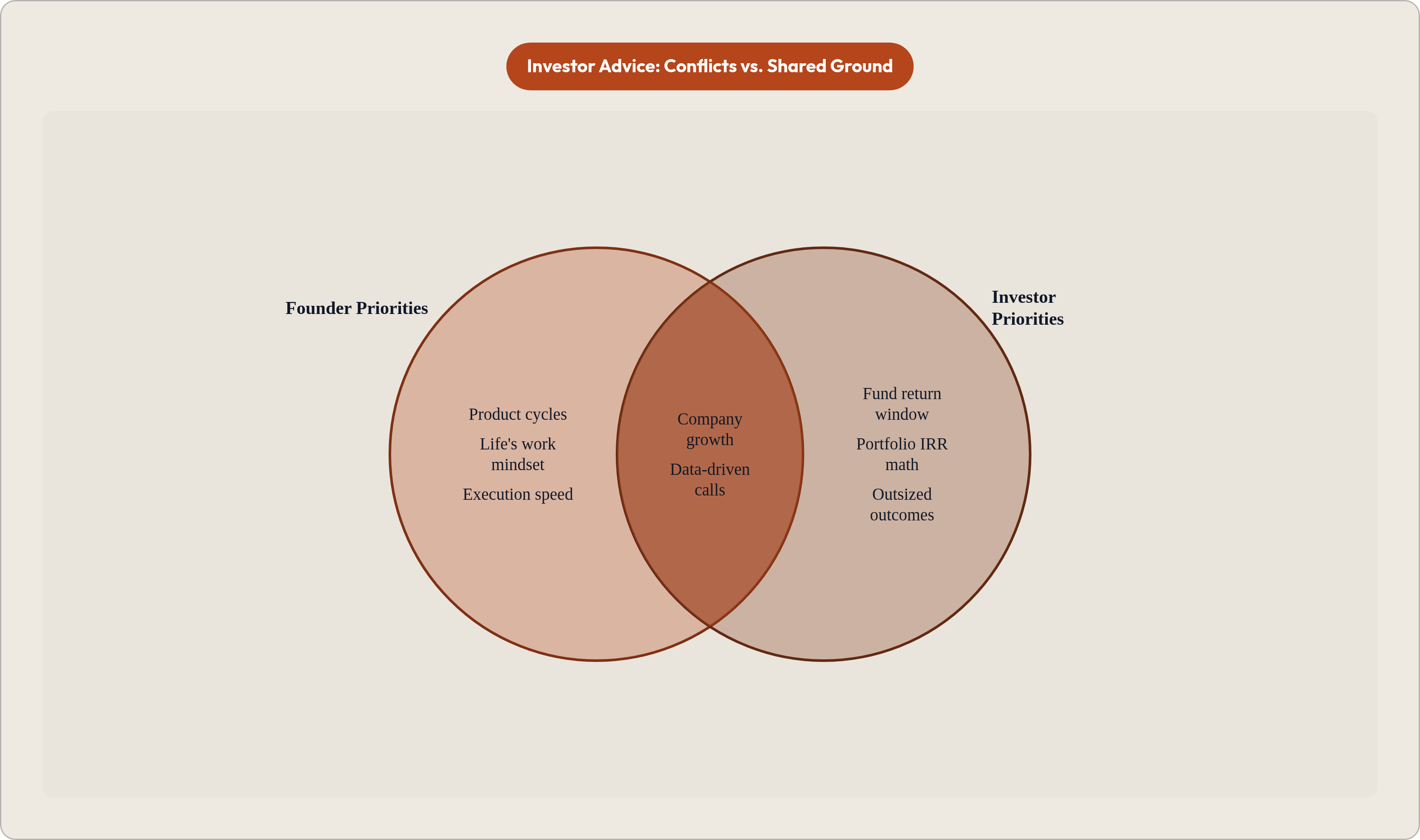
Picture a founder cruising toward a modest outcome. From where that founder sits, that's a win, a real one, the kind you frame and hang in the hallway. From the VC's seat, if the fund needs outsized returns to move the needle, that same $8M outcome is basically a write-off, and the "rational" move is to push the company toward a riskier, bigger swing. Neither person is lying to you. They're just optimizing different equations, and both equations are legitimate.
Fund size stacks another layer on top of that. A $50M seed fund and a $300M "big seed" fund will both call themselves seed investors at a dinner party, but a $500M exit means wildly different things to each of their spreadsheets. A GP juggling 30-plus portfolio companies has, structurally, less time for you than a solo GP with eight. That's bandwidth math more than a character flaw, and it makes engagement transactional whether the GP wants it to be or not. Worth asking outright, even if it feels rude: is this person playing for management fees, or for carry? The answer quietly shapes every piece of advice they'll ever give you.
Then there's the clock. VC funds typically run on a 7 to 10 year return window, while founders tend to think in product cycles, or in "this is my life's work" terms, not fund vintages. That mismatch usually stays quiet for years, then detonates right around Series C or D, exactly when a strategic sale versus a secondary, or "hold for a better number" versus "take the offer on the table," actually matters.
None of this means the advice is bad. Each investor is being perfectly rational about their own situation, which is a different thing than being rational about yours. Once you see the incentive sitting underneath the recommendation, the recommendation stops feeling like a riddle.
What unchecked conflict actually costs — and why decisiveness is the point
Decisive CEOs are 12 times more likely to be high performers than indecisive ones, according to a decade-long study cited in Harvard Business Review, and that number is worth sitting with because it's not subtle.
Here's the twist, though: the exact conditions that create investor conflict, smart people with real conviction, pulling in different directions, are the same conditions most likely to wreck your decisiveness. Founders don't freeze because they're weak, in other words; they freeze because the decision feels like it's testing their identity, and stalling feels, in the moment, like the safe move. It isn't.
Governance research backs this up structurally. Boards with more than 10 members show decision latency roughly 25% higher than leaner boards. More voices in the room doesn't mean better decisions; it usually just means slower ones, unless something is actively filtering the input before it hits the table.
And the cost compounds. A 2024 survey found 53% of founders reported burnout, and managing investor relationships is a real contributor to that pile. Startups where early founder-investor misalignment sat unresolved have documented losing months of execution time, not because the eventual decision was wrong, but because nobody made it fast enough to matter.
So the framework that follows carries real weight, not a leadership-book flourish for your LinkedIn bio. It's the thing standing between you and months you'll never get back.
Mapping each investor's lens before treating their advice as interchangeable
Diligence on your investors doesn't end when the term sheet gets signed; that's actually when it should ramp up.
A founder who knows an investor's fund size, fund age, portfolio makeup, and stated thesis can ask one sharp question the moment advice lands: what outcome does this serve? Also worth a second look, quietly: does this investor have a competitor or an adjacent bet already in the portfolio? That kind of conflict rarely announces itself; it just shows up disguised as "market feedback."
Three things worth mapping for every name on your cap table. Incentive horizon: when does their fund need to show returns, and how does your outcome register on that scoreboard? Domain authority: where did this person actually operate, build, or ship, versus where are they just pattern-matching from something they read about? Engagement bandwidth: how many companies are they juggling right now, and how much of their advice is real attention versus a heuristic they hand out to everyone?
Business psychologist Jena Booher, writing in Entrepreneur in 2024, sketches three dysfunctional investor archetypes worth knowing by name. The Bully pushes subjective opinions through sheer authority, the Neurotic hands you anxiety dressed up as insight, and the Distracted rations advice based on however much bandwidth they've got left that week, not on how good the advice actually is. These are diagnostic labels, and they help you weight what you're hearing before you act on any of it.
End of this exercise, you should have something simple: a small matrix, investor by investor, tracking domain authority, incentive horizon, and bandwidth. Every advice-sorting decision after this point runs through that matrix.
Sorting conflicting advice by what it's actually optimizing for
Not every disagreement is the same species of disagreement, and treating them as if they are is where founders get stuck.
Tactical conflicts are the easy ones: two investors disagree on a channel, a pricing tier, a hiring order. Usually solvable by just testing it, because everyone actually wants the same outcome underneath. Strategic conflicts run deeper, pivot versus stay the course, growth versus profitability, when to exit, and these are almost never about disagreeing on facts. They're about different return math wearing a strategy costume. Structural conflicts are the ones to watch closest: advice that, if you followed it, would help that investor's portfolio at your expense. Those get solved with governance, which we'll get to, rather than a good conversation alone.
You earn the right to go against investor preference with data, not just gut feeling. CAC trends, burn ratio, unit economics, numbers turn a strategy argument into an evidence question instead of a popularity contest. A founder who can point at the actual numbers behind a call earns trust even while doing the opposite of what the room wanted.
One question, repeated for every piece of conflicting advice you get: is this person telling me what's best for the company, or what's best for their position in the company? Both answers can be valid inputs. They just belong in different buckets when you're actually building toward a decision.
A few fights worth pre-sorting before they ambush you mid-crisis. Pivot or stay: who's optimizing for a fast IRR, and who's got the runway to wait out a real pivot? Burn and growth: who benefits from a loud growth story, and who can actually stomach a down round if it comes to that? Exit timing: secondary sale versus strategic buyer is, almost every single time, a fund-horizon question dressed up as a strategy debate.
The governance structures that give founders the right to make the call
Dual-class share structures are the foundation here, and they're less exotic than they sound. Founders hold Class B shares at 10 votes each; outside investors get Class A shares at one vote each. That gap lets a founder keep real decision power even after giving up a big chunk of equity. This isn't some fringe move anymore: 44.1% of tech IPOs between 2020 and 2024 came from dual-class firms, up from just 9.2% across the prior 40 years. What used to be the exception is now closer to the default for founders who plan ahead.
Board composition does similar work on a smaller scale. A common early template runs two founder seats to one investor seat, adding independent directors as the company matures, giving investors real oversight without handing away the wheel before it's earned.
Deadlock clauses and reserved matters are the pre-written rules for the fights you know are coming eventually. A deadlock clause keeps operations moving even when the room can't agree; one documented case involved a startup's product pivot going forward through mediation plus a pre-set deadlock clause, after investors pushed back hard. Reserved matters spell out, in the actual shareholder agreement, which decisions need investor sign-off and which the founder simply owns. Set your quorum rules, your voting thresholds for the big stuff (hiring, fundraising, partnerships), and write down every resolution, because ambiguity later is worse than disagreement now.
This kind of structure channels conflict rather than creating it. A founder who sets this up before the fight happens is building the plumbing that lets disagreement flow somewhere useful instead of just flooding the room.
The communication cadence that keeps conflicts from compounding
The default failure mode is silence. Small misalignments left alone don't stay small; they compound, quietly, until they show up as a crisis nobody saw coming, except it was visible the whole time to anyone paying attention. Documented cases show months of stalled operations tracing straight back to assumptions nobody ever said out loud.
Structured updates are the fix, and they carry real substance beyond relationship theater. Monthly notes with real metrics, real challenges, real progress, these keep every investor calibrated to the same version of reality, so nobody's surprised later by a fact everyone else already knew. When a hard decision is coming, flag it early. Share your framing, share the options on the table, share what data you're still waiting on, and that gives investors a real chance to weigh in before the window closes, instead of second-guessing you after the fact, which helps no one.
Go one-on-one before you go to the group. Investors self-censor, or dig in harder, when they're performing in front of each other; alone, they tell you what they actually think. Then you get to synthesize the real positions privately, instead of refereeing a live debate in a room where everyone's watching everyone else.
Disagreement doesn't need to get resolved on the spot; it needs to get written down. Note where people disagree, what each position assumes, and what evidence would flip the answer, that turns a fight into a testable hypothesis instead of a grudge. Write down the agreements too, because "what did we actually decide" is its own kind of landmine, and it's often worse than the original disagreement.
Build in time, separate from the operational updates, to just talk about the investor-founder relationship itself, distinct from the business itself. Skip this and relationship friction has a way of leaking into business judgment when you least want it to.
Making the call — and owning it without fracturing the cap table
By now you've got four things built: a map of who's advising you from what angle, a way to sort tactical from strategic from structural conflicts, a governance structure that says who actually gets to decide what, and a communication rhythm that keeps everyone caught up instead of blindsided.
Here's the actual decision rule: consensus matters less than a rationale you could defend under questioning. Which inputs you used and why, which ones you weighted down and why, and what evidence would make you reconsider. This isn't a performance for your investors, it's for you, so the call is genuinely yours, not a default you backed into because deciding felt scarier than waiting.
Owning the call looks specific in practice. Tell every investor at the same time, with the same framing, no side conversations that let one person feel more informed than another. If the decision cuts against what some of them wanted, say so plainly: "I know this isn't the direction two of you pushed for, here's my thinking." That lands better than a decision that just appears with no context attached. Leave the door open, too. "Here's what would change my mind" turns a disagreement into something you're both still testing together, rather than a scoreboard with a winner and a loser.
Your cap table was never supposed to be a consensus committee, and investors who've backed strong founders before already know that. A founder who's done the homework, respected the governance rules, kept everyone in the loop, and made a call they can actually explain, that's exactly what a good investor wants to see, even when the call didn't go their way. The goal was never to make everyone agree; it's making sure disagreement never gets to make the decision for you again.