Pre-Seed Fundraising Without Revenue
Investors bet on founder-market fit and problem clarity, not revenue—here's how to demonstrate both.

Pre-seed fundraising is the stage where investors write checks based almost entirely on who you are and what you understand. Not what you've built. Not what you've sold. That's a strange dynamic if you've assumed businesses need proof before they get funded. But it's how early-stage venture works, and if you're a first-time founder raising without revenue, understanding that dynamic is the most useful thing you can do before you send a single email.
Think of it like being asked to prove you can swim before anyone will let you near the pool. The proof isn't a lap time — it's convincing someone you were built for water.
Who Actually Writes Pre-Seed Checks and What They Each Expect
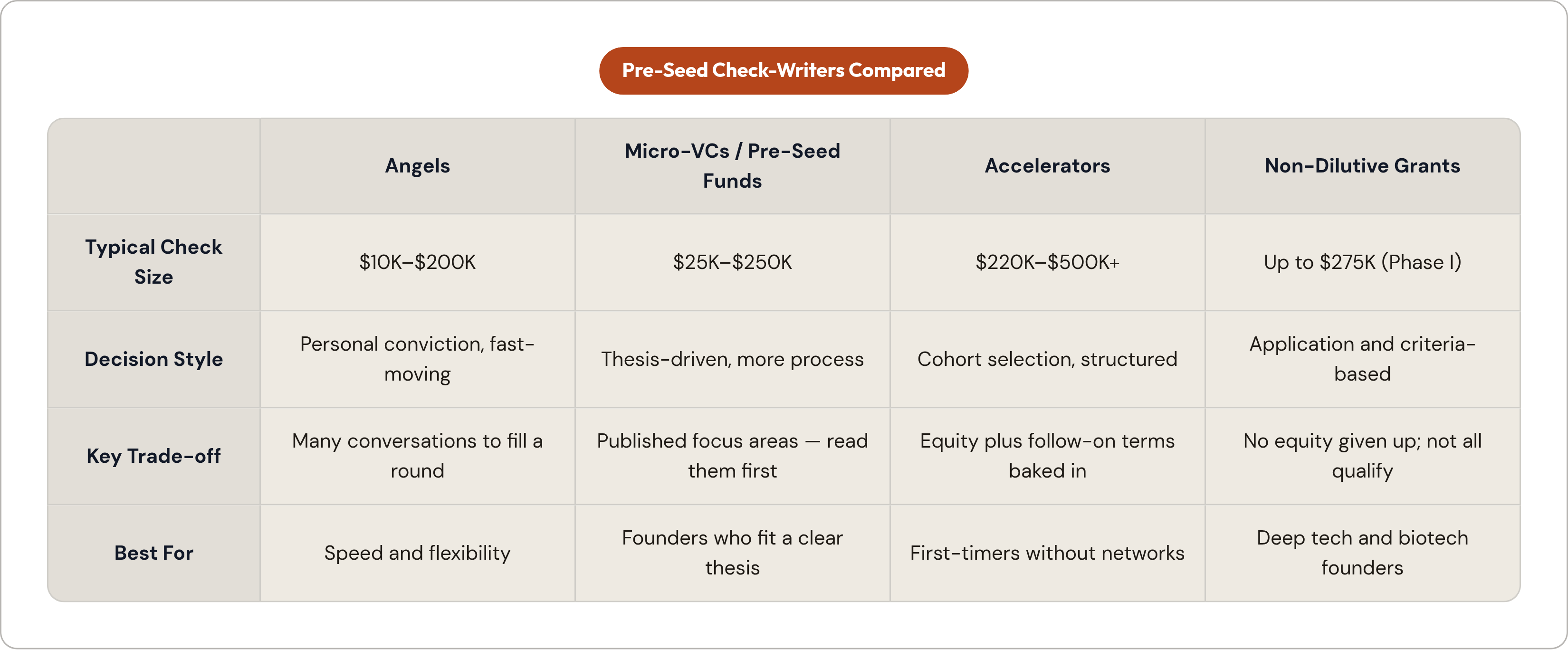
Four types of check-writers show up at this stage. They have different incentives, different processes, and very different expectations. Knowing who you're pitching changes how you pitch.
Angels invest their own money. Checks run $10K to $200K. They move fast and rely heavily on personal conviction and whether they like you. The upside is speed. The downside is that stitching together a full round from angels means talking to a lot of people, which takes longer than it sounds.
Micro-VCs and dedicated pre-seed funds like Hustle Fund, Precursor Ventures, Chapter One, and Soma Capital write $25K to $250K checks. More process-driven than angels, more thesis-driven than later-stage funds. They usually publish their focus areas publicly. Read those before reaching out. Seriously.
Accelerators are a different animal. They're not just writing a check. They're buying you into a cohort model with structured programming, a network, and follow-on deal terms baked in. A few benchmarks from 2025:
- Y Combinator: $500K per company. $125K on a post-money SAFE for 7% equity, plus $375K on an uncapped SAFE with a Most Favored Nation clause.
- Techstars: $220K paired with a three-month mentorship program.
- South Park Commons: $400K for 7% via SAFE, plus $600K guaranteed in the next round.
For first-time founders without existing investor networks, accelerators are also the most reliable warm introduction mechanism available. Worth keeping in mind as you read through the rest of this.
Non-dilutive options don't get enough attention, especially in deep tech and biotech. NSF SBIR/STTR Phase I grants go up to $275K with no equity given up. Phase II awards can reach $1M or more. If you qualify, it's worth pursuing before or alongside a SAFE round. Not every founder fits the criteria, but the ones who do almost always overlook it.
Why Investors Fund Without Revenue — and What They're Actually Betting On
The data investors normally rely on doesn't exist at pre-seed. No revenue, no retention curves, no growth metrics. So they've built a different evaluative framework. The bet is on people first, market insight second, and early execution signals third.
Surveys of pre-seed investors consistently show that roughly half will invest pre-revenue if other signals are strong. Another quarter will invest below $150K ARR. Only a small minority require meaningful revenue before writing a check.
But here's the thing. "Pre-revenue" doesn't mean "no evidence." That distinction matters more than it did a few years ago, and a lot of founders are still operating like it's 2021.
Idea-only pre-seeds still happen, mostly for repeat founders or teams building in categories investors are actively chasing. For first-time founders, the bar has quietly crept up. A prototype, documented early users, or a clear record of customer discovery is increasingly expected rather than optional.
The practical substitute for revenue: three to five customer discovery conversations on record, some form of prototype or MVP, and a credible path to first paying customers within six to nine months. That's the floor, not the ceiling.
Founder-Market Fit Is the First Filter, and Most Founders Misunderstand It
This is the most cited criterion across pre-seed investors. It's worth understanding precisely what they mean by it, because "smart and hardworking" is not the answer. Almost everyone who reaches a pre-seed investor's inbox is smart and hardworking. That's not the bar. That's just the cover charge.
The actual question: does this specific person have a structural advantage in solving this specific problem?
A former Stripe engineer building payments infrastructure. Obvious fit. A management consultant building AI drug discovery tools. A much harder case without compensating evidence. The gap between those two isn't intelligence. It's proximity to the problem.
What earns credibility here:
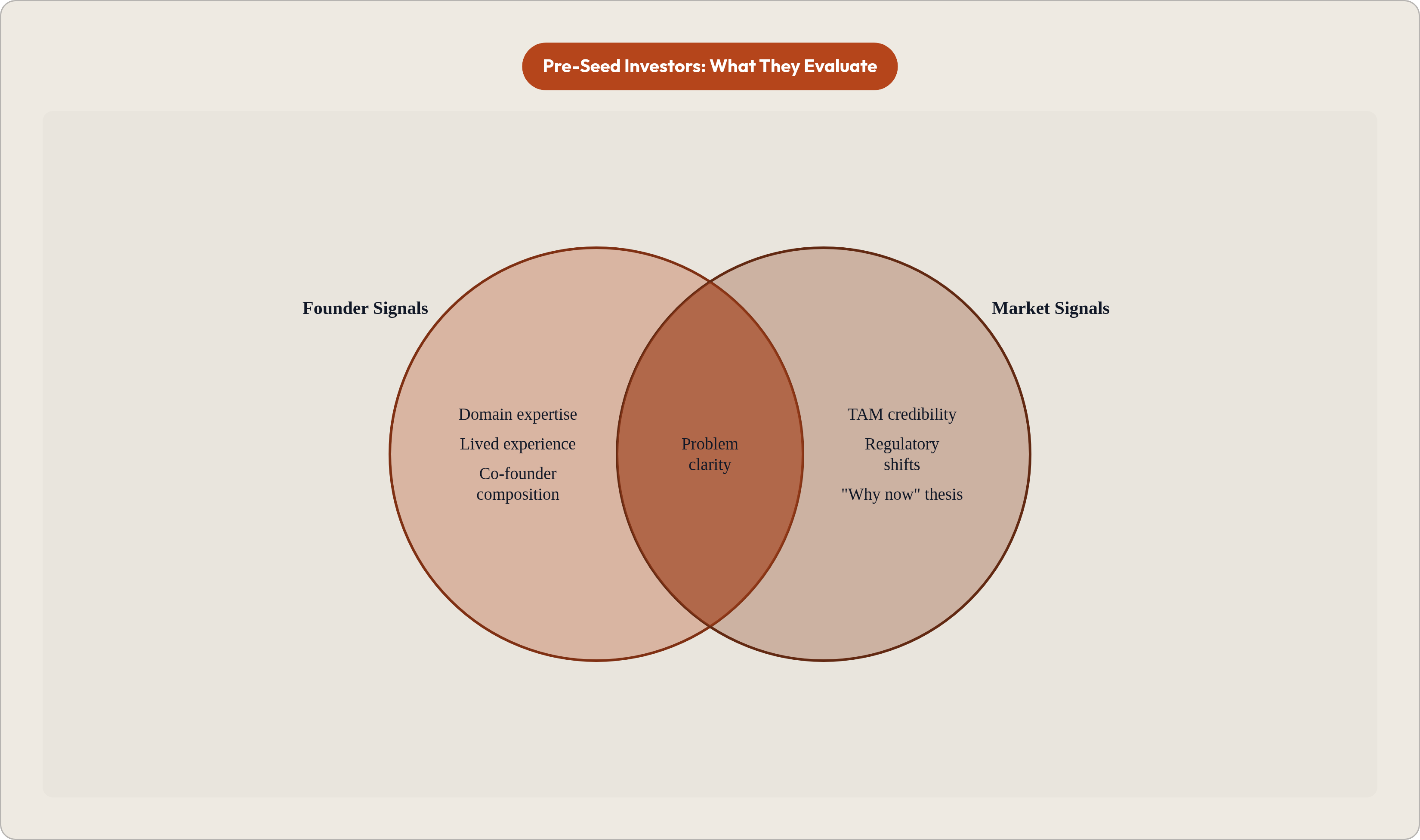
- Domain expertise in the relevant field
- Lived experience with the problem you're solving
- Prior professional proximity to the space
- A track record of building in or adjacent to the category
Co-founder composition is a related signal. Solo founders made up a large share of companies incorporated in 2024 but a much smaller share of companies that actually closed venture rounds. Solo founders can raise. The bar for demonstrated progress and self-sufficiency is just higher, and most investors will ask about it directly.
The reason founder-market fit outweighs your market size slides is pretty simple. Market analysis can be constructed. A deck can make any market look enormous with enough creative math and selective citations. Founder-market fit is harder to fake and is a better predictor of whether the team survives the early pivots. And there will be early pivots. Every single time, without fail.
Problem Clarity Is the Second Pillar, and Most Pitches Skip It
There's a difference between founders who have identified a problem and founders who actually understand it. Investors are filtering for the latter, and the gap shows up fast.
What problem clarity actually looks like in practice:
- You can say who specifically has the problem, how often they hit it, and what their current workaround costs them in time, money, or friction. Not roughly. Specifically.
- You have a thesis about why the problem is solvable now that wasn't true before. A regulatory shift, new infrastructure, a change in user behavior that creates an opening.
- Your customer discovery is real and documented, not inferred from a market research report someone else wrote.
On market size: investors want a TAM that's credibly large, not lazily inflated. "Every business needs X" is a red flag, not a hook. It tells investors you haven't figured out who your actual first customer is yet.
The "why now" question is one of the most common failure points in pre-seed pitches. Founders who can't answer it are like someone who shows up to a weather conversation having only ever read yesterday's forecast — they know what happened, but not what's coming or why. Investors ask it because the answer reveals whether the insight is real or borrowed.
In AI and infrastructure specifically, investors in 2025 are drowning in pitches and filtering hard for differentiated thinking. A general bet on the category gets you nowhere. The founders getting meetings can explain specifically what they understand that the market hasn't priced in yet.
The Milestones That Tell Investors You're Ready, Depending on What You're Building
Pre-seed capital is meant to fund one specific milestone that unlocks the next round. Investors are evaluating two things: whether the milestone is real, and whether the capital ask is actually sized to reach it. Both questions are harder than they look.
Benchmarks by startup type:
- SaaS / B2B: $10K–$25K MRR from initial customers, or 50-plus validated customer discovery interviews showing clear willingness to pay.
- Consumer: First 10 to 50 users with early engagement data that tells a coherent story.
- Engineering-first: A working prototype that demonstrates the core technical insight.
- Talent or platform plays: Founding team assembled, including the right technical co-founder.
- Regulated sectors (fintech, healthtech, hardware): Regulatory or technical clearance as the milestone itself.
On valuation caps: the median pre-seed pre-money valuation as of mid-2025 was around $7–8M. First-time founders with a validated problem typically land $5M–$8M SAFE caps. Serial founders on B2B SaaS tend to see $10M–$15M. AI teams with genuine differentiation can reach $15M–$25M, though "AI" alone stopped being enough to justify a premium a while ago.
Your capital ask should cover 18 to 24 months and land you at a specific, measurable milestone that makes the seed round easier to close. Investors will check whether the math holds. If it doesn't, that's a signal you haven't actually worked through the plan.
What a Pre-Seed Pitch Deck Should Do Differently Than a Later-Stage Deck
Later-stage decks lead with metrics. Pre-seed decks lead with vision, founder-market fit, and early product evidence. The structure is different because the story is different. You're not proving performance. You're making a case for potential.
Length: successful pre-seed decks tend to run 10 to 14 slides. Enough to build a real narrative, not enough to bury the thesis under supporting materials.
Investors spend about four minutes on a pitch deck before deciding whether to take a meeting. That's the whole audition. Design accordingly. Every slide has to earn its place.
The most scrutinized section, consistently, is business model and monetization. Investors linger there longer than anywhere else. The question they're trying to answer: can this actually become a business? At pre-seed, you don't need revenue proof. You need a credible theory of how money flows and who actually pays.
What the deck has to make explicit:
- The raise amount and how the capital will be allocated
- 18 to 24 months of runway modeled from that capital
- Specific, measurable milestones that show progress toward product-market fit
- What changes between now and the seed raise, and why the next round becomes achievable
One thing founders consistently underestimate: the founder-market fit argument needs to live in the deck itself, not just in your verbal pitch. Investors who don't take a meeting never hear you talk. If the case for why you are the right person to solve this problem isn't on the slides, it doesn't exist for the majority of investors who see your deck.
How to Raise Pre-Seed as a First-Time Founder When You Don't Know Anyone
Warm introductions still dominate. Most pre-seed investors don't respond meaningfully to cold outreach because they're genuinely overwhelmed and use signal filtering to manage the volume. The real work is building the right surface area before the raise starts, so that when you reach out, there's a connection or a credible referral behind the ask.
The most reliable path for first-time founders without existing networks: accelerators. Y Combinator, Techstars, South Park Commons. Getting into a top accelerator functionally solves the network problem. Alumni networks, angel syndicates, and founder communities are the next tier down.
Geography still matters, despite the remote-friendly narrative. The Bay Area, New York, Boston, and Los Angeles are where capital concentrates. Founders outside those markets should plan for more outreach and longer timelines, or focus on micro-VCs and regional angels who actively invest locally. Both strategies work. Neither is fast.
Expect the process to take three to six months as a first-time founder. Treat it like a sales pipeline with stages: first meetings, follow-ups, partner meetings, term sheets. Not a single pitch event you either win or lose.
What to have ready before the first meeting:
- A 10 to 14 slide deck
- A clear, specific answer to the founder-market fit question
- Documented customer discovery with real names and real conversations
- A specific raise amount tied to a specific 18-month milestone
The funding environment right now rewards preparation over volume. Fewer rounds are closing than a few years ago, and the ones that do close are going to founders who walk in knowing exactly what they're asking for and exactly what it buys. That's where the bar sits today.