Managing Board Meetings as a Startup CEO
How to structure board meetings so you stay in control.

Before you ever open your mouth in a board meeting, the room already has an opinion about who's in charge. That opinion was formed the day you signed your term sheet. Think of it like a chess match where the opening moves were made before you even sat down at the board. Early-stage boards start small and collaborative — at seed, founder voices carry naturally. By Series A, you're typically looking at a five-person structure: two founders, two investors, one independent director. Balanced, in theory.
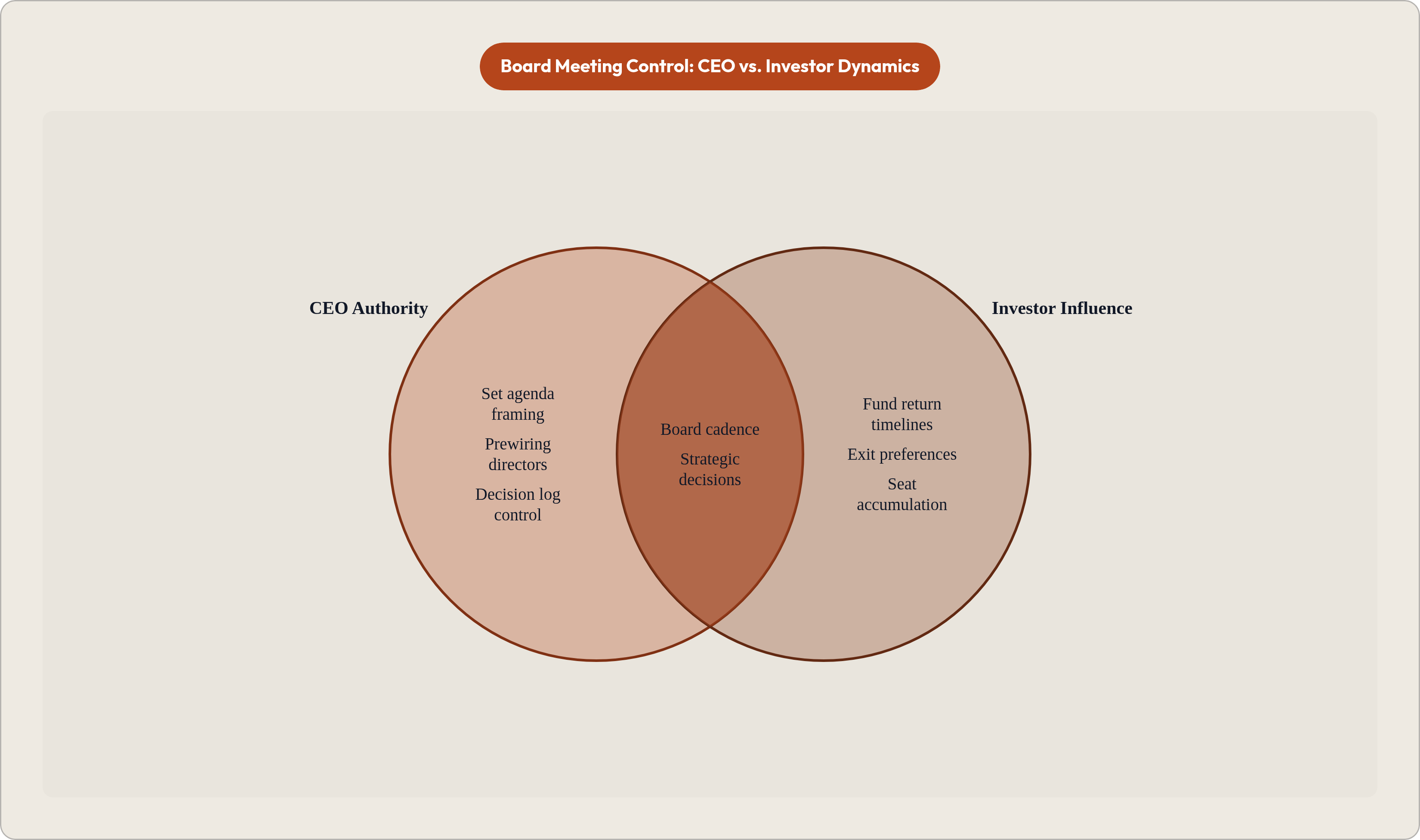
By Series B and beyond, investor seats accumulate and founder concentration thins. This shift is not imaginary. Boards dominated by investors push toward faster exits, lower valuations, and decisions optimized for fund return timelines. That is incentive structure, not malice. Conflating them will make you paranoid when you should be strategic.
The independent director is your counterweight. Research by Venugopal and Yerramilli (2024) found that startups appointing an outside director early raised larger follow-on rounds and were more likely to reach an IPO. A well-chosen independent — someone with operating experience, a long time horizon, and no fund to answer to — can rebalance a room that is tilting toward investor-preferred outcomes. Most CEOs leave that seat empty. Don't be most CEOs. And one warning worth saying plainly: ceding board seats or voting control early is almost impossible to reverse. Whatever you give up in a term sheet negotiation, you give up for every meeting that follows. Read that twice before you sign anything.
Set Cadence to Match Your Stage
Investors are creatures of habit. Left to their own devices, many will tell you to meet monthly, forever, because that is what they did at their last portfolio company. This is worth pushing back on, politely and firmly.
Cadence should match where you actually are:
- Seed stage: Monthly or bi-monthly works. Runway is short, the model is still shifting, and the board needs fresh signal.
- Series A: Start moving toward quarterly, usually around nine to twelve months after close, as your operating rhythms stabilize.
- Series B and beyond: Quarterly is the norm. Special sessions for acquisitions, major personnel moves, or a genuine strategic inflection point.
Crisis is its own mode. When runway gets scary, you shift. Bi-weekly CEO updates, a live cash dashboard, a pre-agreed set of trigger options for headcount or pricing decisions. The goal is to give directors enough signal to advise without accidentally turning emergency check-ins into a permanent standing meeting that someone else now controls. That last part happens more than you'd think.
One practical thing: lock your board dates at least six months out. Board members' calendars fill fast. If you are scheduling meetings last-minute, you are already signaling that you are in reaction mode rather than running the show. It looks small. It is not.
Design the Agenda as Decision Architecture
The most common board agenda failure is spending most of the live session reviewing numbers that could have been read in advance. You end up with forty-five minutes of reporting and fifteen minutes of actual decision-making. That is backwards, and it happens constantly.
The fix: push operational updates into the pre-read, and use live time almost entirely for strategic discussion and real decisions.
A clean four-block agenda looks like this:
- Opening and administrative items (10 minutes or less)
- CEO and financial update that assumes directors have already read the pack (15 minutes)
- Strategic discussion block focused on one or two real decisions (60 minutes)
- Closing block for action items and the executive session (15 minutes)
Ninety minutes is about the ceiling for most early-stage boards. Decision quality drops with fatigue, and a tight meeting signals that you came prepared. Both of those things matter.
Frame agenda items as decisions, not topics. "Pricing strategy decision" tells the room what it is there to do. "Pricing discussion" invites everyone to talk indefinitely without committing to anything. The word choice is not cosmetic.
Two more tools worth using:
- Talk-time blocks with role tags. Assign explicit time to each section. This prevents a single investor from turning the meeting into a 45-minute anecdote session. (It will happen if you let it.)
- The consent agenda. Bundle routine approvals. minutes, option grants, standard resolutions. into one pre-approved package. Routine items should never consume live discussion time.
What Goes in the Board Pack
Think of the board pack as a pre-meeting argument — the kind where you want to win before anyone has even opened their mouth. By the time directors walk into the room, they should already understand the context, the decisions on the table, and roughly where you stand. The meeting is where they act on the situation, having learned the context in advance.
A complete pack includes:
- Metrics dashboard
- Summary financials compared against plan
- Brief functional updates from key areas
- Prior meeting minutes
- Proposed option grants
- Current cap table
- Decision framing for each agenda item
Keep it short enough that a busy person actually reads it. Comprehension is the goal, not comprehensiveness.
On format: it does not have to be slides. Amazon-style written memos work well for many teams, and companies like Qualtrics and Thumbtack used them effectively. The right format is whichever one your team can produce clearly and consistently. Pick one and get good at it.
Now, the part most CEOs underestimate. Send it at least a week before the meeting.
This is a trust signal, beyond courtesy. When materials land in directors' inboxes a week out, they can read, digest, and show up ready to decide. When materials arrive the night before. or worse, the morning of, which actually happens. you have made a high-quality discussion structurally impossible. And everyone in the room knows whose fault that is.
Consistently late packs rarely produce a direct complaint from directors. Instead, you get something worse: disengagement. People start showing up less prepared, less invested, and less useful. It compounds quietly, and by the time you notice it, trust has already eroded.
Expect to spend real time. spread across several weeks. on pack preparation. That investment is what makes the actual meeting short and decisive. The meeting is the easy part if the pack is done right.
Prewire Before the Real Meeting
If a director encounters a major problem, a strategic pivot, or a troubling number for the first time during the live session, you have already lost control of that meeting. Full stop. The session shifts from decision-making to interrogation, and you spend the time in defensive mode instead of moving anything forward.
Here is the underlying logic. A director with no prior context defaults to skepticism. A director who was briefed in advance defaults to closure. Same director, same information, completely different dynamic depending on when they got it.
This is the logic of prewiring. In the days after the pack goes out, have individual calls with key directors. To surface concerns before they become live dynamics in front of the full room, not to lobby them.
Things you should never reveal for the first time in the meeting:
- A major strategic pivot
- Bad news on a key metric
- A personnel change
- Any decision where a director's reaction is genuinely uncertain
All of these should be socialized in advance. As context, not as spin. There is a real difference.
The CEO's role in prewiring is to listen and adjust, not to pre-sell. Directors who feel managed rather than consulted will disengage over time. Directors who feel heard will show up as allies. You will notice the difference pretty quickly once you start paying attention to it.
How CEOs Maintain Live Room Authority
You open the meeting. You state what the meeting is designed to decide. You set the agenda, not as a formality, but as an act of ownership. That framing matters from the first sentence.
A few things that matter more than most CEOs realize:
Do not read your slides aloud. Reading from a deck signals that you have no independent command of the material. The pack was sent in advance so that you can speak to decisions, not narrate information directors already read on the plane.
Present problems with owned solutions. Walking in with an unresolved problem and asking the board to diagnose it reads as a leadership failure, not a collaboration request. The right posture: here is the problem, here are the options I evaluated, here is my recommendation, now I want your input on the call. Inviting input on a framed decision is strength. Outsourcing the diagnosis undermines it.
Use a decision log. Track in real time what was raised versus what was resolved. It gives you a live tool for closing the meeting purposefully instead of letting it drift into a loose conversation that ends because people have flights to catch. That is a real risk.
Bring in your CFO and rotate functional leaders. The CFO attends every meeting. Beyond that, invite a rotating functional leader to present their area. It exposes directors to your broader team and prevents you from becoming the board's only window into operations. That single point of contact creates fragility you do not want.
Close cleanly. Restate every decision made. Confirm owners and timelines. Send a clean action item summary within a day. The CEO who follows through within hours trains the board to expect accountability, and that habit compounds in your favor over time.
The Executive Session and Its Value
The executive session is the block at the end of the meeting where directors speak without management in the room. No CEO, no CFO, no observers.
Schedule it at every meeting. Even routine ones. Especially routine ones.
Here is why. If you only convene an executive session when something is wrong, the mere act of calling one becomes a signal. Directors start reading into it. Anxiety fills the gap where information should be. By running it routinely, you remove all of that noise. When a genuinely difficult conversation is eventually needed. CEO performance, compensation, succession. the structure already exists and its use carries no weight.
A CEO who resists executive sessions signals insecurity. A CEO who builds them into the standing agenda signals confidence. Boards notice the difference.
After the session, the board chair or lead independent director should brief you on any themes or action items. You do not need the verbatim transcript. You do need to know what requires follow-up, and you should ask directly if the debrief is vague.
What Belongs in the Minutes
Minutes are not a transcript. They capture decisions made, actions assigned, and resolutions adopted. That is the whole job.
This matters more than it sounds. Detailed discussion notes that name recruiting targets, potential acquirers, or sensitive personnel situations will surface in due diligence someday. They can create legal or competitive exposure you never intended to create, documented in your own governance record. Lawyers love finding that stuff. You will not.
Best practice: a clean, high-level summary with formal resolutions attached. Distribute for director review within a day or two. Approve the prior meeting's minutes through the consent agenda so the administrative record stays current without burning live discussion time.
Keep them tight. Keep them clean. Future-you, sitting across from an acquirer's legal team, will be grateful you did.
Patterns That Erode CEO Authority
None of these happen in a single meeting. They accumulate. And by the time a CEO notices the pattern, the board has already adjusted its view of who is running things.
Treating the meeting as a performance. Polished decks, carefully managed narratives, minimized bad news. Investors who sit on many boards have seen most operational patterns before. A sanitized version of reality often reads as exactly that, and you lose credibility rather than gaining it.
Letting operational updates crowd out strategy. When most of the live session is spent reviewing metrics that were in the pre-read, you have ceded control of the agenda's purpose. The board does not exist to hear you narrate what you already sent them.
Announcing surprises in the room. We covered this. Do not do it.
Sending materials late. You make a high-quality discussion impossible, and the board knows whose fault that is.
Posing open problems without solutions. The board can sharpen a decision. It should not be handed a diagnosis and asked to generate options from scratch. That is your job, and showing up without having done it signals something.
Letting the meeting drift with no decision log and no clean close. If the meeting ends because time ran out rather than because you closed it, the room ran the meeting. Not you.
Authority in a board meeting is not granted by the org chart. It is demonstrated through preparation, structure, and follow-through, repeatedly, over time. The good news is that every single one of these patterns is within your control to fix.