Startup Valuation Methods at the Seed Stage
Five frameworks founders use to defend seed-stage valuations.

If you're raising a seed round, one of the first questions you'll face is: what is your company actually worth? You have no revenue to point to, no comparable public company trading at a clean multiple, and no formula that spits out a number everyone agrees on. Yet investors expect a defensible answer, and the number you land on has real consequences for how much of your company you give away and what your cap table looks like for years to come.
The good news is that there are established frameworks practitioners use to think through seed-stage valuation. None of them are perfect, and all of them are approximations. Understanding how they work, when to use them, and how to layer them together puts you in a fundamentally stronger position. Founders who walk in with a number they picked because it felt right rarely fare as well.
This post walks through the main methods in use today: Berkus, Scorecard, the VC Method, Risk Factor Summation, and Cost-to-Duplicate. It also covers how round structure affects what valuation means in practice and what qualitative signals actually move the needle in investor conversations. Before any of that, you need a grounded picture of the market you're operating in.
Every relative valuation method anchors to a regional or sector median. If you skip this step you're doing math on a made-up baseline. Here's the current snapshot:
Seed median post-money valuations hit a new all-time high in Q4 2025, per Carta—more than double the level seen in 2019, per PitchBook. That's a structurally different market than most of the valuation literature was written for.
Pre-seed median pre-money valuations have moved in a tighter band and edged slightly downward quarter-over-quarter, per the PitchBook-NVCA Venture Monitor. Pre-seed is a different conversation than seed, and founders conflate the two more often than you'd expect.
Sector premiums are real and large. AI and SaaS companies command meaningfully higher medians than the broader market, per Carta's Q3 2025 data.
Geography compounds the effect. Bay Area and New York startups capture a disproportionate share of top-decile seed valuations. US seed deals run significantly higher than comparable European or Southeast Asian rounds, per both Carta's's and Dealroom's 2025 data.
Round structure is splitting at the seed stage. Priced rounds dominate larger deals. SAFEs (Simple Agreements for Future Equity) dominate smaller ones. Each instrument has different valuation implications, covered at the end.
One caveat: those median figures describe a competitive slice of the market. If you're raising a smaller round or operating outside a top-tier hub, calibrate your expectations to your actual tier rather than the headline number.
The Berkus Method: A Structured Starting Point for the Earliest Pre-Revenue Deals
Dave Berkus built this method in the 1990s because traditional valuation tools fell apart for companies with no financial history. His fix was to stop projecting cash flows and instead assign value to the presence or absence of five risk-reducing factors:
Sound idea. The value of the concept itself
Prototype. Reduces technology risk.
Strong management team. Lowers execution risk
Strategic relationships. Minimizes market and go-to-market risk
Early sales or rollout. Reduces production and demand risk
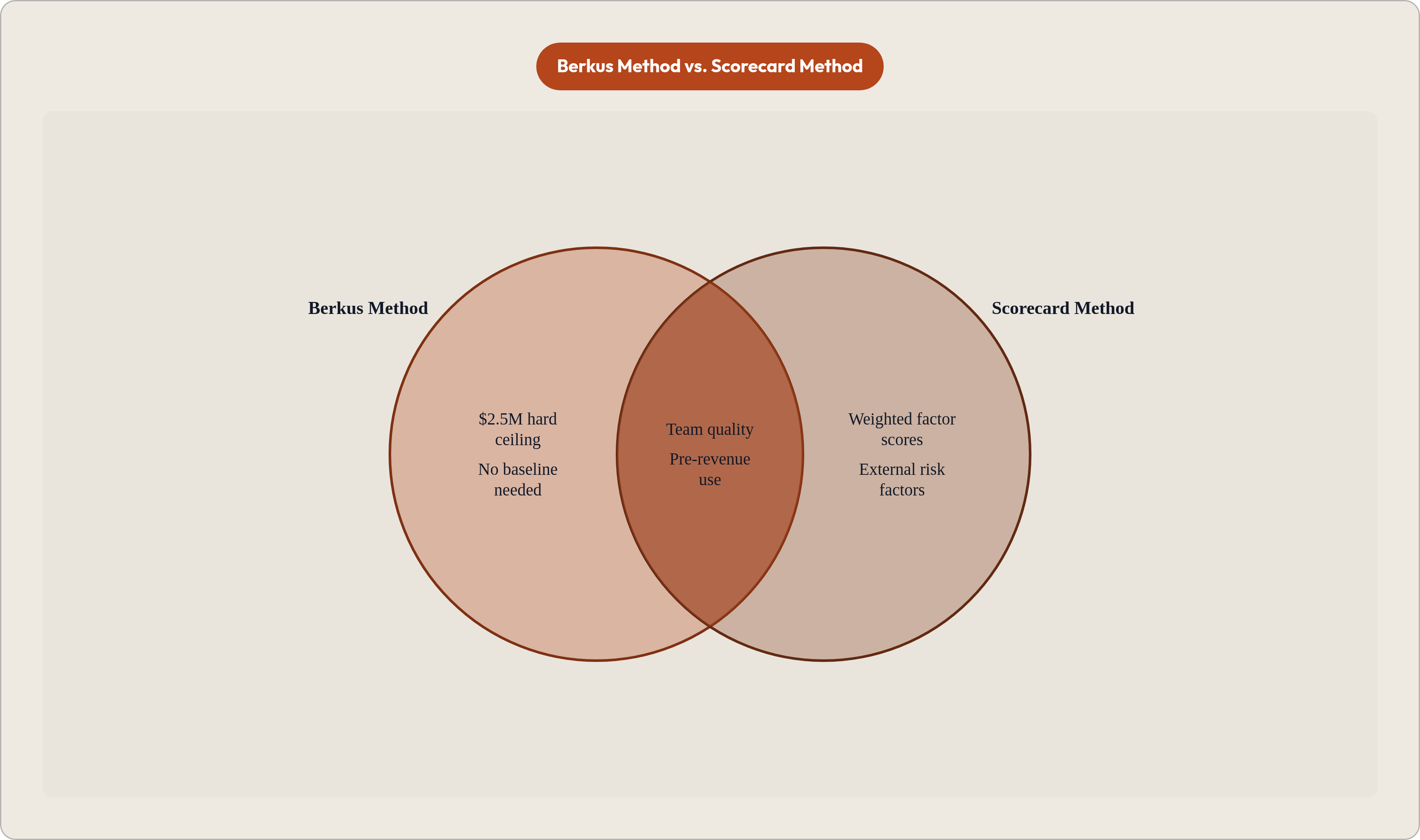
Each factor can contribute up to $500,000, for a maximum pre-revenue valuation of $2.5 million. That ceiling is the honest limitation. In a market where seed medians have more than doubled since 2019, $2.5 million is a starting point, not a finish line.
The Berkus Method still earns its keep in three ways: as a first-pass sanity check on early angel checks, as a structure for identifying which risks have and haven't been de-risked, and as a foundation to pair with the Scorecard Method or market comparables when you need a number defensible in 2025. The real value of the method isn't the dollar figure. It's the discipline of asking, for each factor, whether you've actually reduced the risk or are just hoping you have.
The Scorecard Method: Calibrating Quality Against Market Norms
Developed by angel investor Bill Payne, the Scorecard Method has become standard for angel groups and seed-stage investors. The mechanic: start with the median pre-money valuation for recently funded companies in your region and sector, then adjust up or down based on weighted factor scores.
The weighted factors, roughly in order of importance:
Team quality. Carries the heaviest weight. Execution risk dominates this stage, and experienced investors know better than to pretend otherwise.
Market size. Second largest. The ceiling has to be big enough to matter.
Product strength. Moderate weight.
Competitive environment. Moderate weight.
Sales channels and other factors. Lower weight.
Each factor gets rated as a percentage relative to comparable deals—above 100% means above average, below 100% means below. Multiply each score by its weight, sum the adjustments, and apply the result to the baseline median. A startup with an exceptional team but a thin product and a crowded market will still land close to or below median. The method forces a holistic view. You can't claim a world-class team and expect the number to float on that alone.
The Scorecard makes the market data from the previous section directly actionable: look up your region's and sector's current median, run the scorecard, and walk into a negotiation with a number you can explain. The limitation is that the output is only as reliable as the baseline—in sectors or geographies with thin deal flow, finding a meaningful median is harder.
The VC Method: Working Backward From an Exit to Arrive at Today's Price
The VC Method works backward from a future exit to determine what an investor should pay for your company today. It asks: what must this company be worth at exit for us to hit our fund's return target, and what does that imply about what we should pay today?
The formula: Post-Money Valuation = Terminal Value ÷ Anticipated Return Multiple
Return targets vary significantly by stage. Seed investors target much higher multiples than growth-stage investors because they're absorbing a higher failure rate over a longer time horizon. This is why the same company can look expensive to a seed fund and perfectly reasonable to a later-stage fund—same company, different math, neither side wrong.
Ownership thresholds change the whole dynamic. Many lead VCs have minimum ownership requirements set in their LP documents. In practice, they back-solve from the amount being raised and the ownership percentage they need before arriving at a post-money valuation. If you're raising a specific amount and they need a specific ownership percentage, the implied post-money valuation falls out of that math, not from an independent assessment of intrinsic worth. Your qualitative merit enters the conversation through whether they want to invest at all.
For founders, this is useful. If you understand what return multiple and ownership percentage a given investor needs, you can model whether their implied valuation is reasonable before the negotiation starts. As Jason Mendelson of Foundry Group has noted, running precise spreadsheets on seed valuations misses the point—there's simply not enough data. The VC Method is a framework for understanding investor logic, not a precise model.
Risk Factor Summation and Cost-to-Duplicate: Two More Tools With Specific Use Cases
Risk Factor Summation
Risk Factor Summation was developed at Ohio TechAngels. Like the Scorecard Method, it starts from a regional pre-money median and adjusts across roughly a dozen risk dimensions. What differentiates it from the Scorecard Method is that RFS explicitly breaks out external risk factors, like regulatory environment, legislative risk, and market timing, that Scorecard folds into broader categories without isolating.
It's best suited to deals where risk is unevenly distributed. A company with strong tech and a great team operating in a heavily regulated sector, for example, can score that regulatory exposure as its own line item rather than burying it in "competitive environment." Like Scorecard, its quality depends entirely on having a reliable regional and sector baseline.
Cost-to-Duplicate
The Cost-to-Duplicate method answers one question: what would it cost to replicate this company's technology or product from scratch? Think of it as a floor, not a ceiling. It captures tangible asset value but ignores team quality, market opportunity, and competitive position. That means it misses most of what actually matters at seed.
Where it earns its keep: hardware, deep tech, and biotech, where significant capital has been deployed before any revenue exists. It's far less useful for software or marketplace startups, where the cost to duplicate the product dramatically understates competitive value.
What About Discounted Cash Flow?
Discounted Cash Flow analysis is not applicable at seed. It only becomes meaningful at Series B and beyond, when cash flows are predictable enough to model. If an investor runs a DCF on your pre-revenue seed round, ask pointed questions about why.
How the Methods Fit Together and When to Use Which One
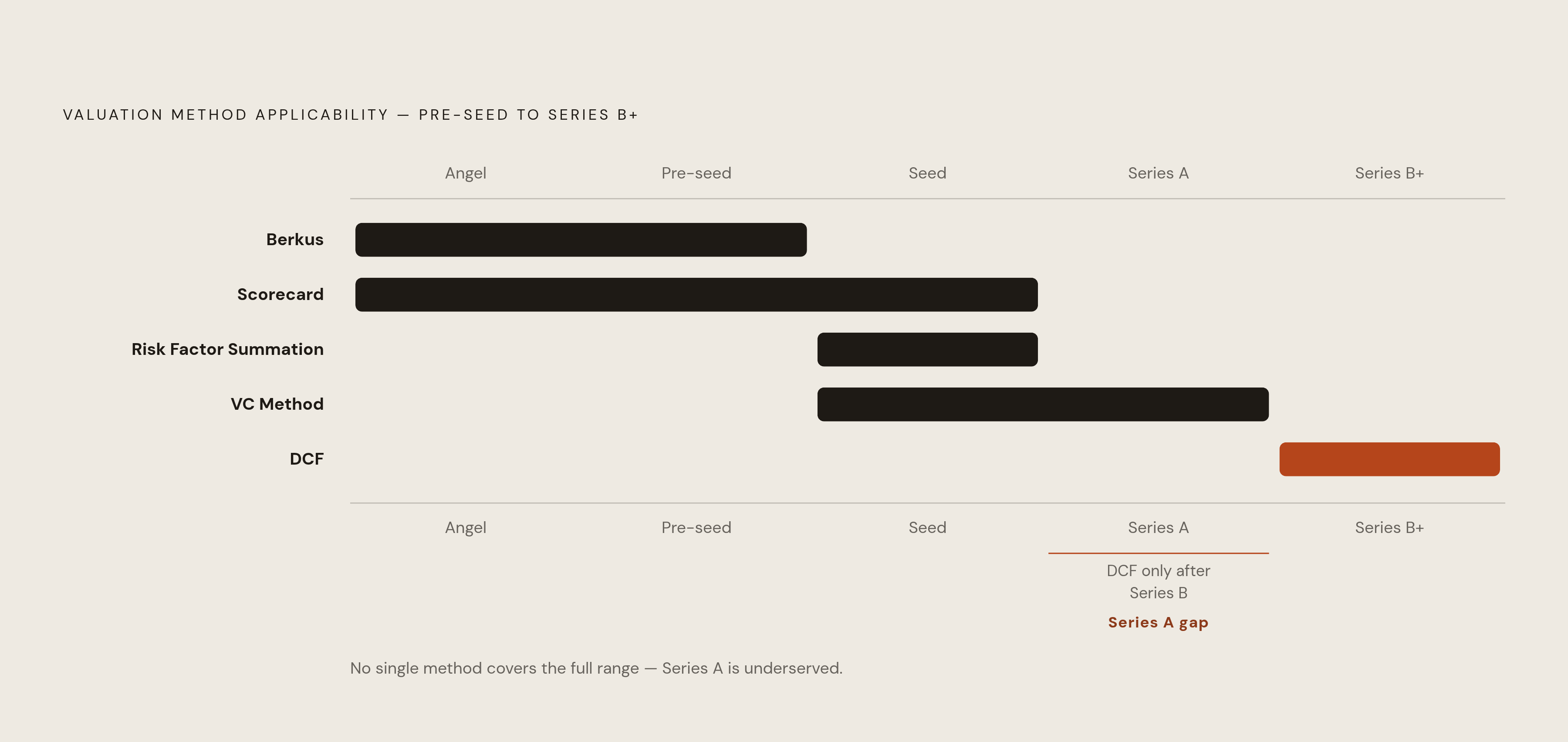
No single method is complete. Each compensates for blind spots the others have:
Berkus captures milestone-based risk reduction but has a hard ceiling most 2025 seed deals exceed.
Scorecard and Risk Factor Summation both anchor to market medians but cut the adjustment differently. Scorecard weights internal factors while Risk Factor Summation separates external ones.
VC Method captures investor return logic but can produce a valuation that reflects fund mechanics more than company quality.
Comparables provide a market sanity check but are only as useful as the recency and quality of the deal data you can access.
Here is how to layer the methods by stage:
Pre-revenue angel rounds: Berkus as a starting structure, Scorecard to adjust toward market norms, comparables as a cross-check.
Seed rounds with some traction: VC Method to understand investor return logic, Scorecard or Risk Factor Summation to validate the qualitative picture, comparables to anchor to the current market.
Series B and beyond: DCF becomes primary, with comparables as a sanity check.
Running two or three methods and seeing where they converge gives you a defensible negotiating range and signals to the investor that you understand the logic behind your number. When the methods diverge sharply—say the VC Method implies a much lower valuation than your Scorecard output—that gap is worth resolving before you negotiate.
What Actually Moves a Seed Valuation: The Qualitative Signals Investors Weight Most
The frameworks are containers. These signals are what fills them:
Team quality. At seed, investors are largely betting on people. The plan will change; the team is what executes through the change.
Market size. Investors need to believe the ceiling is large enough to produce the return multiple the VC Method requires. A technically impressive product in a small market is structurally unattractive at seed—the math simply doesn't work for a fund targeting large multiples in a small pond.
Traction signals, even modest ones. These disproportionately move valuation because they reduce the most fundamental risk: that anyone actually wants the thing. A waitlist, a pilot customer, a letter of intent, or early retention data all count. In the Berkus framework, "early sales or rollout" is its own factor precisely because evidence of demand is qualitatively distinct from everything else. It shifts the conversation from belief to evidence.
Competitive positioning. A crowded market without a clear differentiated wedge weighs negatively across multiple methods. The question investors are quietly asking: why can't someone with more resources just do this tomorrow?
The narrative premium. This doesn't appear in any formula, but it's real. Investors at seed are buying into a story about where the market is going. A founder who can articulate why now, why us, and why this market is larger than it appears can move a valuation in ways no framework captures directly. The methods get you in the room, but narrative determines what happens once you're there.
SAFEs and Convertible Notes: How the Instrument Shapes What Valuation Even Means
A large share of pre-seed deals and a substantial portion of seed deals use SAFEs rather than priced equity, per Carta 2025. That means many founders are negotiating a valuation cap, not an actual valuation. Conflating the two causes real downstream problems.
How SAFEs Work
A SAFE is a short investment contract—not debt, no interest, no maturity date—that converts to equity at a future priced round. The investor's ownership isn't fixed at signing; it's determined by the cap and/or discount applied at conversion. YC's cap-only SAFE has become the clear market default, per Carta 2025.
Valuation cap mechanics: The cap is a ceiling on the conversion price. If the next round prices above the cap, the SAFE investor converts at the cap price, receiving more shares than new investors for the same dollar amount. That's the early-investor benefit baked into the structure.
Discount mechanics: If a SAFE carries a discount, the investor converts at a set percentage below the new round's price per share. Different mechanism, same basic logic: reward for coming in early and taking early risk.
The Stacked SAFE Problem
Multiple SAFEs with different caps and discounts can produce larger-than-expected dilution at conversion. Raise a pre-seed, then a seed bridge, then another small check at a different cap. When a priced round finally arrives, the dilution math is messier than any individual SAFE suggested. Model the stack before you sign the next one. It feels like a minor administrative detail until it suddenly isn't.
What This Means for Valuation Conversations
When you're raising on a SAFE, you're agreeing on a cap that will shape future dilution, not agreeing on a valuation. That changes what you're actually negotiating. The cap you set today has downstream consequences that compound in ways that aren't obvious when you're focused on closing the check. The valuation method you choose only matters if you understand what kind of number you're actually setting.


