Predictive Analytics for Venture Portfolio Management
Data and machine learning help VCs cut through thousands of deals.

- Written by
- Elise Beck
- Updated
- September 10, 2026
- Reading time
- 10 min read
- Sources cited
- 5 sources ↓
What this covers
- What "predictive analytics" actually means in a VC context, and what it does not
- How predictive models are applied at the deal sourcing and screening stage
- Where predictive analytics shortens and sharpens due diligence
- Monitoring portfolio companies after investment: moving from quarterly check-ins to continuous signal tracking
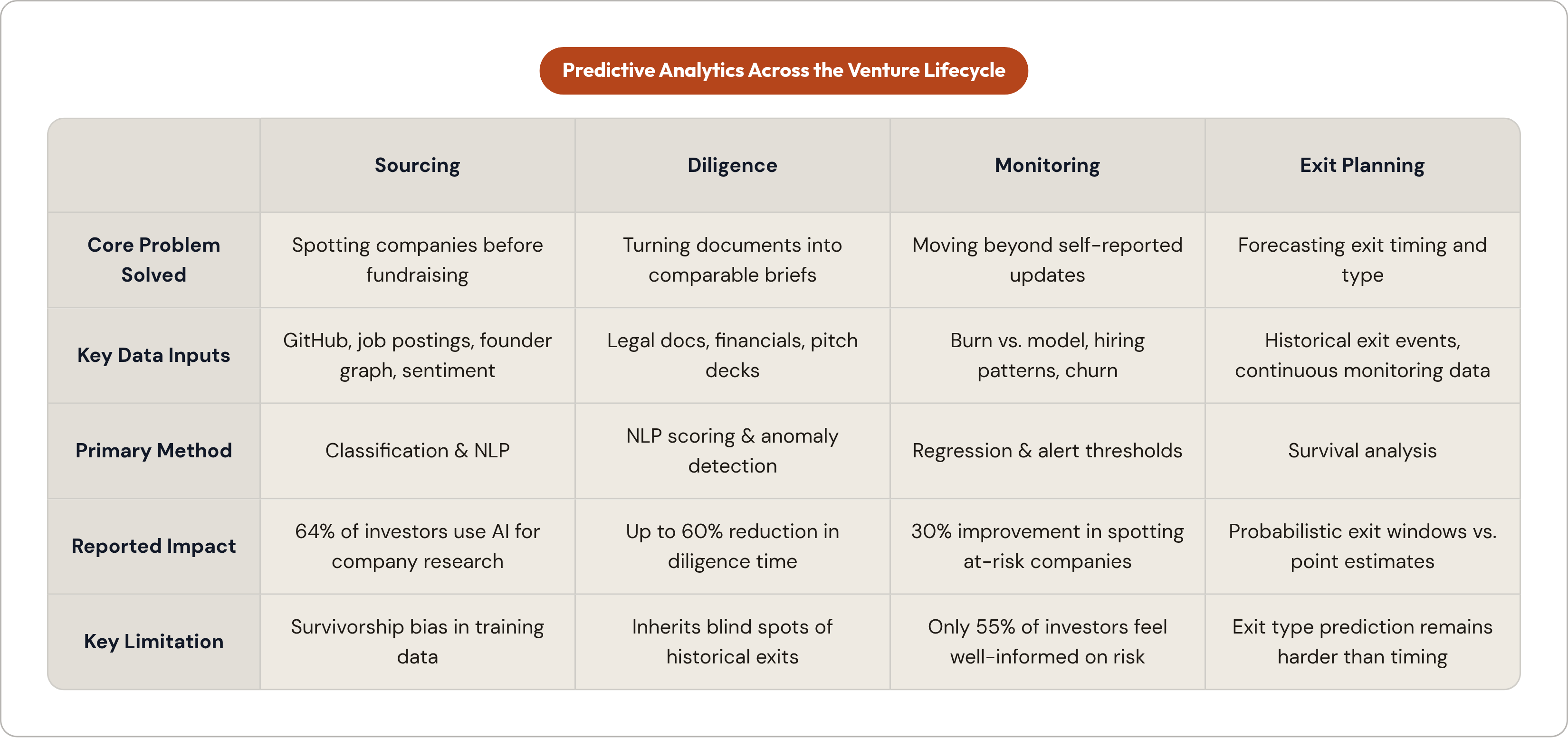
Venture firms put roughly $425 billion into more than 24,000 companies in a single year, per Crunchbase's 2025 annual report. Nobody can track that many positions with gut feel and a spreadsheet. This piece walks through where predictive analytics actually fits in the venture lifecycle: sourcing, diligence, monitoring, and exit, plus what the accuracy numbers really mean when you dig into them.
What "predictive analytics" actually means in a VC context, and what it does not
Predictive analytics is the use of historical data, statistics, and machine learning to estimate the odds of a future outcome. That's different from descriptive analytics, which just tells you what already happened, and different from prescriptive analytics, which tells you what to do about it. In venture, a few methods do most of the work.
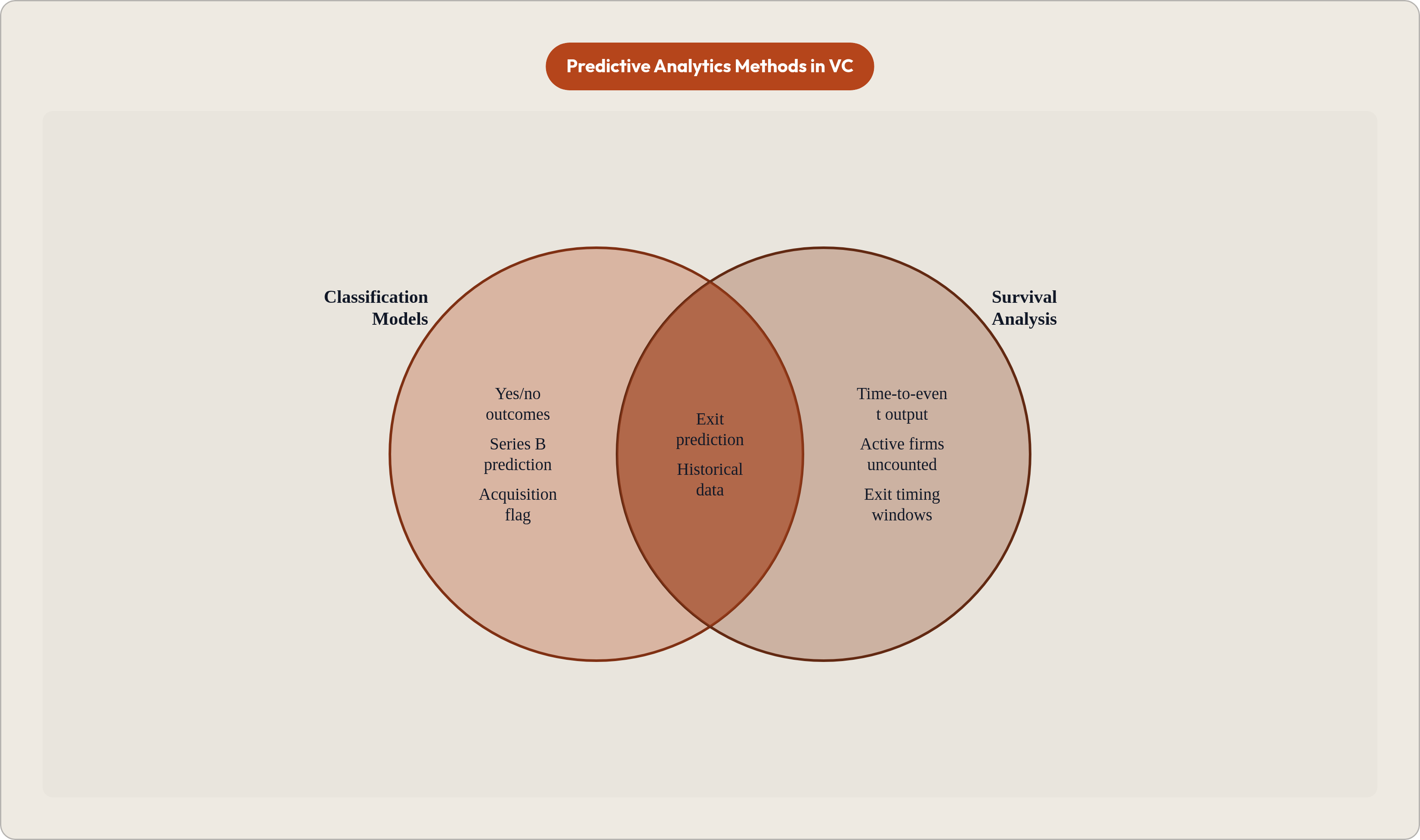
Classification models answer yes-or-no questions: will this company reach Series B, will it get acquired. Regression models estimate a number on a sliding scale, like revenue growth or months until the next raise. Survival analysis, borrowed straight from medical research, estimates not just whether something happens but when, given that it hasn't happened yet. Natural language processing pulls structured signal out of messy text: pitch decks, contracts, news articles, job listings. And ensemble methods like Random Forest, Gradient Boosting, and XGBoost stack several weaker models together to get a steadier answer than any one of them alone.
Here's what none of this is: a magic scoring system, a substitute for a partner who's seen fifty term sheets go sideways, or a model that works the same in Jakarta as it does in San Francisco without being retrained. And there's a base-rate trap baked into the whole exercise. The vast majority of startups fail. That means a model that just predicts "this one fails" every single time would look pretty accurate on paper while being completely worthless. The real test is picking out the small fraction that make it, and that's a much harder problem than the headline accuracy number suggests.
It also matters where that accuracy number comes from. A model reporting 82% accuracy on a small, retrospective dataset that's already been labeled with hindsight is not the same claim as a model tested prospectively against live deal flow it's never seen. Both kinds of studies exist in the literature, and mixing them up is how firms end up trusting numbers they shouldn't. The tooling market itself is still shifting fast underneath all this: predictive analytics broadly was valued at $18.9 billion in 2024, with forecasts ranging anywhere from $82.3 billion by 2030 to $116.65 billion by 2034 depending on which research firm you ask. That's a wide enough range to tell you the category is still finding its shape.
How predictive models are applied at the deal sourcing and screening stage
Most deals a firm never even sees. The question predictive tools try to answer is whether you can spot a company before it starts knocking on doors for a raise.
Models at this stage feed on a mix of signals. Founder background (prior exits, domain expertise, who they've worked with before) sits alongside company momentum proxies like GitHub commit activity, app store rank changes, engineering hiring by function, and job posting velocity. Add in market sentiment pulled from news and social chatter (tools like CB Insights run sentiment analysis for exactly this), plus relationship graph data from CRM platforms like Affinity, which map the connections between founders and the broader investor and operator network.
EQT Ventures built a tool called Motherbrain designed to flag companies before they begin fundraising, giving the firm an earlier look than a typical inbound deal flow process would allow. That's the whole point: catching a company while it's still quietly building traction, not after it's announced a round and every other fund is calling the same founder. SignalFire runs a proprietary data platform that continuously watches a large range of sources including GitHub, app stores, and job boards to surface early signals on companies and talent. CEO Chris Farmer calls it "a mini-Google for venture."
Founder quality turns out to carry more predictive weight than most firms give it credit for. Research into startup success factors consistently finds that founder quality carries substantial predictive weight, suggesting many firms undervalue a signal that's sitting right in front of them. The catch: models trained on already-funded companies never see the ones that got passed over, so the training data has a built-in survivorship bias. What "looks like success" in the data is really just what past investors happened to fund. Adoption is already ahead of the curve here. 64% of investors say they now use AI to speed up company research, according to Affinity's 2026 Predictions Report, and that number is notably higher than adoption at the monitoring stage.
Where predictive analytics shortens and sharpens due diligence
Diligence isn't really an access problem anymore. Firms already get the pitch deck, the cap table, the legal docs, the reference calls. The bottleneck is turning all of that into something a partner can actually read and compare across deals in a consistent way.
NLP tools scan legal documents for weird clauses, gaps in IP ownership, or regulatory red flags. They parse financial statements to pull out KPIs and flag revenue recognition patterns that don't match sector norms. They score pitch decks against a firm's own criteria before a human even opens the file. Practitioners commonly cite time savings of up to 60% on diligence work, with some document review timelines dropping from weeks down to hours.
What gets scored: product-market fit signals, revenue quality, whether the team looks complete, and how the company stacks up against comparable funded deals. There's a real bias benefit buried in here too. Standardized scoring applies the same criteria to every founder regardless of how polished their pitch is or how well they know someone at the firm; the OECD points to this as one of AI's genuine upsides in venture evaluation. That said, the benefit only holds if the training data is actually representative, which is a big if.
The tension nobody's fully resolved: speed and consistency are real wins, but a model trained on historical exits also inherits the blind spots of whatever period it was trained in. A flag that "looks like" a past failure might just be a genuinely novel company that doesn't fit the old pattern. So the model's output should land as a structured, evidence-graded brief, not a stamp of approval. Human judgment still has to make the call.
Monitoring portfolio companies after investment: moving from quarterly check-ins to continuous signal tracking
Once the check clears, most firms fall back on founder-written monthly or quarterly updates. Those are self-reported, backward-looking, and shaped by what founders think investors want to hear. That's the gap continuous monitoring is built to close.
Continuous tracking layers a few things on top: revenue and burn tracked against the original model, with automatic alerts when the two start to drift apart before it shows up in a board deck; hiring pattern analysis by role, since where a company staffs up says a lot about its actual bets versus its stated ones; churn and customer concentration data where sharing agreements allow it; and competitive shifts like pricing changes or a rival's new funding round.
Firms using more advanced monitoring tools report a 30% improvement in spotting portfolio companies that need operational help, according to Technavio's private equity market analysis. That's not just a nicer dashboard; it means catching trouble earlier, when there's still time to do something about it. And there's clearly room to improve: only 55% of investors said they felt well-informed about portfolio risk in a 2025 State Street survey, even with these tools already on the market.
The real use case is triage. Models assign a rough health score to each company so a GP's attention goes where it's needed instead of getting spread evenly across a portfolio that doesn't need it evenly. A company burning cash faster than projected while hiring outside its core revenue functions looks very different from one with the same burn rate but rising trial-to-paid conversion, even though a quarterly update might describe both the same way. The value isn't the prediction itself; it's the runway it buys a GP to step in early, whether that means introducing a CFO candidate, opening a customer intro, or starting the bridge conversation before the company's back is against the wall.
How machine learning models actually perform when predicting startup outcomes
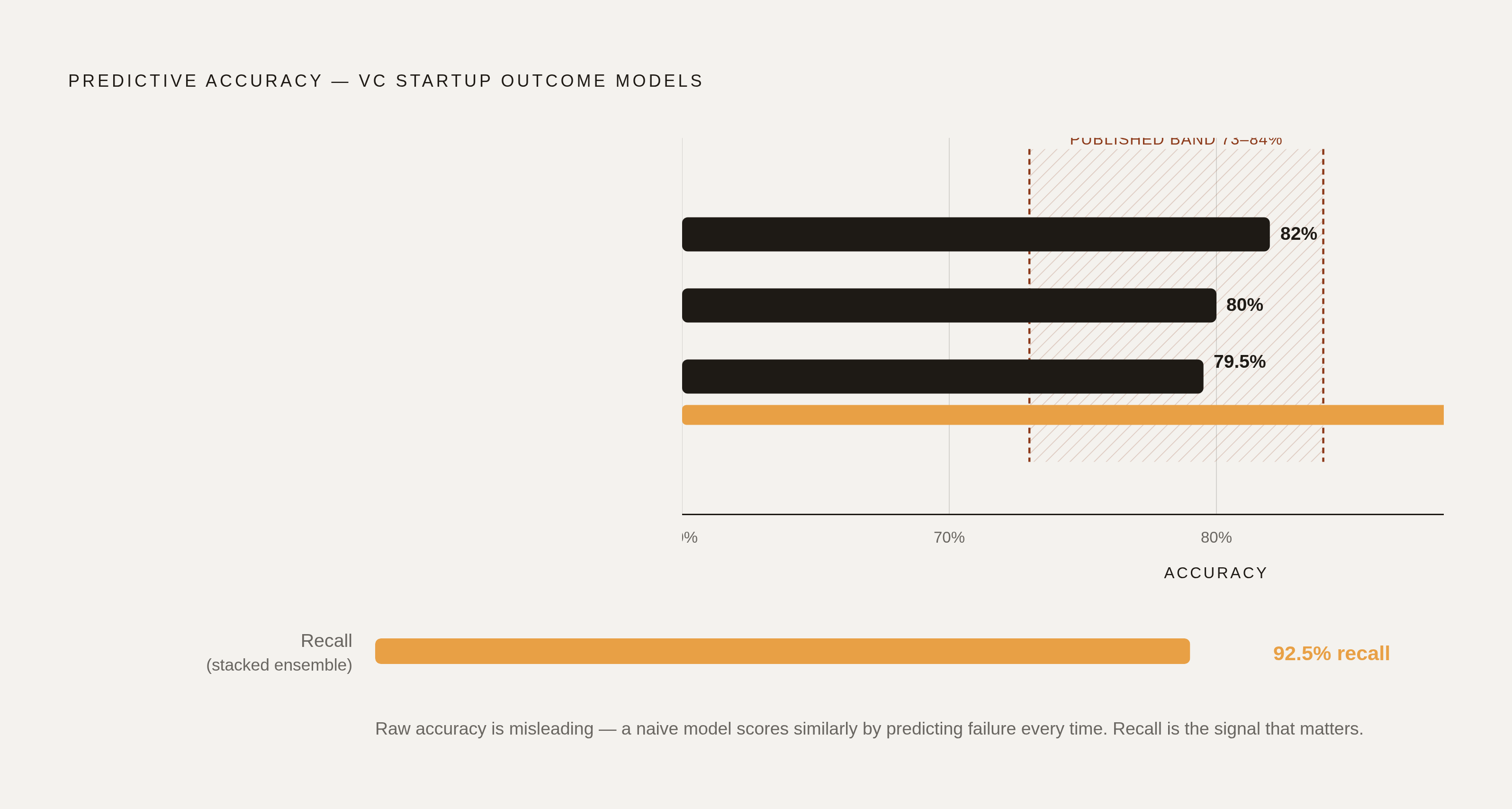
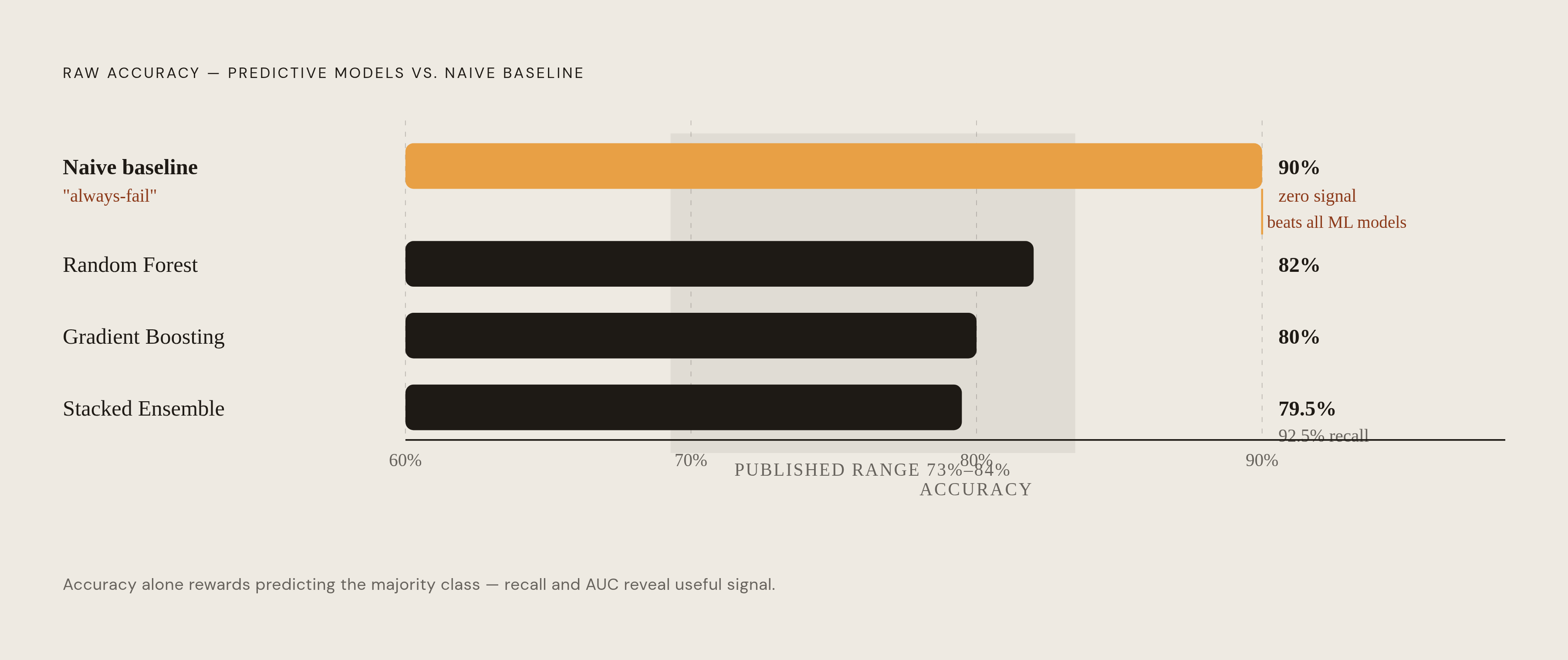
Start with that 90% failure rate again, because every accuracy number in this section has to be measured against it. A model that guesses "fail" every time scores well and tells you nothing.
Here's what the published research actually shows. A comparison in the Springer Journal of Innovation and Entrepreneurship found Random Forest hit 82% accuracy and Gradient Boosting hit 80% across five model types. Separate studies using models like XGBoost to predict IPO and M&A exits have reported strong AUC scores, with Bayesian Networks and Random Forest also showing competitive accuracy in exit prediction tasks. And a stacked ensemble model landed at 79.5% accuracy with a 92.5% recall rate, recall being the priority there since missing a future winner is the expensive mistake in this business.
None of these numbers mean quite what they look like at first glance. An AUC of 0.91 shows strong separation between outcomes, but only holds up if the training data actually resembles the deals a given firm sees day to day. Models tuned for high recall (catching every possible winner) trade away precision, which means more false positives and more work reviewing companies that don't pan out. And most of these studies train on retrospective data from companies that already got funded; testing against live, real-time deal flow is still rare in the published work.
Language models are pushing into this space too. One multi-agent framework showed a 108.3% relative improvement over GPT-4o-mini on prediction accuracy, though "better than a baseline model" and "accurate in absolute terms" are two different claims, and it's worth keeping them separate. The takeaway for anyone actually using these tools: accuracy across published methods runs somewhere between 73% and 84%, meaning one in five to one in four calls is wrong. Knowing which direction those errors lean matters a lot more than the headline number.
Predicting exit timing and type: where survival analysis applies
Exit timing decides a lot: when reserves get allocated, how lock-ups get planned, what a fund's return profile ends up looking like. And yet it's historically been the least modeled piece of the whole venture process.
Survival analysis is built for exactly this. It's the same time-to-event modeling used in medical research, estimating the odds that an exit happens in a given window, conditional on it not having happened yet. It gives two separate outputs, likelihood and expected timing, which serve different planning purposes. And it handles the data cleanly: a company that's still active when you're observing it doesn't get miscounted as a failure, the way a lot of cruder models would treat it.
PitchBook rolled out a "Time to Exit" tool in July 2026 as part of its VC Exit Predictor, forecasting the odds of a successful exit within one, three, or five years using machine learning. It's the first major commercial product to treat exit timing as its own standalone feature rather than an afterthought bolted onto a valuation model.
What can a manager actually do with that? Shift reserves toward companies showing high near-term exit odds. Time secondary sales more deliberately; when a model flags low near-term exit probability, selling on the secondary market starts to look a lot more attractive by comparison. And sharpen LP conversations, since a probabilistic exit window is a more defensible claim than a single point estimate pulled out of thin air.
The limits are real too. Predicting exit type (acquisition versus IPO) is a much harder problem than predicting timing. And any model trained during one rate environment needs recalibrating once public market appetite or interest rates shift underneath it. The method works best on rich data, which means firms that kept up continuous monitoring earlier in the lifecycle end up with far better inputs for survival models than firms still relying on a founder's quarterly email update.
How leading VC firms have built proprietary predictive infrastructure
SignalFire's Beacon AI is the clearest example of a firm treating this as core infrastructure rather than a side tool. CEO Chris Farmer describes it as "the fabric that stitches the entire firm together," not a sourcing add-on but something closer to an operating system for the whole shop. It continuously monitors a broad range of data sources in real time — GitHub commits, app store rankings, job postings, domain registrations — to surface early signals on companies and people. It also doubles as a recruiting and lead-gen tool for portfolio companies after the check has already been written, so the model keeps generating value well past the sourcing decision. SignalFire has continued raising capital, with its data-driven approach cited as a core part of the firm's LP pitch.
EQT Ventures' Motherbrain takes a narrower but sharper angle: it's built to find companies before they've announced anything, giving the firm a meaningful head start over funds that rely on inbound deal flow. The lesson there isn't really about accuracy. It's about timing. The edge a proprietary model buys you is seeing the same company everyone else will eventually see, just a year earlier, while there's still time to build a relationship instead of racing through a term sheet.
Most firms aren't going to build a Beacon or a Motherbrain from scratch; that kind of infrastructure takes years of data collection and an engineering team most venture shops don't carry. But the direction is clear enough: the firms treating predictive analytics as plumbing, not a bolt-on feature, are the ones compounding an advantage that gets harder to copy every year they keep running it.
Methodology & sources
- https://qubit.capital/blog/ai-tools-predict-investor-behavior
Provided the statistic that only 55% of investors felt well-informed about portfolio risk, cited from a 2025 State Street survey.
- https://www.affinity.co/guides/the-ultimate-guide-to-portfolio-management-for-vc-firms
Provided the figure that 64% of investors now use AI to speed up company research, sourced from Affinity's 2026 Predictions Report.
- https://www.scoopanalytics.com/blog/5-key-venture-capital-trends-in-2024
Provided the figures on venture firms investing $425 billion into more than 24,000 companies in a single year.
- https://www.gurufocus.com/news/8950719/pitchbooks-vc-exit-predictor-now-forecasts-when-companies-will-exit
Provided details on PitchBook's 'Time to Exit' tool launched in July 2026, which forecasts exit odds within one, three, or five years.
- https://stratengineai.com/blog/vcs-use-predictive-analytics-deal-flow
Provided the commonly cited figure of up to 60% time savings on diligence work when using predictive analytics tools.