AI Due Diligence Platforms for Investment Teams
Explore which AI tools actually cut diligence time and which combinations fit your deal flow.

- Written by
- Dana Ashworth
- Updated
- September 10, 2026
- Reading time
- 10 min read
- Sources cited
- 6 sources ↓
What this covers
- What AI is actually doing in a diligence workflow — and what it still cannot do
- The six functional categories — and why most firms need two or three of them
- Document intelligence platforms: Hebbia, Harvey, and what deep-document analysis actually means
- Market intelligence and external validation: AlphaSense and PitchBook
M&A deal value cleared $3.2 trillion in 2025. Timelines shrank while regulatory workstreams (EU CSRD, expanded CFIUS review) piled on. Meanwhile, financial services firms poured $45 billion into AI, and most deal teams are still copy-pasting numbers out of PDFs by hand. That gap between money spent and habits changed is what this piece is about. The AI due diligence tools market itself is worth roughly $1.13 billion as of 2024, and it's on track to hit close to $9.9 billion by 2033, growing at nearly 29% a year, which is a growth rate most procurement committees are not moving fast enough to keep up with. The real question for an investment team isn't whether to buy something. It's which combination of tools actually fits how your deals get done.
What AI is actually doing in a diligence workflow — and what it still cannot do
Due diligence has gone through three eras. First came the physical war room: boxes of paper, coffee, and lawyers reading by lamplight. Then came virtual data rooms, which digitized access but left the actual reading to humans, just on a screen instead of a table. Now we're in wave three, where AI reads the documents itself, flags what looks off, and hands analysts a shorter list to argue about.
That middle wave matters more than people give it credit for. VDRs solved the problem of getting documents to the right people. They never solved the problem of understanding what's in those documents. So when a platform calls itself an "AI-enhanced VDR," ask what the AI is actually doing. Sorting files into folders is not the same as reading them.
Here's what AI genuinely does well right now. It can triage thousands of files faster than any team of analysts, catching the handful that matter and setting aside the rest. It pulls structured numbers, an interest coverage ratio, an LTV figure, a specific clause, out of a 200-page PDF in minutes rather than hours. It flags anomalies instead of burying them in an appendix nobody reads. Feed it a 50-page CIM and it hands back a clean investment summary before your coffee gets cold.
What it still can't do is just as important. It doesn't tell you whether a flagged item is a dealbreaker or a rounding error, that's a judgment call, and judgment calls are still a human job. It can't read a founder's body language on a call or sense that the CFO is dodging a question. And it struggles with reasoning that spans documents in ways that require context the model never saw in training.
So the honest way to describe the shift: AI does the first pass, people verify and decide. That's not a small change. It changes who gets hired, how teams are staffed, and how closely someone needs to supervise the output. Reported time savings of 60 to 70% on financial workstreams appear in the literature. Ask which tasks, which deal types, and which team sizes produced that number, because it's rarely specified, and it should be.
The six functional categories — and why most firms need two or three of them
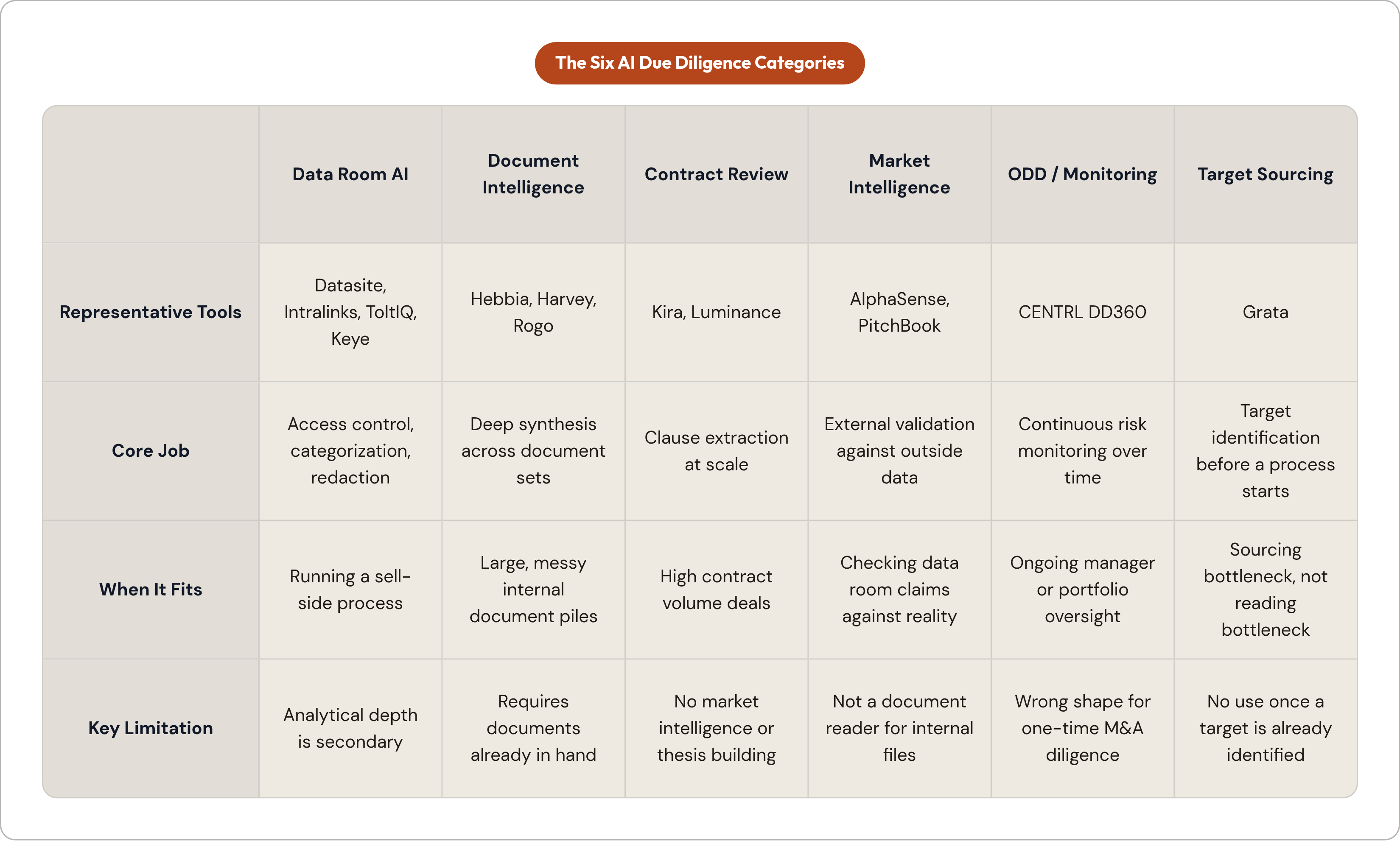
The market breaks into six distinct buckets, and no platform does all six well. Confusing them is how firms end up buying an expensive tool that solves the wrong problem.
Data room AI, the kind built into Datasite, Ansarada, or Intralinks, works inside the room's own security wall. It handles categorization, redaction, access permissions, and tracking who's looking at what. Document intelligence platforms, like Hebbia, Rogo, V7, or Eilla, go deeper: they read and synthesize across a large set of documents once you've already gathered them. Contract review tools, Kira and Luminance among them, specialize in pulling clause-level terms out of hundreds of agreements at once. Market and competitive intelligence tools, AlphaSense and PitchBook being the two names everyone knows, pull in outside information, filings, research, expert call transcripts, private market data, to check whether what's in the data room matches reality. Sourcing and screening tools like Grata map the private company universe and flag deal signals before a process even starts. And ODD platforms, CENTRL DD360 chief among them, are built for allocators running ongoing risk monitoring, not one-time deal reviews.
Most private equity and M&A teams end up running two or three of these at once. The question isn't which single tool wins. It's which combination matches the deals you actually run. And that shapes the integration question too: data room AI has to live inside the VDR's walls, document intelligence tools need a secure way to ingest files from outside, and ODD tools need a steady data feed, not a one-time document dump.
Document intelligence platforms: Hebbia, Harvey, and what deep-document analysis actually means
This is where the most interesting AI work is happening, and also where vendor claims are hardest to check without running a real pilot.
Hebbia uses what it calls an agentic architecture, reading thousands of documents at once and tying every answer back to the exact sentence it came from. The company says it automates up to 90% of manual document synthesis in diligence work, and claims use by more than 40% of the largest asset managers by AUM (these are Hebbia's own numbers). It's raised $159 million, including money from Andreessen Horowitz, and it's built for deep analysis once you already have a specific set of documents in hand. A common setup among firms: AlphaSense for outside market context, Hebbia for chewing through the internal document pile. The two aren't competing, they're doing different jobs.
Harvey tells a more textured story. At GSK Stockmann, across M&A, private equity, venture, and real estate diligence, structured workflows saw time savings in the 15 to 20% range, while unstructured data room analysis hit as high as 75%. That gap is the real lesson here: AI has a lot more room to help when the input is messy than when it's already organized. Harvey's strongest use case is legal work; it's less of a standout as a pure financial analysis tool.
Before you sign anything, run a pilot and ask a few pointed questions. Does the tool cite its source down to the sentence? Can an analyst check a flagged finding without leaving the platform? And when the model doesn't know the answer, does it say so, or does it guess and sound confident about it? Hallucination is still the category's biggest unsolved problem, and sentence-level citation is the best defense anyone's built so far, not a guarantee.
Market intelligence and external validation: AlphaSense and PitchBook
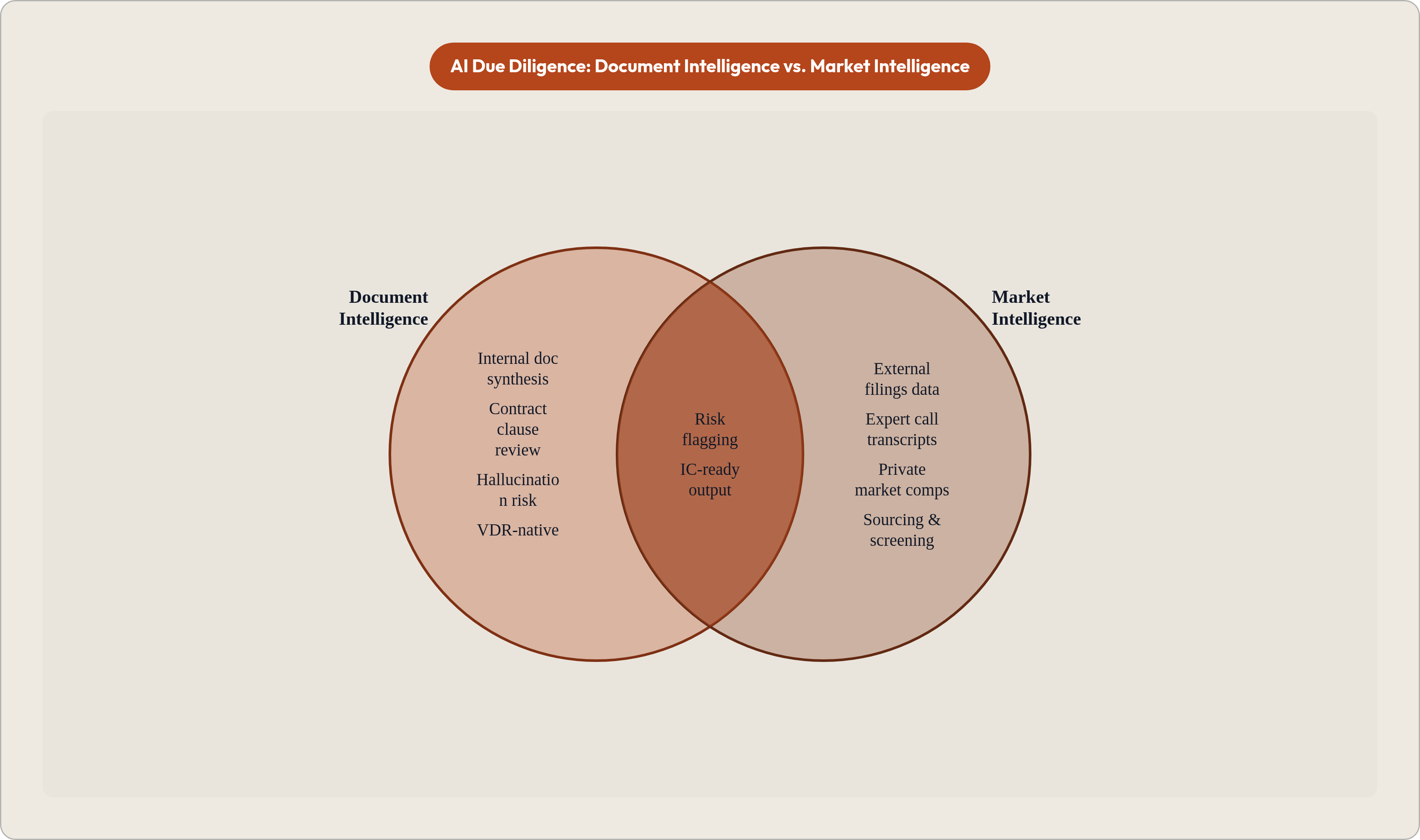
These tools ask a different question than document intelligence platforms do. It's not "what does the data room say," it's "does what the data room says hold up against the outside world."
AlphaSense closed a $350 million funding round in June 2026 at a $7.5 billion valuation, roughly double where it stood before, and passed $600 million in annual recurring revenue in the first quarter of 2026. It covers more than 500 million business documents: filings, broker research, expert call transcripts, licensed news. Its client roster includes 90% of the S&P 100, 80% of the top asset managers, and 75% of the top hedge funds. Pricing runs $10,000 to $20,000 per seat annually, with enterprise deals landing between $50,000 and $100,000 or more. Its Due Diligence Workspace syncs directly with VDR documents, runs AI agents that flag risk, and checks management's claims against outside sources before producing an IC-ready output. That last part is the differentiator: it's the tool that catches a claim that looks fine sitting in the data room but doesn't square with a public filing or an expert call transcript.
PitchBook serves more than 100,000 professionals across the deal and investment community. Think of it less as a document reader and more as the sourcing and comparables layer underneath everything else.
The pairing logic is straightforward: AlphaSense for validation and outside intelligence, PitchBook for private market data and comps. Teams running a full process tend to need both, not one or the other.
Contract review tools: Kira and where specialized AI still outperforms general models
Contract review is the oldest, most tested AI use case in M&A diligence. These models have trained on legal language longer than any other application in this space, and it shows.
Kira Systems, now part of Litera after its 2021 acquisition, still gets called the gold standard for AI contract review in high-stakes deals as of 2026. That reputation isn't built on flashy architecture. It's built on accuracy, a deep well of training data, and enterprise-grade security that legal teams trust. Its Quick Study feature lets lawyers train custom models on firm-specific clause types without needing a data scientist in the room, useful for firms whose deal structures don't look like everyone else's. Enterprise pricing starts around $35,000 a year.
The case for a specialist tool like Kira over a general-purpose document platform comes down to one thing: pulling clause-level terms out of hundreds of agreements at scale is a narrow task, and a model trained specifically for that task still beats general-purpose large language models on accuracy. The tradeoff is equally plain. Kira doesn't do market intelligence. It doesn't build investment theses. It does one job, and it does it well.
Before adding a seat, ask whether the accuracy gain is worth the extra cost and integration work, given the actual volume of contracts your deals produce. For a small deal with twenty agreements, maybe not. For a portfolio company add-on with three hundred, probably yes.
VDR-native AI and deal-room-first platforms: Datasite, Intralinks, ToltIQ, and Keye
The pitch for VDR-native AI is simple: no extra ingestion step, no data leaving the security perimeter, and it works inside the process your team already runs. The catch is that these tools are built first for document management and access control, with analytical depth as a secondary feature.
Datasite's AI is oriented toward document management and process control, strong for running a sell-side process, less notable as a deep analysis engine. Intralinks has a similar shape, with AI capabilities aimed at document analysis and process management built into its platform.
ToltIQ was built with VDR realities in mind: messy formats, inconsistent documents, rooms holding thousands of files. Every finding links back to its source, so verification happens without leaving the tool. For teams where a security review is the gate that decides the purchase, ToltIQ's documentation on that front is worth examining directly.
Keye was built specifically for private equity diligence. It plugs directly into the VDR and turns raw deal files into structured, investor-ready outputs. Its approach to data handling is a selling point for firms treating deal information as genuinely sensitive. Keye is reported to save users more than five days per deal and is used by funds managing over $1.4 trillion in AUM, according to jinba.io.
The purchase logic here is simple: if you want AI without ripping out your VDR or building a new ingestion pipeline, look at Keye and ToltIQ before the bigger, broader platforms. The capability claims are narrower, but they're easier to verify and lighter to integrate.
ODD and continuous monitoring: how CENTRL DD360 approaches a different diligence problem
Operational due diligence isn't really the same sport as M&A diligence. It's recurring. It's built around questionnaires. And it's about watching risk over time, not closing a deal.
The old ODD model, periodic reviews built on static questionnaires, doesn't match how risk actually moves through a portfolio. That's the gap CENTRL DD360 is built to close. It's aimed at asset owners, allocators, and consultants, not deal teams doing transactional M&A work. CENTRL frames its approach as "ODD 3.0," moving from periodic, questionnaire-driven check-ins to continuous, data-driven monitoring, with risk identification, insight delivery, and decision tracking all sitting in one platform.
If your diligence headache is ongoing manager monitoring rather than reading through data room documents deal by deal, this is the category to look at, and most of the other tools in this piece are the wrong shape for that job entirely. The distinction runs deeper than use case, too. ODD platforms need a steady stream of data from managers over time. They're not built around a one-time document dump, and setting one up looks nothing like standing up a document intelligence tool.
Target sourcing and commercial diligence: Grata and AI-driven deal origination
Traditional diligence starts once a deal is already on the table, after an LOI, after a banker has shopped the company around, after the data room opens. Grata flips that sequence, using AI to surface potential targets before a formal process even begins.
For teams whose bottleneck is finding the right target rather than reading through one they've already found, this category solves a different problem than everything else in this guide. It's not competing with Hebbia or Kira or AlphaSense; it's operating a step earlier, before there's even a document to review. That earlier step matters. A diligence platform, no matter how sharp, can't do much for a deal your team never found.
Methodology & sources
- https://www.centrl.ai/due-diligence/
Provided background on CENTRL DD360's ODD 3.0 approach to continuous, data-driven manager monitoring for allocators.
- https://www.harvey.ai/blog/ai-due-diligence-for-m-and-a
Supplied the GSK Stockmann case study figures showing 15–20% time savings on structured workflows and up to 75% on unstructured data room analysis.
- https://www.hebbia.com/resources/ai-due-diligence
Informed the description of Hebbia's agentic architecture and its use in financial due diligence workflows.
- https://toltiq.com/
Provided detail on ToltIQ's design for VDR environments with messy formats and source-linked findings.
- https://www.intralinks.com/products/dealcentre/diligence
Described Intralinks as a VDR-native platform with AI capabilities aimed at document analysis and process management.
- https://www.v7labs.com/blog/best-ai-tools-for-investment-banking
Provided the $45 billion figure for AI investment by financial services firms.