Risks of Algorithmic Bias in AI Venture Decisions
AI hiring tools trained on skewed venture data risk perpetuating funding gaps.

- Written by
- Ravi Quist
- Updated
- September 29, 2026
- Reading time
- 9 min read
- Sources cited
- 3 sources ↓
What this covers
By 2025, more than three-quarters of VC executive reviews will run through AI and data analytics somewhere in the process. Meanwhile, AI companies pulled in roughly a third of all global venture funding in 2024, the single largest sector. So the same technology deciding who gets funded is also the thing everyone's funding. That loop matters, because it means the bias question in venture capital is no longer a peripheral concern. It is central to how capital flows.
Consider the platforms already doing this work at scale. EQT Ventures runs a tool called Motherbrain that tracks millions of companies worldwide and reaches out to promising targets an average of 14 months before those companies even start fundraising. It sourced deals that turned into an $8 billion DoorDash acquisition of Wolt and a $700 million Zynga acquisition of Small Giant Games. SignalFire's Beacon watches over 600 million data sources and roughly half a trillion data points. Other firms have built or deployed their own proprietary screening tools. These are active filters deciding which founders a human ever lays eyes on, using AI to read pitch decks, run due diligence, gauge sentiment, and size up markets across the entire intake funnel. If a founder does not surface on the shortlist, no partner ever sees their deck.
Why the training data is already biased
Every predictive VC tool learns the same way: it studies historical funding outcomes. Which founders got backed, which companies took off, which pitches made it past the first meeting. Researchers have put it plainly: models trained on historical venture data tend to favor founders who resemble the ones already backed in the past. Nobody codes that in on purpose. It falls out of pattern-matching on a data set that was skewed to begin with.
These systems risk hardwiring past preferences into future portfolios, locking out atypical founders in an industry that already struggles badly with diversity. There is a name for this in the academic literature: the backward-similarity paradox. The model gets sharper at predicting what investors rewarded yesterday, not what the market will reward tomorrow.
If historical data shows that 83.6% of funded deals went to all-male founding teams, the model learns, by its own internal math, that "male team" and "gets funded" correlate. Large language models add a second layer: they arrive already carrying the social associations embedded in their pre-training text, before anyone fine-tunes them for venture-specific work. A model can be technically accurate on the data it was trained on and still produce results that are structurally unfair.
The funding gaps that AI is learning from
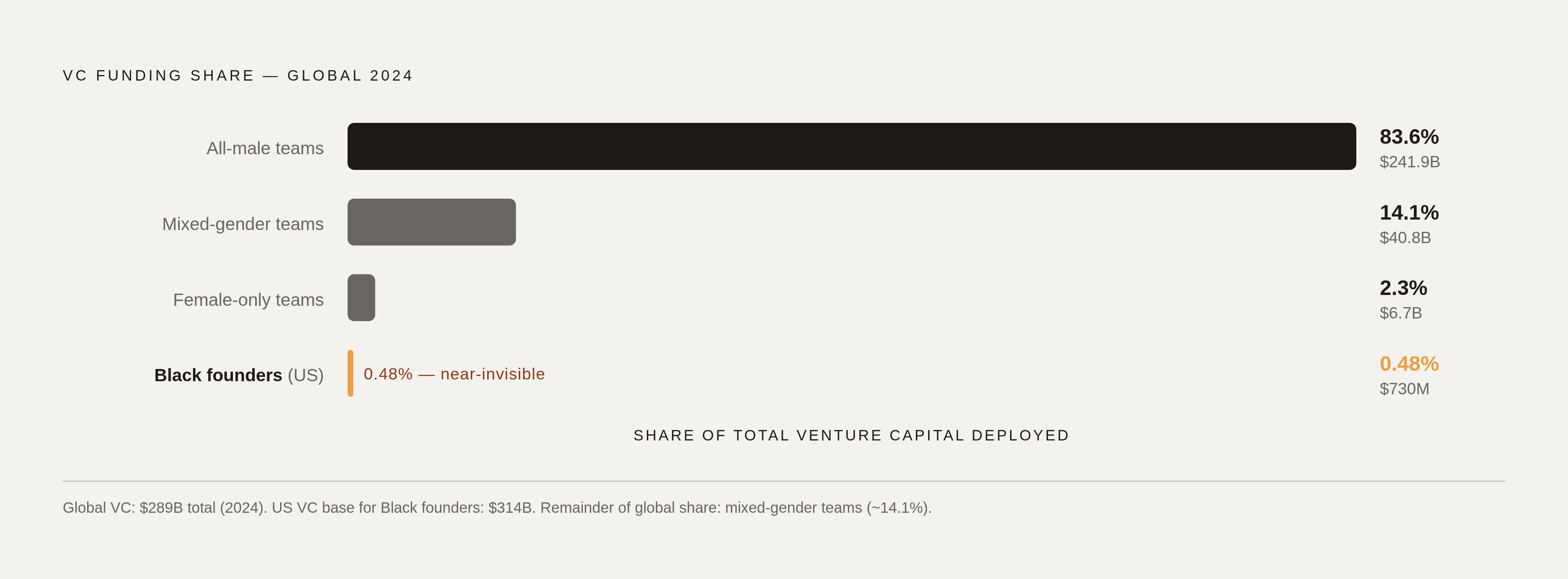
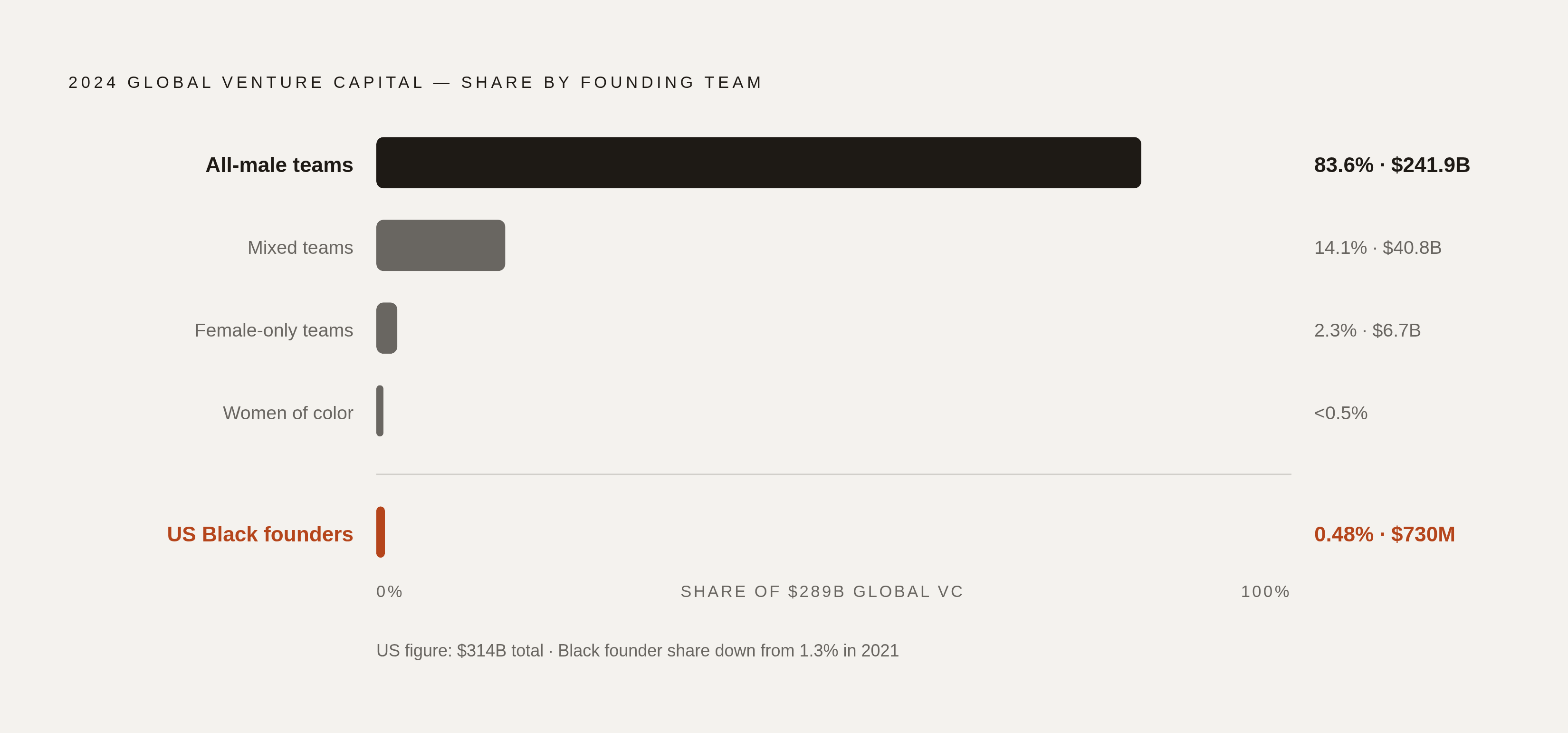
Of the $289 billion invested globally in 2024, 83.6% ($241.9 billion) went to all-male founding teams. Female-only teams received 2.3% ($6.7 billion), up from 2.1% the year before. Progress measured in decimal points is not meaningful progress.
The racial gap is larger and moving in the wrong direction. Black founders at US startups received 0.48% of total US venture capital in 2024, down from 1.3% in 2021. Out of $314 billion in total US startup funding that year, only $730 million reached Black founders. The gap widens at every subsequent stage: just 17% of Black-founded deals reach Series A, compared to 37.7% for startups generally. Research out of Columbia Business School found that only 3.47% of founders seeking venture capital were Black, which suggests the barrier starts long before anyone sits down to pitch.
This is the accumulated shape of the industry, and it is exactly what gets fed into an AI system as its working definition of what a fundable company looks like. The signal itself carries the bias, embedded throughout the training data.
How AI amplifies gender bias in pitches
Research examining large language models like ChatGPT in investment scenarios has found a clear lean toward masculine traits over feminine ones, mirroring persistent stereotypes about what a fundable entrepreneur is supposed to look and sound like.
This bias operates through language without requiring an explicit gender field. UNESCO research found that these models link female names to words like "home," "family," and "children," while male names get paired with "business," "executive," "salary," and "career." One model produced domestic-role associations for women four times as often as for men. A study using GPT-4 ran 2,400 financial advice interactions and found that advice given to implied women came out less risky, more focused on caution, and more patronizing in tone than advice given to implied men.
That matters directly for venture capital, because pitch evaluation depends on exactly the kind of subjective reads these models are trained to make: tone, confidence, how ambitious the market claims sound, how leader-like the language is. A founder whose writing or speech patterns get coded by the model as feminine can score lower on traits the model has quietly learned to treat as proxies for investability, with no gender flag ever raised explicitly. A 2025 audit of GPT-4 Turbo by researchers Wang and Gu found that gender-related scoring gaps appear even when the only cue is a name at the top of a pitch deck.
How racial bias enters AI screening tools
Columbia Business School ran an experiment that illustrates the mechanism precisely. Researchers used an algorithm to sort founder photos by race. A Black woman with long, straight hair was sorted into the white folder. That is not a random error. It is the model reading hair texture, skin tone, and facial features as proxies for race and producing a directionally skewed result.
Text carries the same failure mode. Name-based cues have long been shown to trigger unequal treatment in hiring audits, and that effect now appears in AI-driven financial evaluation. Related research has found racial gaps in capital allocation that persist even when demographic information is made explicit, with implicit cues sometimes producing stronger effects than explicit ones. Randomized tests across multiple language models have found that these systems disadvantage Black male applicants even when their qualifications match everyone else's exactly, a finding from hiring research that maps directly onto VC screening.
These models do not fail randomly. They fail in the same direction as the gaps already present in the training data, consistently and repeatedly.
Women of color face compounding, intersecting bias
Narrow the lens to women of color and the funding share drops below half a percent, lower than the already-thin slice going to women founders overall. Gender bias and racial bias do not simply add together in these models; they interact. Whatever a model has learned to associate with "Black woman" is not the average of its associations with "Black founder" and "woman founder" separately. It is a distinct pattern, and the research indicates it is typically worse than either.
Some research has found that AI models can favor female candidates overall while disadvantaging Black male applicants, a framing that says nothing about what happens to Black women specifically, who face a different combination of signals entirely. Current anti-discrimination frameworks treat race and gender as separate categories. AI bias research shows that the most severe failures occur where those categories overlap, which means audit tools built to test one category at a time will miss the worst cases systematically. A firm could pass a gender bias audit, pass a race bias audit, and still be screening out Black women founders throughout the process.
Three mechanisms that introduce bias
Three failure modes appear consistently in the research, each distinct from the others.
The first is training data dependency: models learn what a successful founder looks like from historical data, and in doing so they absorb whatever demographic patterns accompanied past success, treating those patterns as signals of investability rather than artifacts of prior exclusion. The second is the proxy variable problem. Inputs that appear neutral, such as which university someone attended, who they worked for previously, how central they are in a professional network, or how confident their writing sounds, function as stand-ins for race or gender whenever those groups were historically excluded from the institutions producing those signals. The third involves names and images, which carry demographic cues that appear incidentally in a founder's LinkedIn profile or pitch deck and trigger documented bias patterns in model outputs directly.
A fourth mode is emerging: founders are learning to write their profiles and pitches to match the language of previously funded founders, working in expected keywords and framings. This could filter out the kind of genuine differentiation that makes a company worth backing. Beyond that, these tools perform poorly at evaluating qualities like resilience, market instinct, or community ties, the factors that matter most for founders operating outside established VC networks. Each of these problems is addressable individually. The difficulty is that they tend to appear together and amplify one another once a system is running.
Opacity prevents founders from detecting bias
Most VC AI tools produce visible outputs, a ranked list, a risk score, a recommendation, while keeping the underlying reasoning hidden. A founder who gets downgraded has no way to find out why, let alone challenge the result.
Research on algorithmic systems shows a consistent pattern: as these systems grow more complex, they become harder to interpret and harder to regulate, and the reputational cost of that opacity is becoming a real liability for firms that have not addressed it. There is also an ethical dimension. When demographic signals rather than financial fundamentals drive advisory outcomes, the justification for delegating decisions to AI in the first place is undermined. Opaque systems also resist correction, because no one can debias a model whose logic they cannot inspect. For founders, the absence of transparency makes it impossible to distinguish algorithmic exclusion from a straightforward assessment of risk.
Can AI reduce bias if built correctly?
Researchers on both sides of the debate acknowledge a genuine counterargument. AI trained on representative data could, in theory, evaluate founders more fairly than human investors who rely on gut instinct and professional networks that are demographically homogeneous. Human decision-making in venture capital was never a neutral baseline. It is the process that produced a 0.48% funding share for Black founders and decades of negligible progress for women. Replacing human judgment with a machine is not automatically a regression.
The honest research consensus is that whether that potential is being realized in practice remains unresolved. Achieving it requires training data that is representative rather than simply historical, auditing that checks for intersectional outcomes rather than one demographic category at a time, sufficient explainability to detect when a proxy variable is performing demographic work, and human review that functions as a genuine check rather than a formality applied after the AI has already narrowed the field.
Final investment decisions still sit with humans, and AI is officially positioned as a support tool. But if a human only ever sees the founders the AI decided to surface, that human's actual influence over outcomes is considerably smaller than it appears. The hybrid approach researchers recommend has humans engaged before the shortlist is finalized, not after. Most systems in use today do not operate that way.
What researchers and investors are doing now
On the technical side, bias audits are beginning to use randomized demographic variation in test inputs, the method Wang and Gu applied in their GPT-4 Turbo study, to detect differential treatment before a tool is deployed. Some teams are treating representative training data as a design requirement from the start rather than a retrofit. Others are building intersectional testing frameworks that evaluate demographic categories in combination rather than separately.
Regulatory pressure is increasing, though slowly. Researchers are explicit that current anti-discrimination law is not equipped to handle intersectional AI failures, and there are direct calls in the academic literature for rules that address this gap. On the investor side, some firms now treat bias audits as a matter of fiduciary responsibility and reputational risk rather than optional practice.
The structural problem that none of this fully resolves is that when AI filtering happens early in the intake process, careful human review later cannot recover the founders who never appeared on the list at all. The tools for measuring bias in these systems are improving faster than the requirements to use them, which means adoption remains voluntary. A system designed to address this problem would allow humans to see the AI's shortlist alongside the full pool it was drawn from, override filtering decisions before they become final, and be held accountable for the demographic composition of the outcomes that result.
Methodology & sources
- https://lawreview.law.miami.edu/mitigating-artificial-intelligence-bias-in-venture-capital/
Provided the 'backward-similarity paradox' concept used to describe how AI models learn to replicate past investor preferences rather than predict future market success.
- https://ff.co/women-funding-statistics-2025/
Provided the 2024 global venture capital funding figures showing 83.6% went to all-male teams and only 2.3% to female-only teams.
- https://peopleofcolorintech.com/articles/black-founders-received-just-0-4-of-all-startup-funding-in-2024/
Provided the 2024 statistics showing Black founders received 0.48% of US venture capital, down from 1.3% in 2021, with only $730 million out of $314 billion total.