Legal Documentation Workflow for Closing a Funding Round
Understanding the paperwork sequence saves founders weeks and prevents costly errors down the road.

Signing a term sheet feels like crossing the finish line. It's actually the starting gun. What follows is weeks, sometimes months, of drafting, diligence, filings, and chasing down signatures before a single dollar hits the bank. Founders who understand that sequence close faster, and they dodge mistakes that come back to bite them in the next round. Regulation D offerings, the exemption most startups use, accounted for over $1.5 trillion in capital formation in 2024, according to DFIN Solutions. Every one of those deals ran through some version of the workflow below.
How the instrument you're using shapes everything that follows
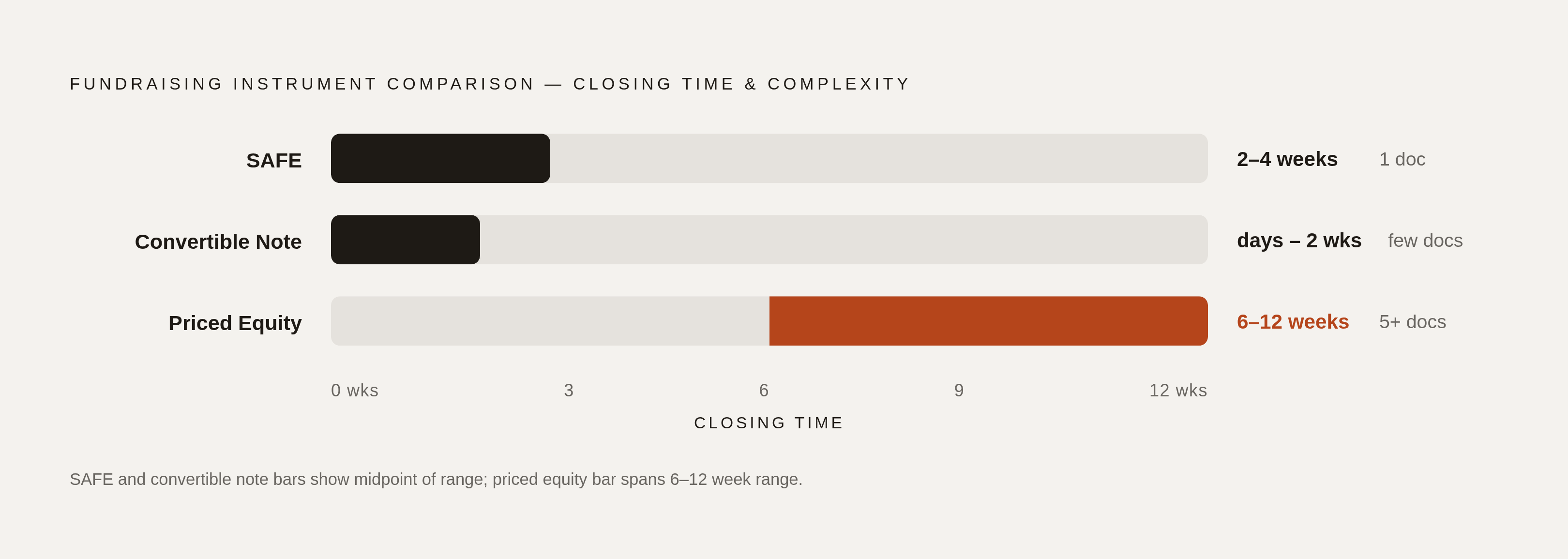
Three instruments run startup fundraising, and they are the SAFE, the convertible note, and the priced equity round. Pick one and you've picked your paperwork, your timeline, and roughly how many gray hairs the process costs you. Of the three, founders consistently underrate how much heavier a priced round gets, and fixing that mistake before it costs six extra weeks is what matters.
SAFEs are the simplest by design. One standardized document, about six pages, no debt, no maturity date, no interest piling up in the background. It converts into preferred stock at the next priced round, and the path to signing is close to a straight line: board approval, a little negotiation, signatures. Pre-seed and seed rounds using SAFEs or convertible notes can close in two to four weeks. That's fast by legal-document standards, the way a microwave burrito is fast by cooking standards. It gets the job done. Nobody's writing home about the craftsmanship.
Convertible notes add a few more moving parts. They're short-term debt, so they accrue interest and carry a maturity date, and the term sheet has to nail down the discount rate, valuation cap, maturity date, and interest rate up front. Get those wrong, or leave them vague, and the mess resurfaces later at conversion, usually at the worst possible moment. Legal fees for the paperwork typically stay under $2,000, and once terms are agreed, the whole thing can wrap in a day or two.
Priced equity rounds, Series A and beyond, are where founders most often underestimate what they've signed up for. Investors buy preferred stock at a set price per share, based on a negotiated pre-money valuation, and instead of one document, there are five or more agreements requiring negotiation from both sides. Expect six to twelve weeks, driven by legal complexity, deeper diligence, and the simple math of more parties needing to agree on more things. The median seed round in 2024 to 2025 landed around $3.5 million, with typical rounds spanning $500,000 to $5 million, so even a "simple" seed deal deserves careful paperwork. Everything from this point forward applies most fully to priced rounds, since SAFE and note closings skip or compress most of these steps. That's half of why founders like them.
The term sheet's binding and non-binding terms
The term sheet isn't a binding investment commitment. Think of it as an engagement: it signals intent, but it isn't the marriage certificate. It does structure what the definitive documents have to reflect later, though, so getting it right shapes every term that ends up locked into those binding documents down the line.
It sets valuation, investment amount, instrument type, and the key governance and economic terms. For convertible notes specifically, the discount rate, valuation cap, maturity date, and interest rate all get pinned down here. Any ambiguity at this stage doesn't stay contained. It spreads into every document drafted afterward, the way a typo in the first line of code breaks the build twenty files later.
Once signed, founders should line up a realistic closing window, typically four to six weeks for most rounds, with total time from term sheet to close running 30 to 90 days across all round types. The job at this stage is simple to describe and easy to skip: confirm the term sheet actually reflects what was negotiated before legal drafting starts. Amendments mid-draft cost real money and tell investors the company doesn't have its act together.
Start building the data room now, too. Due diligence runs alongside document drafting, not after it, and a slow data room doesn't just delay diligence. It delays the whole close.
The documents in a priced round and the function each one serves
A priced round generates a stack of documents, and each one does a specific job.
The Amended and Restated Certificate of Incorporation authorizes the new class of preferred stock and gets filed with the state. No shares can legally issue without it.
The Stock Purchase Agreement (SPA) is the core contract: price per share, total investment, representations and warranties from both sides, and the closing conditions, which function as the literal checklist that has to be satisfied before funds move.
The Investor Rights Agreement (IRA) governs what happens after the money lands: information rights, pro-rata rights in future rounds, registration rights. It's usually the most fought-over document, since its terms follow the company for years, through every closing that comes after this one.
The Voting Agreement sets out how investors and founders vote on major company matters, including board seats.
The Right of First Refusal and Co-Sale Agreement protects investors if a founder tries to sell shares down the road. It gives the company or investors first crack at buying, or the right to sell alongside.
Board and stockholder consents are the corporate sign-offs approving the financing, required before anything gets executed.
Side letters show up when specific investors, often large or strategic ones, negotiate extra rights outside the main documents. These apply only to that investor, and they need careful tracking, because a side letter provision that quietly conflicts with the IRA is the kind of landmine that only goes off during the next round's diligence.
The pro forma cap table isn't a legal agreement, but it's required all the same. It shows post-investment ownership, including conversion of prior SAFEs or notes and any option pool adjustments. It gets built and agreed before signing, and cap table errors here are a classic source of last-minute delay.
Investor counsel typically marks up NVCA model forms to reflect the negotiated term sheet, and company counsel reviews and responds from there. Call it a negotiated back-and-forth on a known template.
The contents the data room needs and the reason gaps stall deals
Due diligence and document drafting run on parallel tracks. A slow data room stalls both at once, not just one.
Legal diligence covers organizational documents, outstanding equity and convertible instruments, material contracts, IP ownership, employment and contractor arrangements, regulatory compliance history, and any pending or threatened litigation. For a Series A, the data room usually breaks into a handful of buckets: corporate documents (Certificate of Incorporation, Bylaws, Board Resolutions, Meeting Minutes), capitalization records (Cap Table, Stock Option Plan, Option Grant Records, 83(b) Elections), financials (Income Statements, Balance Sheets, Cash Flow Statements, Projections), fundraising history (prior SAFEs or notes, prior SPAs, Form D filings), contracts (customer, vendor, partnership agreements), employment materials (offer letters, contractor agreements, IP assignment agreements), IP filings (trademarks, patent applications), and compliance items like privacy policies.
Two problems cause most of the delay: a disorganized data room that slows investor counsel's review, and cap table errors or missing option grant paperwork. Most of this should already exist if the company kept its legal house in order from day one, which stings a little. The data room is assembly. If a founder finds themselves drafting documents instead of just gathering them, the deal is already behind schedule, whether anyone's said so out loud yet. Company counsel should own the job of pulling everything into a secure data room and handing it to investor counsel. Founders shouldn't be the ones fighting with folder structure at 11pm.
Signing mechanics: from signature packets to electronic execution
Once the documents are finalized, counsel puts together a signature packet for each investor containing every required agreement. Electronic execution is standard now, with platforms like DocuSign and Carta widely used for signature collection.
A "closing" is the moment all of the SPA's closing conditions are confirmed satisfied, signature pages get released, and funds transfer is authorized. Some rounds, especially ones with several investors, close in tranches rather than all at once, and each of those rolling closes carries its own signature set and its own regulatory trigger (more on that below).
At this stage, the job is almost tediously simple: confirm every investor's signature packet is complete before releasing anything. A single missing page from one investor can hold up the entire close, which is a frustrating way to lose a week. Right after signing, an updated cap table reflecting the new securities needs to go out immediately, because accuracy here matters for future fundraising, employee equity grants, and every future investor's due diligence.
SEC Form D and state filings: the regulatory clock that starts at signing
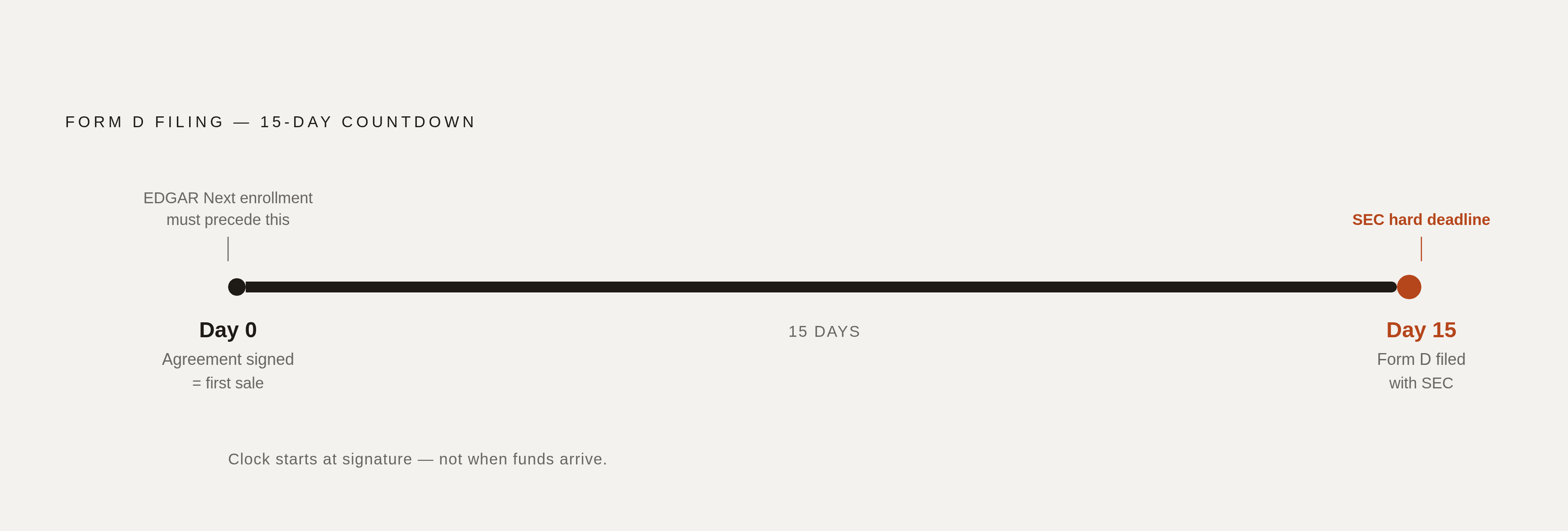
Most startup rounds skip full SEC registration under Regulation D, and Form D is the filing that keeps that exemption valid. The clock starts the moment the first sale of securities happens: the SEC requires Form D within 15 calendar days of that date.
"First sale" doesn't mean funds landed in the bank. It means the point an investor is legally committed, even before money moves. For SAFEs and convertible notes, that's the date the agreement gets signed. Most startups raise under Rule 506(b) or 506(c), which carry different rules on how investors can be solicited and how accreditation gets verified.
Form D can't be filed until EDGAR Next access is set up, and this is where a surprising number of rounds get stuck for reasons that have nothing to do with the deal itself. All filings now run through the EDGAR Next dashboard, and each filer needs an individual Login.gov account. The SEC recommends naming at least two account administrators, so one person's vacation or laptop crash doesn't stall a time-sensitive filing. EDGAR Next enrollment needs to happen well before the first closing. Waiting until closing is scheduled is like trying to get a passport the week of the flight: technically possible, mostly a bad idea.
On top of the federal filing, certain states require their own "blue sky" filings, and requirements shift depending on the state and where investors live. Rolling closes add another layer of bookkeeping. Form D histories for companies like SpaceX and Stripe, per BlueSkyComply, show multiple filings across successive equity rounds, with each one updating the "amount sold" figure and adding jurisdictions as capital came in. Build the habit of checking after every close whether an amendment is triggered, ideally within 48 hours, rather than letting it pile up.
None of this produces fireworks when it's mishandled. Delayed filings, misclassified offerings, overlooked state requirements: these rarely cause an immediate problem. They appear later, during institutional diligence, the next financing round, or acquisition talks, which is exactly the wrong moment for a surprise.
The delays that kill momentum and the ways to avoid them
Most closing delays are avoidable, and they tend to come from the same handful of places over and over. Founders who blame investor foot-dragging are usually looking the wrong direction: the actual bottleneck is almost always something sitting in the company's own files.
Data room gaps top the list: incomplete formation documents, missing option grant records, gaps in 83(b) elections, IP assignments that were never actually signed. Cap table errors run a close second, whether that's a mismatch between the cap table and actual option grants, or a pro forma disagreement that forces a renegotiation of economics after the documents are already drafted. Getting caught flat-footed on EDGAR Next is its own special flavor of pain, since it creates a hard stop on Form D right when the 15-day clock is already running. Investor-side surprises, like a late withdrawal or a substitution, or side letter talks that reopen economics the IRA already settled, can undo weeks of work in an afternoon. Term sheet ambiguity, terms that were agreed out loud but never pinned down on paper, tends to become visible exactly when two sets of counsel read the same sentence two different ways.
Timing pressure compounds all of this. The full fundraising timeline, counting everything before the term sheet even gets signed, typically requires at least five months. In the UK, SEIS and EIS rounds face a hard tax-year deadline of April 5th, and SeedLegals data shows closing volume in March running 100% higher than January or February, which compresses legal timelines right when everyone's least equipped to handle it.
The fix takes discipline, not cleverness: treat the closing like a project. Use a checklist, name an owner for each item, run a daily status check. The workflow is predictable enough that slippage almost always traces back to one specific missed step. Tracking which investor holds which side letter, which reps survive closing, and how each document's terms interact takes real precision, especially once the cap table has been through a few rounds already. Dedicated fundraising workflow tools can help founders think through how investor communication and documentation should stay coordinated as a round moves forward. The paperwork is the same, deal after deal. The founders who close fast are just the ones who stopped treating it as a surprise every single time.