Managing Parallel Investor Conversations During a Raise
Run fundraising as a pipeline, not a sequence, to create real investor competition.

US startups raised more than $400 billion in the first half of 2026 alone, already ahead of any full-year total on record. That number sounds like a party invitation, but it is actually a magnifying glass. The top 1% of startups by valuation now soak up 33% of all VC dollars, up from 12% in 2022. Companies outside that top slice are not seeing the rally that headlines describe.
The bar keeps moving too. Median Series A now requires a substantial jump in ARR, up 75% from 2021, and only a small fraction of seed-funded companies ever make it to a Series A. SVB's own H1 2026 markets report calls the environment "surgical": fewer deals, bigger checks, conviction concentrated at the very top. The money is there, but it is picky, fast-moving, and mostly looking elsewhere.
For founders outside the AI cluster getting all the attention, the pressure to move fast and move smart has increased rather than decreased. Approaching investors one at a time, waiting for an answer, then moving to the next is a slow way to lose a fast-closing window. A single "no" three weeks in can cost a founder the whole raise. The founders who close faster, and on better terms, treat fundraising as a pipeline problem to manage rather than a series of relationships to nurture one at a time.
Why parallel process changes investor behavior
An investor who is the only person at the table has zero reason to hurry. As Hustle Fund's Elizabeth puts it, "There isn't a reason for them to move quickly. There's no investor at the table." That single investor can take a meeting, go quiet for three weeks, and there is nothing pushing them to reply because nobody is competing for the deal.
Investors respond to other investors. When other credible names are already in the mix, competitive pressure does most of the negotiating for the founder, and term discussions become less aggressive almost on their own. Running conversations in parallel creates authentic competitive tension because the timing lines up naturally, not because anyone manufactured an offer. Investors conduct diligence, and fabricated competing term sheets get caught. Coordinated timing is a scheduling choice; invented urgency is a misrepresentation, and only one of those survives a background check.
Social proof compounds momentum. When respected investors show interest, that interest changes how other investors perceive the deal's quality, and the effect feeds itself. One yes makes the next yes easier. Sequential raises cannot build that dynamic because there is only ever one conversation happening at a time.
The leverage extends beyond valuation. Board seats, pro-rata rights, and the level of day-to-day involvement an investor expects all become negotiable once a founder has more than one option. Compressing meetings into a single week and structuring the raise in tranches has helped founders close at valuations well above their starting point, with the same company and the same pitch deck.
Build your timeline before the first outreach
Start the process 6 to 9 months before hitting zero cash in the bank. Raising while the runway is nearly gone eliminates leverage before a single meeting happens, and investors recognize and price in that pressure.
Once the raise starts, keep the active window tight at 8 to 12 weeks. That compression is the mechanism that makes the whole process work, not a side effect of good planning.
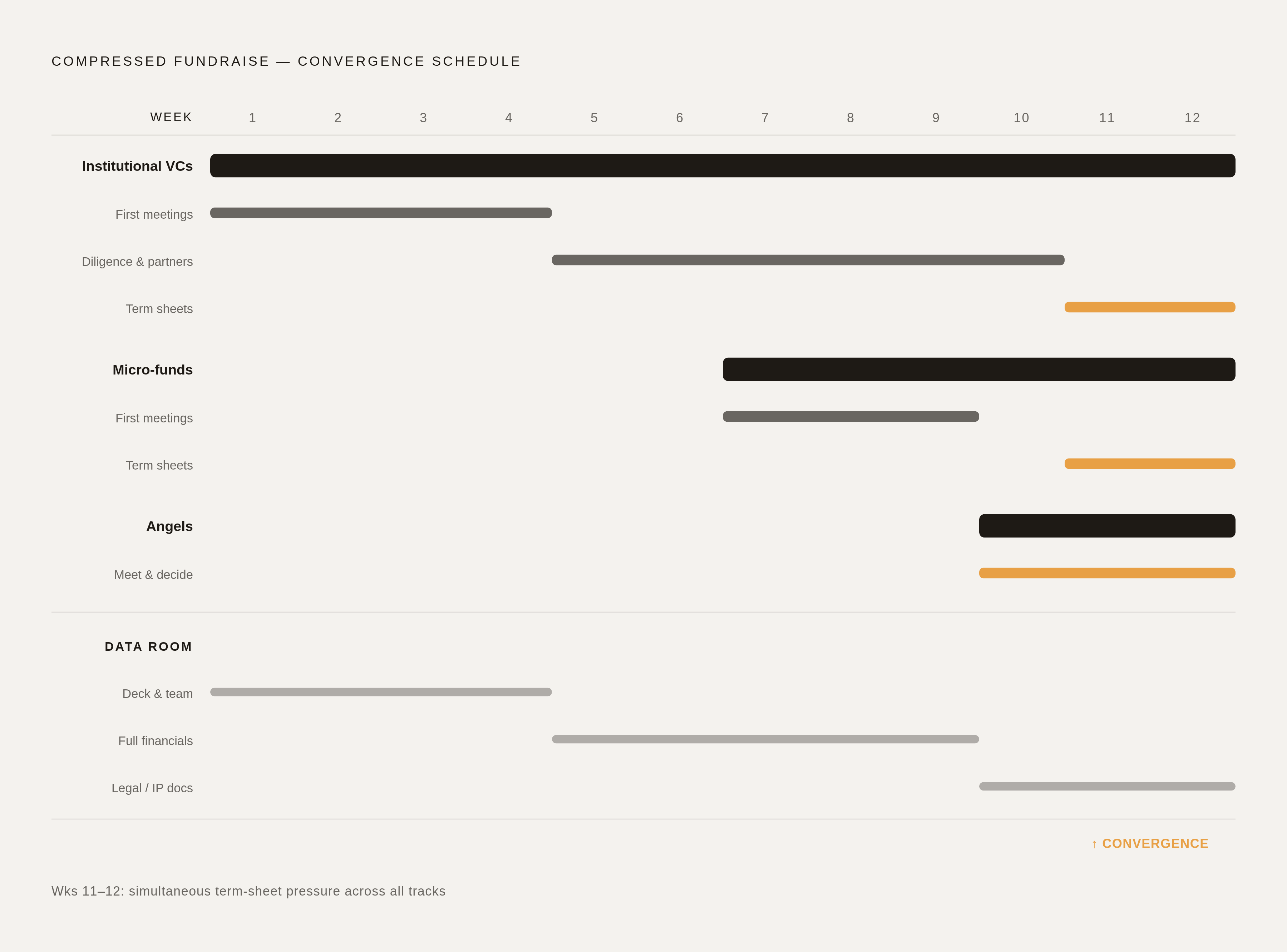
Meetings should land in batches rather than drips. Spreading Tier 1 investor meetings across four months of scattered scheduling eliminates any sense of urgency before it forms. A practical structure is to schedule first meetings with top-priority targets close together within the first four weeks.
Investor type changes the timing math. Angels and micro-funds can say yes in under a week, which makes them useful for generating early momentum. Institutional VCs typically take six to eight weeks from first meeting to term sheet, so they need to enter the calendar earlier even though they will finish around the same time as faster-moving investors. Starting slower investors first and timing faster ones to catch up means multiple decisions converge near the same date instead of trickling in over months.
Build slack into the diligence timeline as well. Whatever an investor estimates for due diligence, plan for meaningfully longer, because new questions and document requests appear almost every time regardless of how clean the initial data room looks. The timeline must be built before the first outreach email goes out, because once conversations are scattered across different stages, there is no way to retrofit a clean structure onto a disorganized start.
Segment your target list before outreach begins
A pipeline of 100 or more target investors is the realistic starting point for creating real competitive tension. Most seed rounds run through 40 to 80 investor conversations before a term sheet appears, so a shorter list runs out of room quickly.
The list gets built before outreach starts, not during it. Sending 50 emails in a single day creates momentum. Trickling out five a week for ten weeks does not.
Segmentation determines what materials go out and when. Stage, check size, sector focus, decision speed, and geography all change what a useful conversation looks like. A corporate investor weighing strategic synergy needs a different conversation than a VC evaluating scale potential, and sending them the same deck at the same cadence wastes both meetings.
Allied Venture Partners recommends defining an Ideal Investor Profile before the list is even built, covering sector, stage, check size, and recent deployment activity verified against real data rather than assumptions about who is supposedly active.
Internal fund dynamics shape deal outcomes more than founders typically recognize. Associates and principals shape the investment memo that brings a deal in front of partners, and championing a weak deal costs them credibility inside their own fund. That makes them worth engaging seriously as allies rather than routing around on the way to the partner who signs the check. Decision-makers at larger funds also carry more risk appetite than the associates screening deals for them, since the upside incentive sits higher on the org chart. Pitching each level differently reflects the fact that they are weighing different considerations.
Signal NFX, AngelList, and Crunchbase remain the standard tools for building this list from scratch.
Track 50-plus conversations without losing signal
The investor pipeline worksheet is the tool that holds the whole process together: firm name, current stage, last touchpoint, check size, and the next required action, all in one view. It works consistently from pre-seed through Series A and is worth building properly the first time.
Once the list crosses 20 active conversations, a spreadsheet no longer holds up, and something closer to a CRM dashboard is necessary. Passive tracking fails at that volume because too many rows go stale without anyone noticing.
Qubit Capital's research into pipeline templates shows every row needs to capture firm, stage, last contact date, next action with a real deadline attached, and a conviction tier coded for weekly review. Founders juggling five or more live conversations who track meeting cadence, follow-up status, and partner sentiment together in one place consistently outperform those relying on a single status column.
Follow-up is a structural requirement. Investors are not ignoring outreach intentionally; they receive large volumes of it. Hustle Fund's advice is direct: email the same day as the meeting, and if there is no response within 3 to 4 days, follow up again.
Communication needs one designated point of contact across every track, usually the CEO, and every investor needs to hear the same news at the same time. If one investor learns about a new metric or milestone, all of them do, on the same day. An investor who finds out secondhand that they received information later than someone else loses trust in the process immediately.
Weekly pipeline reviews identify which tracks are moving, which have gone quiet, and where a follow-up is already overdue. That weekly discipline is the only mechanism that prevents conversations from dying without anyone noticing.
A strong data room compresses the diligence cycle
89% of investors now expect secure digital access to due diligence materials through a virtual data room, and that expectation begins at seed stage rather than Series B. Treating it as a later-stage formality creates avoidable scheduling delays.
A well-built data room can shrink the diligence cycle from roughly 8 weeks down to 3, which is the single largest time saving available anywhere in the process.
Tiered access makes the data room function as a tool for managing parallel conversations rather than simply a document repository:
- Early conversations get the pitch deck, market sizing, and team bios
- Serious diligence unlocks full financials and the cap table
- Conversations approaching a term sheet add employment agreements, IP assignments, and tax documents
Per-folder permissions mean each investor sees only what matches their stage in the process. That keeps sensitive material controlled and avoids handing a full cap table to someone who took one introductory call.
Engagement data is where a well-built data room earns its value. A shared Google Drive link tells a founder nothing about who is actually reading anything. A proper data room shows exactly which investors are engaged and which are not. One documented example from the field: a founder spent weeks following up with a VC who had never once opened the room, while a different investor had already spent significant time reviewing the financials and cap table without the founder knowing until they checked the activity log.
The failure modes that quietly kill momentum are almost always the same three: a financial model dated months back, a cap table missing the most recent SAFE, and missing IP assignment agreements. One seed-stage founder had two co-founders and three early contractors with no signed IP assignments. A VC's legal team flagged it in week one of diligence. It took six weeks to resolve, the original term sheet expired during that period, the lead investor walked, and the raise ultimately closed on worse terms than what had been available before the delay.
Updating the data room every month signals to every investor watching that operations are well managed, which matters when several of them are evaluating the same company at the same time.
Use a term sheet to accelerate other conversations
The moment a term sheet arrives, check two things first: the expiration date and whether there is an exclusivity or "no-shop" clause attached. A 30-day exclusivity window blocks soliciting brand-new investors, but it does not prevent a founder from notifying investors already in the pipeline that a deadline now exists.
The standard language for that conversation, drawn from multiple sources in the space: "We've received a term sheet that requires a decision by [Date]. We hold your firm in high regard and would welcome the opportunity to consider an offer from you before then." That message puts a real deadline in front of an investor who might otherwise allow the conversation to drift for another month.
Knowing market baselines matters when evaluating terms. Cooley's Q2 2025 data shows 98% of deals used a 1x liquidation preference, 95% were non-participating, investor veto rights appeared in over 90% of rounds, and pay-to-play clauses appeared in about 10% of deals. Carta's Q2 2025 data puts median seed ownership by lead investors around 12.6%. Knowing these figures means negotiating from a position of market knowledge rather than anchoring to whatever number an investor introduces first.
With two term sheets in hand, the leverage becomes specific: "Firm A offered 1x non-participating at a $15 million post-money. Can you match those terms at your proposed $20 million post?" That is a direct comparison based on real offers, and it is the concrete form that competitive tension takes once there is paper on the table.
Fabricating competing offers or artificial deadlines collapses the moment an investor's diligence team asks questions, and they routinely do. Genuine market interest carries real weight in a negotiation; a fabricated offer is a liability that will surface during diligence. A legitimate investor who believes in the company will give it reasonable time to review, so there is rarely a need to manufacture urgency that authentic parallel process would have created anyway.
For earlier-stage raises where a formal term sheet is not yet available, tranche structuring accomplishes similar work. Breaking the raise into sequential tranches with rising valuation caps creates real commitment pressure without requiring a signed term sheet, which is the mechanism behind the Hustle Fund example where post-money valuation roughly doubled.
Build investor relationships before and after closing
Before a raise starts, the strongest founders are already building familiarity by sending monthly updates to potential investors long before there is an ask attached. Investors prefer watching a company execute over time to evaluating it from a single pitch meeting, and a year of consistent updates does more convincing than any one conversation.
That habit continues after the round closes. Every monthly update after closing functions as preparation for the next raise. Investors track founder consistency across six to twelve months before deciding whether to write another check, and a sharp, regular update rhythm reduces the friction of Series B diligence long before that process officially begins.
Allied Venture Partners frames this well: a pass should not be treated as a permanent decision. Regular updates and tangible traction milestones keep previously passed investors engaged, so the investor who declined at seed is not necessarily unavailable at Series A.
Once a lead investor commits, the remaining conversations shift from persuasion to allocation, using the lead's commitment as evidence of quality to draw in the rest of the round. Once one serious name commits, subsequent investors have a reference point that reduces their perceived risk.
Tracking conversion at each stage, from first meeting to second meeting and from second meeting to term sheet, shows exactly where the narrative lost traction. That data explains the current raise and provides a blueprint for improving the next one.
The habits that make parallel process work, tight tracking, batched outreach, deliberate sequencing, and a data room that stays current, are the same habits that build a durable investor base rather than a single closed transaction.