Automating Fundraising Outreach and Follow Up
Strategy without execution wastes automation; define your goal before choosing tools.

Fundraising automation runs on four steps: prepare, target, reach, and track. If you skip the first one, the rest fall apart, because no tool can fix a goal you never defined.
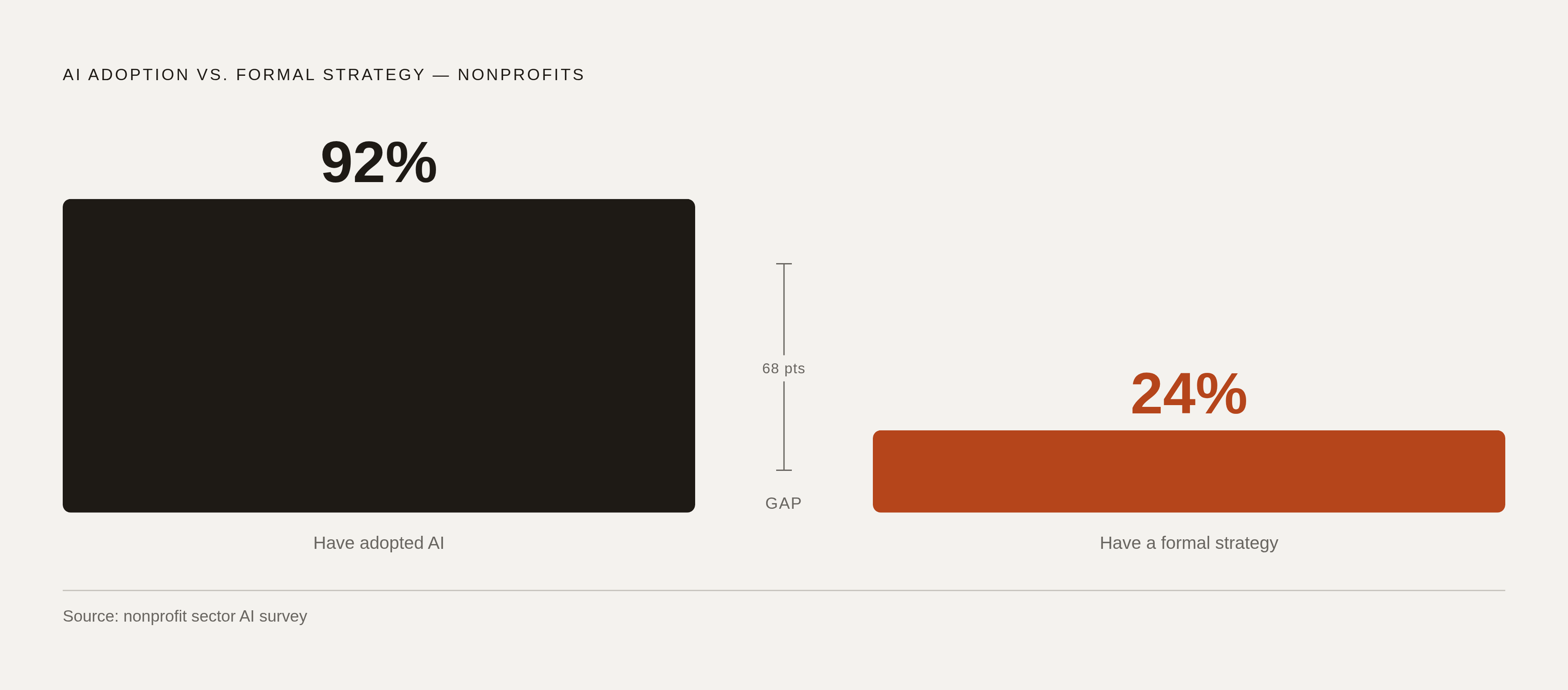
Adoption of AI in the nonprofit sector is nearly universal now. The 2026 Nonprofit AI Adoption Report puts the number at roughly 92%. Raisely's 2025 Fundraising Benchmarks study found 47% of fundraisers see AI as their biggest opportunity in digital fundraising, yet only 24% have a formal strategy behind it. That gap between broad adoption and shallow execution is exactly where automation breaks: it ends up adding noise instead of saving you time.
Two groups are running fundraising automation right now, and they rarely talk to each other. Nonprofits are automating donor outreach and stewardship. Startup founders are automating investor research, targeting, and follow-up. The mechanics overlap (find the right person, message them well, follow up on time) but the audiences, the ethics, and the content diverge enough that mixing advice for one into the other produces bad guidance. This piece covers both, labeled clearly, so you can go directly to the section that applies to you.
Prepare Before You Turn Anything On
Nonprofits need to pick a goal before picking a tool. Efficiency on admin tasks, donor retention, major gift identification, and grant prospecting are four different problems that call for four different automation setups. A platform built to speed up data entry will not help identify a lapsed donor worth a personal call.
Founders have their own version of this. The data room needs to exist before the pitch deck is polished. Retention numbers, unit economics, and a pipeline a skeptical partner can check in five minutes belong in the room before anything else.
Before any of this goes live, build a written framework for how AI gets used. Tie it to your organization's actual mission and values, and include a plan for what happens when something goes wrong in a live message. Research finds that around 92% of nonprofits feel underequipped for the changes AI brings. That makes training a prerequisite for your team, not an afterthought. Implement new systems during a slower stretch of the calendar, not mid-campaign, and set success criteria that match the actual goal. If the goal is retention, track retention. If it is engagement, track engagement. Strategy, scope, and governance policy all need human approval before a sequence runs.
Target the Right People With Predictive Tools
On the nonprofit side, predictive tools are doing real work here. DonorSearch Ai runs custom machine learning models to flag donors likely to give repeatedly and non-donors likely to give for the first time, going beyond basic wealth screening into engagement signals and giving history. Kindsight's Intelligence module, inside its Ascend platform, surfaces the highest-impact prospects and suggests the next best action using giving history and relationship data. Its companion tool, Look-alike Search inside iWave, finds mid-level donors whose profiles resemble the organization's top givers. EverTrue Signal builds prioritized outreach lists from recent donor activity and suggests when and how often to follow up. Segmentation tools now run sentiment analysis on donor communications, which helps identify who is at risk of lapsing before they actually do.
Founders face a version of the same problem with venture capital instead of donors. AI has significantly cut down the amount of time it takes to do investor research. Crunchbase remains the backbone for funding history and portfolio data, and it added AI-generated company summaries in 2024 and a real-time funding signal feed in 2025 (Pro runs $29 per seat monthly, Enterprise starts near $5,000 a year). Fundra leans into warm intro paths and activity signals at $79 a month. Evalyze handles investor matching and deck feedback at $20 a month. CapitalReach bundles matching, outreach, and a CRM pipeline into one workspace for founders who prefer not to juggle multiple tools.
In both contexts, your target list is the output of good research logic, not the starting point. Bad targeting produces a list of people who were never going to say yes, and no amount of clever messaging will fix that.
Reaching Out: Automate Drafts, Write the Voice
Kindsight's Personalized Donor Outreach tool drafts donor emails and call scripts blended with an institution's own brand voice, so a first draft actually sounds like the organization instead of a generic template. Generative AI handles repetitive writing tasks well: drafting solicitation emails, translating copy, adjusting length, building out grant proposal frameworks, and generating subject line variations. None of that replaces a writer; it gives a writer a faster starting point. Use specific, detailed prompts. Include the audience, tone, prior donor history, and the actual ask. A human editor can then shape the output into a final draft in minutes rather than an hour.
On the founder side, AI can pull an investor's recent activity, such as a portfolio announcement or a podcast appearance, draft a reference to it, and produce an email that is roughly 90% complete. You write the opening line in your own voice and adjust the tone based on how well you actually know this person. By 2026, investor inboxes are saturated with outreach drafted by automated tools, and investors can identify a templated line referencing "your recent investment in [Company]" almost immediately. A poorly automated pitch can get a founder flagged in shared pass channels before the outreach sequence even finishes running.
A few tools blend database and drafting functions. Tanka markets itself as a "fundraise agent," building decks, refining business plans, running mock investor interviews, and facilitating VC introductions. Leopard AI works as a research and sourcing tool, with pricing starting at $199 a month.
AI output is a first draft, never a finished product. One study found a 15% hallucination rate as the lowest recorded across a range of generative models tested. Check every fact, every number, and every claim about impact yourself before it reaches a donor or investor.
Track Follow-Up So Pipelines Stay Warm
DonorPerfect automates follow-up tasks triggered by donor actions, helping teams handle acknowledgment and record-keeping without manual effort. A Zapier, OpenAI, and Raisely combination can auto-generate personalized thank-you emails for high-value donors. DonorDock keeps things lean on purpose, capping workflows at ten triggers, thirteen actions, and twenty steps, sized for small teams that do not need enterprise complexity. CharityEngine's SustainerIQ manages recurring gifts and payment updates automatically, freeing staff to build relationships instead of chasing failed credit card charges. Virtuous builds full email sequences tied to donor behavior, so the communication a donor receives stays consistent across touchpoints. EverTrue Signal helps prioritize follow-up timing rather than leaving it to a fixed calendar.
Follow-up automation matters more this year than in previous years for a specific reason: AFP's Fundraising Effectiveness Project found fewer donors gave in 2025, the fifth straight annual decline. When the donor pool is shrinking and new-donor acquisition costs keep climbing, retention becomes the most cost-effective lever available, and a well-timed automated follow-up directly supports retention. Automated welcome series consistently outperform standard fundraising sends on engagement, making them a reasonable starting point for any team that is still skeptical.
As a founder, drive your follow-up from engagement signals rather than arbitrary calendar reminders. Papermark builds AI-powered data rooms with page-by-page analytics: which slide an investor lingered on, which financial projection held their attention, and which sections prompted a second look. A real-time notification when an investor opens the deck becomes the follow-up trigger. Papermark's AI can also summarize the deck and surface key metrics for the investor reviewing it, which reduces friction in their review process (free tier available, Pro at $24/month, Business at $59/month). Cherub combines data rooms with investor matching and has a free tier. Easy VC runs investor matching and outreach automation at $119.99 a month, or $89.99 if paid annually.
According to Nathan Chappell, chief AI officer at Virtuous and co-founder of Fundraising.AI, predictive and generative AI are converging into a single assistant. A fundraiser logs in and sees both a ranked list of who to contact and a drafted message reflecting that donor's specific history, in one place, without combining multiple tools.
Keep Human Judgment Where It Counts
A benchmark study from Virtuous and Fundraising.AI, covering 346 nonprofits, found nearly half have no AI governance policy at all, which means a large number of automated systems are running without any documented rules about what they are permitted to do.
There are three categories of decisions you should never let run without human review. Major relationship moments, such as a major donor solicitation or a lapsed-donor re-engagement at a significant gift level, carry too much weight for an unreviewed message to slip through. Content accuracy and brand claims need human review every time, whether in a grant proposal or an impact story with a specific number attached. Strategy changes, including resetting a segmentation model, retiring a follow-up sequence, or changing how donors are described, are calls that automation can flag but should not make independently.
The same logic applies if you are a founder. AI drafts, you decide, and you send. No sequence should fire off a first message to a new investor without your review. If you let automation run donor stewardship without review, your outreach starts to feel less genuine to recipients. Donor trust is the asset you deplete every time that happens. TechSoup and Tapp Network's research found 85.6% of nonprofits exploring generative AI tools, against just 24% with a formal strategy guiding that use. Building a human approval checkpoint into every workflow at the exact moment AI output is about to reach a real donor or investor prevents your experiments from failing at scale.
Measure What Actually Matches Your Goal
Your measurement has to match whatever goal you set in the prepare phase. Retention automation gets measured on retention, not open rates. Investor outreach gets measured on meetings booked, not emails sent. Measuring the wrong thing leads to celebrating a metric that has nothing to do with the problem you set out to solve.
For nonprofits, four numbers matter most. Donor retention rate over time is the most important, especially given AFP's data showing a five-year decline, so automation should be visibly improving that number. Engagement rates on automated sequences, benchmarked against standard sends, provide a useful performance signal. Conversion rates on prospecting lists generated by predictive tools show whether flagged high-propensity donors are actually converting at a higher rate. And per Kindsight's research, 30% of nonprofits report AI tools increased fundraising revenue over the past year, which serves as a useful benchmark.
For founders, two numbers do most of the work. Response rate on initial outreach shows whether targeting and personalization are landing; a low response rate on a heavily personalized sequence points to a targeting problem rather than a writing problem, and those require different fixes. Deck engagement analytics from tools like Papermark complete the picture: which slides receive real attention, which sections generate follow-up questions, and where investors lose interest.
Automating the drafting step without a human reviewing it is where most of these systems quietly fail. Templates handle repetitive work well: subject lines, cadence, and reminder timing. Anything involving a factual claim, a competitive comparison, or a shift in relationship tone requires a person responsible for the decision. Letterbrace, for one, builds human approval into every structural decision before a message goes out, treating automation as a tool for repetition rather than judgment. That division should govern any fundraising sequence: let the machine handle what is genuinely repetitive, and keep a human in charge of the voice, the offer, and anything said about the organization's track record before the first message ships.