AI Startup Valuations and Market Dynamics
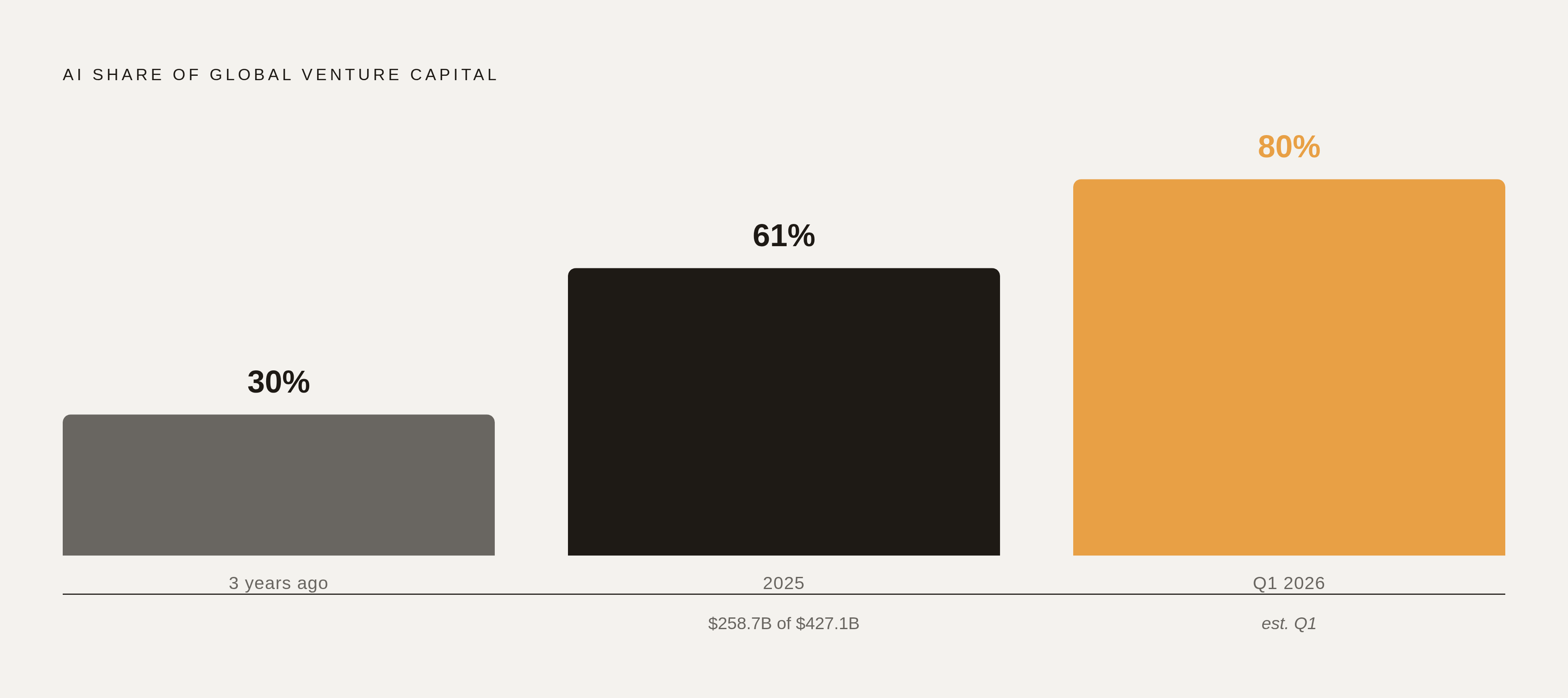
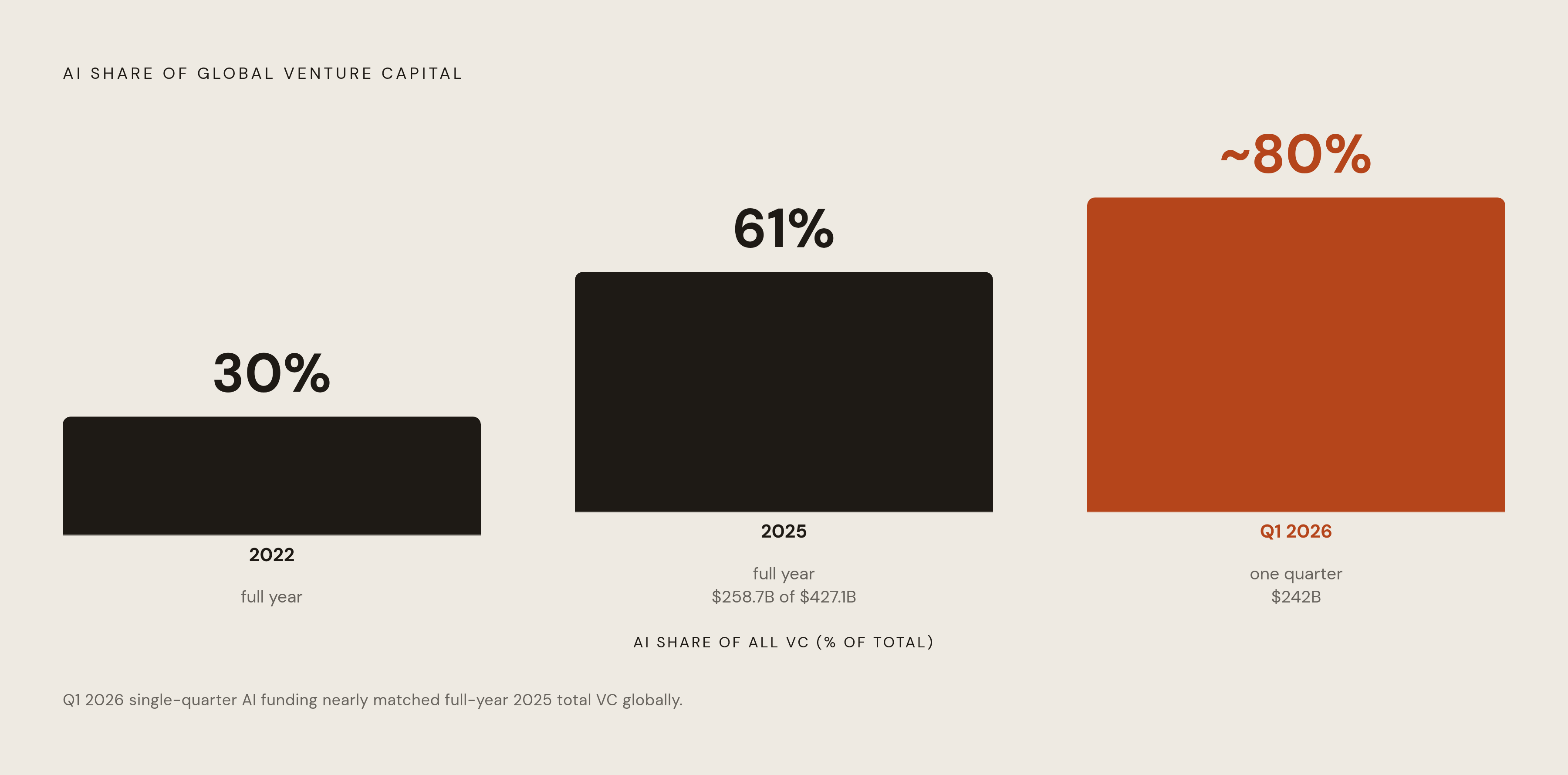
AI startups captured 61% of global venture capital in 2025.

- Written by
- Ravi Quist
- Updated
- September 17, 2026
- Reading time
- 9 min read
- Sources cited
- 5 sources ↓
What this covers
AI startups grabbed 61% of all global venture capital in 2025. That's $258.7 billion out of $427.1 billion total, per OECD data, up from 30% just three years back. AI's share of global venture capital doubled in roughly three years, driven by a wave of foundation model companies, agentic AI platforms, and infrastructure providers attracting capital at a scale and pace the startup market hasn't seen before. Understanding what's behind these valuations, which metrics investors actually use, where capital is concentrating, and what risks are building underneath the headline numbers, matters for anyone trying to make sense of where this market is heading.
2026 isn't cooling off either. Q1 alone brought in $242 billion for AI startups, roughly 80% of every venture dollar spent globally that quarter. The full corporate picture combining VC, private equity, and M&A hit $581.7 billion in 2025, more than double 2024's $253 billion and well past the old record of $360 billion set in 2021. Deal count backs this up: 7,646 rounds closed in 2025, a 50% jump past the 2021 peak, according to Aventis Advisors. The whole market got bigger, everywhere, at the same time.
The largest AI valuations right now
Anthropic hit $965 billion after its Series H in May 2026, while OpenAI sits at $852 billion. Two AI labs are now worth more than nearly every public tech company on the planet, and one of them didn't exist ten years ago.
OpenAI's climb has its own logic. Back in October 2024, it raised at a $157 billion post-money valuation, roughly 46 times its annualized revenue of $3.4 billion at the time. Anthropic's path is more striking: it started 2025 at $61.5 billion after a $3.5 billion Series E, then by September had raised a $13 billion Series F at $183 billion, tripling its valuation in approximately six months.
The foundation model duopoly isn't the whole show. Anysphere, the company behind Cursor, raised $900 million at $9.9 billion in June 2025. Safe Superintelligence reached a multi-billion-dollar valuation without a shipping product. Thinking Machines Lab, founded in February 2025 by former OpenAI CTO Mira Murati, raised a multibillion-dollar seed round within months of opening its doors. The combined value of AI unicorns has grown sharply, with OpenAI and Anthropic alone accounting for a significant share of the sector's total private market worth.
Valuation multiples vary by stage and category
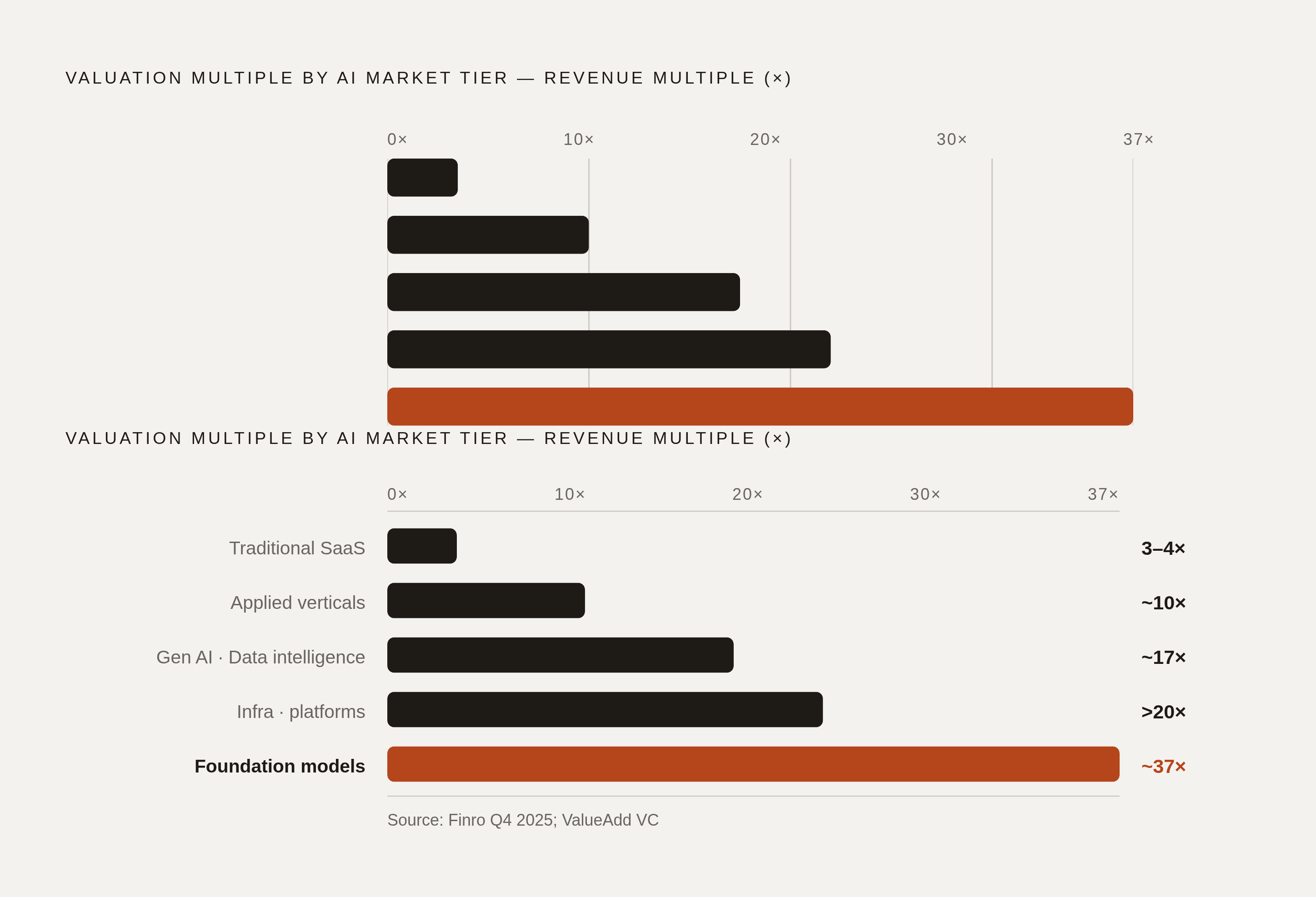
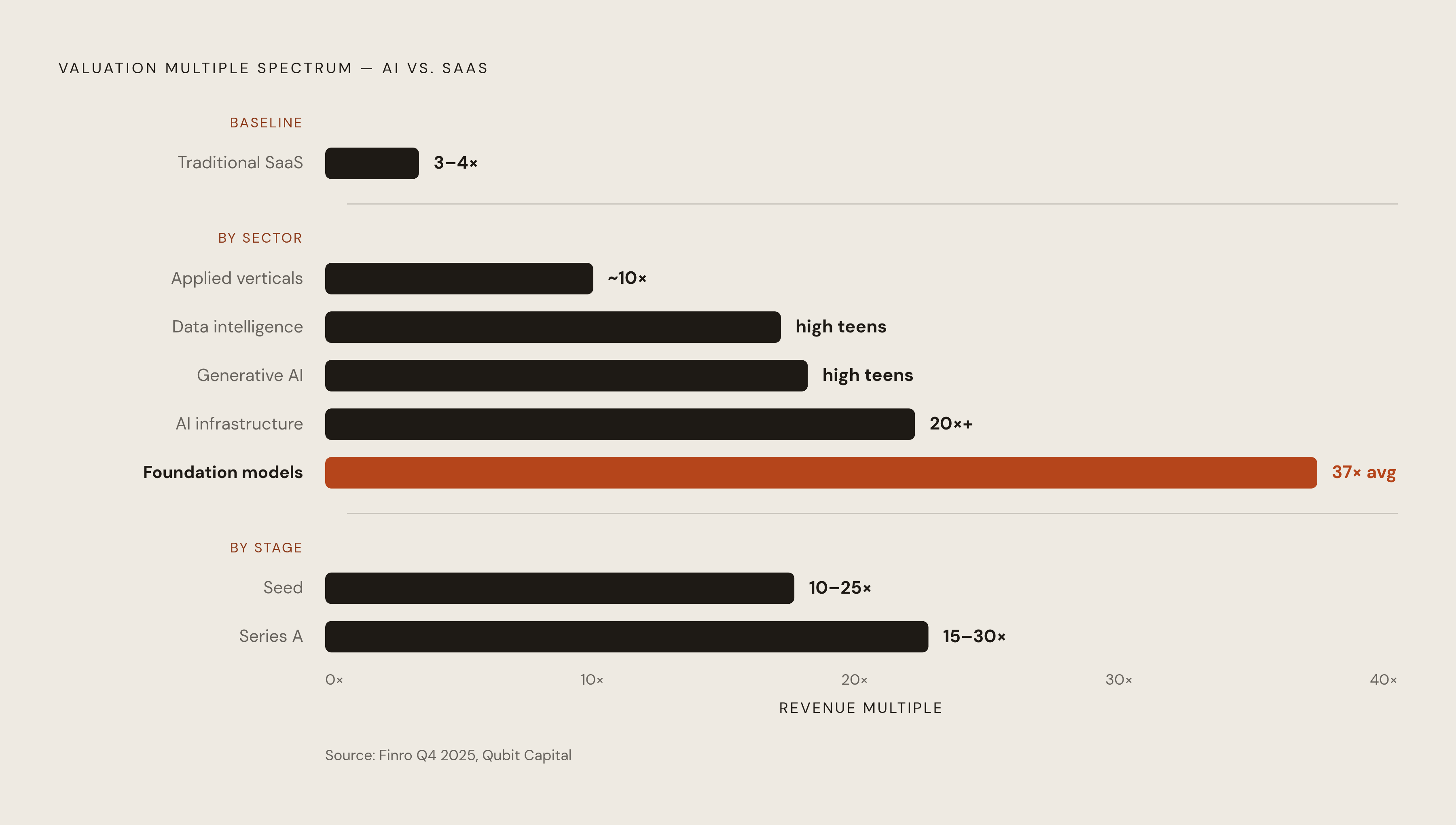
Foundation model companies trade at revenue multiples that would be difficult to justify using standard public market benchmarks. ValueAdd VC puts the average around 37x revenue, against roughly 3 to 4x for traditional SaaS.
Stage matters too. Seed deals run 10x to 25x revenue, per Qubit Capital. Series A sits in the 15x to 30x band, with LLM infrastructure plays sometimes exceeding that ceiling. Late-stage rounds still carry a significant premium over what a SaaS company at the same stage would receive.
Sector positioning matters just as much. AI infrastructure and platform companies pull the highest multiples, north of 20x on average according to Finro's Q4 2025 numbers. Generative AI and data intelligence follow close behind in the high teens, while applied verticals such as HR tech, prop tech, or ed tech with an AI layer trade noticeably lower.
Databricks versus Snowflake makes this concrete. Databricks carries a real valuation premium over Snowflake despite nearly identical revenue, and the gap traces straight back to how much of that revenue comes from AI workloads. Where a company sits in the stack, whether at the infrastructure or application layer, determines which pricing rules apply to it.
What investors are actually paying for
Most of an AI startup's appraised value doesn't come from anything you can touch or count. Lucid's analysis found that intangible assets, including proprietary algorithms, exclusive training data, and the depth of a technical team, make up the large majority of the valuation, with investors pricing potential rather than existing inventory.
Four things drive that premium over traditional SaaS math, per ValueAdd VC. Winner-take-most dynamics come first: investors are betting that a handful of foundation models will capture most of the long-term value in the space, the way a small number of search engines or social networks did in prior tech cycles. Second, growth at a scale that breaks standard models, since triple-digit year-over-year growth on top of multibillion-dollar revenue bases is not historically common, yet the data from 2024 and 2025 shows it happening consistently. Third, strategic capital from the hyperscalers: Microsoft, Google, and Amazon have made direct equity bets in the labs they host, creating a valuation floor that doesn't respond to standard discounted cash flow logic. Fourth, compute access works as a structural moat, since training a frontier model requires infrastructure controlled by a small number of cloud providers, the same ones holding equity in the companies they supply.
Data ownership carries real weight too. A documented, defensible proprietary dataset can move a valuation meaningfully, per Lucid's research.
The hyperscaler dynamic creates a closed loop worth examining. The same three companies supplying the compute also hold the equity, and their continued backing functions as a structural safety net, which then raises the price everyone else pays to participate in subsequent rounds.
Capital is concentrating in very few companies
Mega-deals, rounds above $100 million, made up a dominant share of total AI investment value in 2025. The top foundation model labs have each raised at scales that place them in a category apart from the rest of the market.
Unicorn formation tells the same story from a different angle. AI and machine learning startups account for a large majority of new unicorns minted in recent years, and fast growth and fast concentration are moving together.
As mega-deals have grown to dominate total AI investment, earlier-stage companies have found themselves competing for a narrowing slice of available capital. A startup outside the infrastructure or foundation model tier is competing for a smaller share of available capital every year it remains in that lane. The headline statistics, $258.7 billion raised and 61% of all VC, describe a market where a handful of rounds set the tone for how the entire sector gets perceived, including by the startups that never come close to those numbers.
There is a feedback loop embedded in this structure. Large strategic investors validate high valuations, which pulls in more capital, which raises the floor for the next round, and that dynamic is a significant reason deals close faster than they used to.
Funding rounds are closing much faster now
Anthropic tripling from $61.5 billion to $183 billion in six months is the clearest example of compressed timelines at scale this market has produced. Fortune's reporting from late 2025 documented AI valuations doubling and tripling within months as back-to-back raises became something close to standard practice.
Several factors are driving this speed. Revenue growth that outpaces the traditional annual re-underwriting calendar is part of it: a company at $3.4 billion in ARR and growing triple digits annually is a fundamentally different business six months later. Competitive pressure among investors plays a role too, since the perceived cost of missing a round now outweighs the perceived risk of overpaying for one. Hyperscalers are not purely chasing financial returns, so they will accept terms that a financial-only investor would reject.
When valuations move faster than anyone can independently verify the underlying numbers, the gap between price and evidence widens.
AI metrics differ from standard startup benchmarks
Traditional SaaS benchmarks, the sub-5x revenue multiples common in public markets, don't apply to AI infrastructure or foundation model companies, and nobody in the market is pretending otherwise at this point.
Growth trajectory replaces current margin as the primary signal: triple-digit annual revenue growth at the scale Anthropic and OpenAI have shown changes the denominator on any multiple within a single year. Market capture probability replaces present cash flow almost entirely. Investors are pricing a company's expected share of a future market, a version of the logic that drove 1999 internet infrastructure bets, except this time the underlying revenue is real and growing. Strategic optionality matters too, since hyperscaler equity means part of a company's value is tied to what it's worth to a future acquirer or partner, not to a standalone cash flow model.
For AI-specific due diligence, different factors carry weight: proprietary data ownership and how well it's documented, compute access and the strength of infrastructure relationships, the background of the founding technical team (Thinking Machines Lab reached a multibillion-dollar valuation largely on founding-team pedigree), and how much revenue is genuinely AI-driven versus legacy product revenue with new branding applied.
Safe Superintelligence represents the extreme version of this valuation logic: a large valuation, no shipping product, with the market pricing pure future potential anchored almost entirely to the winner-take-most thesis. That thesis hasn't been tested by a real downturn yet.
Fastest-growing sectors beyond foundation models
Agentic AI was the breakout category of 2025, drawing a surge of investor interest and capturing a notably outsized share of funding relative to prior years. Agentic systems, which handle discrete business tasks autonomously rather than simply responding to prompts, represent the nearest-term path for enterprises to extract measurable returns from foundation model capabilities, which is why investors are treating the category differently from earlier waves of applied AI.
Within agentic AI, customer service and sales applications attracted significant investor attention across recent funding cycles. Healthcare AI drew growing interest from crossover and strategic investors. Defense AI emerged as a meaningful category in 2025, anchored by large rounds at companies like Anduril.
These sectors trade at lower multiples than foundation model infrastructure, sitting toward the bottom of the AI range in Finro's Q4 2025 data. The risk profile is different too, since revenue in these verticals tends to tie back to specific enterprise contracts rather than a probabilistic bet on future market share.
Capital concentration signals real structural risks
Yale School of Management's framing is worth borrowing here. The classic warning signs of an overheated market, rapidly rising prices, compressed due diligence, fear-driven capital allocation, and winner-take-most assumptions priced as certainties, are all visibly present. What distinguishes this cycle from past ones is that the underlying revenue growth is real, not hypothetical.
That doesn't eliminate the risks. There is a widening gap between valuation and evidence: when Anthropic's price tripled to $183 billion on a $13 billion raise, the implied 36.6x revenue multiple reflects a price well ahead of any straightforward revenue-based anchor. Concentration risk is significant, with roughly 73% of AI investment sitting in mega-deals and two companies making up a tenth of total unicorn value, meaning the sector's overall health depends heavily on a small number of names performing. Hyperscaler dependency creates a structural vulnerability: the same backstop propping up valuations, specifically Microsoft, Google, and Amazon through compute supply and equity, doubles as a point of failure. A strategic shift at any one of them moves the floor for the broader market. And multiple compression is a plausible outcome on the application layer: as foundation model capability becomes more commoditized, applied AI startups carrying an AI premium may see those multiples revert toward standard SaaS territory.
What separates this from a textbook speculative bubble is the scale of actual revenue. Anthropic was running at a $7 billion annual pace by late 2025. The winner-take-most thesis hasn't been disproven, but it hasn't been proven either, and every valuation coming out of 2025 and 2026 is a bet on that thesis, priced as though the outcome is already settled.
For anyone trying to evaluate one of these numbers, whether as an investor, a founder benchmarking a raise, or a buyer assessing a vendor, the size of the valuation is less useful than understanding where the company sits in the stack, what its revenue is actually composed of, and whether its multiple reflects documented growth or a thesis-driven premium. Proprietary algorithms and technical talent are the hardest things to verify from the outside, and they are doing most of the work in setting the price. Some AI companies now track how often they get cited by AI answer engines alongside standard search rankings, treating that visibility as a rough proxy for the intangible assets investors are pricing. The underlying challenge remains the same regardless: establishing what a valuation is actually made of before the next round reprices everything.
Methodology & sources
- https://aventis-advisors.com/ai-valuation-multiples/
Provided the 2025 deal count of 7,646 rounds and the 50% jump past the 2021 peak, as well as sector-level multiple data attributed to Finro's Q4 2025 numbers.
- https://fortune.com/2025/11/29/ai-startup-valuations-are-doubling-and-tripling-within-months-as-back-to-back-funding-rounds-fuel-a-stunning-growth-spurt/
Documented the pattern of AI valuations doubling and tripling within months as back-to-back funding rounds became standard practice.
- https://www.secondtalent.com/resources/ai-startup-funding-investment/
Supplied the Q1 2026 figures of $242 billion raised and 80% of global venture spend, as well as the Anthropic and OpenAI valuation figures.
- https://www.lucid.now/blog/ultimate-guide-ai-powered-startup-valuations/
Provided the analysis that intangible assets such as proprietary algorithms, training data, and technical teams make up the large majority of AI startup valuations, and supplied the 36.6x revenue multiple figure for Anthropic.
- https://valueaddvc.com/blog/ai-company-valuations-in-2025-how-the-top-ai-startups-are-being-priced
Provided the average 37x revenue multiple for foundation model companies versus 3–4x for traditional SaaS, and the four drivers of the AI valuation premium.