CRM Systems for Managing Investor Pipelines
Standard CRMs fail investor pipelines because relationships loop back, not close in straight lines.

Most CRMs get built for a sales team closing deals in a straight line: find a lead, work the lead, close the lead, repeat. Investor pipelines don't move like that. They loop back every few years when a new fund opens, and they run on relationships that outlast any single close. That mismatch explains why so many GPs end up bolting spreadsheets onto software built for an entirely different job.
Here's what the mismatch looks like day to day. Deal flow sits in one tool. LP relationship history sits in another. Portfolio monitoring lives in a spreadsheet one analyst maintains and nobody else fully understands. None of it talks to each other, so someone spends Tuesday afternoon copying numbers between tabs instead of doing actual work.
Worse: everything learned during a fundraise, who engaged, what they asked, where they went quiet, gets archived the day the raise closes. Eighteen months later, a partner walks into an LP annual meeting with no idea what got discussed last quarter, because that conversation lives in somebody's inbox instead of a shared record.
The gap only widens as a fund grows. More capital calls, more distributions, more LP touchpoints, more chances for a generic CRM to buckle under weight it was never designed to carry.
What Investor Pipelines Actually Demand
Relationship hierarchies are one major gap. An LP relationship spans multiple contacts across multiple companies: entities, households, allocators, consultants, gatekeepers, parent-child firm structures, all connected. A flat contact card can't hold that shape, and forcing it to try is how firms end up with three duplicate records for the same family office.
Fund cycles run long and involve many stakeholders. A single commitment might involve multiple people weighing in over many months. The system needs memory that spans fund cycles: how engaged this LP was during Fund II, who has the relationship with their CIO, when they last received a portfolio update. Losing that memory means re-establishing trust from scratch every fundraise.
Governance matters too. LP communications carry a level of sensitivity a shared sales CRM doesn't enforce by default. Reporting has to hold up under scrutiny, not as a sales dashboard built for quota tracking, but as touchpoint logs and coverage summaries that survive hard questions from a partner or an LP.
Fundraise pipeline visibility is its own requirement. Which LPs are at which stage, who has received materials, who needs a follow-up, where each commitment sits against the fund target. That has to run in the same platform as deal sourcing, or someone is re-keying the same data twice a week. Relationship health signals belong in that same layer: timestamps on every touch, flags on conversations gone quiet, and prompts on which introductions need following up. That is what turns stored data into actionable work for an IR team, and it is where AI has started showing up, scoring relationship health from interaction patterns and engagement signals, flagging LPs at risk of cooling before a re-up is lost.
How Top Firms Turn Relationship Data Into Edge
Affinity's analysis of more than 3,000 VC firms found the top performers made 16% more introductions year over year than their peers. Volume alone doesn't win. The edge belongs to whoever turns that volume into actual LP retention.
Speedinvest is a clear example. After investing in relationship infrastructure, the firm grew its coverage of future Series A rounds among European companies by more than 30%, according to Affinity. That growth came from better visibility into which portfolio companies and investors were already connected to which opportunities, not from a new sourcing strategy. Same network, better records.
The firms whose systems scale with rising contact volume pull ahead. The ones whose systems buckle under it fall behind.
Five Purpose-Built Platforms Compared
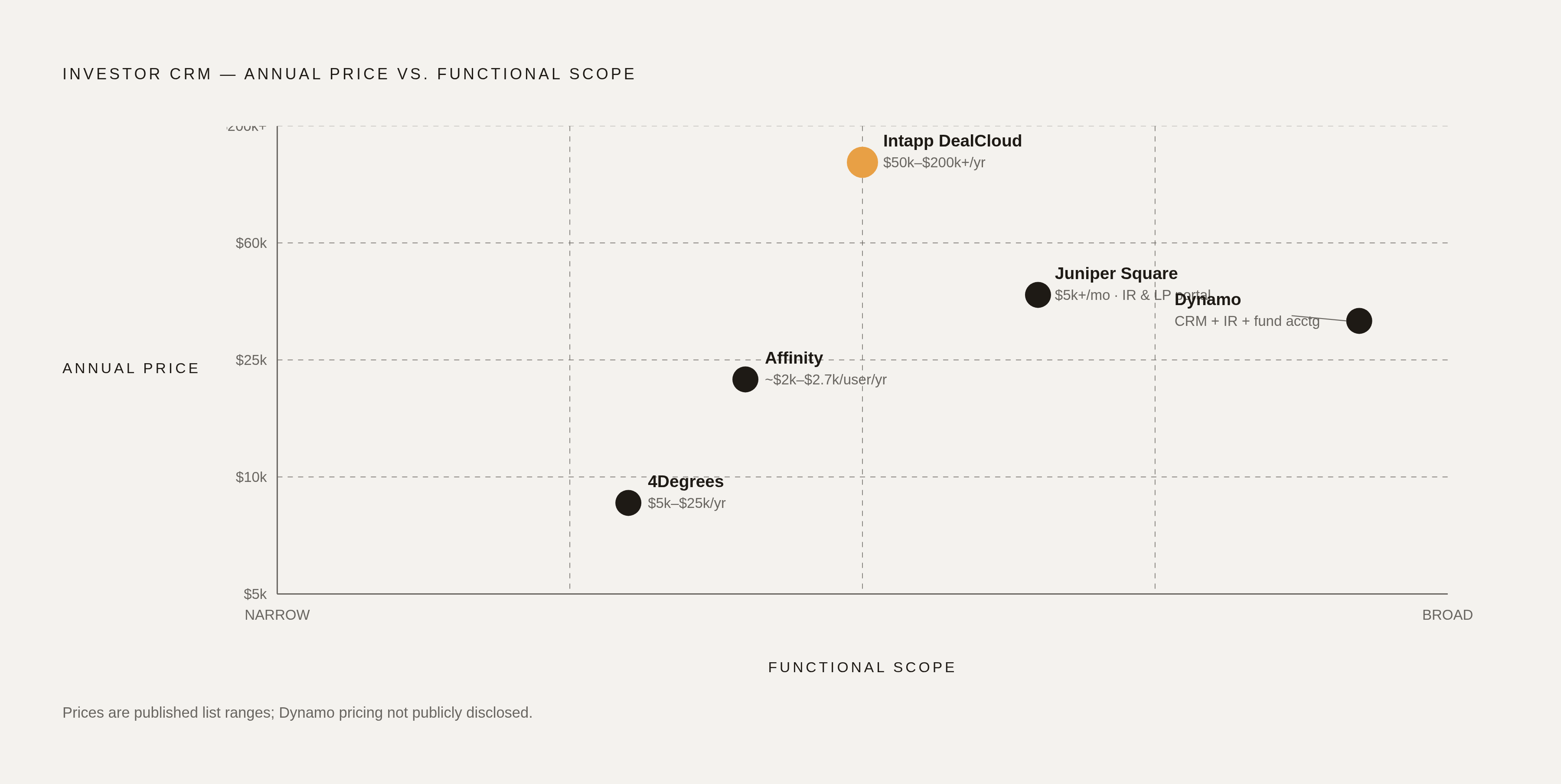
Intapp DealCloud is built for private capital specifically, designed as one record of truth for relationships, pipeline forecasting, and deal execution. It is the standard at large PE firms and investment banks, rated best overall for complex PE workflows and governance in FundCount's 2026 review. Pricing runs $50,000 to $200,000-plus a year, which is justified when partner-level reporting and multi-fund complexity are genuine requirements.
Affinity takes a different approach: it reads a firm's email and calendar data to build the relationship map automatically, so the system updates itself instead of waiting on someone to log a meeting. It is popular across PE, VC, and growth equity, priced around $2,000 to $2,700 per user per year as of March 2026. It fits family offices, growth equity shops, and search funders where relationship intelligence matters more than deep fund-accounting features.
4Degrees occupies similar territory at a lower price point, $5,000 to $25,000 a year, with automated contact enrichment, relationship-strength tracking over time, and a visual deal pipeline. It offers comparable relationship intelligence without the per-user pricing a premium platform like Affinity charges.
Dynamo bundles CRM, IR, a secure investor portal, portfolio monitoring, valuation, and fund accounting into one system. The benefit is that one record feeds everything downstream with no re-typing data between systems. The tradeoff is reduced flexibility, and a firm with strong tools already in adjacent categories may end up paying for modules it will never use.
Juniper Square received recognition for investor relations technology at the Private Equity Wire US Awards 2025 and has announced an AI CRM for Investor Relations aimed at automating investor workflows and deepening LP engagement. Pricing starts around $5,000-plus a month for the LP portal, with investor portal access and reporting sold as add-ons. It is oriented toward investor-relations needs rather than deal-sourcing needs, making it a better fit for firms whose primary challenge is the LP portal and reporting side of the business.
General-purpose tools are worth addressing directly, since they are not automatically the wrong choice for every firm. Salesforce works for transactional B2B sales but requires heavy customization to fit private markets. Pipedrive gives founders a simple visual pipeline for early fundraising, but the compliance features and relationship mapping do not hold up as a firm scales. Zoho CRM bundles into a broader business suite and costs little for early-stage founders, but it was not built with PE workflows in mind. A founder tracking 40 angels for under $30 a user a month is well served by Pipedrive. That tool stops being appropriate the moment multi-fund complexity and LP compliance requirements arrive, and firms that keep it past that point pay for it in manual rework.
How Firm Size Should Shape Platform Selection
A lean five-person PE firm can run CRM and data room together for under $500 a month using lighter tools. The legacy version of that same stack, DealCloud paired with Ideals, runs $10,000-plus a month. The gap comes down to what the firm actually needs versus what it is paying for, and plenty of small shops are still paying enterprise rates for features they rarely open.
A boutique firm's stack typically breaks into four layers: a CRM for deal sourcing and relationship tracking (Affinity, 4Degrees, or a lighter option in the $24 to $225 per user monthly range), a data room for due diligence, a market data source for screening deals, and an LP portal for reporting.
The signal to move to an enterprise platform is not headcount. It is complexity: multi-fund structures, formal LP governance, partner-level reporting requirements, and audit trails push a firm toward a platform like DealCloud regardless of team size.
Salesforce and HubSpot are capable tools, but every workaround built to approximate fund-cycle tracking or LP hierarchy inside them accumulates as technical debt. That debt becomes a problem when a fund closes or the person who built the workaround leaves. For a founder raising a first institutional round, a lightweight tool like Visible.vc covering pipeline, update delivery, and a data room for under $100 a month solves the actual problem without locking into enterprise pricing prematurely.
Where AI Is Changing CRM Workflows Now
The role of AI in this conversation is no longer a thing of the distant future. As of 2025, a substantial share of financial advisors already use generative AI tools built into their CRM workflows.
In practice, that means automatic meeting transcription that enriches an LP's record without requiring typed notes after every call. It means relationship health scoring that reads interaction frequency, response rates, and document engagement to identify which LPs are becoming less engaged. It means signal monitoring that watches for fund formation filings, leadership turnover at a target LP, commitment expiration windows, or portfolio exits, surfacing the right moment to reach back out. It also means sequenced outreach across email and LinkedIn, queued for human review before sending. Juniper Square's announced AI CRM for Investor Relations is a notable example of a platform building investor-workflow automation into the core product rather than adding it later.
None of this replaces judgment. When two LP relationships go cold at the same time, deciding which one gets the call first, or how to frame a difficult portfolio update to a specific person, requires knowing that LP's personality and history in a way no dataset fully captures.
The scoring is also only as good as the data feeding it. A firm with years of gaps from inconsistent data entry gets AI scores it cannot trust. Relationship health scoring should be treated the way a careful analyst treats any engagement metric: track what actually converts, meaning LP commitments and capital deployed, not spikes in activity that look good on a dashboard but predict nothing.
What Correct CRM Configuration Actually Looks Like
Three things have to work together. Automated tracking of every LP communication in real time, not entered manually by whoever remembers to do it. Fundraising pipeline visibility sitting in the same platform as deal flow, so the IR team pulls live numbers directly into an LP update instead of exporting from one tool and re-entering into another. And relationship context that survives fund cycles, so engagement history from Fund II is accessible when preparing Fund III outreach.
A few configuration choices separate a system that works from an expensive contact list nobody trusts. Pipeline stages need to match the fund's actual workflow, not a default sales pipeline with relabeled fields. The relationship hierarchy has to reflect how decisions are actually made at an LP: who is the allocator, who is the gatekeeper, who signs the LPPA. Permissions need to keep sensitive LP conversations visible to IR without broadcasting them to the whole deal team. Every contact record needs a named owner, because that is what keeps a warm LP relationship from going cold between one fund and the next.
The 16% gap in introductions made year over year from Affinity's benchmark is a real proxy for relationship activation, not just relationship storage. A CRM doesn't just support the strategy: it is the operational layer that makes a relationship strategy executable at scale. Firms that treat it as infrastructure are the ones whose IR teams walk into every LP meeting already knowing what matters.