Evaluating AI Startups as a Venture Capital Investor
Four founder traits now matter more than "AI-powered" alone.

- Written by
- Elise Beck
- Updated
- September 17, 2026
- Reading time
- 10 min read
- Sources cited
- 6 sources ↓
What this covers
Founders these days get judged on four things. Real technical difference from what's already out there, early customers actually using the product instead of just watching demos, a business model that scales, and a team that's thought about regulation before some regulator forces the issue. "AI-powered" used to open doors by itself, but now it's just the cover charge, and you can thank the first wave of chatbot wrappers slapped on top of GPT calls for that.
How AI startup evaluation differs from traditional software due diligence
Old-school SaaS diligence rested on one comfortable assumption: once the product worked, it kept working. Check churn, check the codebase, check whether the founders can hire, move on with your day. AI snaps that assumption in half. The product leans on a model the company doesn't own, the cost structure shifts every time a provider tweaks pricing, and the internals stay opaque in ways most investors, frankly, never trained for.
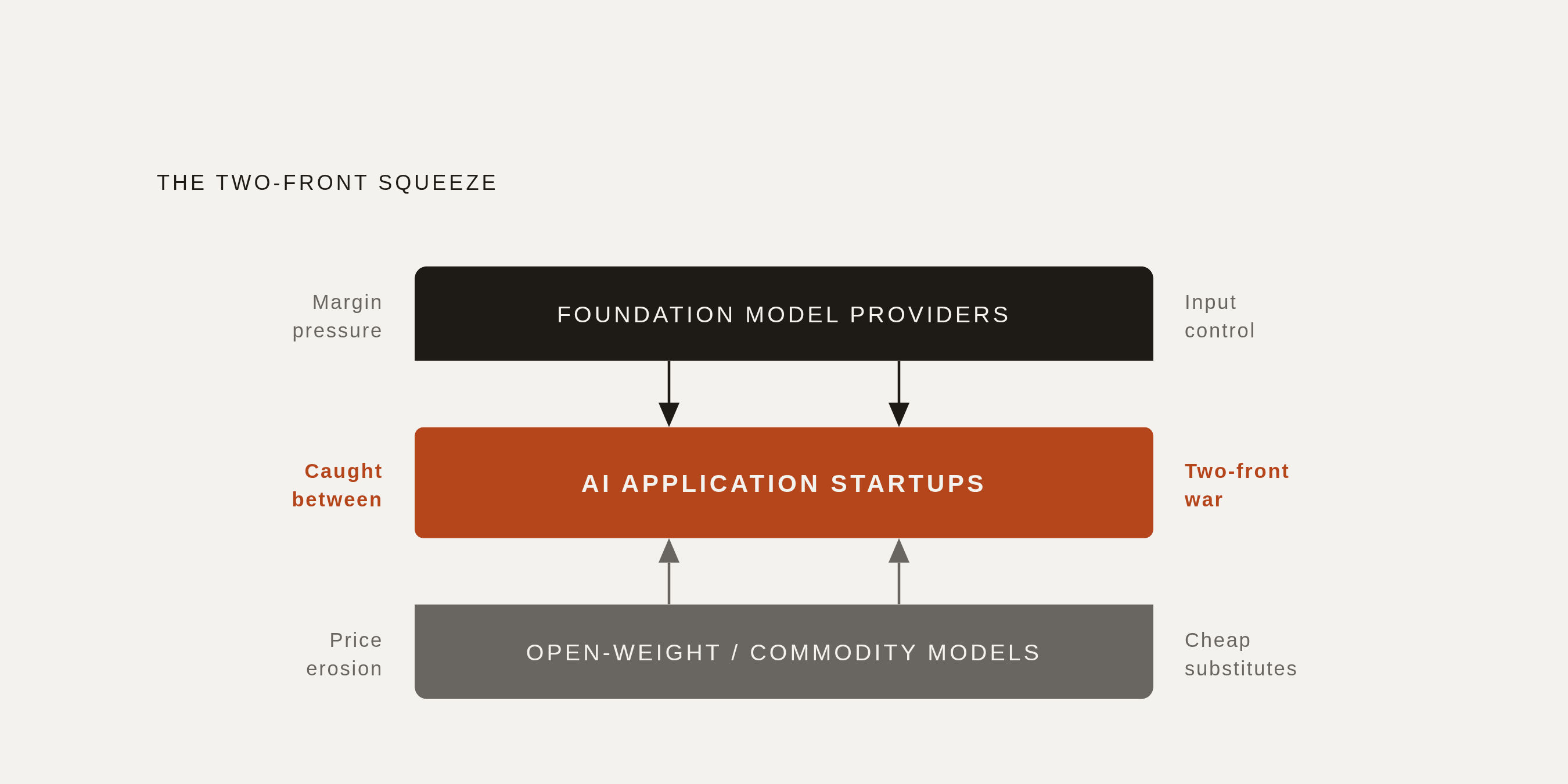
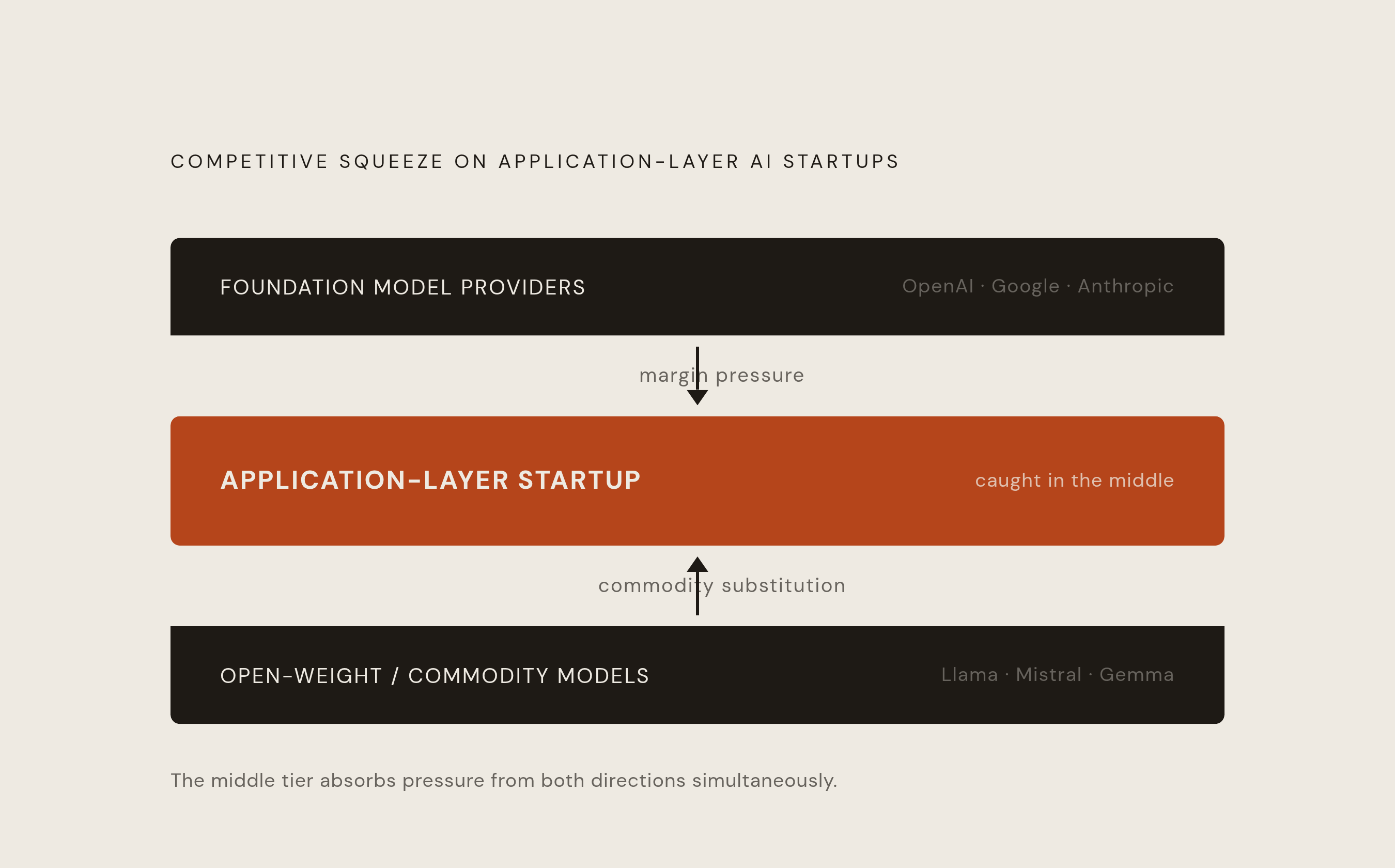
There's a structural squeeze underneath all of it. Foundation model companies sit above the application layer and control the input everyone else needs, so they can push margin pressure down onto anything built on top of them. Open-weight models are closing the gap from below at the same time, meaning the cheap alternative keeps looking less like a discount and more like a genuine substitute. A startup caught in the middle of that pincer is fighting a two-front war whether it knows it or not. These deals also move faster than a typical software round, so a bad read costs more, since there's no slow second look before the term sheet's already out the door.
What to look for in a founding team beyond technical credentials
At seed and Series A, team is still the whole ballgame, and investors will pay a premium for founders who came out of a frontier lab. But the pattern that actually holds up in strong teams is one lead engineer with real chops (published papers, patents, or scars from shipping a full AI system end to end) paired with a co-founder who's actually lived inside the industry the product serves. Medical, finance, legal, it doesn't matter which, as long as it's someone who's worked the workflow rather than just read a case study about it.
Ask whether the founders can direct AI the way a conductor runs an orchestra. A good conductor doesn't play every instrument, but she knows exactly when the horns come in. A brilliant model architect with nobody to turn that into something sellable is running a research project with a runway.
Check three things early. How central is AI to the product, really, versus a feature bolted onto something else afterward? Which models does the team depend on, and are they locked to one API or built to swap? And does any of this touch a real business workflow, or does it just look good in a fifteen-minute pitch deck demo?
A widely discussed 2025 case study on a failed Series B spells out exactly how this goes sideways. Technical debt nobody disclosed during diligence tripled the timeline on a planned feature rollout, and the data pipeline hit a wall the second volume scaled past pilot stage. The founders fought hard enough that the technical lead walked, taking a chunk of institutional knowledge out the door with him. Checking whether the team is smart rarely catches any of that. Whether they can stay in the same room for four more years is the harder, more useful question.
Distinguishing a real moat from a wrapper with good branding
Here's the trap. A slick interface sitting on top of somebody else's model, nothing proprietary underneath, is the single warning sign investors bring up most often, and they're right to. Inference prices dropped more than 280-fold between November 2022 and October 2024, and the model itself is now a commodity input, priced about like bandwidth or cloud storage. You can't build a defensible business on something that cheap and that easy for a rival to buy off the same shelf.
Single-provider dependence is its own flag. Investors want architecture that can swap providers without a rebuild, because a company welded to one vendor is one pricing email away from a very bad quarter.
So what actually holds up, the stuff a model provider can't just ship as a feature update and wipe out overnight?
Proprietary data, for one: data the product generates through its own use, with contract terms that let the company keep it and build on it. That compounds, and the dataset gets richer with every customer interaction in a way no foundation model replicates by scraping more of the open internet.
Workflow depth is sneakier to spot from the outside. A product wired into a repeated, high-stakes process, with human review steps and exceptions and structured hand-offs, gets painful and risky to rip out. That friction is often a stronger moat than any clever feature on the roadmap.
And distribution. If the product can get copied in six months, owning the customer relationship is what's left standing, and a growing number of investors now call distribution the last defensible thing in categories where everything else gets commoditized.
What ties these together is time. Data accumulates, workflows get embedded slowly one contract renewal at a stretch, and distribution gets earned rather than bought. Regulatory approval, infrastructure, network density: same story, none of it fakeable in a single funding cycle. That's why vertical AI companies built on genuinely odd, hard-to-get datasets keep beating horizontal ones. The real question for any investor is whether the startup holds data or behavior logs that OpenAI or Google simply can't get their hands on. Capital already votes with its feet here; observed patterns in where capital is flowing suggest money clustering hard around the parts of the stack that are hardest to copy while growing pickier everywhere else.
Reading traction signals that separate genuine adoption from pilot theater
Every investor in this space has a name for the thing that keeps them up at night: pilot purgatory. Enterprises run AI trials constantly with zero urgency to ever sign a real contract, and the usage numbers look great on a slide while meaning almost nothing by themselves.
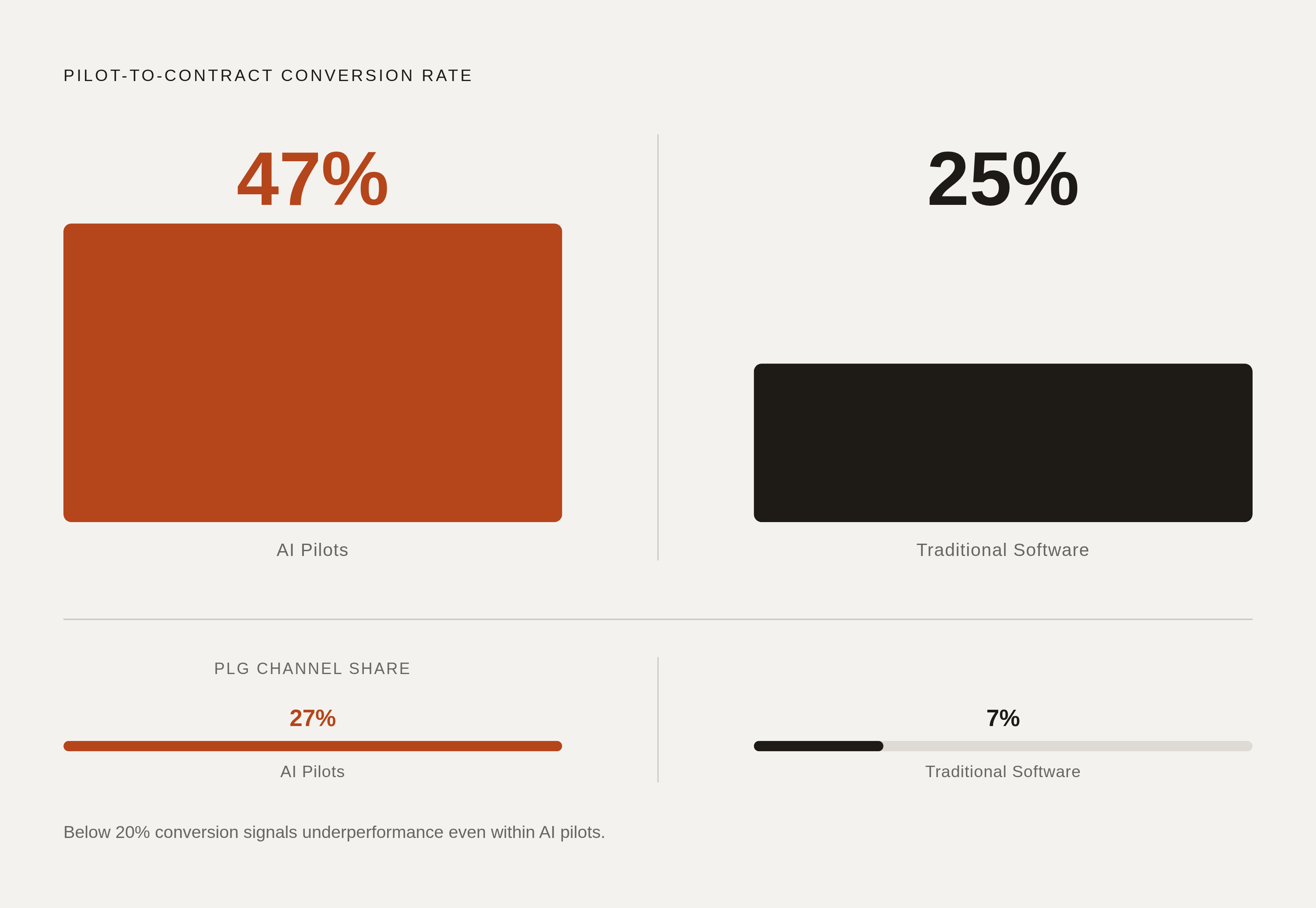
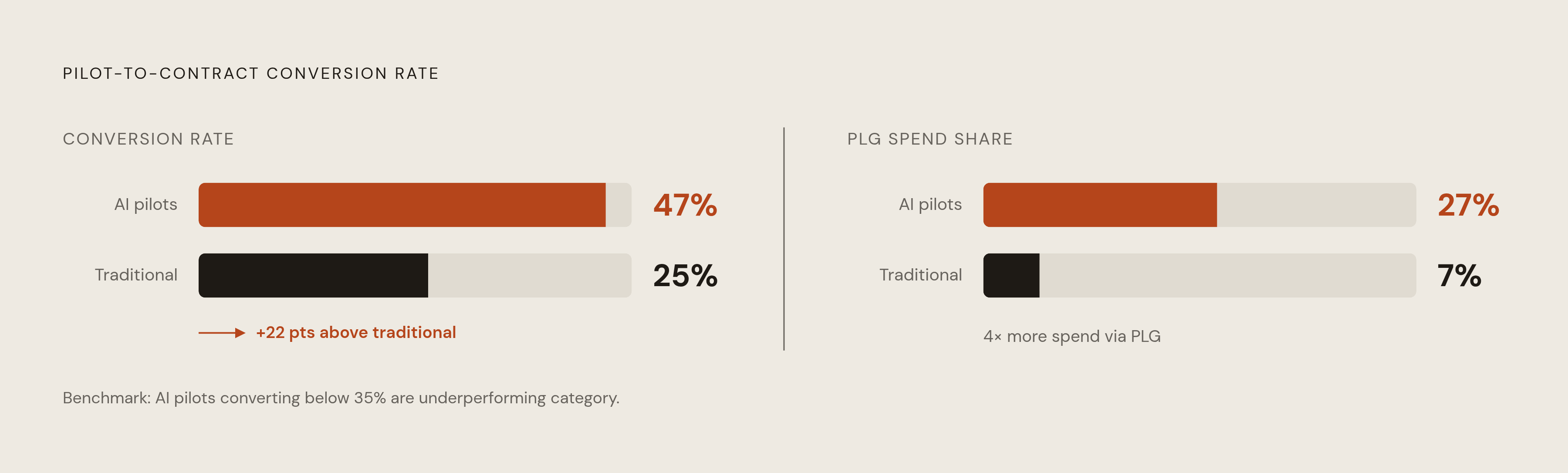
There's a real bar to check against, though. Roughly 47% of AI pilots convert into signed contracts, against roughly 25% for traditional software. That's a higher bar than most people assume walking in, which means a startup converting at 20% is underperforming its own category.
What actually counts as evidence: signed contracts, expansion revenue, existing customers using more of the product over time instead of just running a wider trial. Product-led growth is worth checking too; roughly 27% of AI spending now flows through PLG channels versus roughly 7% for traditional software. A company with real PLG traction is selling itself, while one without it grinds through enterprise sales cycles a deal at a time, a slower and more expensive way to grow up.
Ask directly: what's the pilot-to-contract rate, and how does it stack against that category number? Is expansion coming from deeper usage at existing accounts, or just new logos padding the top line? Who approved the pilot, and is that the same person who signs the real purchase order? And maybe the sharpest question of all: what breaks in the customer's day if you pull the product out tomorrow?
One enterprise customer whose entire workflow depends on the product beats ten pilots still "in progress," because quality beats count every single time.
The financial metrics that actually test an AI startup's unit economics
AI startups traded at revenue multiples of 25 to 30 times between 2025 and 2026, while traditional SaaS sits around 6 times. That gap is real money, and it punishes hard if the traction underneath turns out to be a wrapper wearing a moat's clothing. AI companies also commanded a 38% valuation premium over non-AI companies at Series A in 2025, and the label alone was worth something on paper, whether or not the business underneath had earned it.
The bar for actually raising that Series A climbed fast, too. According to Carta and ValueAdd VC, the typical ARR threshold for a Series A sits around $3.5 million, up from roughly $1 million just three years prior. The checklist investors run now centers on ARR near $3.5 million, strong month-over-month growth, healthy net revenue retention, gross margins trending well above break-even, and a burn multiple that signals efficient growth.
Burn multiple (net burn divided by net new ARR) is the fastest gut check in the whole kit. A tight burn multiple puts you in the running for top-tier checks, while a loose one invites hard questions most investors won't sit through patiently. Strong NRR is the number that actually proves workflow depth in dollar terms; customers expanding usually signals real integration, not a trial that just hasn't officially ended yet.
Watch the gross margin line closely, though. Inference cost is a variable expense that scales with usage, so a company posting a healthy margin at early ARR levels can look completely different at much larger scale if every new customer adds inference cost with no offsetting efficiency gain. Margin at small scale tells you less than the trend line as scale kicks in.
Regulatory and compliance exposure as a hidden pricing variable
Regulatory readiness is really a question about how much of the company's moat rests on rules that could move under it without warning. Healthcare, finance, and legal AI all face active rulemaking happening in multiple places at once, and backing a vertical AI company in one of those sectors means backing a bet on where that regulation lands, whether you meant to or not.
The EU AI Act sets tiered obligations depending on how a product's use case gets classified, so the compliance burden depends on what the product actually does, not how good the underlying model is. Two failure points show up again and again in diligence: training data with murky licensing, and customer data used to improve the model when the contract never actually granted that right.
Ask where the training data came from, and what the license terms actually say. Ask whether the customer contract explicitly hands over rights to use their data for model improvement, or whether that's just assumed and hoped for. And ask if anyone on the team has mapped the product against an applicable AI risk framework, and whether they understand what that classification actually demands of them.
Here's the upside case, though. A startup that's already cleared a real regulatory pathway has something competitors can't fast-track their way around. Regulatory approval takes calendar time to earn, the same way proprietary data and infrastructure do, and no well-funded competitor buys that time back no matter how much money they throw at the problem.
Putting the framework together into a repeatable diligence process
Run it in order. Team first: can this group build the thing and still be speaking to each other in three years? Then defensibility: is there a real moat here, or a wrapper with a good pitch deck? Then traction: is that moat converting into contracts and expansion revenue, or just pilots that never close? Then unit economics: do the numbers hold at scale, or fall apart once inference costs catch up with revenue? Then regulatory exposure: what's the risk sitting off the P&L entirely that could still sink the whole thing?
The question tying it together is what you might call the squeeze test. Does this company have real protection from both directions, with foundation model providers eating margin from above and open-weight or competitor commoditization pressing in from below? A company that passes the team and traction checks but fails the moat test has real numbers today and zero proof those numbers survive contact with a cheaper, better model next year. Given the valuation premium AI companies command right now, that's the single most expensive mistake on the table.
Watch where the smart capital clusters, too, since it's a useful signal in its own right. Money piling into infrastructure and real deployment while pulling back from application-layer bets says something about where sophisticated investors think the squeeze actually bites. Tracking whether a claimed data moat is holding up or quietly eroding underneath the pitch deck is increasingly something investors try to verify before the check clears, and platforms like Letterbrace, a B2B SaaS content network that tracks AI-answer citations alongside search rankings, reflect how broadly that instinct is spreading.
The question worth carrying through every stage, the one that actually matters five years out, is simple to state and hard to answer honestly: when the underlying models get meaningfully more capable and meaningfully cheaper, does this company's position get stronger, or does it get replaced? Everything above is just a way of answering that one question early, before the term sheet, instead of late, after the check's already cleared.
Methodology & sources
- https://iexchange.substack.com/p/the-2026-vc-playbook-how-investment
Provided the pilot-to-contract conversion rate and PLG channel share figures cited in the traction section.
- https://www.openvc.app/investor-lists/ai-investors
Supplied the roughly 25% pilot-to-contract conversion rate for traditional software used as a comparison benchmark.
- https://techconglobal.com/the-2026-vc-playbook-how-investment-criteria-are-evolving-in-ai-first-startups/
Provided the four evaluation criteria for founders that open the article.
- https://www.lucid.now/blog/ultimate-guide-ai-powered-startup-valuations/
Provided the 25–30x revenue multiple figures for AI startups cited in the unit economics section.
- https://percolator.substack.com/p/ai-moats-building-defensible-start
Informed the two-front competitive squeeze framing facing application-layer AI startups.
- https://theinnovationattorney.com/proprietary-data-moats-and-ai-startup-defensibility-in-2026/
Provided the 280-fold inference price drop statistic cited in the moat evaluation section.