AI Copilots for Investor Memo and Document Workflows
AI saves analysts weeks per deal by automating the document grunt work that buries memo production.

- Written by
- Dana Ashworth
- Updated
- September 12, 2026
- Reading time
- 10 min read
- Sources cited
- 8 sources ↓
What this covers
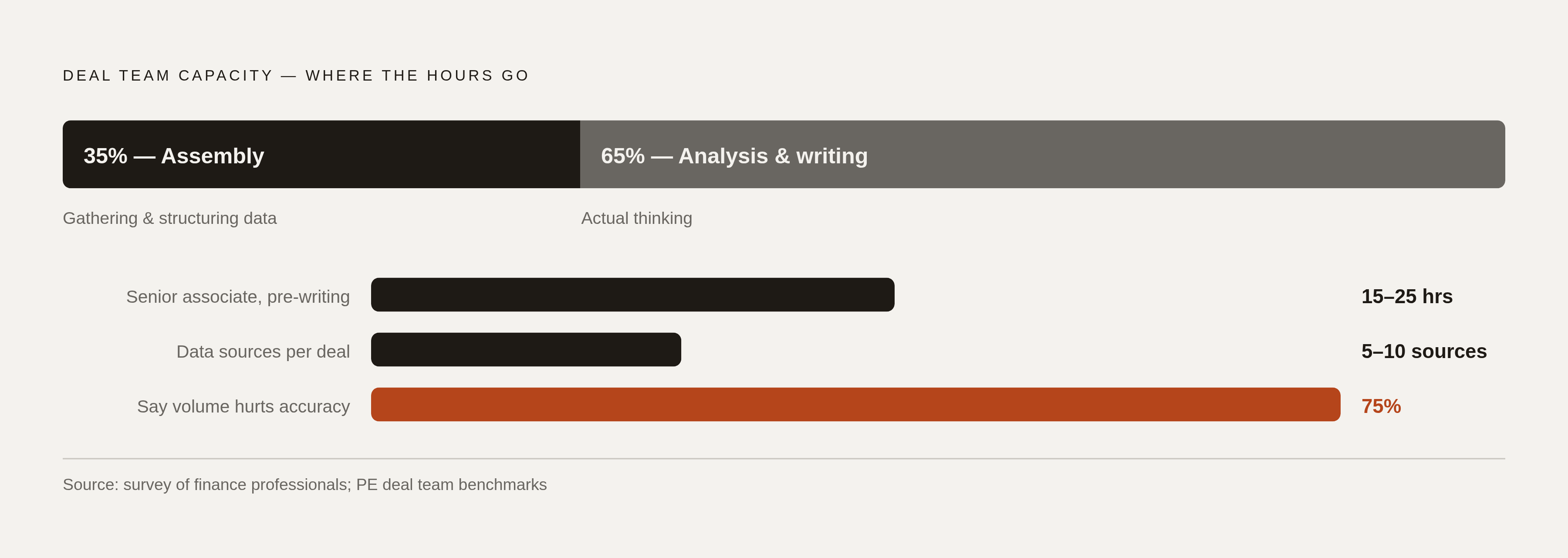
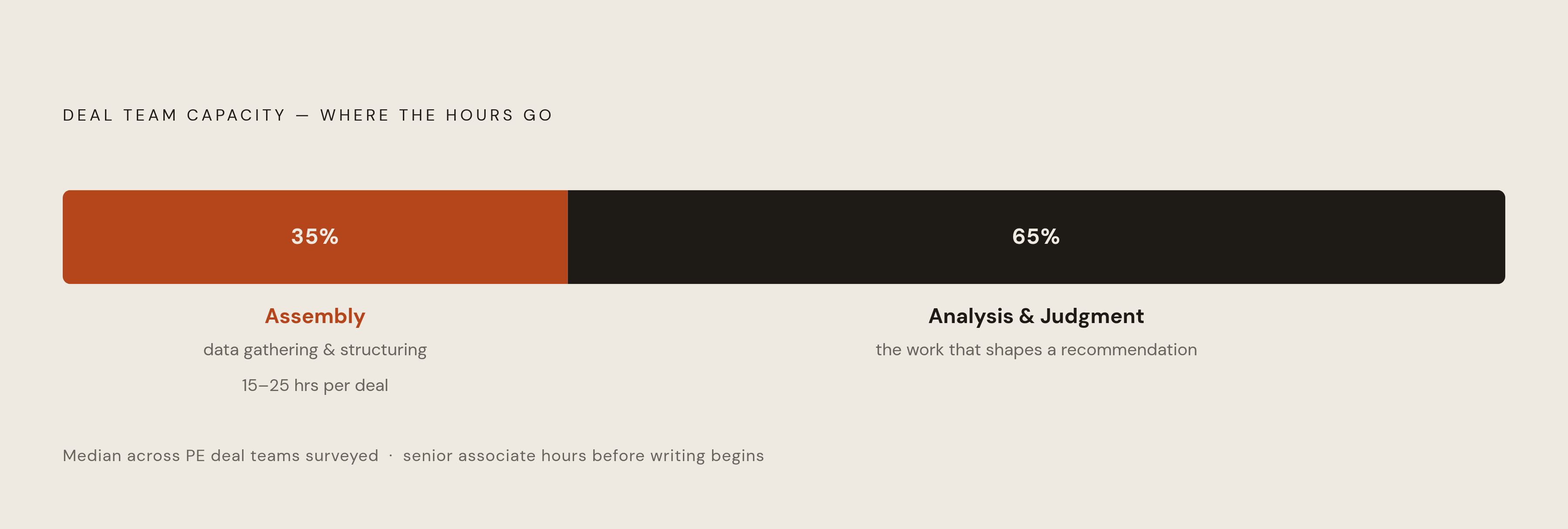
The investor memo is where deals go to get slow. It sits between screening and the investment committee, and it eats analyst hours by the fistful before anyone even starts drafting sentences. A senior associate at a mid-market PE firm spends 15 to 25 hours just gathering and structuring data before the actual writing begins, and per PitchBook's 2025 PE analyst survey, the median firm burns 35% of deal team capacity on memo assembly. That's more time than gets spent on the analysis and judgment work that actually shapes a recommendation, which tells you something about where the bottleneck really sits.
What does assembly even mean, in practice? You pull numbers from 5 to 10 sources per deal (the CIM, data room files, management decks, market research, comp databases), cross-check figures across documents that were never built to agree with each other, then jam all of it into the narrative shape the IC expects. A financial documentation survey found 75% of finance professionals say document volume is hurting the accuracy or depth of their analysis. Hours spent stitching spreadsheets together are hours not spent thinking about competitive dynamics, management quality, or what happens if the downside case actually shows up.
How broadly AI has actually been adopted in finance, and the gap between adoption and integration
Hebbia's December 2025 survey of 529 deal- and investment-focused finance professionals found 93% report using or evaluating AI in some capacity. Close to everyone, in other words. Only 25% say AI is fully built into how their team or firm actually works day to day.
That gap matters more than the headline number. Someone poking at a chatbot on their own laptop is a different animal than a firm that's rebuilt its workflow around the tool, and most of finance is still stuck in the first camp.
The pattern shows up everywhere, not just in finance. McKinsey's 2025 State of AI survey found 88% of organizations use AI in at least one business function, up from 78% the year before, and two-thirds now use it across multiple functions. Yet only 6% qualify as AI high performers pulling 5%+ EBIT impact from it. Using a tool and redesigning a workflow around it are two separate jobs, and almost nobody has finished the second one.
Finance drags its feet on integration for reasons that actually make sense. Memo work needs outputs you can cite and audit; a chatbot handing you a confident answer with zero paper trail is close to useless in front of an investment committee. Compliance and accuracy bars sit higher here than in most functions too, since a wrong number in a memo doesn't just embarrass someone, it can move a bid. And most early AI use in finance stayed narrow: summarize this document, search that filing, rather than handle the whole memo build end to end. So adoption numbers tell you people are experimenting. They don't tell you whether the actual workflow has changed underneath them.
What the time savings look like when integration actually happens
The 93% figure only means something once you look at the hours it frees up. In that same Hebbia survey, 63% of respondents said they save more than six hours a week using AI, and 27% said they save more than 10 hours weekly on research and analysis work. That's a real chunk of somebody's Tuesday back.
At the firm level, the numbers get more specific and, frankly, more interesting. A global PE firm managing over $100 billion in assets brought on Brownloop's Kairos platform in February 2026, pulling live data straight from Excel models and CRM systems, and cut IC memo prep time by 70%. Other case studies floating around claim north of 80%, though every single one carries the same asterisk: someone still has to check the work. Hebbia separately reports investment bankers saving 30 to 40 hours per deal on marketing materials and client meeting prep, and in another Hebbia survey of over 500 banking and investing professionals, 71% said AI sped up their research and diligence over the past year.
Scale tells its own story here. A two-person business development team at Notable Capital manages more than 500 intros a year using AI-powered workflows, a job that would've needed a much bigger headcount five years back. BlackRock's research group increased throughput fivefold through AI integration.
None of this settles whether the memos themselves got better, though. Time savings show up cleanest on structured extraction, pulling numbers out of documents. What analysts actually do with the hours they get back is a much harder thing to measure, and honestly, most firms haven't tried.
The three stages of memo production where AI actually operates
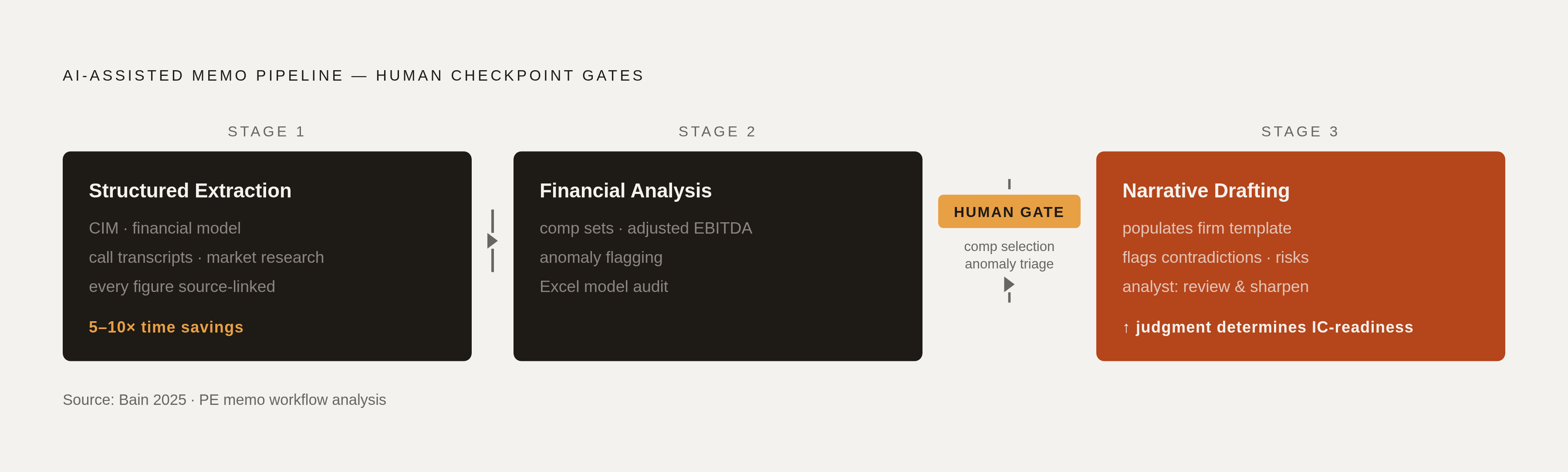
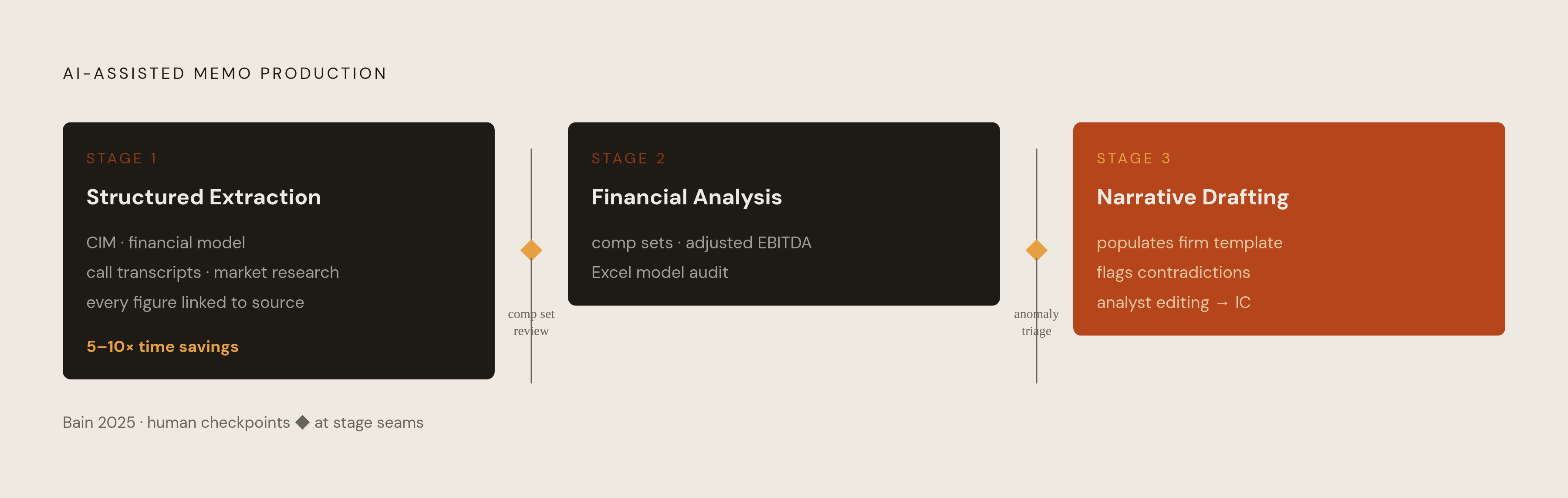
Memo production breaks into three stages, and the human checkpoints sit right at the seams between them.
Stage one is structured extraction. An agent ingests the full document set, the CIM, financial model, call transcripts, market research, and runs extraction across everything at once. Every data point it pulls, revenue, EBITDA, a market sizing assumption, gets linked back to the exact document and page it came from. Bain's 2025 Technology Report calls document extraction the single highest-ROI AI use case in financial services, with 5 to 10x time savings on structured data work. The bar here is unglamorous but firm: the tool has to handle PDFs, spreadsheets, transcripts, and filings without ever losing track of where a number came from.
Stage two is financial analysis. Once the numbers are structured, AI runs them against comp sets, calculates adjusted EBITDA, flags anything that looks off. Raw data turns into the tables and exhibits that fill the middle of the memo here, and this is also where model auditing happens, rolling forward multi-tab Excel models and checking the formulas still hold. The human checkpoint sits in comp set selection and anomaly triage. Deciding which businesses actually belong in the comparison set, and sorting real red flags from messy terminology mismatches, still needs a person.
Stage three is narrative drafting. The system pulls outputs from every diligence workstream, drops them into the firm's memo template, flags contradictions, calls out key risks. The analyst's job shifts to review and sharpening, building on a draft instead of staring at a blank page. Firm-specific templates matter a lot here too; a tool that can't bend to a firm's actual IC structure just produces a draft that gets rewritten anyway.
AI compresses stage one and stage two with real, repeatable reliability. Stage three is where the tool's reasoning and the analyst's editing decide whether what comes out is something you'd actually hand an IC.
How the leading platforms divide the workflow between them
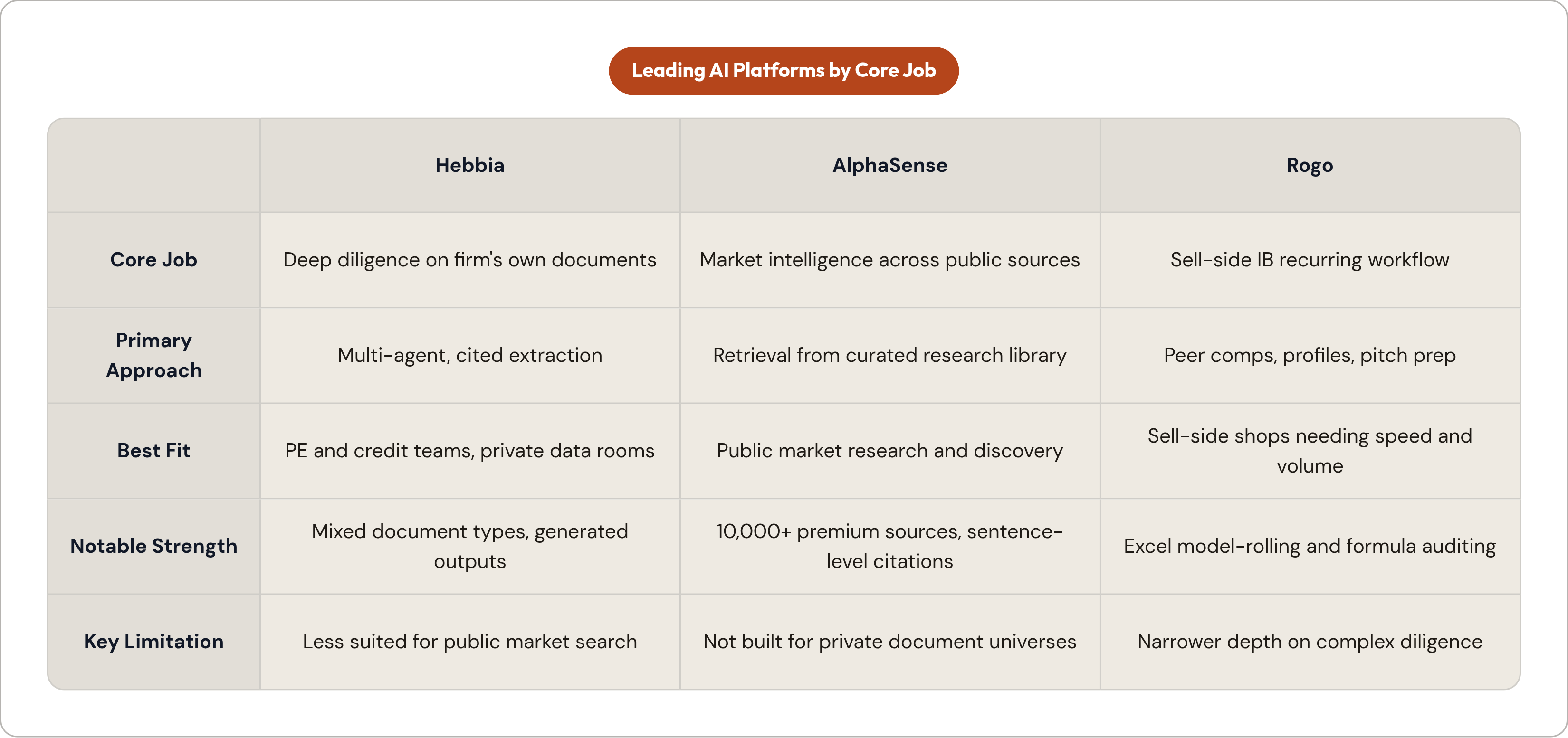
Here's a simple way to sort the landscape. AlphaSense answers "what does the market and research say." Hebbia answers "what do our documents say, with citations." Rogo answers "help my deal team do the recurring work faster." Different jobs, different vendors.
Hebbia's Matrix runs on a multi-agent setup that chews through large volumes of mixed document types (PDFs, spreadsheets, transcripts, filings) and returns cited answers alongside generated spreadsheets, slides, and reports. It raised a $130M Series B in mid-2024 at roughly a $700M valuation, with clients including BlackRock, KKR, and Carlyle. As of early 2026 it serves more than 40% of the largest asset managers by AUM. Its June 2025 acquisition of FlashDocs pushed the output straight into branded PowerPoint, Word, and Excel files. It fits best for PE and credit teams doing deep work across their own document universe, a specific data room, a portfolio company's credit agreement library.
AlphaSense takes a retrieval-based approach, returning sentence-level citations from a library of broker research, expert call transcripts, filings, earnings calls, and news, spanning more than 10,000 premium sources. It passed $500M in annual recurring revenue as of October 2025, with more than 6,500 customers including 88% of the S&P 100. Per SpendHound's read of actual customer contracts, the median contract runs $18,375 a year, with per-seat pricing landing between $10,000 and $20,000 in most cases; enterprise pricing climbed sharply through 2025, enough that some teams have started shopping around. AlphaSense is built for market intelligence and discovery across public information, a different job from digging through a firm's own private files. Plenty of serious M&A teams run both tools side by side anyway: AlphaSense for what's publicly known, Hebbia for what the firm already has on file.
Rogo is built for sell-side IB work: peer comps, company profiles, CIMs, pitch deck prep, industry research. It's raised $310M total, and maintains data partnerships with major financial data providers. It has developed strong Excel model-rolling and formula-auditing capabilities.
A handful of smaller tools fill narrower gaps. StackAI sets up in about an hour and produces a structured memo in 5 to 10 minutes per company, a lighter option for teams not ready for something enterprise-scale. Some lighter tools target early-stage screening, converting pitch decks and transcripts into structured documents quickly. Affinity works as a relationship intelligence layer, useful for sourcing and mapping warm intros rather than drafting memos. Granola, which raised $43M at a $250M valuation in 2025, handles meeting capture and has picked up a loud following among VCs; its transcripts can feed into earlier stages of the memo workflow.
No single platform does all three stages well. The firms that have actually gotten this working combine tools by stage instead of betting the whole workflow on one vendor.
Where hallucination risk is highest and why source grounding is the non-negotiable requirement
Here's what happens when this goes wrong. AI-generated misstated earnings caused $2.3 billion in trading losses in Q1 2026, and hallucinations have been widely flagged as a finance compliance risk.
The mechanism is simple, if unnerving. A generic large language model without grounding in actual source documents will invent financial figures, and it does this structurally, not as some rare glitch. Ungoverned AI tools in due diligence have been observed to build peer sets that ignore business model differences, produce cost estimates disconnected from how the business actually operates, and hallucinate metrics out of misread text.
In a memo, this turns dangerous fast. A fabricated EBITDA margin in a preliminary draft can push an IC toward the wrong screening call, and from there, toward a wrong opening bid. The error compounds quietly too, since the IC sees a clean, polished document with nothing on the page flagging which numbers came from a machine and which came from an actual source. Hallucinations consistently rank among the top barriers to AI deployment that enterprise users cite.
Source grounding is the whole ballgame here. Every extracted figure needs a link back to the exact document and page it came from, and a well-built system refuses to answer when it can't find a source rather than guessing at one. The citation trail needs to be something an analyst can actually check before the memo leaves their desk. Picking a vendor, then, is both a productivity decision and a compliance one. The gap between a properly governed retrieval system and a generic LLM wrapper is the gap between a tool you can trust and a liability sitting in your deal file.
What human review must cover at each stage, and where it cannot be delegated
AI moves analyst judgment around rather than eliminating it, shifting the work from building the memo to checking and interpreting it.
At stage one, the analyst has to confirm the document set going in is actually complete. A missing data room folder or an outdated CIM version produces output that looks perfectly plausible and is quietly wrong, and nothing in the extraction step will warn you about that.
At stage two, comp set selection needs business judgment that AI can't reliably supply on its own. A platform business and a services business can post nearly identical revenue numbers and deserve completely different valuation logic; no model catches that by itself. Every anomaly the AI flags needs a human to sort through, too, since some are genuine red flags and others are just two documents using different terminology for the same thing.
At stage three, the narrative carries the analyst's actual read on the deal: competitive position, how good management really is, which risks matter most. That interpretive judgment stays with the person, not a model trained on generic financial text. When the AI flags a contradiction between two workstreams, that's the system doing its job. Resolving it is the analyst's.
Across every stage, any real change to how the target company gets described, its risk profile, its competitive standing, its financial health, needs a human sign-off before it lands in a draft headed to the IC or a counterparty. The firms doing this well treat the AI as the one doing the first pass, with the analyst as the editor who owns what actually goes out the door.
How to evaluate
Judge a platform by where it earns its keep, not by the demo. Ask how it handles extraction across messy, mismatched document formats, since that's where the real time savings live. Ask whether every number in its output traces back to a source page, since that's the line between a tool and a liability. Ask how well it bends to your firm's own IC template, since a draft that needs a full rewrite was never really a draft.
Match the tool to the actual job, too. A firm doing deep diligence on its own document universe needs something built for that, a different requirement from a research search engine repurposed for the task. A sell-side shop cranking out standardized comps and pitch materials needs speed and volume more than it needs depth.
And measure success honestly. Hours saved on assembly are real and worth having, but they only matter if analysts spend the recovered time on judgment calls that actually move an IC. A memo built faster and reviewed worse isn't progress; it's a quicker route to the wrong answer landing in front of the people deciding where the money goes.
Methodology & sources
- https://www.v7labs.com/blog/best-ai-tools-investment-memo-private-equity
Provided the figure of 15 to 25 hours a senior associate spends gathering and structuring data before drafting begins.
- https://workwisesolutions.org/guides/best-ai-tools-investment-memos-private-equity.html
Sourced the PitchBook 2025 PE analyst survey finding that the median firm spends 35% of deal team capacity on memo assembly.
- https://stratengineai.com/blog/ai-in-investment-memos
Provided the case study figures of 70% and 80%+ reductions in IC memo prep time from AI platform deployments.
- https://fellow.ai/blog/finance-ai-tools/
Provided funding and valuation figures for Hebbia and AlphaSense, including Hebbia's $130M Series B and AlphaSense's $500M ARR and customer counts.
- https://www.hebbia.com/resources/ai-trends-in-financial-services-2026
Provided multiple statistics from Hebbia's December 2025 survey, including 93% AI adoption, 25% full integration, 63% saving 6+ hours weekly, and 27% saving 10+ hours weekly.
- https://www.hebbia.com/resources/rogo-competitors
Provided the figure that AlphaSense spans more than 10,000 premium sources.
- https://www.v7labs.com/blog/rogo-ai-alternatives-investment-banking
Provided Rogo's total funding figure of $310M.
- https://vantaige.io/ai-tool/hebbia
Provided the statistic that Hebbia serves more than 40% of the largest asset managers by AUM.