Secondary Market Transactions for LP Interests
Selling private fund stakes shifted from distress signal to routine portfolio management.

Selling your stake in a private fund used to be an admission of defeat. If a limited partner showed up trying to offload a fund position before its natural end, the market read it as one thing: trouble. Distressed institutions, over-committed endowments, LPs who'd bitten off more illiquidity than they could chew. The secondary market existed almost entirely as an escape hatch for LPs who had no other option, a way to exit a position before the fund wound down on its own schedule. Selling meant something had gone wrong.
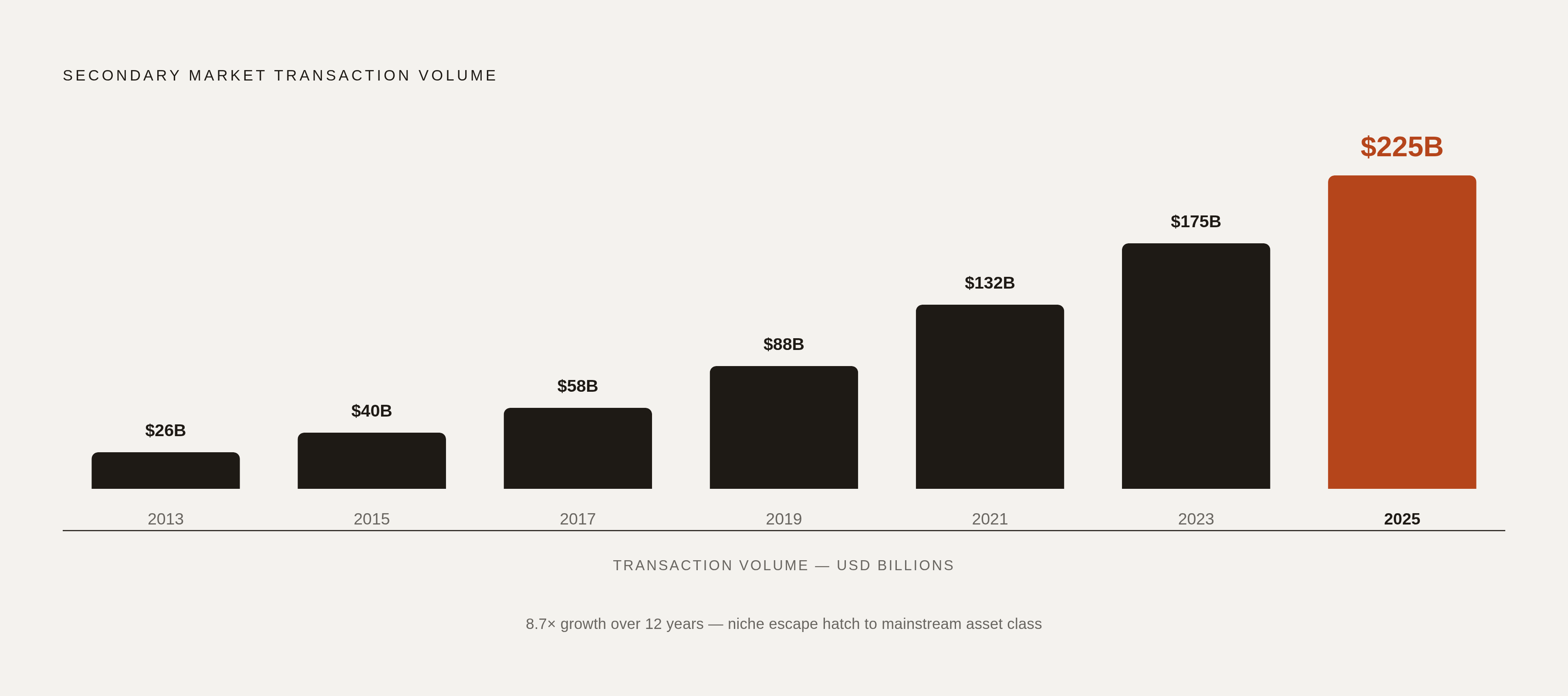
That stigma has mostly evaporated. What used to be a distress signal is now a scheduling decision, and the volume numbers reflect the shift. Total secondaries volume sat at a modest $26 billion in 2013; by 2025, it had crossed $225 billion. That's not the growth curve of a niche workaround. That's the growth curve of an asset class finding its footing.
The buyer side of the market changed just as much as the seller side. Dedicated secondary funds now raise capital specifically to buy LP stakes and GP-led continuation vehicles, institutional money that treats secondaries as a standing strategy rather than an opportunistic scavenger hunt. Pricing tightened as competition among buyers increased, and the reputational cost of selling faded along with it. Well-capitalized institutions now run secondary sales as routine portfolio management, the same way a public equities desk might rebalance a position, not as a last resort scraped together under duress.
Even with that growth, the secondary market still accounts for less than 5% of total global private market activity. The market has earned legitimacy, with real infrastructure, real institutional buyers, and real recurring sellers. But there is also a lot of room left to run. Every mechanic, motivation, and pricing pattern covered below sits against that backdrop: a market that graduated from emergency exit to standard tool, and still has runway ahead of it.
The two transaction types: LP-led vs. GP-led
Two structures make up almost the entire secondary market, and they solve different problems for different people. Getting the vocabulary straight here matters, because every section after this one leans on it.
An LP-led secondary is the simpler of the two. An existing limited partner sells its interest in a fund to a secondary buyer, who steps into the LP's economic position for the remaining fund life. The buyer takes on the remaining unfunded capital commitment, inherits exposure to whatever portfolio companies are still sitting inside that fund, and picks up rights to any future distributions. The buyer walks in, the original LP walks away, and the fund keeps running exactly as before.
GP-led secondaries flip the direction of who's initiating. Here it's the fund manager, the general partner, who starts the process, usually by moving one or more portfolio companies out of the aging fund and into a freshly created vehicle called a continuation fund, or continuation vehicle (CV for short). The GP isn't selling out. The GP is asking for more time with an asset it isn't ready to let go of.
Existing LPs in that original fund get a real decision to make when this happens: roll their stake into the new continuation vehicle and stay in, or cash out at the negotiated price and move on. Data shows most LPs choose the exit. GP-led deals therefore function as a major source of LP liquidity too.
Within GP-led deals, there are two flavors. Single-asset continuation funds move exactly one high-conviction company into the new vehicle. Multi-asset CVs bundle several companies together. Both structures see real use, and single-asset deals made up more than half of GP-led volume in 2025, per William Blair. LP-led and GP-led secondaries solve different problems, run on different triggers, and often appear inside the same broader transaction ecosystem at the same time.
Why LPs are selling fund stakes now
The motivations behind LP-led sales cluster into recognizable patterns, and most of them have nothing to do with distress anymore.
Portfolio rebalancing tops the list. Large allocators typically hold positions across dozens of funds, and when public markets drop, the denominator effect kicks in: private holdings suddenly represent a larger share of a portfolio simply because the public-market side shrank. An institution that is suddenly over its private markets allocation ceiling doesn't need a crisis to justify a sale.
Liquidity has also become a proactive pursuit rather than a reactive scramble. The secondary market surge has been driven by investors' proactive approach to liquidity during an extended distribution drought, as GPs have been slow to exit and return capital, and institutions have responded by creating their own liquidity instead of waiting. That impatience connects to a broader shift in how LPs judge performance. Distributions to paid-in capital, DPI for short, has become a much bigger deal: 2.5 times as many LPs now rank DPI as their most critical performance metric compared with three years earlier. Selling a stake on the secondary market is one of the fastest ways to move that number, since it converts a paper position into realized cash immediately.
There's a housekeeping motivation too, less dramatic but just as real. Big institutions can end up with relationships across an unwieldy number of GPs, each one requiring its own reporting, its own legal review, its own slice of staff attention. Selling off lower-priority stakes frees up bandwidth to focus on the GP relationships that matter most, and that streamlining rationale is explicit in institutional decision-making.
What's notable is who's actually showing up to sell. It used to be seasoned secondary-market veterans running these trades. Now first-time sellers are entering the market regularly, institutions with no prior track record of trading fund stakes deciding this is a tool worth using. In terms of who dominates supply, corporate and public pension funds accounted for nearly half of all secondary seller volume in the first half of 2025.
Two examples from 2025 illustrate the trend. Harvard's endowment sold a stake worth roughly $1 billion, and the New York City pension system sold a private fund stake worth roughly $5 billion to Blackstone. Neither of those is a distress sale. Those are two of the most closely watched institutional investors in the country making a calculated call about capital allocation. Jefferies' breakdown of first-half 2025 seller motivations backs this up: about half of sales came down to opportunistic liquidity and rebalancing, a quarter were administrative clean-up or vehicle wind-downs, another 23% was trimming non-core managers, and a small 4% slice was pure de-risking.
How LP interests are priced at transaction
Once an LP decides to sell, the next question is obvious: sell for what? Every transaction starts from net asset value, the figure fund administrators calculate periodically, usually every quarter, and secondary prices get quoted as a percentage of that number.
NAV is a periodic estimate that lags real-time reality by definition. Buyers know this, and they build their own adjustments into pricing rather than taking the reported number at face value. That gap between the printed NAV and what a buyer is actually willing to pay is where the entire pricing conversation lives.
The overall trend has been toward tighter discounts. Buyout private equity stakes sold at 94% of NAV in the first half of 2025, up from under 90% back in 2022, reflecting buyers competing harder and closing the gap between paper value and cash value.
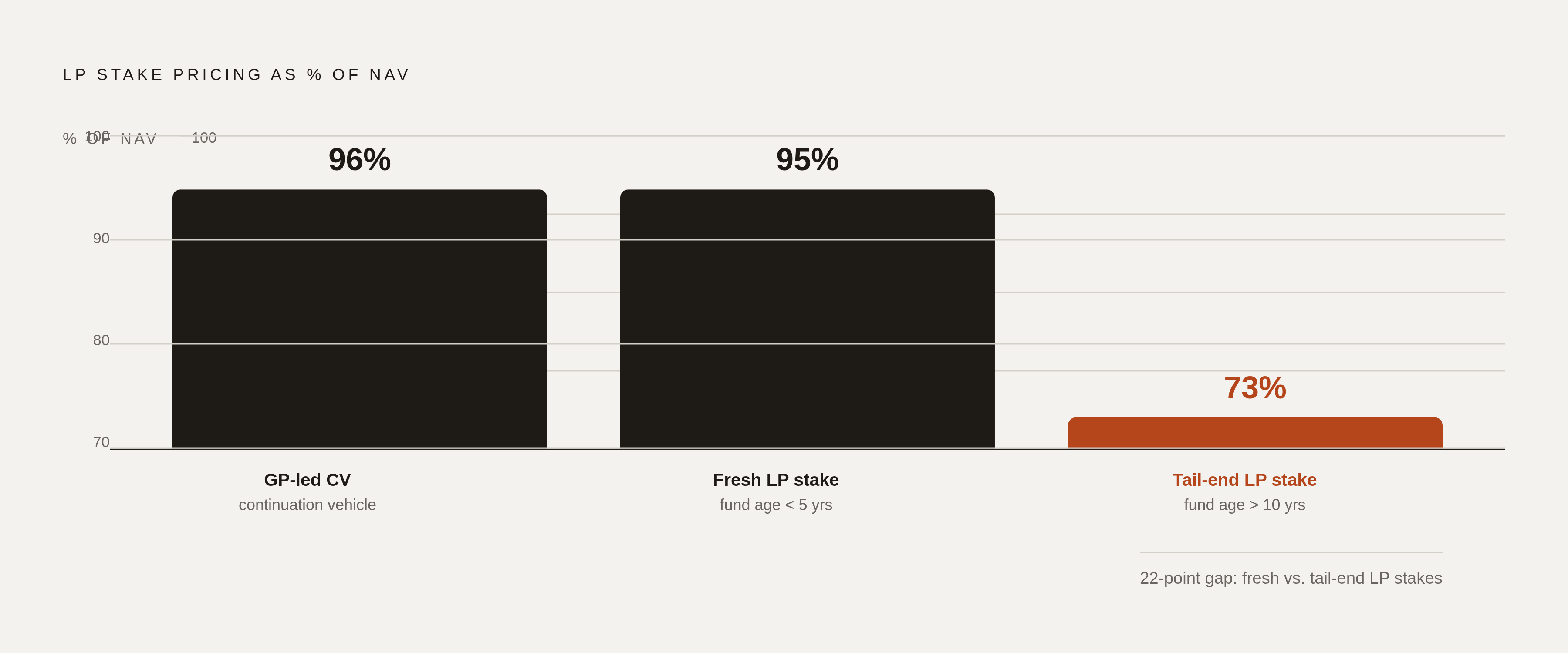
But averages hide the real story, which is vintage. Fresh funds less than five years old priced at an average of 95% of NAV in full-year 2025 data. Tail-end funds older than ten years priced at just 73% of NAV. A newer fund comes with a still-developing portfolio and clear runway ahead, so buyers price it close to par. A decade-old fund is a different animal: whatever's left inside it is probably the hardest to sell, sitting there because the GP hasn't found an exit, and buyers discount hard for that uncertainty. Vintage alone explains more of the pricing spread than almost anything else in the market.
Asset class matters too. Private equity dominates the LP-led market, making up 81% of all transactions tracked by Evercore.
Sellers aren't limited to accepting a fixed discount. Structuring tools give them other options. Deferred pricing, used in roughly 23% of transactions in the first half of 2025, lets a seller share in the fund's future upside instead of locking in a discount today. Structured transactions, which bundle in earn-outs, seller financing, and other hybrid terms, made up about 8% of total secondary volume. Portfolio composition, the reputation of the GP running the fund, and the broader macro backdrop all shift where inside the pricing range a given deal lands.
How GP-led continuation vehicles actually work
GP-led deals start from a completely different impulse than LP-led ones. A GP looks at its portfolio, spots one or more companies it believes still has real value left to unlock, and realizes the fund holding that asset is running out of time before its scheduled end date. The company isn't done growing, but the fund is running out of clock.
The GP builds a new vehicle, the continuation fund, and secondary buyers step in to capitalize it by purchasing the assets out of the original fund at an agreed price. Existing LPs in the old fund get a formal choice at that point: take cash now at the negotiated transaction price, or roll their position into the new vehicle on equivalent terms.
The GP sits on both sides of the table. It is selling the asset out of the old fund and will manage the new vehicle going forward, which is a conflict of interest by design. Independent fairness opinions and LP advisory committees carry real governance weight in these deals because of that, serving as the check against a GP setting its own terms without external review.
The scale of this market grew quickly. GP-led volume hit $115 billion in 2025 per Jefferies, a 53% jump year-over-year, crossing the $100 billion mark for the first time. Deal sizes grew alongside volume: the average continuation vehicle deal grew to nearly $1 billion, and the market saw materially more billion-dollar-plus transactions than the year before. Repeat sponsors represented 42% of 2024 GP-led volume, treating continuation funds as recurring instruments rather than one-off events.
Alignment signals have shifted in a direction favorable to LPs. GPs are increasingly investing their own capital alongside the continuation vehicle out of their most recent flagship funds. A notably larger share of management teams also chose to keep their equity in the new vehicle rather than cash out, a meaningful increase from the prior year. Both trends indicate less opportunistic behavior and more genuine co-investment.
Pricing on continuation vehicles looks nothing like the tail-end LP-led discounts described earlier. More than half of CV transactions priced at or above NAV, with an average discount of just 3.7%. That diverges sharply from a 73%-of-NAV tail-end fund stake, and it makes sense: a GP putting its best remaining asset into a new vehicle, backed by independent valuation, presents buyers with a different risk profile than an LP selling out of an aging fund.
The deal process from decision to close
Every secondary deal, LP-led or GP-led, tends to follow roughly the same sequence, even though the specific paperwork and negotiating leverage shift depending on which side is initiating.
It starts with a decision and a mandate. The seller decides to move forward and either hires an advisor or runs the process directly through a bilateral relationship. The advisor's job is to prepare marketing materials, often called a tear sheet or information memorandum, manage outreach to potential buyers, and negotiate on the seller's behalf.
Before any outreach gets far, there's a gatekeeping step many first-timers underestimate. Most LP fund agreements require notifying the GP before any transfer happens, and the GP often holds a right of first refusal, either to buy the stake back itself or to hand-pick an approved buyer. Some agreements go further and require GP consent for any transfer at all. Fund agreement language varies considerably from fund to fund, and legal counsel is not optional at this stage.
Once the consent question is cleared, the advisor runs buyer outreach, and interested buyers sign NDAs to access fund-level data. Due diligence follows: buyers review fund financials, portfolio company performance, the schedule of remaining unfunded commitments, LP agreement terms, and the GP's track record. Because NAV lags real-time reality, buyers layer in their own adjustments rather than trusting the reported number outright.
From there, the process moves to indicative bids, a shortlist, and final binding bids that lock in price along with any structuring terms such as deferred payments or earn-outs. Negotiation and documentation follow, covering the transfer agreement, representations and warranties, and any remaining consents. At close, economic transfer happens, ownership gets registered with the fund administrator, and the buyer takes the original LP's seat on the fund's books.
Timeline varies considerably. A clean bilateral trade between two parties who already know each other can close in a matter of weeks. A complex portfolio sale requiring multiple GP consents can stretch out over several months. ROFR mechanics typically give the GP a fixed window, commonly 10 to 30 business days, to exercise its right, and failure to respond within that window generally waives the right.
Structural forces shaping 2025 & beyond
The forces driving 2025's record volume are structural, which matters for anyone trying to assess where this market goes next.
On the supply side, the exit environment for private equity portfolios has been narrow. The M&A recovery through 2025 concentrated almost entirely in large-cap megadeals, while midmarket activity stayed flat, and IPO proceeds rose even as the actual number of IPOs barely moved. That combination leaves a lot of portfolio companies sitting in funds with no obvious conventional exit path, which pushes GPs and LPs alike toward the secondary market as a more practical liquidity option. The sheer scale of unrealized private equity assets sitting on the books globally adds to a structural backlog that won't clear itself out quickly.
Demand has kept pace. The secondary market hit a record of roughly $220 billion in transaction volume in 2025, and dry powder reached record levels heading into 2026. A deep backlog of assets that need liquidity on one side, and record capital waiting to be deployed on the other, creates the conditions for continued market growth. The underlying pressure pushing both LPs and GPs toward secondary transactions is not going away anytime soon.
Sources
- 2026 Secondary Market Report In This Report Secondaries Set Records Once
- Secondaries Volume Reached Record in 2025 as LPs Embrace Market | Chief Investment Officer
- Private Equity Secondaries: The Operational Guide
- Secondary Market Trading Volumes Topped $200B In Past Year, Report Reveals | Crowdfund Insider
- Record breaking secondary market volume | UBS Global
- PRIVATE CAPITAL ADVISORY H1 2025 Global Secondary Market Review JULY 2025
- 2025 Global Secondary Market Review: Another Record-Breaking Year | Jefferies.com