Common Investor Objections During Fundraising
Learn what investors really mean when they say no to your pitch.

The rejection rate in venture is brutal. More than 95% of pitches don't get funded. The average fundraising process takes months and requires outreach to dozens, sometimes over a hundred, investors. For any given VC meeting, your probability of getting a check is somewhere between 1% and 10%.
At those odds, founders who treat every "no" as a closed door learn nothing. Founders who treat each objection as a diagnostic question start to figure out what the investor actually doubts.
Here's the thing most people miss: objections are not final judgments. They are shorthand. The investor has an unresolved concern they haven't quite put into words yet, so they reach for a phrase they've used before. "The market is too small." "You're too early." "The valuation is a bit rich." These phrases mean something specific. They just don't mean what they sound like on the surface.
A weak response argues against the surface objection. A strong response addresses the underlying worry the investor couldn't quite name. Think of it like an iceberg: the objection is the tip, but the real concern is the mass hidden below the waterline. That's the whole game.
This matters more right now than it did a few years ago. Total venture funding rebounded sharply in 2025, up nearly 50% year over year, but deal count actually fell. Capital concentrated into fewer, larger rounds. AI companies captured an overwhelming share. For most non-AI founders, and honestly for many AI founders outside the top tier, the competitive density for available capital went up. Seed-stage valuations hit all-time highs. The window between seed and Series A stretched to roughly 20 months. When an objection comes up in a meeting today, it carries more information than it used to.
Pay attention to it.
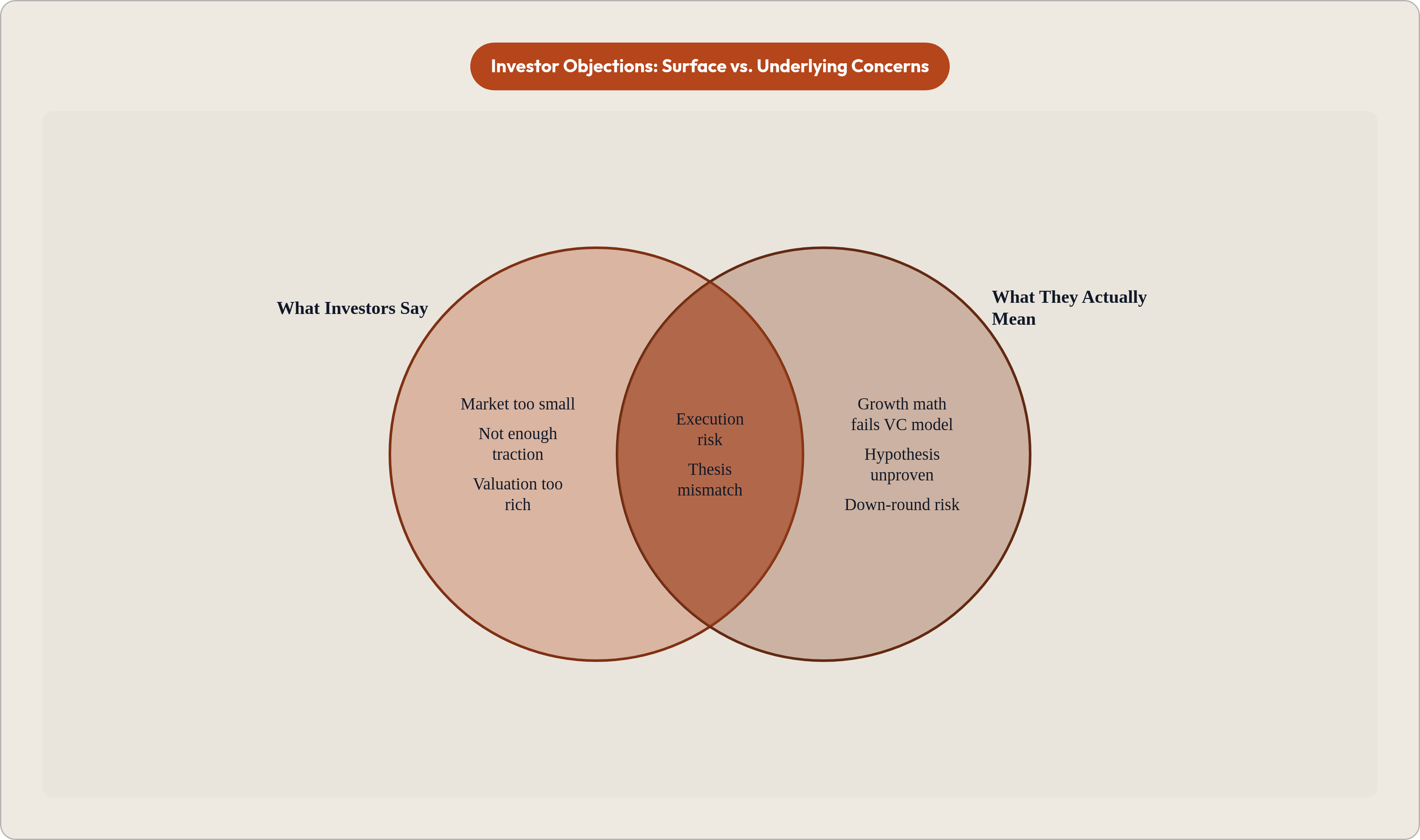
When Investors Say the Market Is Too Small, They Mean Your Growth Math Doesn't Work for Them
"I think you can build a really nice business, but not a venture-scale one."
This is not really about your market size. It's about a structural mismatch between what you're projecting and what a VC fund actually requires to generate returns.
Here's the math they're running. Venture funds need startups that can grow to $100M or more in revenue to move the needle on a large fund. A healthy, profitable $10M-a-year business is genuinely impressive. It's just not what the VC model is designed for. First-time founders miss this constantly. It's not personal. It's arithmetic.
The bigger mistake founders make here is how they frame the market in the first place. A top-down number, something like "the global CRM market is $47 billion," signals that you borrowed a stat, not that you built an argument. Investors don't find it reassuring. They find it lazy.
What actually works:
- Build the TAM from the bottom up. How many customers like your existing ones are out there? What do you charge them? What does that math imply at full penetration?
- Show the path to a large outcome specifically, not aspirationally. Where does the $1B+ scenario actually live in your model?
- Don't undersell. Founders sometimes pitch conservatively to seem credible. If investors think your goals are too modest, they'll pass even if the market is genuinely large.
The job is not to assert the big outcome exists. It's to show the math that gets you there.
When Investors Say You Don't Have Enough Traction, They Mean the Hypothesis Is Still Unproven
"You're too early for us" or "we'd want to see more traction before investing."
Translation: I can't yet tell the difference between a hypothesis and a business.
"Traction" is not a synonym for revenue. It's shorthand for proof. The specific metric that satisfies it depends on your stage and your model. It is a strong MVP with engaged users. A waitlist with real conversion data. A signed pilot with a recognizable customer. Documented retention, not just acquisition.
One thing worth knowing: deals made before meaningful traction tend to produce higher average returns than deals made after traction is well established. So the traction objection is partly a risk-management posture, not a pure signal about whether the business will work. Investors are protecting themselves. That's legitimate. But "too early" is not necessarily a verdict on whether you'll succeed.
What actually works:
- Before you raise, figure out what specific proof would move this particular investor from "interesting" to "fundable." Then either produce it or make the honest case that you're at the right stage for the round you're asking for.
- Learn to distinguish between two very different problems. "Too early for us" is a stage mismatch. "We don't believe this will work" is a fundamental doubt. The responses are completely different, and conflating them will send you down the wrong path.
Post-2023, investors are more careful about metrics than they used to be. Growth numbers need to be conservative and repeatable. Revenue needs to be backed by contracts and cash received. This is not the era of massaged numbers.
When Investors Question the Team, They Are Trying to Price Execution Risk
"We invest in teams as much as ideas." (Followed by a pass.)
This is the politest version of a serious concern. The idea is good. The doubt is whether this team can execute it through the hard parts. Every experienced investor will tell you the same thing: the product can change, the market can shift, the team has to navigate the pivots. They're not being cliché when they say they invest in people. They mean it.
The specific things they're looking for:
- Founder-problem fit. Do you have a personal connection to this problem? Lived experience, deep domain knowledge, or at least a compelling story about why you are the right person to solve this?
- Repeatability. If only the founder can sell the product, there's no sales motion. There's founder persuasion. Investors will probe whether you understand the buyer, the sales cycle, and the objection patterns, and whether any of it can actually scale.
- Self-awareness about gaps. Missing core expertise in technology, operations, or marketing is a pattern investors recognize immediately. The fix is not to hide it. It's to show you see it and have a credible plan to address it through hires or advisors.
In 2025 and into 2026, with less capital available for non-AI deals, investor preference skews toward lower-execution-risk founders. Prior exits, operator track records, domain expertise. These things matter more than they did a few years ago.
Make the founder-problem fit explicit and early. Surface relevant track record even when it's not a direct prior exit. Show that the team has already hit at least one hard obstacle and navigated it. That last one is underrated.
When Investors Push Back on Valuation, They Are Protecting Against a Scenario Most Founders Haven't Modeled
"The valuation is a bit rich for where you are."
What they're actually worried about: reduced expected returns, the risk of a down round in the future, and a quiet signal that the founder is difficult to work with on terms.
Here's the scenario most founders haven't run. If you raise at an aggressive valuation now and don't hit the growth milestones that justify it, your next round becomes structurally harder. Not "harder to close" hard. Structurally, mathematically harder. An inflated seed valuation can foreclose a Series A before you've done anything wrong operationally. It's like setting the high jump bar at seven feet when you've only ever cleared five — you haven't failed yet, but you've already made success harder.
The market has demonstrated this at scale. A large share of unicorn IPOs in 2025 were priced below their last private valuation. The disconnect between private marks and durable value is not a new story. Investors remember it.
The AI-specific wrinkle: AI startups commanded a meaningful seed-round valuation premium over non-AI peers in 2025. But many companies claiming enterprise contracts have not proven those contracts convert to durable recurring revenue. That's exactly what investors are pricing when they push back on your number.
What actually works:
- Ground your valuation in specific data. Revenue multiples for comparable companies. Growth rate. Stage. Show that you understand the model investors use to price the risk.
- The goal is not to maximize the current number. It's to set a price that creates alignment and leaves room for the next round to actually be an up-round.
When Investors Raise Competitive Threats, They Are Testing Whether the Business Has a Reason to Still Exist in Three Years
"What stops [large incumbent] from just building this?"
The underlying concern: the startup is a feature, not a product. And features get absorbed or copied.
Two common mistakes in response. First, claiming no competition. This raises a separate red flag entirely. Either the founder has done incomplete research, or many others tried this and the space already failed. Investors want to know what you learned from those failures. Second, describing a moat that's aspirational rather than structural. "We'll have network effects eventually" is not a moat. It's a hope.
The AI-specific version of this objection is now the most common form. If a customer can switch to a competitor or directly to a foundation model provider in minutes, there's little lock-in. Investors are essentially asking: would this company still have a reason to exist if a foundation model provider released something dramatically better tomorrow?
The companies that pass this test share a few characteristics. They own unique datasets. They sit deeply inside customer workflows. They operate in regulated verticals where switching costs are structural, not just behavioral. CIOs are actively cutting experimental budgets and consolidating tools with overlapping use cases. Horizontal, general-purpose AI applications face specific investor skepticism right now, regardless of current revenue.
Name the competitors accurately. Explain what they can and cannot do. Describe the mechanism by which your position compounds over time. The moat has to be structural. "We have no competition" is not just wrong. It's a red flag that tells investors something about how you're thinking.
When Investors Say the Timing Is Wrong, They Mean the Pain Isn't Urgent Enough to Force a Buying Decision
"This feels like a nice-to-have" or "check back in six months."
This is not about their calendar. It's about customer urgency.
Low urgency means long sales cycles. Long sales cycles mean high burn before the business finds its footing. Investors have watched nice-to-have products struggle to convert genuine interest into paid contracts. They're not being pessimistic. They're pattern-matching.
The "why now?" question in a pitch is not rhetorical. It requires a specific answer tied to what is different in the market today versus two years ago. Post-2023, investors are skeptical of "market inflection is coming" stories. They want evidence that the inflection is happening now, through customer conversations, contract velocity, or competitive moves that are already underway.
What actually works:
- Present evidence of urgency from actual customers. Contract terms. Renewal rates. Expansion revenue. The cost to the customer of not solving this problem right now.
- Avoid describing the problem in general terms. Describe the proof that customers are treating it as urgent today.
- Consider whether the timing objection is actually a targeting objection in disguise. Sometimes the product is not nice-to-have in general. It's nice-to-have for the wrong customer segment. The product is fine. The ICP is wrong. Those are very different problems with very different fixes.
When Investors Say It Doesn't Fit Their Thesis, They Usually Mean Exactly That (and How to Tell the Difference)
"This isn't really in our focus area right now."
Two genuinely different situations hide behind this sentence, and conflating them is a common mistake.
The real thesis mismatch is exactly what it sounds like. Wrong stage. Wrong sector. End of fund cycle. Existing portfolio conflict. This is not fixable in the meeting. It's not worth arguing against. The right move is to identify investors whose stated thesis matches your startup's stage, sector, and check size before the first meeting, not after.
The polite deflection is more common than founders realize. When this objection follows a meeting where harder questions were asked and not answered well, it's worth looking carefully at what the actual concern was. The investor is letting you down easy, which is honestly a kindness, but it obscures the real problem.
Here's a practical diagnostic. If multiple investors from different firms say "not the right fit" after meetings where substantive questions were probed, the objection is likely a proxy for something else. Market size. Traction. Team. Moat. One of those things went sideways in the meeting and the investor didn't want to say so directly.
Before pitching anyone, research their current portfolio, stated thesis, fund cycle stage, and recent check sizes. Arriving well-matched turns a potential fit objection into a conversation about substance. And knowing the difference between a routing problem and a pitch problem will stop you from iterating on the wrong variable.
How to Build a Response System Rather Than a Rebuttal List
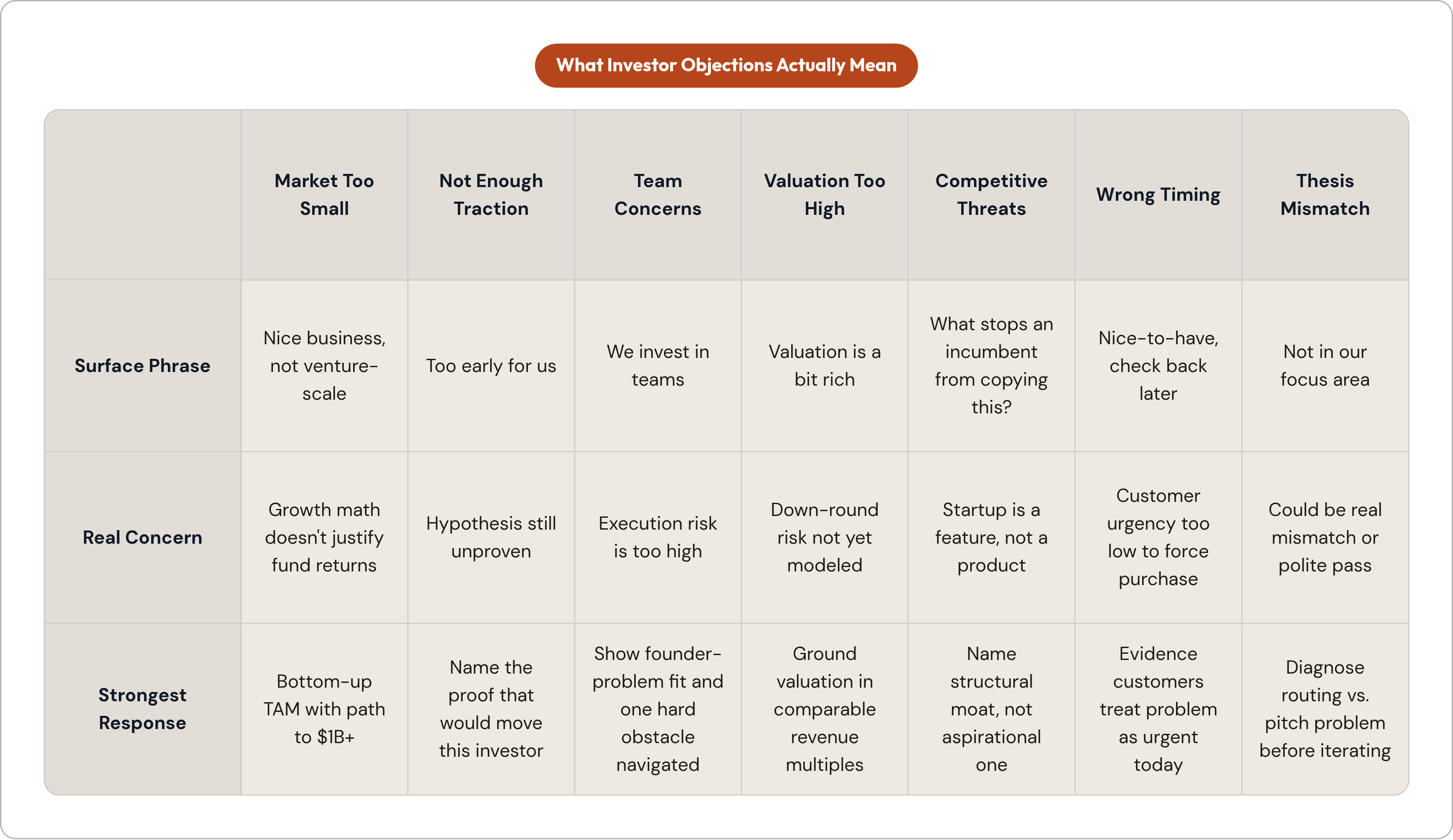
Every objection covered above has a preemptive version. Something you can address in the deck, the data room, or the opening framing before the investor even has to ask. The best founders get there first. Not because they're slicker, but because they've done the internal work.
That internal work is not a rehearsed rebuttal for each scenario. It's a set of honest answers to uncomfortable questions.
Start here:
- What is the weakest part of this story? If you're unsure, someone across the table from you will figure it out in twenty minutes.
- What would a smart, skeptical investor find unconvincing? Not a hostile investor. A smart one.
- Which objection in this piece made you most uncomfortable to read? That's the one. That's the thing you've been avoiding building a real answer to.
The founders who close rounds in this environment are not the ones with the smoothest pitch. They're the ones who know what they don't know. They've built real answers to real concerns. And when an investor raises an objection, they don't deflect or paper over it. They engage.
Objections are not obstacles. They are the conversation. Learn to have it.