ESG Due Diligence Standards for Venture Capital LPs
Standardized questionnaires and data demands now make ESG a dealbreaker for VC fundraises.

- Written by
- Dana Ashworth
- Updated
- October 15, 2026
- Reading time
- 10 min read
- Sources cited
- 8 sources ↓
What this covers
ESG due diligence for venture capital GPs is no longer a soft set of values questions tacked onto the end of a pitch. It's a structured evaluation process with named instruments, specific data demands, and failure points that can quietly sink a fundraise. A decade ago, ESG screening was a niche request from a handful of European pension funds. Today it shapes how the largest private equity and venture capital firms get evaluated before a single dollar of capital commits, and one joint industry survey found that ESG awareness and mobilization had passed the tipping point among LP organizations.
What changed is standardization. LPs now use shared questionnaire instruments and shared reporting templates that produce comparable, auditable outputs. One industry survey found that more than two-thirds of LP organizations factor ESG considerations into their organizational PE investment policies, and more than half of those ESG-policy LPs have fully implemented ESG-specific policies, not just drafted them. Pension funds and sovereign wealth funds now ask GPs to show actual ESG policies and measurement systems, and some have set portfolio-level net-zero commitments that flow straight into how they select GPs. Funds without a credible ESG program are finding it harder to close new raises.
For GPs, this appears concretely in the due diligence questionnaire. ESG questions used to sit in an optional addendum. Now they sit inside the core DDQ, next to track record, fund terms, and team structure. The rest of this piece maps that process: the instrument LPs use to ask the questions, what a real answer looks like, the data layer sitting underneath it, why venture funds face a harder version of this problem than buyout funds, and the regulatory stack in Europe that makes much of this non-negotiable.
The ILPA DDQ Drives LP ESG Questioning
Most institutional LPs collect ESG information from GPs through one document: the ILPA Due Diligence Questionnaire. Learning its structure is the first practical step for any GP preparing for an LP conversation, because the DDQ is where that conversation actually starts.
The ESG section of the ILPA DDQ adopts the UN PRI's LP Responsible Investment DD Questions in full, so it doesn't run a separate, parallel line of inquiry. That matters especially for LPs with formal PRI signatory obligations, who need their own due diligence to match the commitments they've made as signatories. When a GP sees ESG questions in an ILPA-format DDQ, they're looking at a global standard, not a one-off request from a single fund.
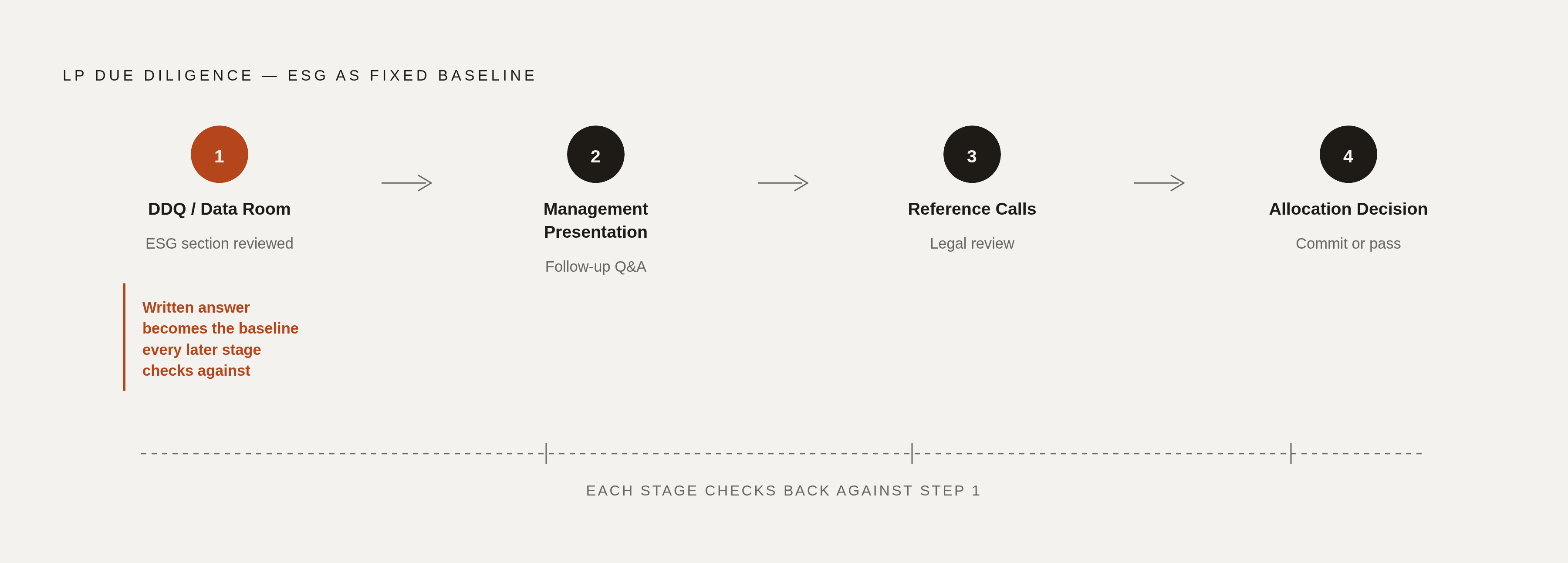
The DDQ also sets the order of operations for the rest of the raise. LP due diligence in 2026 runs as a sequence: the LP requests and reviews a DDQ or data room, holds a management presentation and follow-up, and runs reference calls alongside legal review. The DDQ response is the baseline every later conversation gets measured against. If the ESG section is vague or contradictory, that weakness follows the fund into the management presentation and the reference calls, because LPs return to the written answer and check whether what they're hearing matches what they read.
The evaluation tests whether a GP's stated ESG strategy holds together and can be checked against evidence. A generic answer about ESG values fails the same logic test a generic investment thesis fails. LPs assess whether the strategy on paper would survive a follow-up question.
What GPs Must Demonstrate in ESG Sections
The ESG workstream inside LP diligence looks for documented policy, process evidence, and governance accountability. It does not look for stated values, and a gap in any of those three areas acts as a disqualifier. The GP is not told which question they failed. The fund simply does not receive the allocation.
The first layer is fund-level policy evidence. LPs want a formal ESG policy that's accessible to every staff member, not a document that lives in a partner's inbox. They want an exclusion list with documented compliance, and they want to see that ESG criteria are built into the investment process itself, not bolted on as a separate overlay that exists only for LP reporting.
KfW Capital's March 2026 ESG Policy is a concrete picture of what a major European LP anchor actually requires. It calls for a mandatory formal sustainability policy, exclusion-list compliance, an SFDR regulatory assessment, a standardized sustainability capability questionnaire built on UN PRI's venture capital guidance, and annual data collection through the Invest Europe Reporting Template. Each piece is a named document or a named data submission, due on a schedule.
The second layer is governance data: board composition at portfolio companies, founder shareholding, codes of conduct, and leadership diversity. GPs collect this by questionnaire from their portfolio companies and aggregate it themselves, so the GP's own operational discipline becomes part of what gets evaluated.
The Invest Europe ESG reporting template, first published in 2022, works as the common annual baseline for EIF-backed funds, and it sets the exact fields, the documented methodology, and the on-time delivery that LPs check against. Neither the EIF nor KfW Capital asks for a scoring model. They ask for named fields with a documented method behind each number. A GP cannot average its way out of a missing data point.
SFDR classification sits inside every European LP conversation as a live, ongoing question. A fund's current Article 6, 8, or 9 classification signals how deep its sustainability commitments actually go, and the European Commission's November 2025 proposal would replace that system with three new mandatory categories: Sustainable, Transition, and ESG Basics, each with its own minimum portfolio alignment threshold. GPs need to be ready to explain where they sit under both the current regime and the proposed one. Structuring work on ESG-centered LP investments shows these requirements get written directly into side letters, so ESG and DEI metrics and portfolio-company carbon disclosure now stand as standard provisions for institutional LPs, and a disclosure preference becomes a contractual obligation.
EDCI Is the Default Portfolio Data Standard
The DDQ asks a GP what its policies say. The ESG Data Convergence Initiative asks what the portfolio actually does, and that shift from paper to data is where a lot of ESG programs get exposed.
The EDCI is a coalition of GPs and LPs that built a standardized set of ESG metrics for private markets portfolio companies. Its 2025 Metrics Guidance aligns with established frameworks including GRI, SASB, and TCFD, so a GP reporting through EDCI plugs into a taxonomy everyone already reads the same way. The coalition now counts over 500 GP and LP members representing a large share of private markets AUM, and BCG Expand validated data from thousands of portfolio companies and hundreds of GPs in the 2025 reporting cycle.
FTI Consulting's 2026 analysis of ESG sustainability trends points to the same shift from a different angle: LPs stopped being satisfied with a static dashboard of numbers. They want a narrative, backed by data, that connects ESG work to risk reduction and returns, and the EDCI framework is built to carry exactly that kind of analysis.
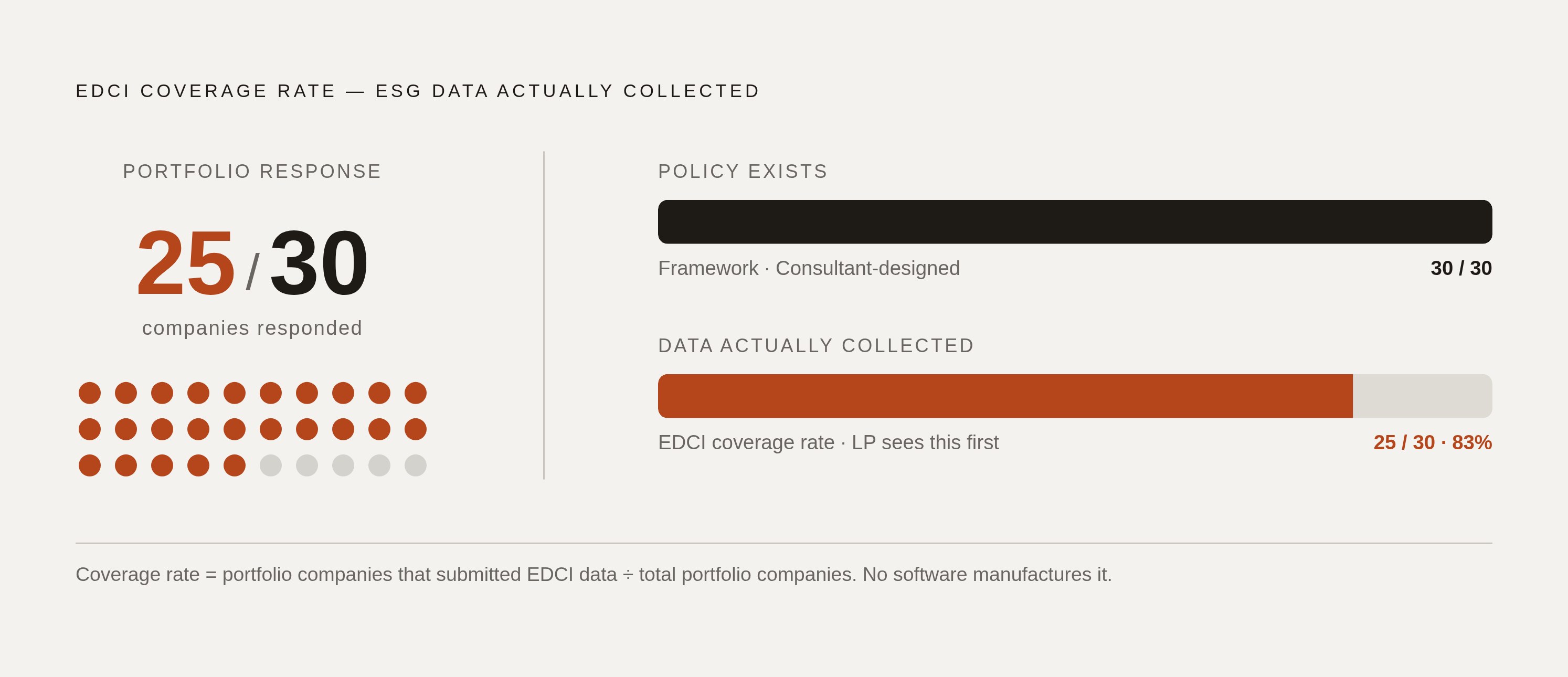
One number in the EDCI dataset matters more than all the others: coverage rate, the share of a GP's portfolio that responded to data collection at all. A GP can write a thorough ESG policy and design a framework that looks rigorous in a pitch deck. Neither changes whether twenty-five out of thirty portfolio companies actually filled out the survey. No software platform can manufacture a coverage rate, so LPs look at that field before almost anything else. It is the one number that tells them whether the ESG program is running through the portfolio or existing only in a presentation.
VC Funds Carry a Heavier Data Burden
Venture funds run into a much harder version of this problem than buyout funds do, and the LP framework does not adjust for it. A buyout fund controls companies that have years of financial history, HR departments, and mapped supply chains. A venture fund holds a minority stake in a company that may have no sustainability function, no historical baseline, and no statutory disclosure obligation of any kind. Yet LPs apply the same DDQ and the same EDCI expectations to both.
The EDCI itself acknowledges this. It encourages venture funds to submit data in line with the same guidance given to private equity GPs, but it specifies that VCs should report on a best-efforts basis, recognizing that a mature metrics program is a significant ask of an early-stage company. That is an acknowledgment of the structural difficulty, not an exemption from the requirement. GPs still have to show up with something.
The sharper constraint is often governance. A minority stake without a board seat limits what a fund can actually demand from a founder, and information rights get negotiated once, at the term sheet. Funds that built reporting covenants into their investment terms from day one can collect real data starting at seed stage. Funds that skipped that step end up asking founders for favors for the entire life of the holding, with no leverage to back the request.
The approach that actually works matches the data demand to the company's stage: governance and policy evidence early on, and operational metrics as the company matures and actually has operations to measure. Ananda Impact Ventures Fund V, backed by the EIF alongside NRW.BANK and Investcorp-Tages, builds this in from the start. The fund formally considers sustainability risks, meaning environmental, social, and governance events that could materially hurt investment value, as part of its pre-investment due diligence. That puts ESG into deal screening before the data collection gap appears, rather than retrofitting it after the check has cleared.
The EU Regulatory Stack GPs Must Navigate
European LP ESG requirements are downstream obligations. The regulations governing the LPs themselves flow through as contractual and reporting requirements to the GPs those LPs fund, and a GP cannot negotiate around a rule its LP is itself required to follow.
The EU Sustainable Finance Disclosure Regulation requires private equity and venture capital managers operating in Europe to classify their funds by sustainability profile. The EIF's use of the Invest Europe reporting template across every fund it backs is a direct expression of that regime.
The most consequential change in motion right now is SFDR 2.0. The European Commission's proposal from November 20, 2025 would replace the existing Article 6/8/9 classification system with three mandatory product categories: Sustainable, Transition, and ESG Basics, each carrying a minimum portfolio alignment requirement and specific exclusions. For early-stage funds, where the portfolio gets built company by company over several years, hitting a fixed alignment threshold is a genuine structural problem that needs to be solved at fund design stage, when the investment strategy and target sectors are being set.
AIFMD II tightens fund governance requirements generally, so the accountability bar that ESG policies have to operate inside goes up, even without introducing new sustainability data points.
The EU AI Act, in force since August 2024, opens a new due diligence front for any venture fund with AI exposure in its portfolio. High-risk AI systems in categories like employment, critical infrastructure, and certain healthcare-adjacent uses such as medical devices and essential services will need conformity assessments, CE marking, and detailed documentation, with obligations under Annex III applying from December 2027. LPs with AI-heavy VC portfolios are beginning to fold this into GP diligence now, well ahead of the compliance date.
CSRD's scope was scaled back by the Omnibus I Directive to cover only the largest companies, so most mid-market portfolio companies currently sit outside any direct statutory obligation. But the obligation reaches them anyway through commercial channels: companies that do report under CSRD are already passing sustainability questionnaires down their supply chains, regardless of whether the recipient is legally required to answer. If a portfolio company sells into a large CSRD-reporting customer, it receives that data request either way. As with the DDQ provisions covered earlier, structuring work on ESG-centered LP investments shows these regulatory obligations increasingly get written straight into side letters, making the regulatory framework legally binding on the GP through fund documentation, on top of whatever the regulation requires directly.
Where LP ESG Diligence Fails in Practice
Three objections come up constantly when GPs discuss this process, and each one has a real answer.
The first objection: this is a European phenomenon, and US-focused funds can skip it. That holds only until an EIF-backed anchor, a European pension fund, or a European sovereign wealth fund shows interest in a raise, at which point the fund inherits the full regulatory stack regardless of where its office sits.
The second objection: top-tier GPs with strong track records can ignore ESG diligence because demand for their fund exceeds supply of capital commitments. That describes a small number of funds at a specific moment in a fundraising cycle, not a durable exemption from a process that more than two-thirds of LP organizations have already built into policy.
The third objection, mostly heard from US-based managers: political backlash against ESG has made this a dead letter. The backlash is real as a political and branding story, but it has not touched the regulatory mechanics behind SFDR, the EDCI's membership growth, or the EIF's template requirements, which continue moving forward on their own schedule.
What breaks a GP's ESG diligence is mismatch: a policy document with no data behind it, a coverage rate nobody tracked, a side letter commitment nobody built a process to meet. The GPs that clear this process are those whose policy, data, and contractual commitments all describe the same fund.
Methodology & sources
- Limited Partners and Private Equity Firms Embrace ESG
Provided data on LP ESG adoption and the shift from niche request to mainstream practice among large PE and VC firms.
- Due Diligence Questionnaire and Diversity Metrics Template
Identified the ILPA Due Diligence Questionnaire as the primary instrument institutional LPs use to collect ESG information from GPs.
- Venture capital investors must take ESG due diligence seriously
Provided detail on the PRI's venture capital ESG DDQ guidance that underpins KfW Capital's standardized sustainability capability questionnaire requirement.
- ESG Due Diligence Questionnaire for Private Equity Investors and
Identified the Invest Europe ESG reporting template as the common annual baseline for EIF-backed funds, specifying the fields and methodology GPs must report against.
- Limited Partners and Private Equity Firms Embrace ESG
Provided the survey finding that more than two-thirds of LP organizations factor ESG into their PE investment policies and that ESG awareness had passed a tipping point.
- RESPONSIBLE INVESTMENT DDQ FOR VENTURE CAPITAL LIMITED PARTNERS
Supplied the UN PRI's LP Responsible Investment DDQ for venture capital, which the article describes as the basis for the ESG section of the ILPA DDQ.
- EU ESG wrap-up: concluding 2025 and stepping into 2026
Provided context on the European Commission's November 2025 SFDR 2.0 proposal to replace Article 6/8/9 with three new mandatory product categories.
- SFDR Reporting Requirements Explained
Explained the SFDR classification system (Article 6, 8, and 9) that GPs must navigate when operating with European LPs.