Defense Tech Venture Rounds Beyond Anduril and Palantir
A tripling of defense tech funding reflects demand for production capacity, not just innovation.

- Written by
- Dana Ashworth
- Published
- October 22, 2026
- Reading time
- 9 min read
- Sources cited
- 1 sources ↓
What this covers
Defense tech venture capital is no longer a two-company story. Beyond Anduril and Palantir, investors are funding a broad ecosystem of autonomous systems, precision weapons, advanced manufacturing capacity and battlefield software. In 2025 alone, defense tech venture rounds reached $29 billion, nearly triple the 2020 total, driven by NATO spending commitments, the battlefield lessons of Ukraine, and growing conviction among mainstream venture firms that defense technology is a durable category. The central shift is from financing promising technology to financing companies that can produce and deploy it at scale, which means backing factories and supply chains alongside the engineering teams that design the systems.
Why defense tech expanded beyond its two famous names
Palantir established the playbook two decades ago for entering a procurement system dominated by legacy contractors. Anduril extended that approach into hardware and autonomy, showing that the opening was not limited to software. Yet neither company is where most of the new capital is going.
The missing detail is where the next layer of companies fits into defense spending. Some build whole systems, while others provide the factories or software needed to make those systems work. Their backers also differ, from financial investors seeking growth to contractors seeking access to technology.
The structural forces driving defense into venture's mainstream
As government budgets grew, investors saw a large group of customers with money to spend. Ukraine then demonstrated the battlefield value of drones, autonomous platforms and AI-enabled systems, moving procurement priorities faster than peacetime arguments could. CB Insights' Jason Saltzman says Ukraine "fundamentally shifted how VCs view defense investments." AI also helped mainstream venture firms feel more at ease with the ethics of investing in defense, as they increasingly described it in terms of democratic values. Together, those changes turned defense from a niche into a major venture category.
But demand for better technology is only part of the explanation. Archangel Ventures GP Nicholas Nelson identifies a deeper problem in governments catching up after decades of underinvestment. Making up that shortfall takes factories and supply chains as well as another demonstration that the technology works. Europe's push to spend more on defense gives that effort the backing of government policy.
How large the funding surge actually is
S&P Global Market Intelligence puts defense tech round values at $29 billion in 2025, nearly triple the 2020 total. Other trackers differ in what they count: dual-use equity, all private defense-related investment, or only venture rounds in military and national-security categories. Those totals are not interchangeable.
The distribution matters as much as the total. Late-stage and venture-growth rounds capture the overwhelming majority of capital, while seed and Series A receive a small slice. Deal count has not grown in proportion to funding, so the boom reflects larger commitments to proven companies more than a broad spread of new bets. S&P Global Market Intelligence also reports that aerospace and defense M&A has declined from its 2021 peak. Venture funding is surging without a matching consolidation wave, leaving the eventual exit path an important open question.
Autonomous systems companies raising the sector's largest rounds
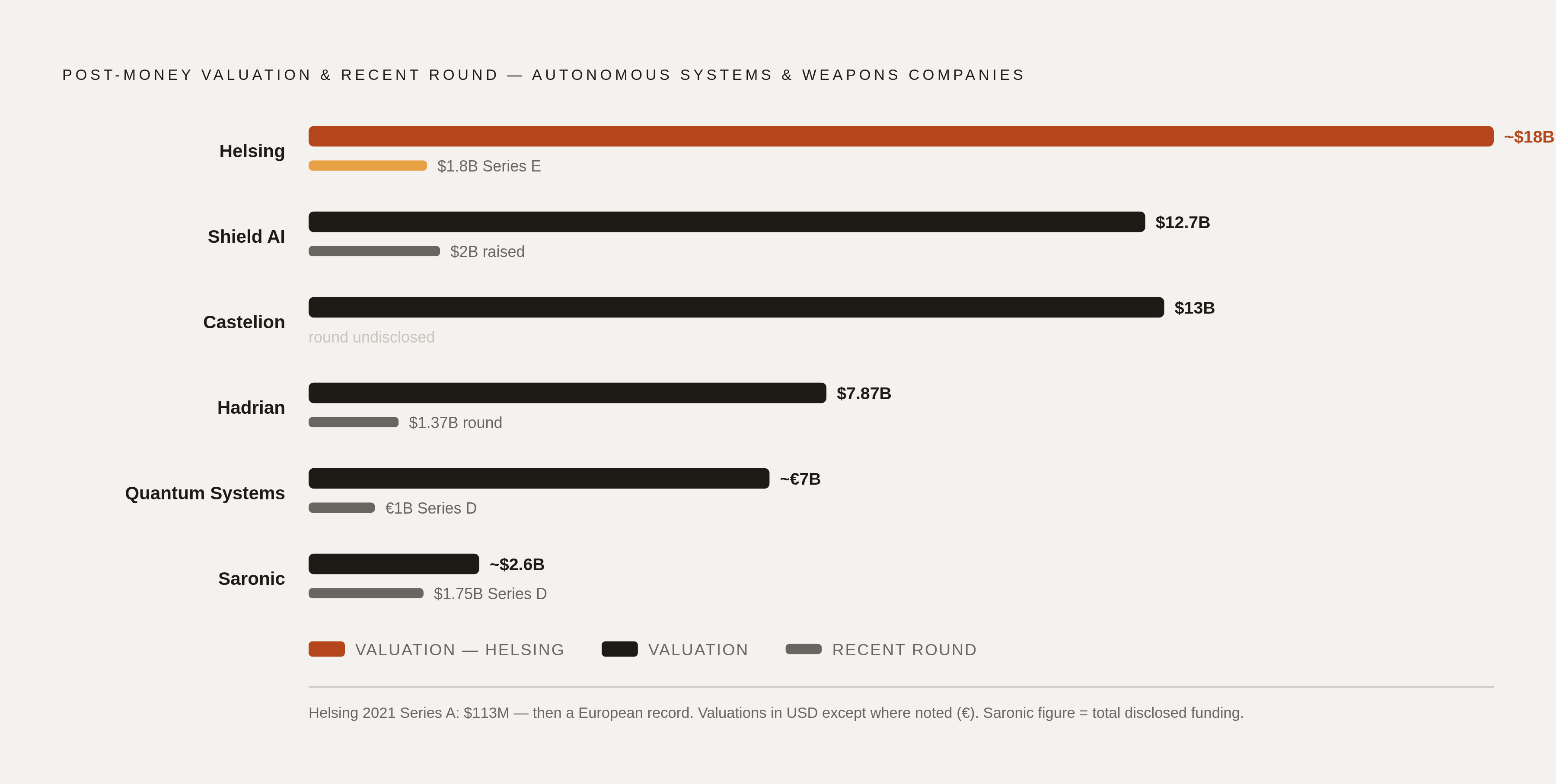
Shield AI announced a $1.5 billion Series G on March 26, 2026, along with a separate $500 million preferred-equity investment from Blackstone. Together, the $2 billion raised gave it a post-money valuation of $12.7 billion, roughly 140% more than its valuation twelve months earlier. Advent International and JPMorgan Chase are the main backers in the capital structure. Its Hivemind AI pilot software flies autonomous drones for the U.S. Air Force, Coast Guard and allied militaries, and the company expects $540 million in revenue in 2026.
Saronic Technologies makes the industrial ambition even more explicit. The Austin company, founded by Anduril alumni, closed a $1.75 billion Series D in March 2026, led by Kleiner Perkins, bringing total funding to nearly $2.6 billion. It builds unmanned surface vessels and plans a roughly $3.2 billion shipyard in Texas. Investors are not just financing a vessel design. They are financing the capacity to build vessels at scale, which requires a substantially larger capital commitment than ordering another prototype.
Quantum Systems signed a €1 billion Series D on July 2, 2026, at an approximately €7 billion post-money valuation, co-led by Blackstone, Noteus, Airbus and Advent. Quantum Systems reports more than 19,000 missions flown in Ukraine in 2025, giving that financing a record of active operational use. Mach Industries raised a $300 million Series C led by Infinite Capital and Ribbit Capital, followed within a few months by a $600 million extension. Its combination of unmanned weapons, propulsion systems and its own production network reinforces the same thesis.
Weapons companies reaching billion-dollar valuations quickly
The same production thesis extends to missiles and hypersonics, where the investment premise is that legacy contractors cannot deliver fast enough or cheaply enough. Castelion, founded by former SpaceX engineers, reached a $13 billion valuation only a few years after founding. Its latest funding is paying to manufacture more Blackbeard hypersonic missiles, develop longer-range weapons and build a mass-produced air-defense missile.
The founders' SpaceX background signals experience building hardware at a pace and cost that legacy contractors have not matched. More telling than pedigree, however, is the commitment to physical production capacity. Castelion has already invested around $250 million in a New Mexico production site and is planning additional facilities. The valuation reflects technology-company expectations, but the spending plan belongs to a manufacturer.
Manufacturers rebuilding the defense industrial base itself
A separate layer of the ecosystem targets the production bottleneck directly. Hadrian raised $1.37 billion at a $7.87 billion valuation for automated defense manufacturing, with precision machining at the center of its business. Lux Capital is among its backers. Every autonomous system, vessel and missile in the sector requires precision-machined components, regardless of how different their final configurations look.
That makes manufacturing capacity a strategic asset. Hadrian's customers are other startups and legacy contractors, rather than the government directly, giving the business an infrastructure-like role in the supply chain. PitchBook's Ali Javaheri describes manufacturing scale as "the next competitive battleground," with investment flowing into robotics, production software and modernized toolchains. A bottleneck at the supplier level can constrain many system builders simultaneously.
European companies now raising at American scales
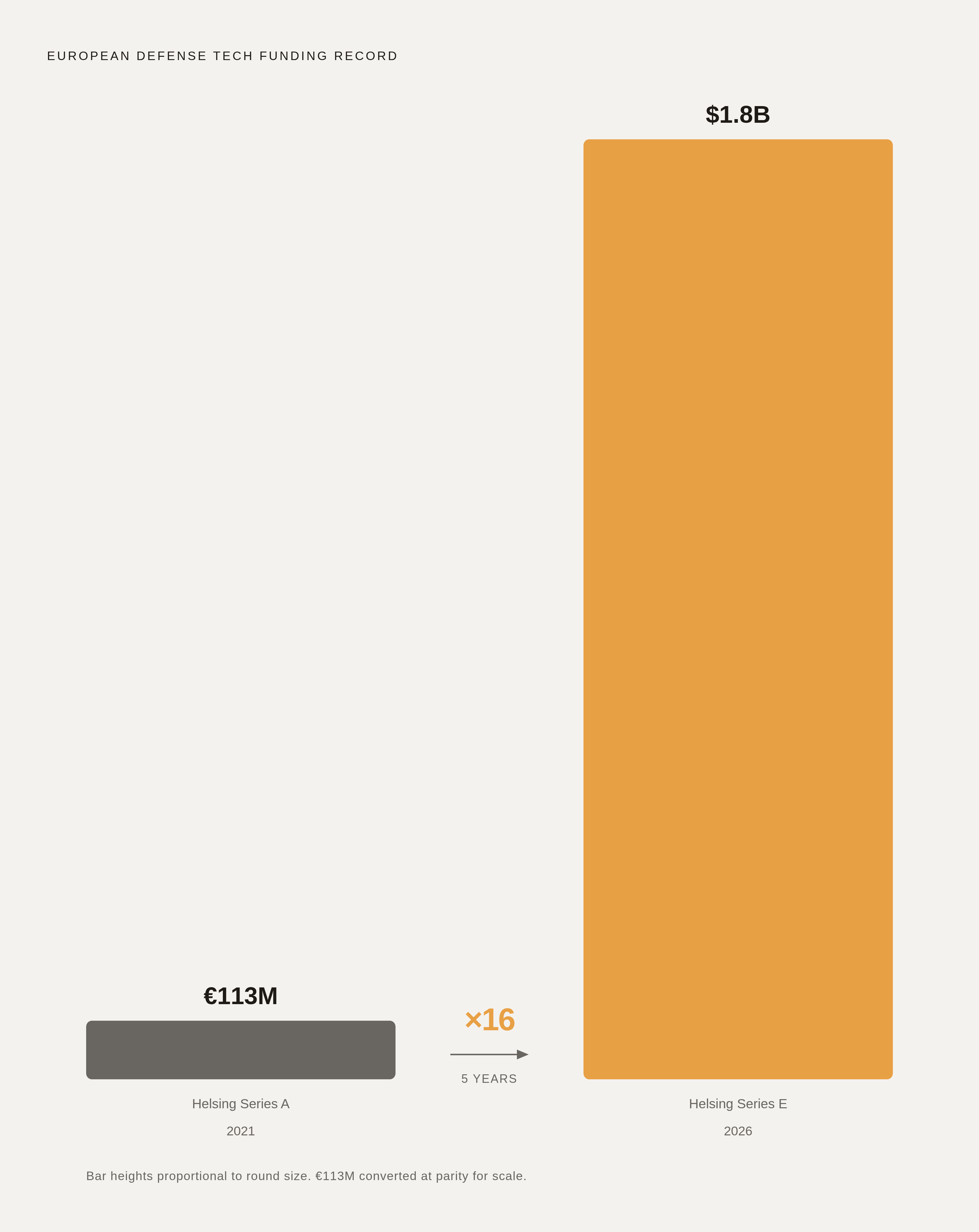
Europe is no longer a smaller version of the American funding story. Helsing closed a $1.8 billion Series E on July 13, 2026, at an approximately $18 billion valuation. That followed Quantum Systems' financing earlier that month, with the two Munich companies setting back-to-back European defense tech funding records. As recently as 2021, Helsing's $113 million Series A was enough to set the European record, meaning the record has grown by a factor of roughly sixteen in five years.
The rationale combines battlefield demand, NATO spending commitments and a more developed investor base. The EU's ReArm Europe / Readiness 2030 plan aims to make up to €800 billion more available for defense spending, giving investors a chance to back businesses whose customers have government policy behind them. Helsing's Series E included General Catalyst, Goldman Sachs Alternatives, Dragoneer, Lightspeed and Plural, among others. American and European investors now participate in the same rounds, which changes how much money European companies can raise and increases the competition their American peers face.
Smaller rounds revealing where ecosystems are forming
Below the megadeals, investor combinations often reveal strategy more clearly than valuations do. Vatn Systems raised a $60 million Series A led by BVVC, with Lockheed Martin Ventures, Airbus Ventures and Hanwha participating. It is deepening cooperation with the U.S. Navy and Marine Corps and has signed its first overseas contract with Singapore's defense agency. The round brings together a dedicated defense investor, the venture arms of prime contractors and a Korean defense conglomerate, reflecting multinational strategic interest in a single early-stage company.
Shift5 points toward a different need within the same ecosystem. Its $75 million Series C, led by Hedosophia, brought total funding to $185 million. The company works in battlefield software and platform data, where growing volumes of military data strain legacy systems without requiring the same production infrastructure as hardware. By taking minority stakes in rounds like these, contractors can build ties with startups while procurement decisions take shape, before any acquisition becomes necessary.
Who is actually writing the checks now
Investors now fall into distinct groups: pure-play defense funds, multi-strategy platforms with teams focused on defense, and strategic investors seeking technology they can use. Their different motives matter because capital can arrive with very different expectations attached. Founders Fund backed Anduril, Palantir and SpaceX early and committed roughly $1 billion of Anduril's $2.5 billion round. Andreessen Horowitz says its American Dynamism practice manages $1.176 billion in dedicated funds within its broader platform. General Catalyst and Lux Capital also have large sums to invest, though they back more than defense.
Strategic investors are building access as much as portfolios. In-Q-Tel, the intelligence agency-backed nonprofit, has made more than 750 investments, while Lockheed Martin has raised its venture capacity to $1 billion and Booz Allen tripled its fund to $300 million. Lakestar closed a $300 million defence and dual-use fund in July 2026, and Expeditions raised a €197 million fund focused on defence. Defense is becoming a standing allocation rather than an occasional exception to a fund's usual mandate.
Serious objections from people who know best
Anduril CEO Brian Schimpf offered a direct warning at Fortune's Brainstorm Tech conference in June 2026: "I do think there's a bit of a bubble," describing investors and companies chasing successful examples with increasingly risky behavior. Anduril co-founder and Founders Fund partner Trae Stephens argued that "there's too much supply in venture capital" and was equally direct about the distinction between defense and consumer software: "This isn't consumer AI. The growth curve isn't zero to $30 billion in 18 months. It's a really, really hard game."
The concern is a mismatch between valuation and operating reality. Software-style growth multiples sit uneasily on businesses that must fund factories, inventory, testing, secure supply chains and long military qualification cycles. Their most likely buyers are legacy contractors that historically pay much lower multiples. Meanwhile, three transactions supplied more than half of the capital raised in the first half of 2026, leaving smaller Tier 2 and Tier 3 suppliers short of primary capital as they face pressure to consolidate. That concentration limits how much the headline boom says about the health of the whole supplier base.
If defense valuations rely on the same forward-looking, scarcity-driven logic as AI infrastructure, a retreat in risk appetite could hit both categories together. Even the largest defense tech companies still receive less than 1% of what the Pentagon spends on contracts, meaning investors are pricing in a procurement transfer that has only just started.
Why structural demand holds even if valuations don't
An excessive valuation and a genuine market shift can exist at the same time. Governments have the capital and increasingly the will to buy from startups, procurement timelines are getting shorter, and contracts are reaching venture-backed companies at a pace that was not true five years ago. Nelson's counterargument rests on "decades of underinvestment" and governments' need to catch up. Dedicated defense funds also suggest that professional allocators see a durable category worth long-term commitment.
The strongest businesses in this sector are likely to combine software-like margins with genuine production scale. Their test is whether they can manufacture, deploy and expand fast enough to meet demand. Autonomous systems builders, European challengers, manufacturing enablers, smaller strategic rounds and specialized investors each reveal a different part of that shift. Anduril and Palantir remain useful reference points, but the sector's direction is clearer when the rest of the ecosystem is mapped in detail.
Methodology & sources
- Venture capital investment in defense tech surges while M&A activity slows
Provided the $29 billion 2025 defense tech funding figure, the comparison to 2020 totals, Shield AI's $1.5 billion Series G and $12.7 billion valuation details, and the data on declining aerospace and defense M&A activity.