AI Infrastructure Market Growth Drivers by Layer
Each AI infrastructure layer faces distinct bottlenecks that drive spending across the stack.

- Written by
- Ravi Quist
- Published
- October 20, 2026
- Reading time
- 9 min read
- Sources cited
- 4 sources ↓
What this covers
AI infrastructure market growth is best understood layer by layer, and the case for sustained high compound annual growth rates depends on how pressures across eight distinct layers feed into each other. Each layer has its own bottleneck, buyer profile, and reason to generate spending. The global AI infrastructure market encompasses GPU and accelerator silicon, GPU cloud and compute services, high-speed networking fabrics, AI-optimized storage, advanced cooling systems, memory technologies, MLOps and orchestration platforms, and inference optimization software. Forecasters including Research and Markets, Technavio, and Fortune Business Insights project CAGRs ranging from roughly 26% to over 40% through 2030, depending on scope and methodology.
Understanding why those projections hold requires tracing how purchasing pressure in one layer creates purchasing pressure in the next: buying more compute sends the bill to networking, storage, cooling, memory, and software in sequence.
Why AI infrastructure growth has many causes
Larger models strain compute and memory, while real-time inference puts pressure on latency and operating cost. Edge computing spreads those requirements beyond core data centers, and hybrid cloud changes who buys the equipment. These are connected forces but not interchangeable ones.
Technavio's 2026–2030 analysis projects growth in the same broad range as other high-growth forecasts, although that agreement does not make every estimate identical. The headline CAGR is useful context, but it hides where spending lands and what releases it. A chip shortage, a heat limit, and an inefficient workload scheduler each produce a different purchasing decision. Explaining the market therefore means identifying which layers face which constraints.
Eight layers, eight economic drivers
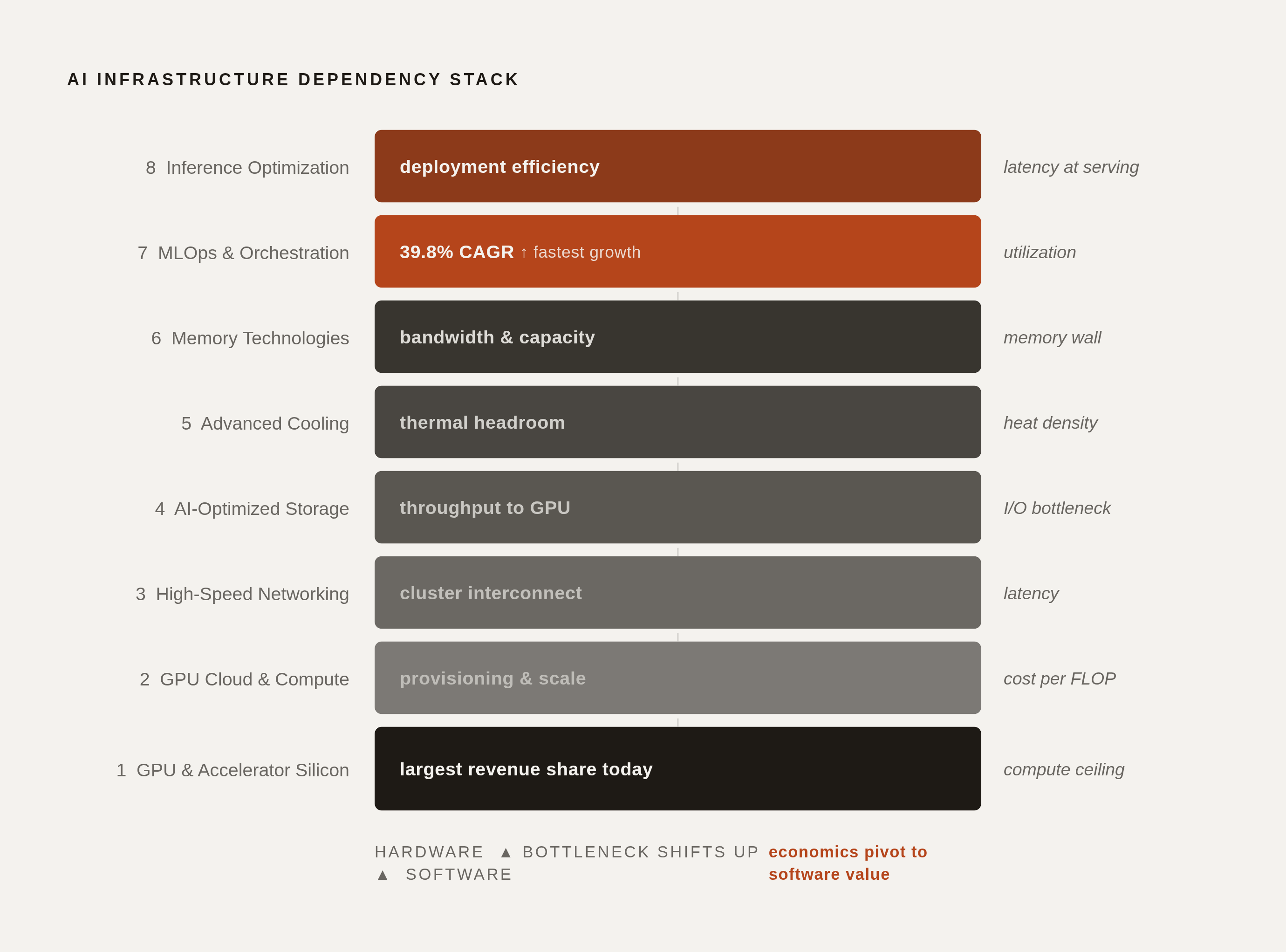
The framework has eight commercially distinct layers: GPU and accelerator silicon, GPU cloud and compute, high-speed networking, AI-optimized storage, advanced cooling, memory technologies, MLOps and orchestration, and inference optimization. Each has a distinct buyer, bottleneck, and growth mechanism. The stack is a dependency chain in which physical capacity makes computing services possible and software puts that capacity to work. The dependencies also run sideways across layers.
Training large language models with thousands of interconnected GPUs processing trillions of parameters stresses several links in that chain simultaneously. Technavio describes the market as "a holistic ecosystem of specialized hardware, sophisticated software, and optimized deployment architectures." Hardware currently accounts for the largest revenue share, but software and services are growing faster in percentage terms. That distinction matters because the largest layer today need not capture the fastest growth tomorrow.
Compute demand outpaces each chip generation
Model scaling is outpacing the cadence of chip generations, which makes accelerator procurement a persistent bottleneck. Training and inference require higher FLOPs and more memory bandwidth as models grow. Demand has no natural ceiling as long as that scaling continues.
The response extends beyond one supplier or one chip design. AMD's MI-series accelerators compete in a layer that also includes Intel, Cerebras, Groq, and SambaNova. Research and Markets identifies rising adoption of GPU and accelerator-based systems as a major trend through 2030.
Custom silicon from Alphabet, Amazon, and Microsoft could erode merchant GPU demand in some workloads. Yet those companies remain the largest buyers of merchant accelerators for cloud-rental services, so their internal chips supplement merchant accelerators with additional capacity rather than replacing them.
Hyperscalers absorb CapEx that enterprises avoid
Enterprises that rent GPU capacity avoid absorbing the full capital cost and procurement risk of an on-premises cluster. A 36-to-52-week wait to procure a GPU makes burst capacity appealing even to large organizations. When the enterprise chooses operating expenses over capital expenditure, spending concentrates at the cloud provider, which must own the capacity that everyone else wants to rent.
Microsoft's fiscal 2026 capital spending rose 79.6% year-over-year, illustrating the scale of that concentration. Cloud adoption justifies accelerator investment, concentrated buying tightens supply, and difficult procurement pushes more enterprises toward cloud capacity. This feedback loop differs from ordinary hardware replacement because access to capacity becomes part of the product itself.
CoreWeave's July 2025 proposed acquisition of Core Scientific demonstrated why a company would use vertical integration to secure physical data center capacity. The deal was ultimately terminated after Core Scientific stockholders voted against it in October 2025, leaving the proposed acquisition as an illustration of the strategic logic. Research and Markets also identifies growing deployment of hybrid AI infrastructure models, making this delivery layer broader than public cloud alone.
Network latency limits what compute can deliver
An idle GPU is expensive whether it lacks work or is waiting for data from another GPU. Distributed training across thousands of accelerators makes the connecting fabric a direct constraint on utilization. Ultra-low latency interconnects, including InfiniBand and RoCE, reduce that waiting time and raise effective throughput across the cluster.
A fully provisioned cluster can deliver only a fraction of its theoretical throughput when its network introduces latency. That gives networking investment its own economic justification: protecting the value of compute already purchased. NVIDIA through Mellanox, Broadcom, Cisco, Arista, and Marvell compete at this layer. Its requirements also extend to edge nodes as localized AI applications spread beyond core data centers.
Silicon photonics represents a forward-looking development rather than an established commercial standard. Transmitting data through light is moving from research toward production as very large clusters expose copper's signal degradation and power limits. That transition could reshape vendor competition as the scale of deployment grows.
Checkpointing & KV-cache reshape storage demand
AI storage must do more than hold a large collection of files. During training, models save their state so work can resume after hardware failures in thousand-GPU clusters. Those checkpoints generate heavy metadata activity that traditional storage architectures struggle to handle. The requirement is not merely more space but a system built for a specific pattern of work.
At the same time, training data must reach GPUs fast enough to prevent compute starvation. Parallel file systems with high-speed storage meet that need for high-throughput data loading. Checkpointing and data loading therefore create a specialized market with a demand logic distinct from general-purpose storage, and more compute makes that distinction more expensive to ignore.
Inference is adding another requirement as context windows expand to millions of tokens. The Key-Value (KV) cache can overwhelm GPU memory, creating demand for ultra-fast storage optimized for KV-cache offloading. This emerging tier connects storage directly to inference optimization and to the memory wall.
Dense racks make liquid cooling a requirement
Modern high-density AI racks draw far more power than traditional server racks, so improved airflow alone cannot handle the heat they generate. Liquid cooling becomes both an operating upgrade and a prerequisite for deploying dense compute at scale. The physical heat limit changes data center design and creates a purpose-built equipment market with specifications that general-purpose cooling vendors cannot meet.
Direct-to-chip liquid cooling also cuts cooling energy consumption meaningfully compared with air cooling. That gives the purchase two distinct functions: removing heat and supporting energy-efficiency targets. Vertiv, Supermicro, CoolIT, Submer, and Green Revolution are among the active vendors serving this demand.
The consequences reach beyond cooling equipment. Data centers are taking a larger role in power grid planning by sharing infrastructure costs, offering load flexibility, and adding on-site power generation and storage. The need to cool dense AI infrastructure drives that shift, linking thermal management to broader capital allocation decisions about site selection and grid interconnection.
Memory bandwidth caps model scale & performance
More processing power cannot compensate for too little memory bandwidth per chip. As model parameters grow faster than available on-chip capacity and bandwidth, the "memory wall" becomes a binding limit on performance. Adding GPUs does not by itself remove that mismatch, so memory has its own investment cycle rather than simply following the accelerator order book.
HBM (High Bandwidth Memory) is the current production solution, while CXL (Compute Express Link) memory pooling offers an emerging alternative architecture. CXL could allow multiple servers to share a common pool of memory and reduce reliance on expensive HBM. It is moving from specification to silicon, but its potential effect on market economics depends on reaching production scale and proving reliability at deployment.
SK Hynix, Samsung, and Micron occupy a core infrastructure role because this bottleneck directly limits useful compute output. The KV-cache offloading described in the storage layer addresses the same underlying pressure from a different direction, functioning as a workaround for limited GPU memory rather than a structural solution to bandwidth constraints.
Orchestration software captures more infrastructure value
Once the hardware is in place, economic value depends on how much capacity gets used. Idle GPU time multiplied by cost per GPU-hour gives orchestration software a straightforward financial justification. Better scheduling, distributed workload management, and experiment tracking extract more productive work from the cluster that was purchased.
The MLOps segment cited in the brief carries a projected 39.8% CAGR, faster than the AI infrastructure market as a whole. That faster growth reflects the segment's transition from a niche developer tool to an enterprise infrastructure requirement. As clusters become larger and more expensive, utilization becomes a larger financial lever, and the value of managing capacity rises with the cost of wasting it.
Technavio treats model training frameworks, inference engines, and MLOps lifecycle management as equally critical components alongside the hardware layer. That framing reflects a shift in where the stack's economic value is being created and captured.
Production inference now shapes infrastructure purchasing decisions
Fortune Business Insights reports that AI training held the majority share of AI data center GPU use in 2024. The stronger supported argument is that production inference is an expanding workload whose economics increasingly shape infrastructure purchases. Cost per token, latency, and throughput matter when a model must serve real user requests at scale.
Inference optimization targets those costs through techniques such as quantization and sparsity, which reduce compute requirements without proportionate accuracy loss. Neural Magic and CentML illustrate this software layer. Research and Markets names growing demand for real-time AI inference as a forecast-period growth driver, supporting the case for an enduring and expanding workload category.
Its effects propagate backward through the stack. Longer context windows expand the KV cache, which increases pressure on GPU memory and creates demand for storage offloading. Processor investment is being justified by both inference performance and training throughput simultaneously.
Sovereign AI adds policy-driven demand across layers
Governments treating domestic GPU capacity as a strategic national asset create a policy-driven demand pool on top of hyperscaler spending. Data residency laws that require training infrastructure to remain within national borders add to that local demand. India's IndiaAI Mission illustrates how a government can direct deployment by coordinating public and private sector investment toward specific infrastructure goals.
This demand is additive because it creates capacity requirements that would not arise from commercial procurement alone. It can also persist through a commercial slowdown, giving infrastructure spending a policy-driven floor that is less sensitive to enterprise budget cycles. Its effect spans the entire stack because domestic GPU capacity still requires networking, storage, memory, cooling, and software.
Geopolitical fragmentation carries costs as well as demand opportunities. Export controls constrain supply in restricted markets while displacing demand toward non-restricted regions building domestic capacity. Research and Markets notes that tariffs increase deployment cost and extend procurement timelines, while simultaneously spurring regions to invest in domestic semiconductor production and expand local data center capacity.
Simultaneous bottlenecks across layers compound growth
Research and Markets projects a 26.5% near-term CAGR, driven by bottlenecks that feed into each other across segments. More GPU compute requires faster networking to avoid idle time and more capable storage to keep it fed. Denser compute requires liquid cooling, larger models require more memory bandwidth, and more deployed models require better orchestration and inference optimization. Investment in one layer creates the technical and economic conditions for investment in another.
Cross-industry expansion broadens that mechanism. Polaris Market Research identifies applications including AIoT integration, cybersecurity, industrial automation, and machine vision. These add demand at the edge and inference layers without replacing core training infrastructure spending, so the market is widening in application scope as well as deepening in per-application intensity.
Efficiency is the strongest structural objection because better software and custom silicon can reduce infrastructure requirements per unit of AI capability. The growth case rests on demand for capability expanding faster than those efficiency gains compress cost, with sovereign and policy-driven spending providing a separate demand floor. Sustained growth requires pressure to remain on several linked bottlenecks, so resolving one constraint tends to reveal the next as layers expand at different rates.
Methodology & sources
- AI Infrastructure Market Report 2026 - Research and Markets
Provided the 26.5% near-term CAGR figure and identified key growth drivers including GPU adoption trends, hybrid deployment models, real-time inference demand, and tariff impacts cited throughout the article.
- Artificial Intelligence (AI) Infrastructure Market Growth Analysis - Size and Forecast 2026-2030
Supplied the 2026–2030 growth projections and the framing of AI infrastructure as a holistic ecosystem of hardware, software, and deployment architectures, including the treatment of MLOps as a critical component.
- AI Infrastructure Market Size, Share
Provided the data point that AI training held the majority share of AI data center GPU use in 2024, cited directly in the inference section.
- AI Infrastructure Market Growth Drivers & Opportunities 2034
Identified cross-industry AI applications including AIoT integration, cybersecurity, industrial automation, and machine vision as sources of expanding edge and inference demand.