Data Center Economics for Venture Capital Investors
Inference shifts data center economics from capital scarcity to power constraints.

- Written by
- Elise Beck
- Published
- October 24, 2026
- Reading time
- 9 min read
- Sources cited
- 2 sources ↓
What this covers
- Why inference demand — not training — restructures data center economics permanently
- How the AI supercycle has driven hyperscaler and private capital into the sector at historically anomalous scale
- Power as the binding constraint that capital cannot simply buy its way through
- What AI-optimized facilities actually cost to build and why the numbers surprise most VC underwriting models
AI inference has changed data center economics by making demand recurring while shifting the main constraint from money to power. For venture capital investors, that separates a capital-heavy facilities business from a more accessible opportunity in the technologies that let facilities operate.
Why inference demand — not training — restructures data center economics permanently
Training builds a model once or updates it from time to time. Inference serves that model millions of times, using compute and power each time a user interacts with it. Training is a cost event. Inference is a recurring, revenue-generating workload. That distinction changes the shape of infrastructure demand. A training run can end, but capacity is needed for as long as users are served.
Inference is expected to surpass training as the dominant AI workload requirement by 2027. Because it needs low latency, that capacity must be distributed regionally. More sites need power, cooling, and connections. The shift therefore changes both how much infrastructure is needed and where it must sit. For investors, the structural change is not a guarantee of endless growth, but a demand base tied to continued use rather than a build-once training wave, with no natural saturation point visible on the horizon.
How the AI supercycle has driven hyperscaler and private capital into the sector at historically anomalous scale
Hyperscaler spending plans show the scale of the response. Alphabet plans capital investment of $195–205 billion in 2026, compared with $91.4 billion in 2025, mostly for AI and cloud infrastructure. Amazon’s 2026 capex plan runs into the hundreds of billions, with most directed at data centers. Meta’s plan sits in the triple-digit billions as it accelerates AI development.
Outside the hyperscalers, private equity has displaced traditional real estate capital as the dominant funding source. PE accounted for nearly three-quarters of U.S. data center investment in 2025. Blackstone acquired QTS in 2021 and now holds a large global portfolio, including facilities under construction, with a prospective pipeline exceeding that figure. KKR, the Kuwait Investment Authority, NVIDIA, and Vistra also launched Helix Digital Infrastructure with substantial committed capital for hyperscale AI-focused infrastructure. The sources of funding are changing with the size of the projects.
That shift is visible beyond deal announcements. U.S. private data center construction reached a $50.7 billion annualized rate in April 2026, surpassing office construction for the first time. Capital is reshaping what the economy builds. Yet projects are still being delayed despite the abundance of funding, because financial commitments do not produce usable capacity on their own.
Power as the binding constraint that capital cannot simply buy its way through
Grid access and power infrastructure lead times now govern development more than capital or land availability. Developers want rapid deployment, while utilities operate on 30- to 40-year asset timelines. Those clocks do not keep the same time. The mismatch creates schedule risk that feeds directly into returns, even when a project has funding and customers.
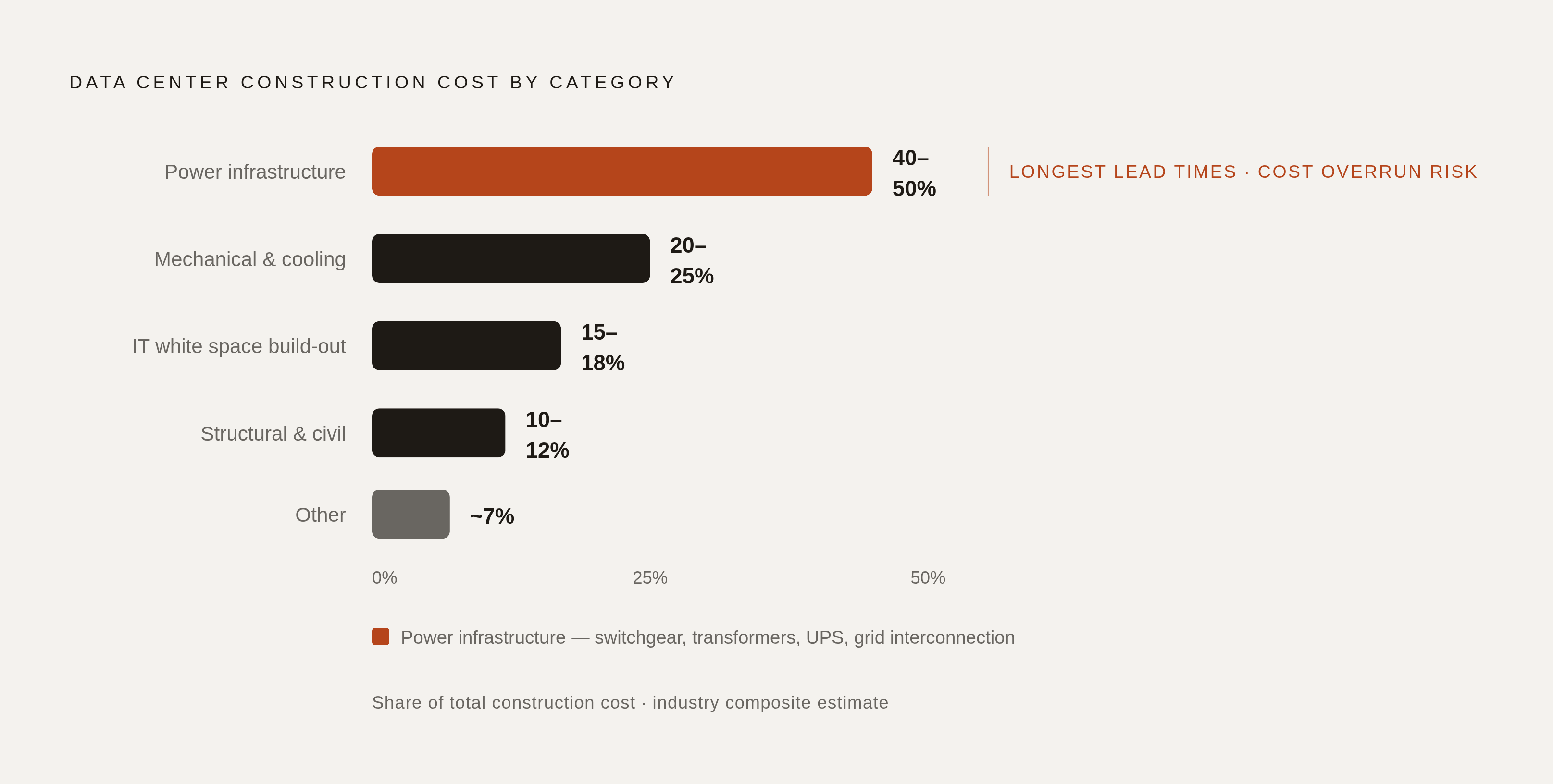
Site selection has changed as a result. Grid access and substation capacity now outweigh land cost or proximity to fiber, reversing the prior decade’s logic. Power infrastructure, including switchgear, transformers, UPS systems, and grid interconnection, typically represents 40–50% of total construction cost. It is the largest construction cost category. A cheap site without deliverable power can therefore be a poor economic bargain, whatever the land appraisal says.
The pressure on that infrastructure is substantial. U.S. data centers consumed 64.4 gigawatts from the grid in 2025, nearly tripling since 2020, and an earlier forecast projected another tripling between 2025 and 2030. Vacancy is at historic lows because utility interconnections are constrained as well as because too little is being built. That distinction changes how future absorption should be understood, because an announced building is not necessarily imminent supply. Local communities are also pushing back, with at least 18 state bills and 86 local moratoriums proposed across the U.S. as of May 2026.
What AI-optimized facilities actually cost to build and why the numbers surprise most VC underwriting models
Shell-and-core costs are only the beginning of AI-facility economics. JLL’s 2026 Global Data Center Outlook says global average shell-and-core construction costs have risen sharply since 2020 and are set to rise further in 2026. Yet tenant technology fit-out for AI infrastructure can more than double the fully loaded per-MW figure relative to shell-and-core cost alone. The benchmark is not the whole budget. Underwriting that treats it as such starts with the wrong denominator for returns.
The gap comes from a different physical plant. AI workloads require higher rack power density and more complex cooling than conventional cloud workloads, while standard air cooling is increasingly insufficient. Liquid cooling adds a large cost that conventional data center pro formas did not include. Higher density also means the structure and HVAC systems must do more. The facility is not simply an ordinary data center with a more fashionable tenant.
Power infrastructure makes costs and schedules harder to underwrite because the largest cost component is also the longest lead-time item. Cost overruns and schedule slippage can gather in the same place. Gordon Bell of EY-Parthenon calls execution risk “probably the largest risk” in the industry, given the unprecedented scale and speed of operators’ commitments. Chips waiting for power cannot earn the planned revenue. The lesson for underwriting is to connect construction costs and activation dates to debt service and equity cash flows, rather than treating the construction schedule as a separate operational appendix.
How CoreWeave's capital structure illustrates the return and leverage risks in AI-first data center operators
CoreWeave makes the tension between contracted growth and financing risk concrete. At the end of Q2 2026, its total liabilities vastly exceeded stockholders’ equity, producing an extreme leverage profile even by infrastructure standards. Interest on some of its bonds reached levels associated with distressed credit. Contracted revenue alone does not show what the returns will be. The cost of funding the capacity needed to earn it belongs in the same analysis.
The bull case sees contracted backlog as revenue that will last and support a large infrastructure build-out. The bear case asks whether return on invested capital will be less than the cost of borrowing. Both address real parts of the business. Their disagreement is not merely about enthusiasm for AI, because a company can have substantial demand and still face difficult equity economics. Backlog is a promise of business whose cash-flow timing still matters.
For VC investors, resolving that disagreement requires comparing the revenue contracts, the build schedule, and the financing burden. A delayed facility can push income back while leaving a highly leveraged capital structure in place. Conversely, durable contracted revenue is relevant evidence even when leverage is high. It remains unclear whether CoreWeave represents an unusual financing choice or a broader model in which high capex, long build cycles, and lagging revenue structurally favor lenders over equity holders.
How capital in this market concentrates at the top and what that means for VC entry points
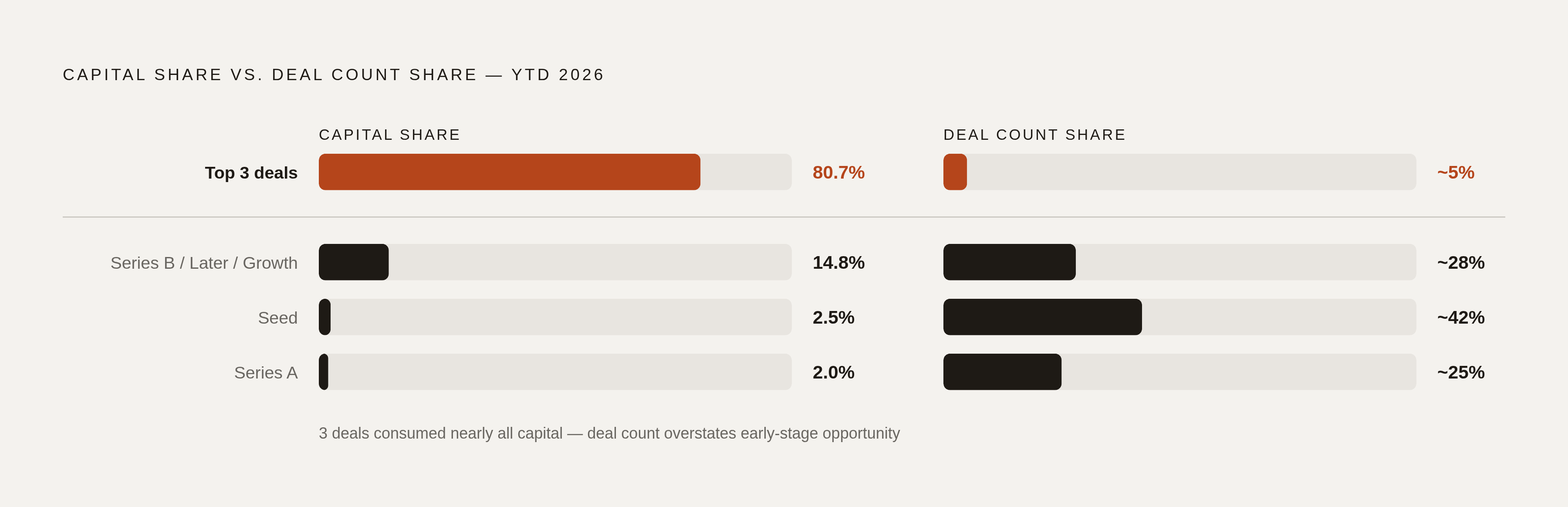
In year-to-date 2026, the top three deals captured 80.7% of all observable sector capital, sharpening a pattern seen over the prior two years. Seed and Series A rounds represented a meaningful share of deal count but very little of the money deployed. Activity is not the same as financial weight. Series B and later rounds, together with Growth Equity, absorbed the overwhelming majority of capital.
That concentration reflects the demands of the assets. PE, sovereign wealth funds, and infrastructure-dedicated vehicles have the balance sheets and investment horizons to absorb 20-year power contracts and multi-billion-dollar construction phases. A VC fund backing a developer is therefore competing with Blackstone, KKR, and sovereign LPs. Those investors will take lower returns and hold assets for longer. A venture fund that wins the same asset on similar terms may still fall short of the returns it needs.
J.P. Morgan’s August 2026 analysis says investors are doing rigorous credit analysis, which makes it harder for new entrants to get funding and keeps some AI-related assets from being financed. That is a constructive signal, but not an invitation to ignore structural disadvantages. For VC, the implication is to redirect attention within the stack, toward businesses that relieve the constraints on facilities rather than require venture capital to fund the facilities themselves.
Where VC returns are structurally available — the power and cooling enabling layer
Power and Cooling Infrastructure had the most deals among qualifying data center investments in year-to-date 2026, with six of fourteen qualifying deals. The appeal is tied to the bottleneck. A company that makes capacity usable can command pricing power and customer stickiness that an operator selling commoditized square footage may lack. For VC investors, the practical test is whether a solution compresses the utility interconnection timeline, reduces per-MW construction cost, or eliminates a component with a multi-year lead time.
Power supply-chain businesses give investors a way to back products already in short supply, including transformers, switchgear, and medium-voltage components, with demand visible for years to come. These are physical products, with hardware economics. On-site and behind-the-meter power approaches, including fuel cells, small modular reactors, battery storage, and microgrids, address a different problem by allowing facilities to bypass grid interconnection queues. The shared theme is access to power, but supplying a constrained component and replacing a route to power are distinct propositions.
Liquid cooling can do what air cooling cannot as AI rack density rises. Direct liquid cooling and immersion cooling sit inside the facility’s need to support denser workloads. Grid interconnection and power procurement software offer a different return profile, with potentially better capital efficiency than hardware through tools that shorten utility timelines or optimize power purchasing. Capital efficiency is an advantage, but the software still needs to change a customer’s timing or cost in a meaningful way.
Blackstone’s Pennsylvania Digital/Energy Hub involves QTS and a joint venture with PPL Corp for power generation, making power supply a differentiated asset. VC can back a business that controls a constraint without paying for the whole campus. The defensible position is the business that removes a costly obstacle customers cannot wish, or fundraise, away.
How to evaluate the overbuild risk that is reshaping VC sentiment toward the sector
The overbuild concern deserves a serious hearing. If AI workload revenue arrives more slowly than capex, or one or two hyperscalers scale back, developers could be left with underused, highly leveraged facilities. Earlier technology infrastructure cycles show that this has happened before. Demand can grow while some investors lose money because their timing is poor, their leverage is too high, or their cost base is wrong.
Only a fraction of U.S. data center capacity announced for 2026 is currently under construction, with the rest facing power, equipment, or permitting constraints. Industry estimates suggest 30–50% of planned 2026 U.S. capacity will slip or cancel for lack of electrical equipment. Announced gigawatts are not electricity at the socket. Expected capex slippage into 2027 and 2028 could also compress future construction activity and renew bottleneck pressure.
Those constraints cut both ways for investors. They restrain speculative overbuilding, but also delay revenue, a risk Bell identifies as underdiscussed. Global occupancy and pre-leasing rates for capacity under construction indicate that demand is absorbing supply as it physically arrives. A market can be short of capacity while a particular operator is short of cash.
The practical framework is to evaluate supply in deliverable MW and demand through contracted revenue with named counterparties. Execution then connects those two sides to the return model. J.P. Morgan describes power availability, supply chains, and permitting as “gating factors that can materially extend project schedules and affect financing structures”. For VC investors, conviction should rest on what can come online, who has committed to pay for it, and whether the financing can withstand the wait.
Methodology & sources
- Data center boom fuels renewables deals; AI drives corporate venture investment
Provided the 64.4 gigawatt U.S. grid consumption figure for 2025 and context on the tripling of data center power demand since 2020.
- Private equity investment surge sends US data center deals to 5-year high
Sourced the detail on utility asset timelines versus developer deployment expectations that creates the grid access mismatch.